
Quantum Computing and Competition Law: Gasser, Aboy et al. Submit Comments to Italian Competition Authority AGCM
By Editor
Stanford, CA, April 20, 2026—An international group of scholars—Urs Gasser, Mateo Aboy, I. Glenn Cohen, Mauritz Kop, Fabienne Marco, Timo Minssen, and John Palfrey—has submitted formal comments to the Italian Competition Authority (Autorità Garante della Concorrenza e del Mercato, AGCM) in its public consultation on quantum computing, part of the authority's IC59 sector inquiry opened in March 2026 (the full submission is available via Urs Gasser's announcement). The submission includes co-authors of the Towards Responsible Quantum Technology framework and the Science standards-first article to answer a question European regulators are asking earlier than ever before: how should competition policy approach quantum computing while the market is still being formed?
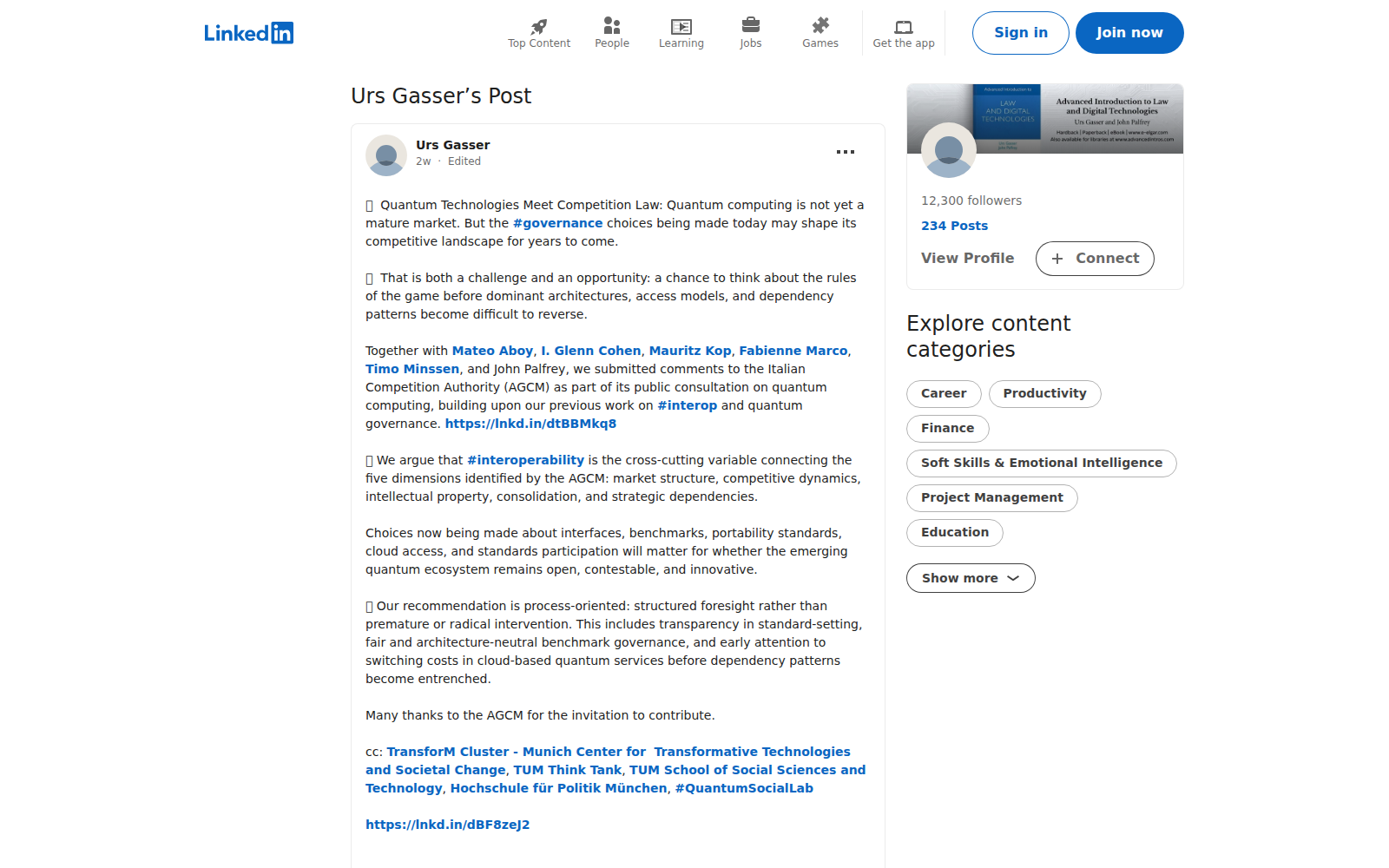
Urs Gasser's announcement of the AGCM submission, with the full comments attached.
A consultation at the formative moment
The submission opens by naming why this moment matters. In 2024, ISO and IEC established JTC 3 to develop international standards for quantum technologies. The European Commission's 2026 Work Programme includes a Quantum Act initiative, with a legislative proposal expected in 2026 (scheduled for the second quarter in the Work Programme). And recent market reports suggest that startup funding in quantum computing increased markedly from 2024 to 2025—driven largely by mega-rounds rather than broader deal growth, a pattern that says more about how capital is being allocated than about its absolute scale. Standards environment, access structure, and market architecture are taking shape simultaneously: choices made now about interfaces, benchmarks, portability, and cloud access may shape the competitive landscape for years.
Interoperability as the cross-cutting lever
The submission addresses the five dimensions the AGCM identified: market structure, competitive dynamics, intellectual property, consolidation, and strategic dependencies. Its central analytical move is to show that all five are linked by one underlying variable—interoperability. How interoperable quantum systems, interfaces, standards, and ecosystems become, at which layers, and through which governance processes, will shape outcomes across every dimension the authority named.
The analysis is layer by layer. Quantum hardware architectures are often incommensurable, not merely incompatible—distinct gate sets, error profiles, and scaling pathways mean that moving a workload across providers can require rethinking, not redeployment. At the software layer, open initiatives such as QIR, QDMI, and OpenQASM may preserve portability across heterogeneous systems—if they remain genuinely open. At the cloud layer, the submission echoes the AGCM's own concern that quantum computing may be absorbed into already-dominant cloud ecosystems through familiar mechanisms: vendor-specific SDKs, quantum credits bundled into broader contracts, and billing integration that makes early experimentation harden into path dependence. And at the institutional layer, benchmark governance is elevated to a first-order issue: early benchmarks are often optimized for particular architectures and should not be treated as neutral measures of capability.
The submission is equally explicit about restraint. Patent activity in quantum computing does not, on current evidence, establish an anticommons problem—concentration remains lower than in mature classical computing markets, a finding rooted in the team's empirical work on quantum computing and intellectual property law. The concern is narrower and sharper: that rights over interface-critical elements—calibration formats, control hooks, benchmark-essential methods—could become unavoidable in practice as standards crystallize.

Interoperability as the cross-cutting lever: many architectures, one competitive order.
Three forms of lock-in, one staged response
Strategic dependency, the scholars argue, is not only contractual. They distinguish technical lock-in (proprietary APIs, non-portable job formats), administrative lock-in (billing integration, enterprise credits, default cloud account structures), and organizational lock-in—the concentration of scarce quantum expertise, workflows, and tacit knowledge around one vendor's environment. A market can look contestable on paper while being unswitchable in practice, because the dependencies that matter have formed in people and processes rather than in contracts.
The recommended posture is process-oriented and staged: begin with monitoring and transparency—visibility into benchmark design, standards participation, cloud contracting, and the portability conditions attached to public testbeds; move to disclosure-oriented safeguards where dependencies begin to form; and reserve interventionist remedies for demonstrated, persistent exclusion. Structured vigilance rather than radical intervention—because in a field this young, locking in the wrong substantive answer is costlier than waiting for evidence.
Three recommendations to the AGCM
First, on intellectual property and standards participation: staged procedural safeguards, beginning with disclosure of patents relevant to standardization proposals, then licensing transparency as standards crystallize around contested IP. Second, on quantum-as-a-service and switching costs: early examination of bundling, credit tying, and administrative lock-in—including in publicly funded quantum infrastructure, where access conditions shape which platforms researchers learn first. Third, on standards governance: competition safeguards built into quantum standard-setting from the outset—open participation, IP disclosure, inclusion of smaller firms and public research institutions, and explicit scrutiny of benchmarks used for regulatory purposes—coordinated with ISO/IEC JTC 3, the European Quantum Standards Roadmap, and the emerging EU Quantum Act, the legislative vehicle the submission repeatedly points toward and to whose agenda Kop's Columbia Law study Towards a European Quantum Act contributed.
The underlying logic ties the document together: in quantum computing, interoperability is for now primarily a process question. The goal is not to specify what the market should look like once the technology matures, but to keep the processes shaping that market—standards bodies, procurement, merger review, the Quantum Act's architecture—open, revisable, and not prematurely foreclosed. Alongside the standards-first approach published in Science and the broader Nexus research program, the AGCM submission extends a consistent doctrine into competition law: govern the formative processes well, and the mature market should need far less correcting.
For competition authorities elsewhere, the submission can serve as a template. Quantum computing will arrive in every jurisdiction's docket, as artificial intelligence (AI) did before it; the authorities that build an interoperability lens now can avoid having to retrofit one after dominance has taken shape.
Last updated: June 5, 2026.