
The Nexus of Quantum Technology, Intellectual Property, and National Security
By Editor
Stanford, CA, February 11, 2026—Mauritz Kop, Founder of the Stanford Center for Responsible Quantum Technology (Stanford RQT), Senior Fellow at the Centre for International Governance Innovation, and Guest Professor at the U.S. Air Force Academy, has posted The Nexus of Quantum Technology, Intellectual Property, National Security and the LSI Test as a preprint on arXiv (arXiv:2602.15051); the Article is also catalogued by the NASA Astrophysics Data System at the Center for Astrophysics | Harvard & Smithsonian under bibcode 2026arXiv260215051K. The book-length Article is the fullest statement yet of a research program that treats patents, export controls, standards, and alliance policy for quantum technology as a single governance problem—and offers democratic coalitions a usable legal instrument for solving it.
A probabilistic world of power
The Article opens with an image borrowed from the physics it regulates. Our world of power and national security, it argues, is increasingly probabilistic: like a quantum wavefunction, it encodes multiple plausible futures until policy choices and shocks collapse them into observable outcomes. Quantum technologies have moved from laboratory curiosities to strategic infrastructure, and recent United States strategic assessments reflect an approaching event horizon—including what the Article describes as the U.S.–China Economic and Security Review Commission's call for a Quantum First posture by 2030, alongside White House initiatives aimed at securing critical inputs and accelerating trusted innovation.
The threat picture is specific. Government research documents that China's quantum program is centrally mobilized under military-civil fusion, and that its consequential advantages may arise not only from computing milestones but also from sensing and cryptanalytic applications. That breadth matters: a strategic surprise need not look like a working cryptographically relevant quantum computer. It can look like a quieter edge in detection, navigation, or intelligence—a theme the public debate first confronted in the Foreign Policy essay on why quantum computing may be even more dangerous than artificial intelligence. The Article's answer is a values-based deterrence-by-denial governance posture: deny adversaries the specific inputs that accelerate their military programs, without dismantling the open science that produced the field.
Security-sufficient openness and the LSI test
The Article's central claim is that the United States and its allies should pursue security-sufficient openness, operationalized through a least-trade-restrictive, security-sufficient, innovation-preserving (LSI) test that disciplines both state and private action. Each prong does independent work. A measure must be the least trade-restrictive option available, so that markets, standards bodies, and allied research networks keep functioning; it must be genuinely security-sufficient, so that the restriction actually closes the capability gap it targets; and it must preserve innovation, so that the protective architecture does not consume the ecosystem it was built to protect.
The test is deliberately doctrinal rather than rhetorical. It gives general counsel, export-control officers, and legislators a question they can actually administer: not may the state restrict, but is this the narrowest restriction that works. In the quantum domain—where a single disclosure can simultaneously implicate patent eligibility, research security, and federal funding obligations—intellectual property law and national-security law can no longer be administered as separate silos. That entanglement has been visible since the field's first systematic legal treatment in Quantum Computing and Intellectual Property Law; the Nexus Article turns the diagnosis into an operating doctrine.

The quantum industrial commons: security-sufficient openness, red-zone vaults, and trusted rails beyond the coalition (illustration)
An implementable coalition playbook
What distinguishes the Article from most writing at the intersection of technology and statecraft is that it is built to be used. Its contribution is an implementable coalition playbook: empirically anchored criteria, templates, and differentiated guardrails—including red-zone domains where denial is the default—designed to avoid both over-securitization and under-securitization. The LSI test integrates emerging instruments of economic statecraft, from export controls to outbound investment screening, and proposes secure closed-loop enclaves for high-sensitivity collaborative R&D: governed environments in which allied researchers can work on the most sensitive problems without either publishing them or abandoning collaboration altogether.
The coalition framing is essential rather than decorative. No single democracy controls the quantum supply chain, the talent pool, or the standards process; protection that ends at one border is theater—an argument anticipated in the early call for democratic countries to form a strategic tech alliance. The playbook also speaks directly to the research-security debates Kop has joined in Washington, including the CNAS quantum roundtable on research security, technology theft, and intellectual property rights—debates in which the cost of getting the balance wrong is counted in both lost science and lost security.
Avoiding a self-defeating Silicon Curtain
The Article names the failure mode it is engineered to prevent: a Silicon Curtain—a wall of indiscriminate restriction that suppresses publication, fractures standards bodies, deters startup formation, and isolates the very alliance it was meant to protect. Properly applied, the LSI test reduces that risk while establishing standards-first interoperability as a stabilizing eigenstate of the international order. Equally distinctive is the Article's outward-facing horizon: responsible quantum technology by design should shape trusted adoption pathways beyond the coalition, including in the majority world—so that the quantum economy's benefits, from sensing for medicine to secure communications, diffuse along trusted rails rather than authoritarian ones. That global-equity register echoes the agenda Kop carried into the United Nations International Year of Quantum Science and Technology.
The contrast with the last technology cycle is instructive. Rules for artificial intelligence largely arrived after AI systems were deployed at scale, leaving regulators to retrofit guardrails onto entrenched architectures. Quantum—and the quantum-AI hybrids now emerging—still offers the rarer option: building the legal architecture concurrently with the technology, while the field remains fluid enough to govern.
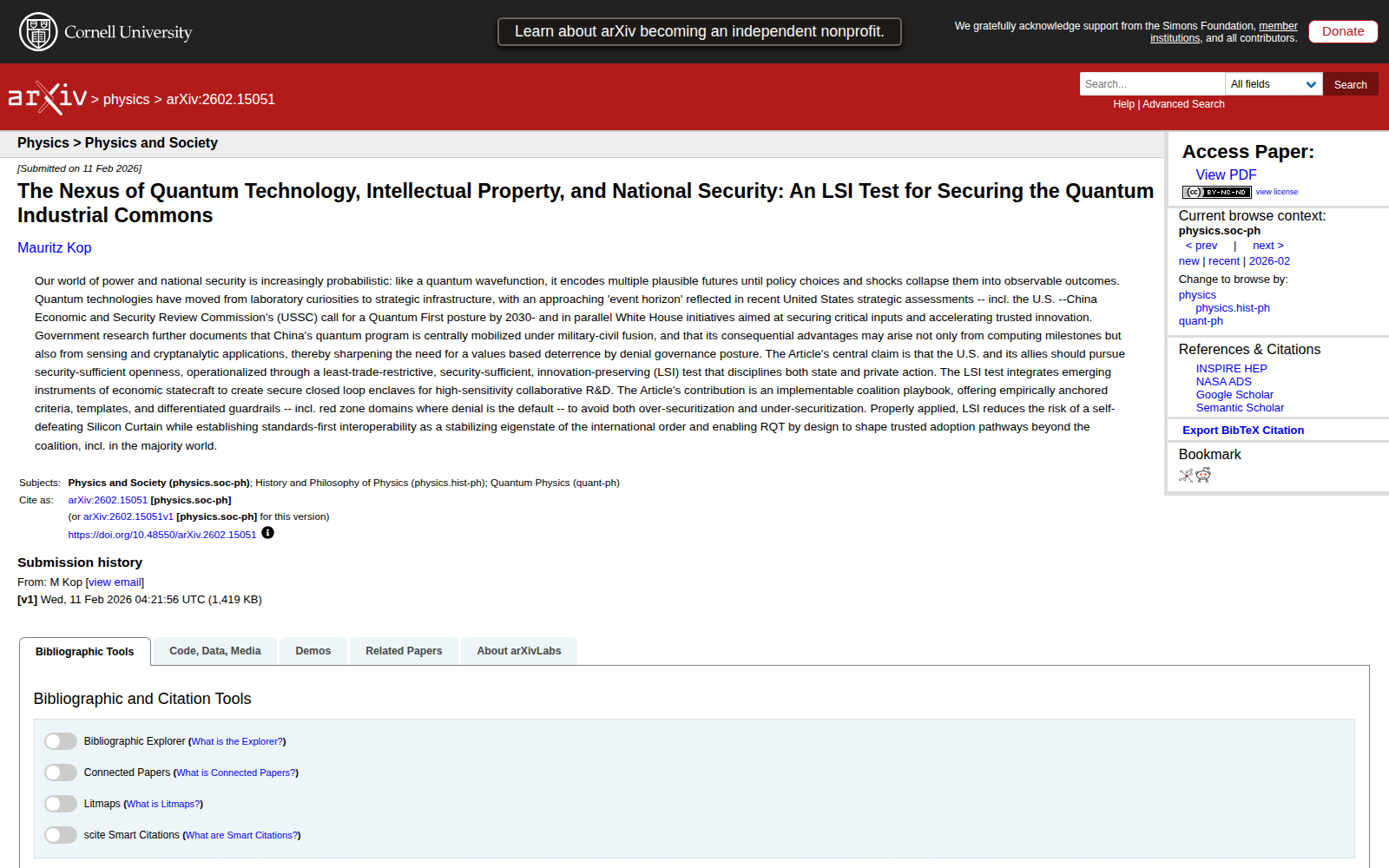
The Nexus of Quantum Technology, Intellectual Property, and National Security — arXiv:2602.15051, posted February 11, 2026 (screenshot: arXiv.org)
From the Article to the policy debate
For readers who want the argument in brief, a companion essay distilling the LSI framework, Quantum Needs a Smarter Legal Control Plane, appears on Vanderbilt Law School's JETLaw Blog—discussed in more depth in our companion post on the JETLaw essay. The full Article—indexed on arXiv under Physics and Society, History and Philosophy of Physics, and Quantum Physics—supplies the doctrinal machinery: the criteria, the templates, and the differentiated guardrails that turn a slogan about balancing security and innovation into a test a court, an agency, or a parliament can apply.
The quantum industrial commons—the shared base of fabrication capacity, components, talent, and standards on which every national program quietly depends—will either be secured by deliberate, narrowly tailored law or ceded through improvisation. The Nexus Article is a sustained argument that democracies still hold the pen, and a demonstration of what disciplined drafting would look like—work that came about with the support of the Centre for International Governance Innovation (CIGI) in Waterloo, where Kop serves as Senior Fellow.
Last updated: June 5, 2026.