
Quantum Nexus LSI Test Published by Vanderbilt JET Law
By Editor
Nashville, TN, April 9, 2026—Vanderbilt Law School's Journal of Entertainment & Technology Law has published Quantum Needs a Smarter Legal Control Plane: An LSI Test for Dual-Use Governance on its JETLaw Blog, a new essay by Mauritz Kop, Founder of Stanford RQT, Senior Fellow at the Centre for International Governance Innovation, and Guest Professor at the U.S. Air Force Academy. The essay opens with a deliberate provocation: quantum law is being written before quantum technology has fully arrived—and that is precisely the point. Once quantum computing, sensing, and networking systems become embedded in procurement systems, security frameworks, and commercial infrastructure, the foundational legal choices surrounding patents, export controls, standards, and disclosure will be much harder to unwind. The better moment to build these rules is now, while the field remains fluid enough to govern.
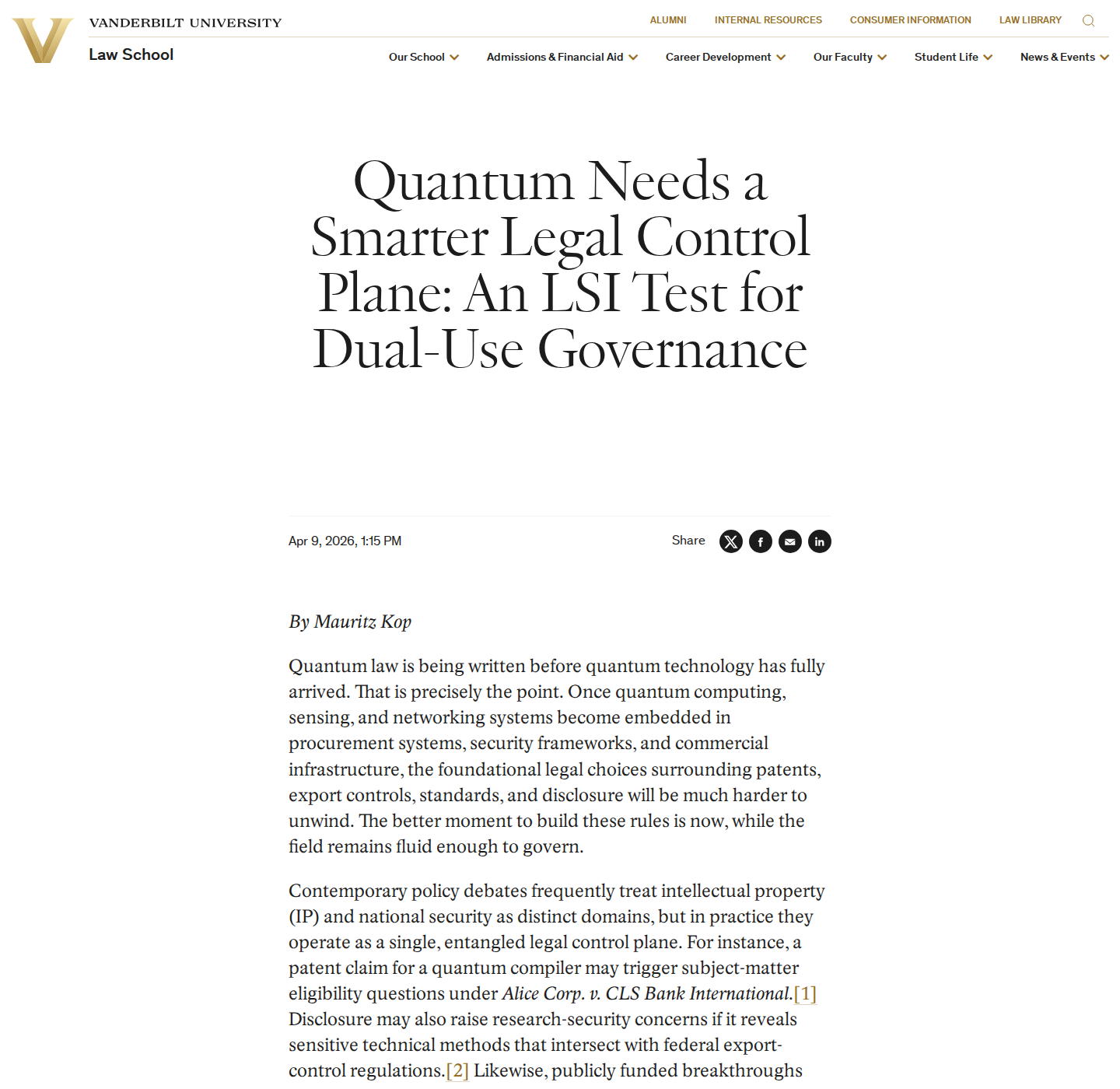
The essay as published on Vanderbilt Law School's JETLaw Blog, April 9, 2026.
One entangled legal control plane
Contemporary policy debates frequently treat intellectual property and national security as distinct domains. In practice, the essay argues, they operate as a single, entangled legal control plane. A patent claim for a quantum compiler may trigger subject-matter eligibility questions under Alice Corp. v. CLS Bank International; the same disclosure may simultaneously raise research-security concerns if it reveals sensitive technical methods that intersect with federal export-control regulations. Publicly funded breakthroughs, the essay notes, are governed not only by the Bayh-Dole Act but also—depending on the funding instrument and subject matter—by federal acquisition regulations, FAR and DFARS, that shape who may use, disclose, and commercialize the resulting software and technical data. Treating these regimes as separate silos produces incoherent governance; treating them as one control plane makes their interactions—and their failure modes—visible. The theme extends an argument developed at book length in earlier work on intellectual property in quantum computing and market power published by Oxford University Press. The standardization and intellectual-property questions that frame this control plane were first mapped on this site in Regulating Transformative Technology in the Quantum Age (2020).
The LSI test: least trade-restrictive, security-sufficient, innovation-preserving
The essay's normative core is a disciplined alternative to two reflexes that dominate the dual-use debate. Quantum governance, Kop writes, should reject both romantic technological openness and reflexive, indiscriminate restriction. The sustainable equilibrium is security-sufficient openness: preserving the cross-border scientific exchange, market scale, and interoperability that innovation requires, while constraining the specific flows that would materially accelerate adversarial military or intelligence capabilities.
That equilibrium is operationalized through the LSI test, which asks whether a given state intervention is the least trade-restrictive, security-sufficient, and innovation-preserving measure available. The legal inquiry is not simply whether a government possesses a restrictive tool, but whether it is deploying the narrowest effective one. The dual-use challenge itself is not novel in structure—as with nuclear physics before it, scientific advances grounded in quantum mechanics may carry both civilian promise and geopolitical consequence. What is novel is the opportunity to discipline the response before the architecture hardens.
From theory to binding law: the 2024–2026 regulatory cascade
Applying such a framework is increasingly urgent, the essay shows, because the quantum control plane is transitioning from theory to binding law at remarkable speed—some measures already final and effective, others marking the legislative architecture now moving into place. The National Institute of Standards and Technology finalized its first post-quantum cryptography standards in August 2024, anchoring future federal procurement. The Department of Commerce added quantum-related items to the Commerce Control List in September 2024. The Treasury's outbound investment security program, effective January 2025, restricts certain U.S. investments in covered foreign persons engaged in specified quantum information technology activities. Congress is revisiting the broader federal architecture through the bipartisan 2026 National Quantum Initiative Reauthorization Act, which would extend the initiative through 2034 while emphasizing allied cooperation, workforce development, and quantum supply-chain resilience. And governance is diffusing below the federal level: Ohio lawmakers are advancing legislation to establish a Frontier Technologies and Quantum Commission—a signal that states, too, now recognize quantum as a domain requiring anticipatory governance.
That convergence reflects a broader reality. Quantum sits at the center of strategic competition, yet remains one of the rare bipartisan domains of U.S. technology policy—spanning qubits, post-quantum cryptography migration, skilled labor, fragile critical-mineral supply chains, and mounting concern over intellectual property leakage and theft.

Between openness and restriction: the Silicon Curtain that the LSI test is designed to prevent (illustration).
The Silicon Curtain and the cost of getting it wrong
Without a disciplining framework like the LSI test, the essay warns, this rapid regulatory expansion risks erecting a costly Silicon Curtain. Over-securitization suppresses academic publication, standard-setting participation, startup formation, and allied interoperability. Under-securitization, by contrast, allows strategically meaningful capabilities to diffuse into rival ecosystems faster than democratic systems can respond. The legal task, then, is not to choose between innovation and national security—it is to design institutions capable of sustaining both. Failing that test does not merely slow innovation; it cedes the quantum industrial commons by default. The argument here echoes, in the legal register, the standards-first approach to quantum governance published in Science: rules and standards built early, with allies, beat restrictions improvised late and alone.
The Quantum Nexus: securing the quantum industrial commons
The JETLaw essay distills a much larger research undertaking: The Nexus of Quantum Technology, Intellectual Property, and National Security: An LSI Test for Securing the Quantum Industrial Commons (arXiv:2602.15051, February 2026; catalogued by the NASA Astrophysics Data System under bibcode 2026arXiv260215051K). The full Article frames today's security environment as increasingly probabilistic—like a quantum wavefunction, it encodes multiple plausible futures until policy choices and shocks collapse them into observable outcomes—and reads the latest U.S. strategic assessments, including what the Article describes as the U.S.–China Economic and Security Review Commission's call for a Quantum First posture by 2030, as evidence of an approaching event horizon. It cites government research documenting that China's quantum program is centrally mobilized under military-civil fusion, with consequential advantages that may arise not only from computing milestones but from sensing and cryptanalytic applications, sharpening the case for a values-based deterrence-by-denial posture.
The Article's contribution is an implementable coalition playbook: empirically anchored criteria, templates, and differentiated guardrails—including red-zone domains where denial is the default—and secure closed-loop enclaves for high-sensitivity collaborative R&D. Properly applied, the Article argues, the LSI test reduces the risk of a self-defeating Silicon Curtain while establishing standards-first interoperability as a stabilizing eigenstate of the international order—and enabling responsible quantum technology by design to shape trusted adoption pathways beyond the coalition, including in the majority world. Where governance of artificial intelligence had to be retrofitted onto systems already deployed at scale, quantum—and the quantum-AI hybrids now emerging—still offers the rarer option of building the legal architecture concurrently with the technology. Readers who wish to situate the framework within the wider arc of this scholarship will find its institutional counterpart in the proposal for an atomic agency for quantum-AI and its European application in the Columbia study toward a European Quantum Act.
In the quantum era, the essay concludes, durable leadership will depend on whether trusted partners can protect the industrial commons without suffocating the scientific commons upon which that governance architecture relies. For legislators drafting the next quantum statute, the LSI test offers the question that should precede every clause: is this the narrowest effective intervention—or merely the nearest available one?
The author thanks the JETLaw editorial team at Vanderbilt University Law School for their precise editorial work on the essay.
Last updated: June 5, 2026.