
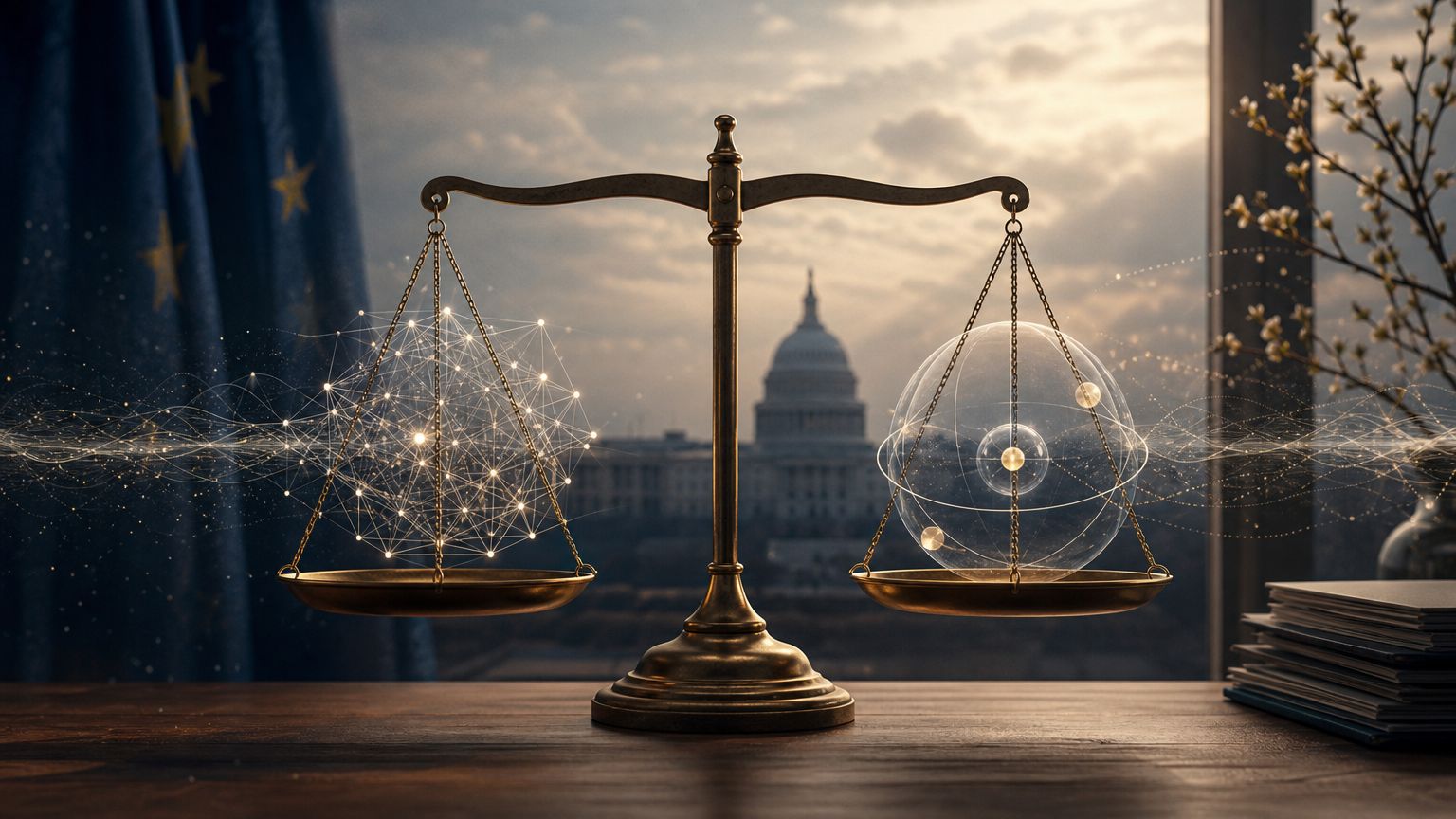
In late 2022, journalist Sarah Glazer interviewed Mauritz Kop—Founder of the Stanford Center for Responsible Quantum Technology (Stanford RQT)—for a CQ Researcher report, The Future of Artificial Intelligence — Can it be successfully regulated?, published under the lineage of Congressional Quarterly. Her questions ranged across the whole governance agenda: the regulatory gaps for artificial intelligence in the United States and Europe, the reach of the EU AI Act, the timing and skepticism around quantum computing, China and defense, and whether a machine could ever be sentient. Kop's written responses offer a compact statement of his position just before the field's law caught up with its technology.
The diagnosis: rules without teeth
Kop's opening line to Glazer was unsparing: "On both sides of the Atlantic, AI regulation is virtually nonexistent at the moment." The EU Artificial Intelligence Act, he explained, would change that—and not only in Europe. Because it is a Regulation rather than a Directive, it binds all Member States directly; and through the Brussels effect it sets a de facto global standard, exporting a risk-tiered, conformity-and-certification approach to AI well beyond the EU's borders.
Quantum is not "twenty years away"
The interview's sharpest thread was Kop's rebuttal to the familiar claim that quantum computing is perpetually two decades off. The framing, he argued, confuses engineering milestones with physical reality. Adversaries can harvest encrypted data now and decrypt it later once a capable machine exists, so the migration clock is already running. The physics is unforgiving: because qubits exploit superposition and entanglement, a quantum register explores an exponentially large state space, and an algorithm like Shor's turns that into the ability to break the assumptions behind today's public-key encryption. The argument echoes the warning in the Foreign Policy op-ed that drew Glazer to him in the first place.
Govern the systems we have
On machine sentience, Kop kept capability and consciousness apart: quantum effects make hard computations tractable, but they do not manufacture an inner life, and nothing in the physics confers rights on a model. The serious work is to govern the AI and quantum systems already in deployment—an interdisciplinary, standards-first program Kop has carried into venues from the U.S. Senate to his scholar profile. Read in 2026, after the EU AI Act's adoption and NIST's finalization of its first three post-quantum cryptography standards, the 2022 conversation looks less like commentary than like an early reading of developments now settled in law.
Meer lezen