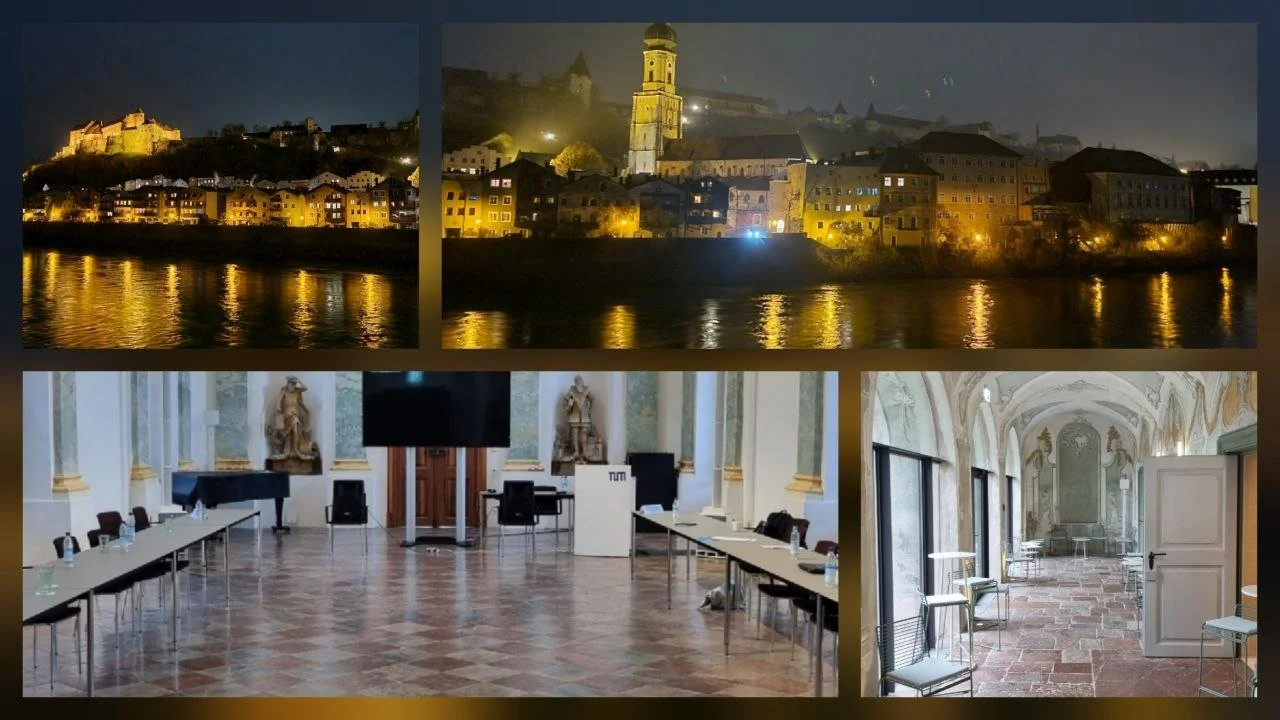
In November 2023, the inaugural Festival of Ideas gathered scholars, technologists, and policymakers at the Technical University of Munich and its historic Science & Study Center at Raitenhaslach Monastery to ask how society should design a new "operating system" for an age of artificial intelligence and quantum computing. I took part as a Stanford Center for Responsible Quantum Technology participant, alongside Professor Urs Gasser of TUM.
Quantum governance on the agenda
Quantum technology ran through the program rather than sitting at its edge. A closing use-case session on responsible technology—focused on quantum, AI, and immersive tools—was moderated by Urs Gasser, Rector of TUM's Hochschule für Politik. It was the same collaboration that soon produced the Nature Physics call for responsible quantum technology that Gasser, Eline de Jong, and I co-authored, making the Festival an early working session for that line of scholarship.
A live demonstration of quantum intuition
My contribution went beyond a conventional talk. I gave a live demonstration using my own photo, video, and music as input to a real-time, beat-synced audiovisual system inspired by fractal geometry, with a generative-AI element in the loop. Fractal patterns recur in nature—and have been observed in quantum materials—so inviting the audience to become the input data made an abstract idea tangible: that art can foster the quantum intuition an interdisciplinary, double-educated quantum workforce will need.
From Abu Dhabi to a Munich grand piano
The Munich demonstration was one public instance of a format I have also performed in Abu Dhabi, on exponential-technology stages of the kind I later addressed as a speaker at XPANSE 2024. As a working musician, I added an unscripted piano interlude on the venue's grand piano—of a piece with the Festival's argument that creativity is a method, and that the most durable guardrails for fast-moving technology are designed where law, ethics, science, and art are allowed to meet.
Meer lezen