Stanford Quantum Incubator Workshop 1.0, November 1, 2024, at Stanford Law School
By Editor
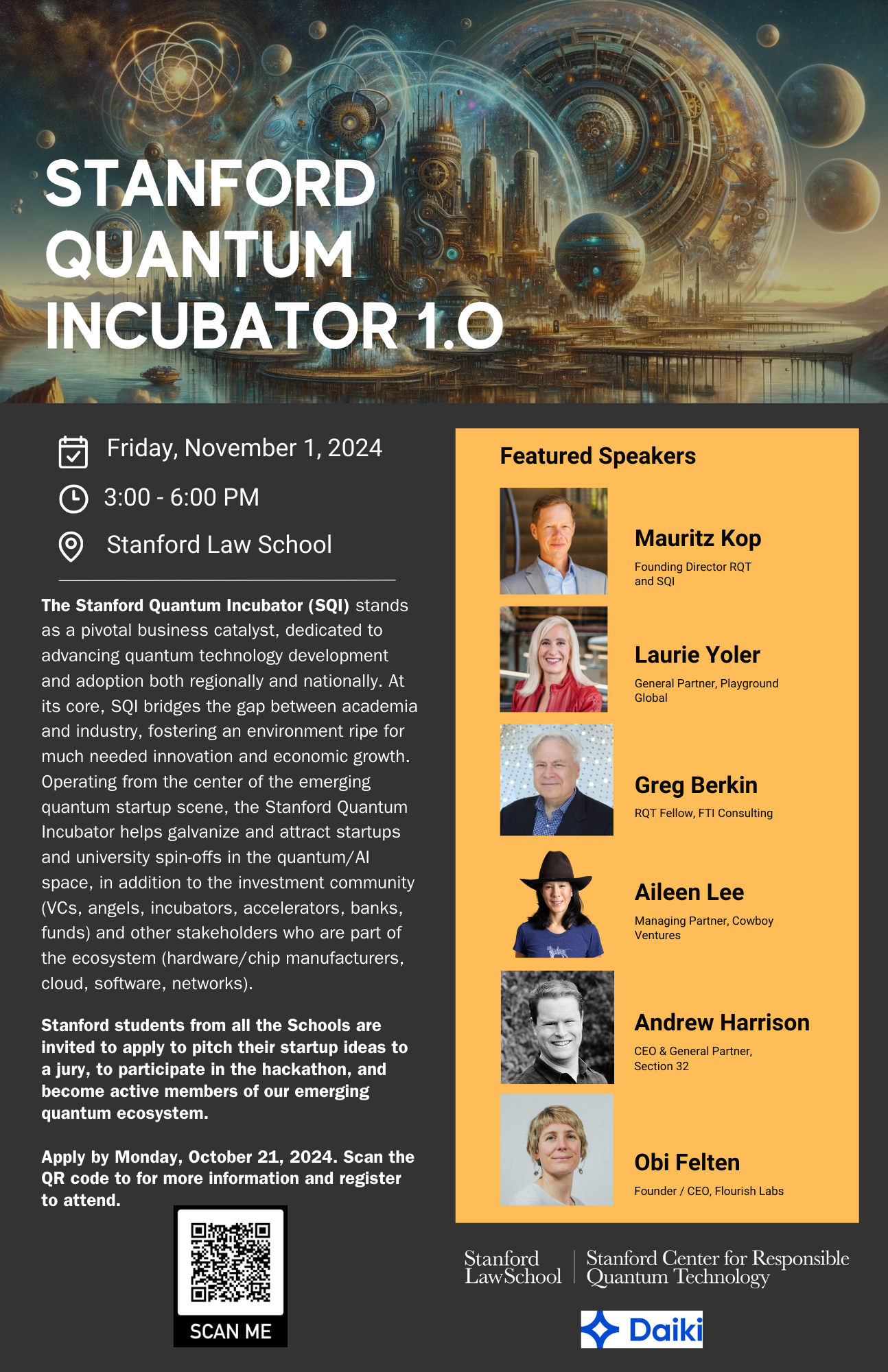
Stanford, CA, November 1, 2024—The Stanford Quantum Incubator (SQI) held its pilot workshop, Stanford Quantum Incubator Workshop 1.0, at Stanford Law School on Friday, November 1, 2024, from 3:00 to 6:00 PM PT in the Classroom Building, Room 190. Founded by Mauritz Kop—Founder of the Stanford Center for Responsible Quantum Technology and a Stanford Law School TTLF Fellow—SQI is a business catalyst designed to move second-generation quantum technology from the laboratory into the market responsibly. The free, half-day event combined a startup pitch competition, a hackathon, and structured networking with the investment community, and was organized by the Stanford Program in Law, Science & Technology, per the Stanford event listing.

Stanford Quantum Incubator Workshop 1.0: startup pitches at Stanford Law School .
A business catalyst at the edge of the quantum market
The workshop's framing was deliberately ecosystemic. As the announcement described it, "The Stanford Quantum Incubator (SQI) stands as a pivotal business catalyst, dedicated to advancing quantum technology development and adoption both regionally and nationally. At its core, SQI bridges the gap between academia and industry, fostering an environment ripe for much needed innovation and economic growth." Operating from the center of the emerging quantum startup scene, SQI was conceived to galvanize and attract startups and university spin-offs in the quantum and artificial intelligence (AI) space, alongside the broader investment community—venture capitalists, angels, incubators, accelerators, banks, and funds—and the hardware, chip, cloud, software, and networking firms that make up the rest of the stack.
That timing was not incidental. As Kop put it, SQI was started "at a time when groundbreaking discoveries in second generation quantum technologies are making their way from the lab into the markets"—advances in quantum computing, cryptography, sensing, simulation, networking, and communication, with applications across life sciences and healthcare, finance, manufacturing, logistics, automotive, defense, and space. Second-generation quantum technology exploits engineered control over individual quantum states—superposition and entanglement among them—rather than merely the bulk quantum effects of the first generation; it is precisely that control over fragile, easily decohered states that turns laboratory physics into a product, and that makes early-stage governance and commercialization questions inseparable.
Pitch, hackathon, and an open invitation
The pilot was built around participation rather than spectacle. Stanford University students from all departments and schools—physics, computer science, medicine, business, and beyond—were invited to apply. In the founder's own words on the call for applications: "Stanford University students from all Departments and Schools (e.g. Physics, Computer Science, Medicine, Business) are invited to apply to pitch their startup ideas to a jury, to participate in the hackathon, and become active members of our emerging quantum ecosystem." Applications were due by Monday, October 21, 2024.
The format married a startup pitch competition, in which selected student teams presented quantum and AI venture ideas to a jury of investment professionals, with a hackathon and open networking. The aim, as SQI put it, was to build "a local values-laden ecosystem of quantum competency"—a phrase that signals the incubator's distinctive posture: it sits inside a law school and a responsible-technology center, so commercialization and responsible-innovation questions are treated as one design problem, not two.
The people: fellows, jury, speakers, and founders
The workshop was organized by SQI Fellows Greg Berkin, MBA, and Bradley Horowitz, whom Kop thanked "for organizing such an exciting event." In his recap, Kop thanked the investment-community and venture-capital jury members who reviewed the selected quantum startup pitches and offered feedback to the student teams: Mark Lemley, Greg Berkin, MBA, Bradley Horowitz, David Hornik, Laurie Yoler, Obi Felten, Andrew Harrison, Aileen Lee, and Ching-Yu Hu. The speaker lineup—Alex Waldherr, Katie Liu, and Victor Wei—ranged across the field's frontier, from designing novel quantum-computing chip architectures to implementing responsible quantum technology paradigms in pharma and healthcare. Among the participants who brought ventures and ideas to the table were Charu Jain, Jin-Hee Lee, MIN-HA LEE, and Varun Agarwal.
The workshop was sponsored by the Stanford Center for Responsible Quantum Technology at Stanford Law School and by Daiki, the AI governance company co-founded by Kop. The sponsorship pairing is telling: a responsible-technology research center and a governance company underwriting a student venture competition is an unusually explicit attempt to wire ethics, law, and policy into the commercial layer of quantum from its earliest days.
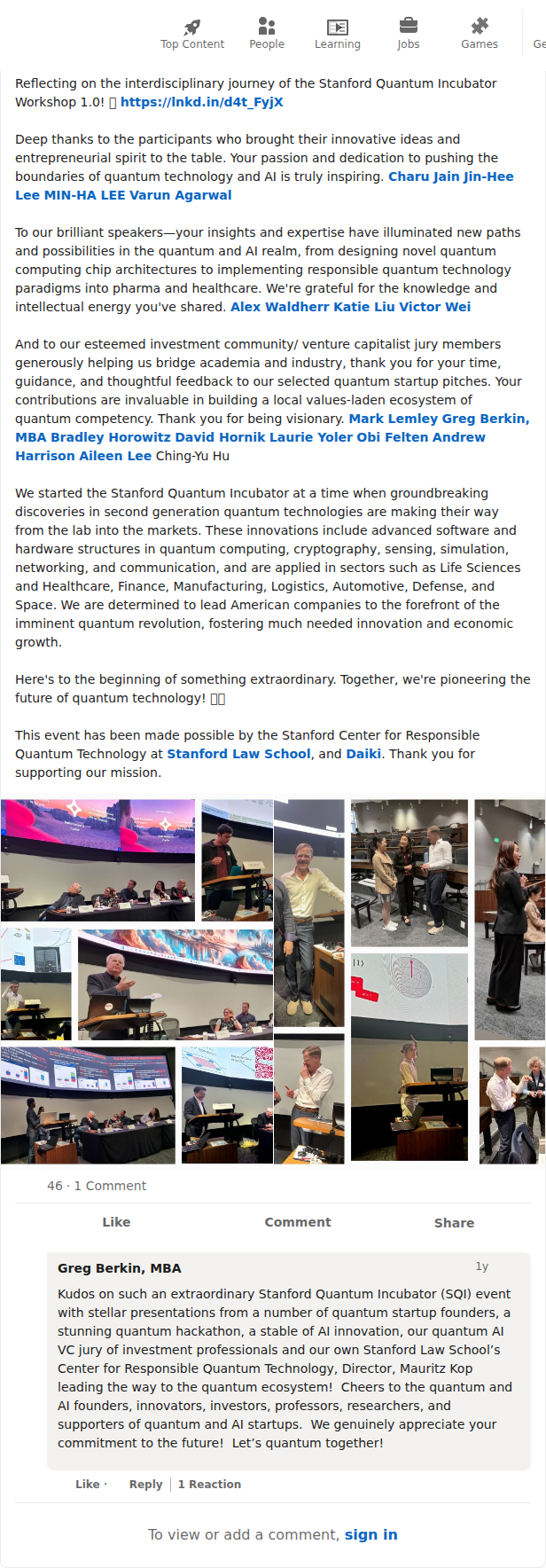
Mauritz Kop's LinkedIn reflection on the Stanford Quantum Incubator Workshop 1.0, November 2024.
Why a law school runs a quantum incubator
Housing an incubator inside Stanford Law School, rather than only in an engineering or business school, reflects a settled view in the center's work: that the legal, ethical, social, and policy implications of quantum technology are best engaged before products ship, not after. That conviction runs through the center's broader output, from the annual Stanford Responsible Quantum Technology conferences to the broader work of the Stanford Center for Responsible Quantum Technology itself. The incubator extends that program into entrepreneurship: it treats responsible innovation not as a brake on commercialization but as a competitive feature of it. SQI was itself launched at Stanford Law School earlier in 2024, and Workshop 1.0 was its first public program.
SQI framed its own ambition in those terms, stating that it was "determined to lead American companies to the forefront of the imminent quantum revolution, fostering much needed innovation and economic growth." As an inaugural workshop, Workshop 1.0 was a proof of concept for that model—an early, interdisciplinary gathering of founders, investors, researchers, and students convened to test whether a responsible quantum and AI startup ecosystem could be built deliberately, from the ground up, with values designed in rather than bolted on.

Last updated: June 6, 2026.