Innovation, Quantum-AI Technology & Law

Blog over Kunstmatige Intelligentie, Quantum, Deep Learning, Blockchain en Big Data Law

Blog over juridische, sociale, ethische en policy aspecten van Kunstmatige Intelligentie, Quantum Computing, Sensing & Communication, Augmented Reality en Robotica, Big Data Wetgeving en Machine Learning Regelgeving. Kennisartikelen inzake de EU AI Act, de Data Governance Act, cloud computing, algoritmes, privacy, virtual reality, blockchain, robotlaw, smart contracts, informatierecht, ICT contracten, online platforms, apps en tools. Europese regels, auteursrecht, chipsrecht, databankrechten en juridische diensten AI recht.

Berichten met de tag Stanford Law School
BioLawLaPaLooZa: Mauritz Kop on Hippocratic Quantum and the End of Stable Records at Stanford Law School

At BioLawLaPaLooZa, the annual law-and-biosciences conference convened at Stanford Law School by Henry T. "Hank" Greely and co-hosted with the Journal of Law and the Biosciences, Mauritz Kop delivered a talk that fused two strands of his recent work: the biomedical-ethics argument of his Harvard-published Hippocratic Quantum project and the security lens of his NATO Strategic Communications advisory work. It was his third appearance at the gathering, which builds on his earlier BioLawLaPaLooZa remarks.

The past is not yet stable

Kop's organizing line was that "the past is not yet stable." Rather than treating the quantum threat as a future event, he argued that today's authenticated, confidential records are contingent on a cryptographic transition still under way: adversaries can harvest encrypted data now and decrypt it once a Shor-capable machine factors the large integers beneath RSA. Confidentiality, in this reading, must be defended retroactively as well as prospectively—making the migration to post-quantum cryptography, for hospitals and biobanks, a clinical duty rather than an IT preference. The point reframes a familiar threat model: the danger is not only what a future machine will decrypt, but what is being copied and stored today against that day.

Four classical principles, recomputed

The talk recast the four principles of biomedical ethics—autonomy, beneficence, non-maleficence, and justice—for a quantum register. Quantum does not replace them, Kop said; it changes what applying them requires. Autonomy comes to demand data sovereignty and a credible right not to know as quantum-AI systems build finer probabilistic patient models. Dual-use simulators that design therapeutics can also lower the barrier to designing pathogens, which is where his LSI test—least trade-restrictive, security-sufficient, innovation-preserving—supports tiered disclosure over blanket secrecy. And the justice problem is a widening one: the quantum divide, he warned, may prove steeper than the digital divide.

The X-Ray City and a constitution for medicine

Widening the lens, Kop described civic-scale quantum gravimetric and magnetic sensors moving from the laboratory toward infrastructure pilots—able, from public rights-of-way, to resolve subsurface and interior spaces, and so to reach into the privacy of the home. He calls this prospect the X-Ray City, and said he had told NATO it needs a Hippocratic Quantum posture of its own. He closed with a "quantum constitution for medicine" in four standards of care: quantum-safe encryption, sovereignty over patient digital twins, human oversight in the loop, and tiered disclosure under the LSI test. The premise the room had not heard before, he suggested, was simply that the past itself is not yet settled.

Meer lezen
Stanford University Library Creates Permanent RQT Scholarship Repository Of Selected Works

Stanford, CA, July 10, 2025 – Stanford University Library, in a significant move to advance the field of responsible quantum innovation, has established a dedicated digital scholarship repository for the Stanford Center for Responsible Quantum Technology (RQT), that had its Law School tenure from December 2023 to January 2025. This new collection, accessible via the persistent URL https://purl.stanford.edu/hp536nb5631, will preserve and showcase the influential research and scholarly output of the Center, ensuring its global accessibility for researchers, policymakers, and industry leaders.

The Stanford Center for RQT, founded by Mauritz Kop and part of the Stanford Program in Law, Science & Technology led by Mark Lemley, stands at the forefront of shaping a future where quantum advancements contribute to equitable and beneficial social goals. With a mission to foster interdisciplinary research, education, and collaboration, the Center addresses the profound societal impacts of quantum technologies, promoting competition, transparency, inclusivity, intergenerational equity, and sustainable innovation, all while safeguarding human rights and democratic values. A highlight of the Center's public engagement is its annual Stanford Responsible Quantum Technology Conference, which brings together global leaders to discuss the field's most pressing issues. The creation of this repository marks a milestone in the Center's efforts to disseminate its foundational works, and ensures their longevity.

The Stanford Library Permanent RQT Repository

The initial collection features a selection of the Center's influential publications that underscore its commitment to a holistic and forward-thinking governance approach. The showcased works include:

10 Principles for Responsible Quantum Innovation: Published in IOP Quantum Science and Technology, this seminal paper by Mauritz Kop and his team outlines a guiding framework for the ethical development of quantum technologies, emphasizing principles from safeguarding and accountability to advancing societal well-being.

Towards Responsible Quantum Technology: This foundational paper from the Harvard Berkman Klein Center for Internet & Society Research Publication Series, authored by Mauritz Kop, Mateo Aboy, Eline De Jong, Urs Gasser, Timo Minssen, I. Glenn Cohen, Mark Brongersma, Teresa Quintel, Luciano Floridi & Ray Laflamme, lays out a comprehensive vision for the responsible development and stewardship of the quantum ecosystem.

A Project-Based Approach to Responsible Quantum Innovation

In addition to its publications, the Center's work is driven by a project-based approach that tackles critical challenges at the intersection of quantum technology and society. Key projects include:

Regulating Quantum Technology: This foundational project performs a detailed study of how to sensibly regulate second-generation (2G) quantum technology. It aims to design sui generis governance frameworks that offer strategic blueprints for decision-makers, integrating risk management, resource optimization, and safety standards to ensure that the benefits of quantum are distributed equitably.

Quantum Leap: Decoding Quantum Computing Innovation: In collaboration with the University of Cambridge, this empirical project by Mateo Aboy conducts a comprehensive analysis of the patent landscape in quantum computing. By examining patenting trends, the project provides valuable, evidence-based insights to inform policy decisions related to intellectual property, innovation, and regulation in this rapidly evolving field.

Key Stanford Center for RQT Focus Areas

The Center's research and policy advocacy are concentrated on several key areas critical to the future of quantum technology:

Global Governance and Standards: Studying how technical standards, certification, and other governance mechanisms can foster the trust needed for technology uptake and responsible deployment. This includes exploring governance tipping points, geopolitics, smart regulation, dual-use, supply chains, and export controls, all within a framework that advances first-to-market innovation, reinforces human rights and safeguards democratic values.

Quantum Diplomacy and Government Advocacy: Informing policymakers, diplomats, and the judiciary about the principles of responsible quantum technology, and fostering international dialogue and strategic alliances to shape effective global governance strategies.

The establishment of this repository by the Stanford University Library not only provides a permanent home for the Center's vital scholarship but also reinforces Stanford's leadership in the global dialogue on technology governance. It serves as an essential resource for anyone seeking to understand and contribute to the responsible development of the quantum future.

Thanks to Professor Mark Lemley and to Beth Williams, Associate Dean, Robert Crown Law Library & Senior Lecturer in Law, for curating the RQT Repository.

To explore the full collection, please visit https://purl.stanford.edu/hp536nb5631.

Meer lezen
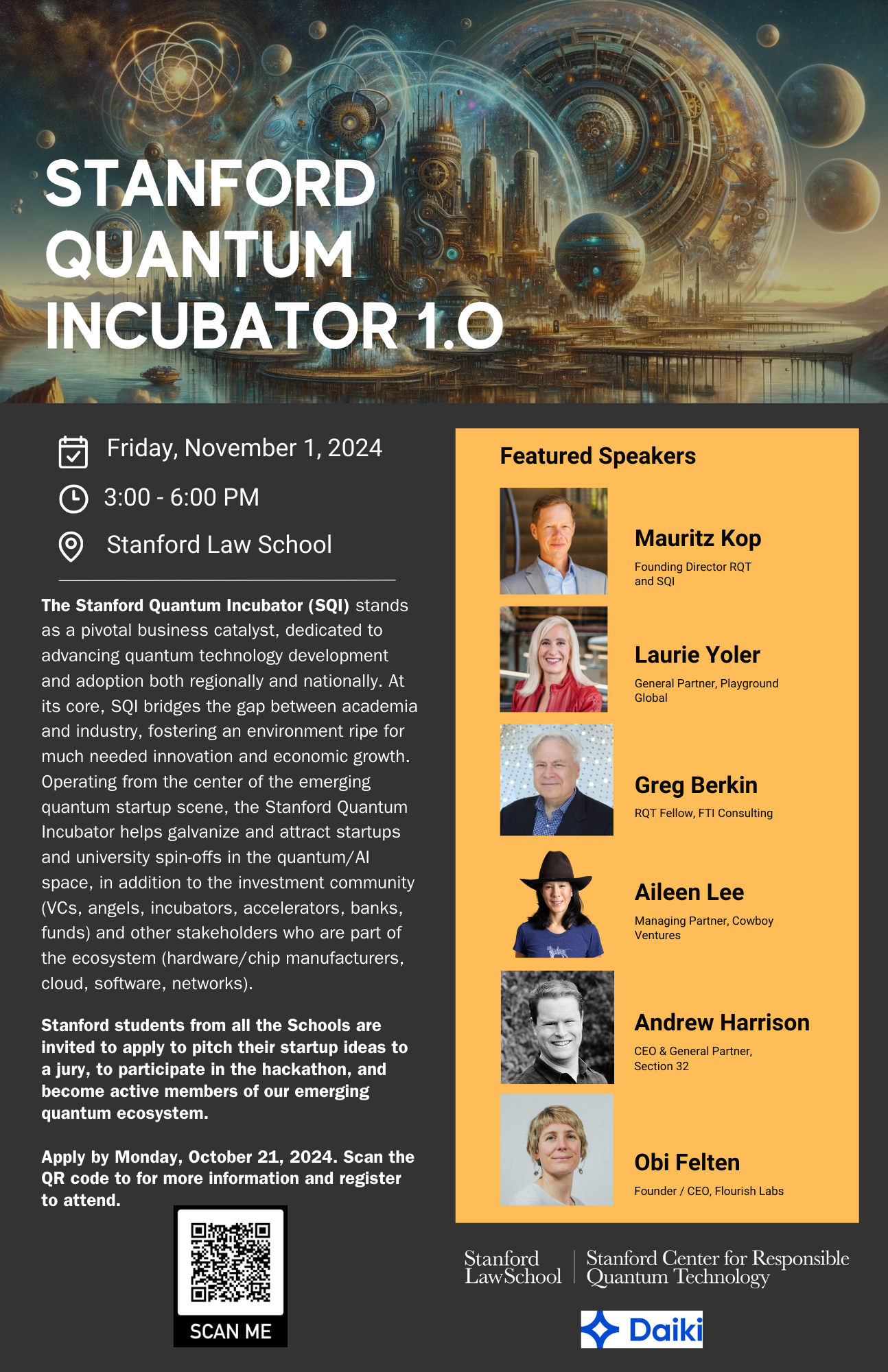
Stanford Quantum Incubator Workshop 1.0, November 1, 2024, at Stanford Law School

On November 1, 2024, the Stanford Quantum Incubator (SQI) convened its pilot workshop at Stanford Law School: a half-day of startup pitches, a hackathon, and venture-community networking, built to test whether a responsible quantum and AI startup ecosystem could be assembled deliberately from the ground up. Founded by Mauritz Kop and sponsored by the Stanford Center for Responsible Quantum Technology and the governance company Daiki, the incubator sits at an unusual address—inside a law school—where commercialization and responsible-innovation questions are treated as a single design problem.

An incubator inside a law school

Most technology incubators live in engineering quadrangles or business schools. SQI's decision to anchor itself in Stanford Law School signals a thesis about second-generation quantum technology: that its legal, ethical, social, and policy implications should be engaged before products ship, not litigated after. The center had already built that conviction into its research and convening program; the incubator carried it into entrepreneurship, framing responsible innovation as a competitive feature rather than a compliance cost.

Pitch, hackathon, and a values-laden ecosystem

Workshop 1.0 was participatory by design. Students from across Stanford—physics, computer science, medicine, business—were invited to apply by October 21, 2024, to pitch ventures to a jury of investment professionals, join a hackathon, and become members of the emerging ecosystem. Organized by SQI Fellows Greg Berkin and Bradley Horowitz, the workshop drew an investment-community jury that Kop thanked—Mark Lemley, David Hornik, Laurie Yoler, Obi Felten, Aileen Lee, Andrew Harrison, and Ching-Yu Hu among them—with speakers Alex Waldherr, Katie Liu, and Victor Wei addressing topics from novel quantum-computing chip architectures to responsible quantum technology in pharma and healthcare. The explicit goal was to build a local, values-laden ecosystem of quantum competency—competence and conscience grown together rather than sequenced.

Why early-stage governance matters for quantum

The incubator launched at a moment when second-generation quantum technologies—computing, cryptography, sensing, simulation, networking, and communication—were beginning to cross from the laboratory into markets spanning healthcare, finance, manufacturing, logistics, defense, and space. Because these technologies depend on engineered control over fragile quantum states that decohere easily, the questions of how to commercialize, secure, and govern them arrive at the same time as the first products. Convening founders, investors, and researchers at the earliest stage is one way to ensure those questions are asked while the answers can still shape the technology, a logic that also runs through the center's work on quantum and AI in healthcare and the life sciences.

A proof of concept

As an inaugural event, Workshop 1.0 functioned as a proof of concept for a deliberate, interdisciplinary model of quantum entrepreneurship—one that pairs commercial ambition in the emerging quantum market with values designed in rather than bolted on. The pilot offered an early template for SQI's stated aim of bridging Stanford's research strength and the venture ecosystem forming around it.

Meer lezen
Stanford RQT 2.0: Inside the Second Stanford Responsible Quantum Technology Conference at Stanford Law School, Chaired by Mauritz Kop

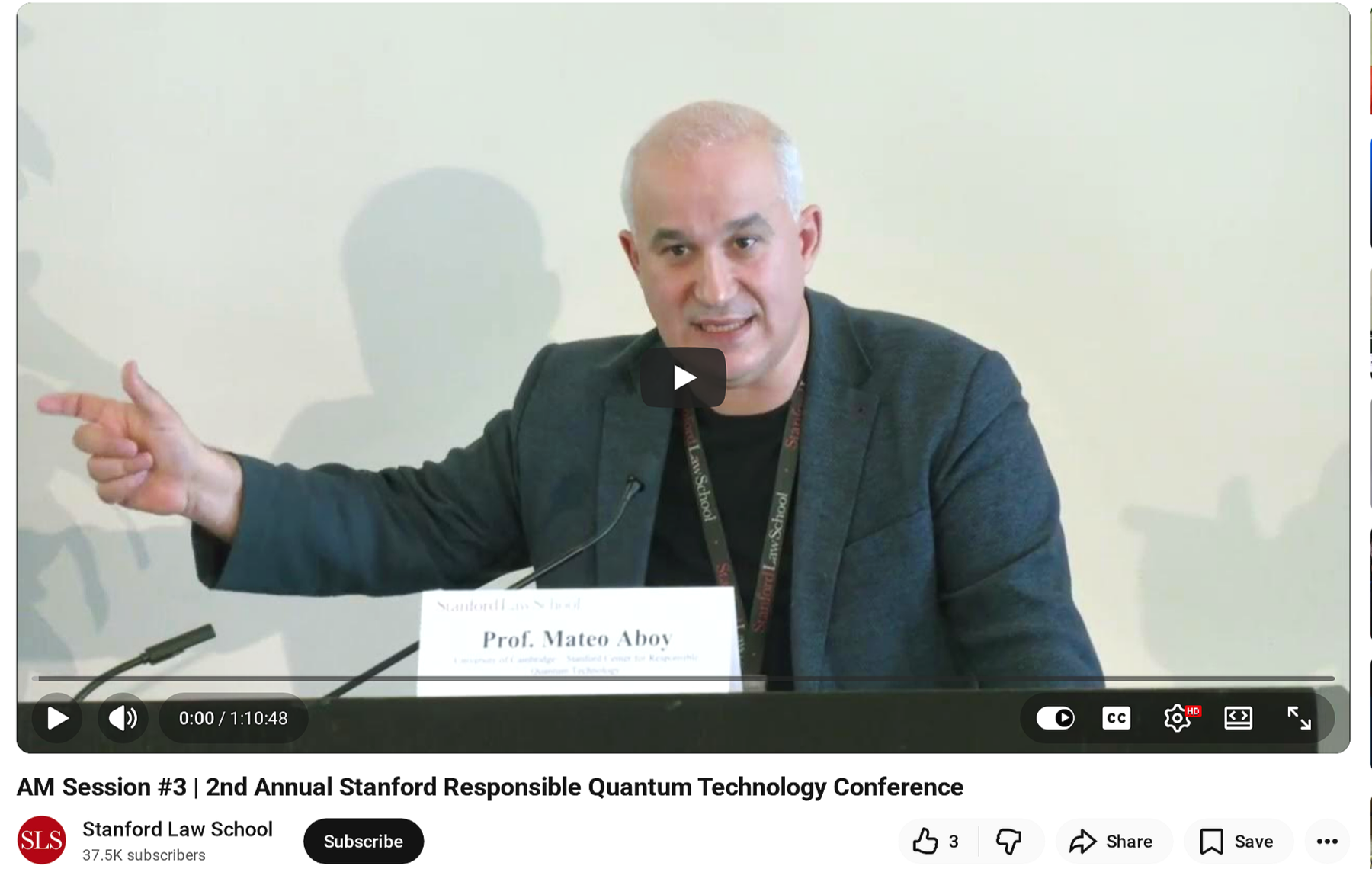
The second annual Stanford Responsible Quantum Technology Conference, chaired by Mauritz Kop at Stanford Law School, took a question that an inaugural event had to argue into existence and treated it instead as settled—then spent the day pressure-testing how to answer it. This is the chair's record of how the conference came together and unfolded, from the welcome address to the concluding panel on quantum geopolitics. A separate write-up summarizes the conference's core themes; the account here follows the program itself.

An address that respects the mechanics

Kop opened by recording the institutional debts behind the day and by stating the project's governing discipline: conceptualizing responsible quantum technology “without breaking the laws of physics.” The year's theme, quantum simulation—studying one quantum system by building another that obeys the same rules—anchored the framing. Because an unknown quantum state can be neither copied nor measured without disturbance, the mechanics are not ornament around the legal argument; they are its premise, shaping every downstream question about verification, security, and trust. The Center's stance, he said, is deliberately and modestly techno-optimistic: pro-innovation, calibrated to keep policymakers from lagging the science.

A program built to be argued with

The day moved from responsible-innovation foundations—the Nature Physics call, the SEA framework of safeguarding, engaging, and advancing society, and the Ten Principles for Responsible Quantum Innovation—through materials science, an industry applications panel, a healthcare and life-sciences panel, and empirical studies of the quantum patent landscape. A governance session set out a phased, FDA-style proposal for quantum technology and invited its critics to stress-test it in real time. International perspectives followed, from a global capacity-building listening tour to supply-chain criticality, a Dutch innovation strategy, and a European Commission view. Disagreement was the design, not a defect: panelists openly contested whether quantum is genuinely novel for law, whether an agency model would help or merely slow new entrants, and whether standards should lead where statutes cannot keep pace.

What a second edition signals

That a conference reached its second edition is itself a datum about a maturing field. The institutional fabric—Stanford Law School, the moderating faculty, two University of Copenhagen and Novo Nordisk Foundation research programs, and an industry sponsor—shows responsible quantum technology as an institutional achievement rather than an individual one. The chair closed where he began, on “the cusp of the second quantum revolution,” and framed the combined work as a research agenda spanning a golden triangle of academia, industry, and policy. The encryption question supplied the day's one near-consensus risk: a capable quantum computer would break widely deployed RSA, Diffie-Hellman, and elliptic-curve public-key systems, making the migration to quantum-safe methods a present task. For the field's intellectual lineage, see the underlying Nature Physics call for responsible quantum technology.

Meer lezen
Stanford Quantum Incubator Launched at Stanford Law School

Stanford, March 31, 2024—Today, we are thrilled to announce the launch of the Stanford Quantum Incubator (SQI)—a Silicon Valley business catalyst dedicated to advancing quantum technology development and adoption both regionally, nationally, and beyond. Situated at the prestigious Stanford Law School, the Stanford Quantum Incubator stands as a pivotal force, bridging the critical gap between academia and industry to foster an environment ripe for much-needed innovation and economic growth.

Stanford Quantum Incubator: Bridging Academia and Industry

Operating from the center of the emerging quantum startup scene, the Stanford Quantum Incubator will help galvanize and attract startups and university spin-offs in the quantum and AI space. It will also serve as a nexus for the broader investment community—including venture capitalists, angel investors, accelerators, banks, and funds—and other essential stakeholders, from hardware manufacturers to cloud and software providers.

The launch of SQI comes at a pivotal moment for the United States. In the wake of the 2022 Biden Executive Orders on Quantum, the CHIPS and Science Act, and the 2023 Executive Order on the Safe, Secure, and Trustworthy Development and Use of Artificial Intelligence, the imperative to cultivate a competitive and responsible quantum ecosystem has never been more pronounced. These government directives are accelerating investment in quantum information science (QIS) and catalyzing a host of new opportunities for public-private collaboration. It is essential that the quantum community capitalizes on this momentum.

We start the Stanford Quantum Incubator at a time when groundbreaking innovations in second-generation quantum technologies are making their way from the lab into the markets. These advancements span quantum computing, cryptography, sensing, simulation, and networking, with transformative applications in sectors such as Life Sciences and Healthcare, Finance, Cybersecurity, Manufacturing, Logistics, Automotive, Defense, and Space.

Inaugural Stanford SQI Fellows Bring a Wealth of Venture Capital Expertise

The success of this ambitious endeavor is anchored by the wisdom and experience of its leadership and advisors. The Stanford Quantum Incubator is honored to introduce its inaugural Fellows, a group of distinguished leaders from the worlds of venture capital, technology, and cybersecurity. The SQI team consists of Fellows Bradley Horowitz, David Hornik, Greg Berkin, and SQI Founding Director Mauritz Kop

A Catalyst for Responsible Quantum Innovation

Building on decades of combined entrepreneurial experience, SQI will develop a comprehensive suite of student/founder mentorship and support services designed to propel startups and scale-ups to success. Guidance will span sustainable business models, legal compliance, performance benchmarking, intellectual property portfolio optimization, and technology transfer. The incubator will directly address the multifaceted ethical, legal, societal, and policy challenges (Quantum-ELSPI) inherent in developing quantum hardware, software, and quantum-classical hybrids.

Central to SQI’s mission is a profound commitment to collaboration. Operating within a quadruple helix model that unites academics, industry professionals, policymakers, and end-users, SQI is positioned to become the epicenter of forward-looking, exponential quantum innovation. To this end, plans are underway to host a recurring networking workshop, in partnership with respected VC tech incubators, to both operationalize the Responsible Quantum Technology (RQT) framework and foster a globally leading, values-based quantum ecosystem.

SQI Networking Event at Stanford Law

The inaugural SQI Networking Event at Stanford Law School is set for November 1, 2024. This workshop aims to establish a local, values-based quantum network that aligns with the RQT framework, positioning the Bay Area at the heart of quantum advancement. The event promises to be an exclusive gathering, featuring presentations from luminaries in the field, startup pitches, and ample opportunities for networking. By encouraging investment and deal flow, this process will amplify responsible quantum technology development, with a clear goal of producing multiple quantum unicorns by 2030.

As we stand on the cusp of the Quantum Age, the Stanford Quantum Incubator invites the broader Silicon Valley innovation cluster to join in this pioneering, interdisciplinary endeavor. A quality-labeled ‘Quantum Made in US’ paradigm, infused with AI and quantum talent and a culture of boundless possibility, can help American companies become leaders in making scalable quantum applications that create real business value and benefit society. By facilitating university-market collaboration, SQI is poised to be an effective catalyst for leadership in the imminent quantum revolution.

For those eager to contribute to and participate in this exciting venture, we encourage you to reach out to Mauritz Kop, Founding Director of the Stanford Center for RQT, for more information. Together, we can unlock the boundless potential of quantum technology and AI, creating a future that benefits us all.

Meer lezen

Quantum Technology Impact Assessment (EU AI Alliance, European Commission)

Brussels, 20 April 2023—The emergence of powerful new capabilities in large AI models, such as Generative Adversarial Networks (GANs), underscores the critical need to continuously improve and update technology impact assessment tools, ensuring they keep pace with rapid technological development. As defined in recent scholarship, technology impact assessment is the systematic process of monitoring and determining the unintended, indirect, or delayed societal impacts of a future technological innovation. Crucially, it is also about capitalizing on opportunities and enabling responsible innovation from the outset.

An article by Stanford Law’s Mauritz Kop on this topic is also featured on the European Commission's Futurium website.

Shaping the Quantum Innovation Process

Quantum Impact Assessments (QIAs) are emerging as vital practical tools to facilitate the responsible adoption of quantum technologies. There are several related approaches to this assessment: (1) interactive QIA, which seeks to influence and shape the innovation process; (2) constructive QIA, where social issues guide the design of the technology from its earliest stages; and (3) real-time QIA, which connects scientific R&D with social sciences and policy from the start, before a technology becomes locked-in.

Often taking the form of codes of conduct, best practices, roadmaps, and physics de-risking tools, QIA instruments can be used by governments, industry, and academia. These soft law toolsallow stakeholders to explore how current technological developments affect the world we live in and to proactively shape the innovation process toward beneficial, societally robust outcomes.

Exploratory Quantum Technology Assessment

Implementing interdisciplinary, expert-based QIAs can help raise awareness about the ethical, legal, socio-economic, and policy (ELSPI) dimensions of quantum technology, including quantum-classical hybrid systems. For instance, QIAs cultivate a deeper understanding of the potential dual-use character of quantum technology, where beneficial applications (such as quantum sensing for medical diagnostics) can exist alongside potentially harmful ones (such as the same sensors being used for autocratic surveillance).

Building on the foundational work of the 2018 AI Impact Assessment developed by ECP | Platform voor de InformatieSamenleving chaired by Prof. Kees Stuurman, this work presents a prototype of a QIA instrument: the Exploratory Quantum Technology Assessment (EQTA). This pioneering initiative was made possible through a collaboration between the Dutch Ministry of Economic Affairs & Climate Policy, Quantum Delta NL (QDNL), and ECP. The EQTA will be presented by Eline de Jong and Mauritz Kop at the inaugural Stanford Responsible Quantum Technology Conference in May 2023.

Guidance for Responsible Quantum Technology Implementation

The EQTA provides a comprehensive, practical step-by-step plan that encourages stakeholders to initiate a dialogue to clarify which ethical, legal, and social aspects are important in the creation and application of quantum systems and their interaction with classical technologies. This structured approach helps make the use of quantum technology—as well as the data and algorithms that power it—more transparent and accountable from an early stage.

Looking forward, establishing a risk-based legal-ethical framework in combination with standardization, certification, technology impact assessment, and life-cycle auditing of quantum-driven systems is crucial to stewarding society towards responsible quantum innovation. Mauritz Kop’s research group has written more on this framework in their seminal article Towards Responsible Quantum Technology (Harvard).

Meer lezen
Mauritz Kop Presents Oxford JIPLP Article on Quantum Computing, IP and Market Power at IPSC 2022, Stanford Law School

IPSC 2022 at Stanford: at the first in-person Intellectual Property Scholars Conference after two virtual years (August 11–12, 2022), Mauritz Kop presented his Oxford JIPLP article Intellectual property in quantum computing and market power: a theoretical discussion and empirical analysis, co-authored with Mateo Aboy and Timo Minssen.

When IP stops doing its job

The theory: intellectual property exists to incentivize innovation, but excessive proliferation of exclusive rights over a foundational technology produces anticommons effects — overlapping thickets that raise transaction costs, deter follow-on research and concentrate first-mover market power. Quantum computing, built on decades of publicly funded science, is exactly where that risk bites hardest.

The patent data behind the argument

The empirics: the article analyzes the quantum-computing patent landscape — who files, where portfolios cluster, and what that implies for market structure in a field whose hardware, algorithms and error-correction methods may all carry exclusive rights. Theory says when proliferation harms innovation; the data say where quantum technology stands today.

A transatlantic collaboration, a Stanford homecoming

Kop, Aboy and Minssen connect European and American IP scholarship on quantum computing; for Kop the venue completed a circle, having spent early 2022 as visiting scholar at Stanford Law School. The presentation put the market-power findings before the scholars best placed to attack the methodology — which is what the IPSC works-in-progress format exists to do. And after two virtual editions, the 22nd IPSC's return to a physical Stanford conference room restored the corridor conversations that turn a panel question into a coauthorship.

Standards: the other half of ownership

Beyond patents, quantum interoperability standards will run on disclosure and licensing commitments from the very portfolio holders the article tracks. Whether those commitments are negotiated early, FRAND-style, or after positions harden will shape access to the technology as surely as any patent dispute — and the article's empirical map is groundwork for getting that negotiation right.

Third station of a research arc

From AI's data inputs (IPSC 2020) via waive-or-pledge quantum IP (IPSC 2021) to ownership structure and market power (2022): the sequence tracks a research line moving from machine learning's raw material to quantum computing's ownership structure, each stage workshopped in public before publication. That line later grew into an institutional one — see Stanford University launches the Stanford Center for Responsible Quantum Technology. If early patent concentration hardens into durable market power, access to the field's foundational capabilities narrows before the technology matures; making that risk empirically discussable, rather than rhetorical, is the article's lasting contribution.

Meer lezen
Mauritz Kop calls for a Quantum Governance Act at the University of Copenhagen, Faculty of Law

Much enjoyed giving a lecture titled ‘Quantum-ELSPI: A Call for a Quantum Governance Act’ on Thursday June 9, 2022 at the University of Copenhagen, Faculty of Law. This was an internal CeBiL event that took place before The Quantum Future symposium, organized by the Royal Danish Academy of Sciences and its newly established Committee for Quantum Information and Quantum Computing, together with the Niels Bohr Institute’s Quantum Life Centre.

EU Quantum Governance Act

With its own Copenhagen interpretation of quantum mechanics in which physical phenomena must be observed and measured to exist, the University of Copenhagen, Faculty of Law was the perfect place to propose an outline for a novel Quantum Governance Act on a European level, fostering open innovation while putting targeted, technology and industry specific risk based controls in place. The EU Quantum Act should jointly optimize advancing quantum technology (investment and innovation) with safeguaring quantum technology, society and humankind (guardrails, standards, values, IP protection and national security). For example, it could contain a product safety regime as found in the EU AI Act, combined with pro-innovation mechanisms as found in the US CHIPS Act. In addition, I connected regulating quantum to regulating general purpose technologies (GPT) like artificial intelligence (AI), but also to nanotechnology, biotechnology, semiconductors, and last not least to managing dual use fissionable materials such as nuclear isotopes and nuclear weapons, utilizing export and intellectual property controls.

The Law of Quantum: Quantum Regulatory Frameworks

The Quantum & Law lecture gave an overview of work done over the past 3 years on quantum regulatory frameworks, incentive and rewards systems, competition law, beyond intellectual property innovation law, ethics, national security policy, standardization, technology impact assessment, benchmarking and certification published or forthcoming in high impact journals at both sides of the Atlantic. My talk ended with discussing the latest research findings pertaining to the Law of Quantum, and Quantum-ELSPI academic disciplines. Thanks to the participants for their inspiring questions and comments!

Panel Debate about the Quantum Future at the Royal Danish Academy of Sciences

The brilliant lectures on atoms, photons, qubits, the nature of quantum information, the history of quantum physics, and current research into quantum computer paradigms -including combatting decoherence on both software and hardware levels- at The Quantum Future symposium where highly enjoyable. This fascinating program ended with a panel debate on how quantum technology will change our society, at the beautiful building of the Royal Danish Academy of Sciences, in attendance of fellow jurists Nicholson Price II, Louise C. Druedahl, Marcelo Corrales Compagnucci, and Agnieszka Radziwon.

Surfing the Waves of the Second Quantum Revolution

The panel debate at the Academy -superbly moderated by Nanna Bonde Thylstrup- gave a true, almost symptomatic picture of the various stakeholders' viewpoints and positions. But we are learning to speak each other's language better and better, a crucial and exciting step when it comes to balancing the societal impact of our mystical family of quantum technologies. Surfing the waves of the second quantum revolution requires building bridges between disciplines, beyond traditional research silos. Bringing together the humanities, social and natural sciences to spur sustainable innovation driven by a golden triangle of academia, government and industry is essential.

Thank you to Professor Timo Minssen and his team at CeBiL for the kind invite. https://jura.ku.dk/cebil/

Meer lezen
Mauritz Kop Visiting Quantum & Law Scholar at Stanford Law School

Mauritz Kop is Visiting Quantum & Law Scholar at Stanford Law School in 2022-2023. Kop was invited by Prof. Mark Lemley, the William H. Neukom Professor of Law at Stanford Law School and the Director of the Stanford Program in Law, Science and Technology.

Advanced legal research on Regulating Quantum technology at Stanford Law School

This Stanford Law School ‘Regulating Quantum Technology’ research project will perform a detailed study of how to sensibly regulate the suite of quantum technologies including computing, sensing and networking, unifying the world of the large with that of the small. It intends to answer questions on how our innovation architecture should be constructed, so that benefits of quantum computing, sensing, simulation, and communication -including quantum-AI hybrids- will be distributed equitably, and risks proportionally addressed. Building upon foundational work done on quantum and AI innovation policy mechanisms, national security strategy, standardization & certification, ethics, responsible quantum R&D, governance principles, technology impact assessments, data ownership and intellectual property in quantum software and hardware structures - published in flagship Journals at Stanford, Harvard, Yale, Berkeley, Physics World, Max Planck, Springer Nature, and Oxford - the transdisciplinary research aims to develop an integrated, holistic vision on smart governance and regulation of quantum & AI infused digital transformation.

Happy to speak at a number of in person events in the nexus of AI, Quantum & Law in the coming weeks:

Scarcity, Regulation and the Abundance Society Roundtable at Stanford

1. April 22, Scarcity, Regulation and the Abundance Society Roundtable at Stanford, where I will present a chapter titled ‘Abundance & Equality’ for the book project co-edited by Mark Lemley and Deven Desai. The chapter connects good governance to the end of scarcity and unifies equality with technology driven abundance, by introducing a novel Post-Rawlsian Equal Relative Abundance (ERA) principle of distributive justice. As befits tradition, we will insert musical interludes for piano, with me performing ‘Stanford Theme & Variations’ à l'improviste in the Stanford Law School Faculty Lounge. https://law.stanford.edu/publications/scarcity-regulation-and-the-abundance-society/

Patenting Quantum Computing Technologies talk at Quantum & Law Conference in Lund

2. April 29, presenting our 'Patenting Quantum Computing Technologies and Market Power: A Quantitative Analysis' research together with my academic friends Profs Mateo Aboy (Cambridge) and Timo Minssen (Copenhagen) at the Quantum & Law Conference in Lund. We wrote 2 papers focusing on IP portfolio strategies, trade & state secrets, and their interface with antitrust regulations, utilizing industry and quantum domain specific mixed theoretical & empirical research methods. http://quantum-law.org/conference/

EU AI Act Presentation at AI World Summit Americas in Montreal

3. May 4, I’ll present an overview of the EU AI Act with its ‘product safety framework’ and market entrance requirements, constructed around a set of 4 risk categories at the AI World Summit Americas in Montreal. We will discuss whether it provides a regulatory framework for AI that should be adopted globally during a Headline panel with Prof. Gillian Hadfield (Toronto) and Dr José-Marie Griffiths (President Dakota State), moderated by Meredith Broadbent (Washington). https://americas.worldsummit.ai/speakers/

Keynote Quantum Computing Ethics at IBM Research

4. May 17, I’ll give a keynote on Quantum Computing Ethics at IBM Research during their Tech for Racial and Social Justice Seminar (internal event), organized by Dr Aminat Adebiyi, moderated by Dr Mira Wolf-Bauwens, with whom I worked together on the WEF Quantum Computing Principles. https://www.weforum.org/publications/quantum-computing-governance-principles/

Quantum Impact Assessment (QIA)

5. We are creating a world’s first application-driven Quantum Impact Assessment (QIA) in The Netherlands -raising ELSA awareness and removing barriers for adoption of QT- with a diverse, multidisciplinary team lead by Prof. Bart Schermer (Leiden) and Daniël Frijters for the Centre for Quantum & Society, made possible by ECP and Quantum Delta NL. https://quantumdelta.nl/centre-for-quantum-and-society

Quantum-ELSPI special for Springer Nature with Luciano Floridi

6. Meanwhile I am editing the Quantum-ELSPI special for Springer Nature on the Ethical, Legal, Social and Policy Implications of Quantum Technology, together with EiC Prof. Luciano Floridi (Oxford). https://web.archive.org/web/20260126194629/https://law.stanford.edu/publications/quantum-elspi-ethical-legal-social-and-policy-implications-of-quantum-technology/

More exciting projects soon ...

Meer lezen
Quantum ELSPI: Ethical, Legal, Social and Policy Implications of Quantum Technology

Call for Papers Quantum ELSPI

Delighted to announce that the Quantum ELSPI call for papers is now open! AIRecht Director & Stanford Law School TTLF Fellow Mauritz Kop has the honor to guest-edit a Topical Collection for Digital Society, a new journal edited by Luciano Floridi (Oxford Internet Institute). This project is a Stanford/Oxford collaboration that aims to explore uncharted territories of Ethical, Legal, Social and Policy Implications of Quantum Technology. Articles should be submitted before 15 February 2022 and will be double blind peer reviewed. Accepted articles will be published by Springer Nature.

You can find the Quantum ELSPI collection page here: https://link.springer.com/collections/eiebhdhagd.

Download the Springer Nature Quantum-ELSPI Call for Papers here: TC_Quantum ELSPI_Call for papers

ELSPI stratagems for quantum technology

Anticipating spectacular advancements in real-world quantum driven products and services, the time is ripe for governments, academia and the market to prepare regulatory and business strategies that balance their societal impact. This topical collection seeks to provide informed suggestions on how to maximize benefits and mitigate risks of applied quantum technology. It intends to deliver insights and actionable recommendations on how and when to address identified opportunities and challenges, which can then be refined into plausible, evidence-based policy decisions by stakeholders across the world.

Special edition of Digital Society

In this special edition of Digital Society, we aim for scholars to reflect on the multifaceted questions associated with Quantum ELSPI. In addition to learning from history and connecting quantum to other big picture trends, quantum should be treated as something completely unique and unprecedented. We especially welcome cross-disciplinary contributions that look beyond research silos and integrate law, economic theory, ethics, sociology, philosophy of science, quantum information science, and sustainable innovation policy, and that consider how to improve ELSPI stratagems for quantum technology. We encourage authors to be pioneers in this complex, and at times counterintuitive field.

Multifaceted questions associated with Quantum ELSPI

Questions and topics that could be addressed by contributions in the topical collection are not restricted to, but could include the following:

-Potential strategies for industries facing disruption such as the cybersecurity industry and financial institutions. What role could antitrust law, intellectual property, prizes, fines, funding, taxes, lifelong learning and labor mobility play while incentivizing innovation?

-How should dual use applications be managed? How do we balance freedom with control? What role could a Quantum Treaty play to make our world a safer place?

-The creation of a list of quantum-specific themes, goals, benefits and risks that need to be addressed by universal, overarching principles of responsible quantum design and application, including a definition of hi-risk quantum-systems.

-How can policy makers learn from history and adjacent fields - such as AI, biotechnology, nanotechnology, semiconductors and nuclear - when regulating exponential innovation and ensuring equal access to quantum computing, sensing and the quantum internet? How can winner take all effects and a quantum divide be prevented? To what extent does governing digitization driven by classical computing paradigms (binary digits) differ from governing quantum computing (qubits)?

-It is not inconceivable that the development and uptake of transnational quantum principles will run along the lines of democratic and authoritarian tech governance models. Against that background, how can we embed cultural norms, liberal values, democratic principles, human rights and fundamental freedoms in globally accepted interoperability standards?

-How can we implement ethically aligned design into our quantum systems architecture and infrastructure? How can quantum technology impact assessments help achieve these goals?

Guest-Editor Quantum ELSPI: Mauritz Kop (Stanford Law School, Stanford University)

Editor-in-Chief Digital Society: Luciano Floridi (Oxford Internet Institute, Oxford University)

Meer lezen
De Wet op de Artificiële Intelligentie

Een bewerkte versie van deze bijdrage is gepubliceerd op platform VerderDenken.nl van het Centrum voor Postacademisch Juridisch Onderwijs (CPO) van de Radboud Universiteit Nijmegen. https://www.ru.nl/cpo/verderdenken/columns/wet-artificiele-intelligentie-belangrijkste-punten/

Nieuwe regels voor AI gedreven producten, diensten en systemen

Op 21 april 2021 presenteerde de Europese Commissie haar langverwachte Wet op de Artificiële Intelligentie (AI). Deze concept Verordening geeft regels voor de ontwikkeling, commodificatie en gebruik van AI gedreven producten, diensten en systemen binnen het territorium van de Europese Unie. Het was bemoedigend te zien dat het team van President Ursula von der Leyen een belangrijk aantal van onze strategische aanbevelingen op het gebied van de regulering van AI heeft overgenomen, danwel zelfstandig tot dezelfde conclusies is gekomen.

Doelstellingen wettelijk kader voor AI

De concept Verordening biedt horizontale overkoepelende kernregels voor kunstmatige intelligentie die op alle industrieën (verticals) van toepassing zijn. De wet beoogt de hoge maatstaven van het EU Trustworthy AI paradigma te codificeren, dat voorschrijft dat AI wettig, ethisch en technisch robuust dient te zijn en daartoe 7 vereisten hanteert.

De Wet op de Artificiële Intelligentie heeft de volgende 4 doelstellingen:

1. ervoor zorgen dat AI-systemen die in de Unie in de handel worden gebracht en gebruikt, veilig zijn en de bestaande wetgeving inzake grondrechten en waarden van de Unie eerbiedigen;

2. rechtszekerheid garanderen om investeringen en innovatie in AI te vergemakkelijken;

3. het beheer en de doeltreffende handhaving van de bestaande wetgeving inzake grondrechten en veiligheidsvoorschriften die van toepassing zijn op AI-systemen, verbeteren;

4. de ontwikkeling van een eengemaakte markt voor wettige, veilige en betrouwbare AI-toepassingen vergemakkelijken en marktversnippering voorkomen.“

Risico gebaseerde aanpak kunstmatig intelligente applicaties

Om deze doelstellingen te realiseren combineert de concept Artificial Intelligence Act een risk-based approach op basis van de pyramid of criticality, met een modern, gelaagd handhavingsmechanisme. Dit houdt onder meer in dat er voor AI applicaties met een verwaarloosbaar risico een licht wettelijk regime geldt, en onacceptabel risico applicaties verboden worden. Tussen deze 2 uitersten gelden er naarmate het risico toeneemt strengere voorschriften. Deze variëren van vrijblijvende zelfregulerende soft law impact assessments met gedragscodes, tot zwaar, multidisciplinair extern geauditeerde compliance vereisten inzake kwaliteit, veiligheid en transparantie inclusief risicobeheer, monitoring, certificering, benchmarking, validatie, documentatieplicht en markttoezicht gedurende de levenscyclus van de toepassing.

Handhaving en governance

De definitie van hoog risico AI applicaties binnen de diverse industriële sectoren is nog niet in steen gehouwen. Een ondubbelzinnige risicotaxonomie zal bijdragen aan rechtszekerheid en biedt belanghebbenden een adequaat antwoord op vragen over aansprakelijkheid en verzekering. Om ruimte voor innovatie door SME’s waaronder tech-startups te waarborgen, worden er flexibele AI regulatory sandboxes geïntroduceerd en is er IP Action Plan opgesteld voor intellectueel eigendom. De concept Verordening voorziet tenslotte in de installatie van een nieuwe handhavende instantie op Unieniveau: het European Artificial Intelligence Board. De EAIB zal op lidstaatniveau worden geflankeerd door nationale toezichthouders.

Meer lezen
Quantum Computing and Intellectual Property Law

Berkeley Technology Law Journal, Vol. 35, No. 3, 2021

New Stanford University Beyond IP Innovation Law research article: “Quantum Computing and Intellectual Property Law”.

By Mauritz Kop

Citation: Kop, Mauritz, Quantum Computing and Intellectual Property Law (April 8, 2021). Berkeley Technology Law Journal 2021, Vol. 35, No. 3, pp 101-115, February 8, 2022, https://btlj.org/2022/02/quantum-computing-and-intellectual-property-law/

Download the article here: Kop_QC and IP Law BTLJ

Please find a short abstract below:

Intellectual property (IP) rights & the Quantum Computer

What types of intellectual property (IP) rights can be vested in the components of a scalable quantum computer? Are there sufficient market-set innovation incentives for the development and dissemination of quantum software and hardware structures? Or is there a need for open source ecosystems, enrichment of the public domain and even democratization of quantum technology? The article explores possible answers to these tantalizing questions.

IP overprotection leads to exclusive exploitation rights for first movers

The article demonstrates that strategically using a mixture of IP rights to maximize the value of the IP portfolio of the quantum computer’s owner, potentially leads to IP protection in perpetuity. Overlapping IP protection regimes can result in unlimited duration of global exclusive exploitation rights for first movers, being a handful of universities and large corporations. The ensuing IP overprotection in the field of quantum computing leads to an unwanted concentration of market power. Overprotection of information causes market barriers and hinders both healthy competition and industry-specific innovation. In this particular case it slows down progress in an important application area of quantum technology, namely quantum computing.

Fair competition and antitrust laws for quantum technology

In general, our current IP framework is not written with quantum technology in mind. IP should be an exception -limited in time and scope- to the rule that information goods can be used for the common good without restraint. IP law cannot incentivize creation, prevent market failure, fix winner-takes-all effects, eliminate free riding and prohibit predatory market behavior at the same time. To encourage fair competition and correct market skewness, antitrust law is the instrument of choice.

Towards an innovation architecture that mixes freedom and control

The article proposes a solution tailored to the exponential pace of innovation in The Quantum Age, by introducing shorter IP protection durations of 3 to 10 years for Quantum and AI infused creations and inventions. These shorter terms could be made applicable to both the software and the hardware side of things. Clarity about the recommended limited durations of exclusive rights -in combination with compulsory licenses or fixed prized statutory licenses- encourages legal certainty, knowledge dissemination and follow on innovation within the quantum domain. In this light, policy makers should build an innovation architecture that mixes freedom (e.g. access, public domain) and control (e.g. incentive & reward mechanisms).

Creating a thriving global quantum ecosystem

The article concludes that anticipating spectacular advancements in quantum technology, the time is now ripe for governments, research institutions and the markets to prepare regulatory and IP strategies that strike the right balance between safeguarding our fundamental rights & freedoms, our democratic norms & standards, and pursued policy goals that include rapid technology transfer, the free flow of information and the creation of a thriving global quantum ecosystem, whilst encouraging healthy competition and incentivizing sustainable innovation.

Meer lezen