
Innovation, Quantum-AI Technology & Law

Blog over Kunstmatige Intelligentie, Quantum, Deep Learning, Blockchain en Big Data Law

Blog over juridische, sociale, ethische en policy aspecten van Kunstmatige Intelligentie, Quantum Computing, Sensing & Communication, Augmented Reality en Robotica, Big Data Wetgeving en Machine Learning Regelgeving. Kennisartikelen inzake de EU AI Act, de Data Governance Act, cloud computing, algoritmes, privacy, virtual reality, blockchain, robotlaw, smart contracts, informatierecht, ICT contracten, online platforms, apps en tools. Europese regels, auteursrecht, chipsrecht, databankrechten en juridische diensten AI recht.

Berichten met de tag Venture Capital
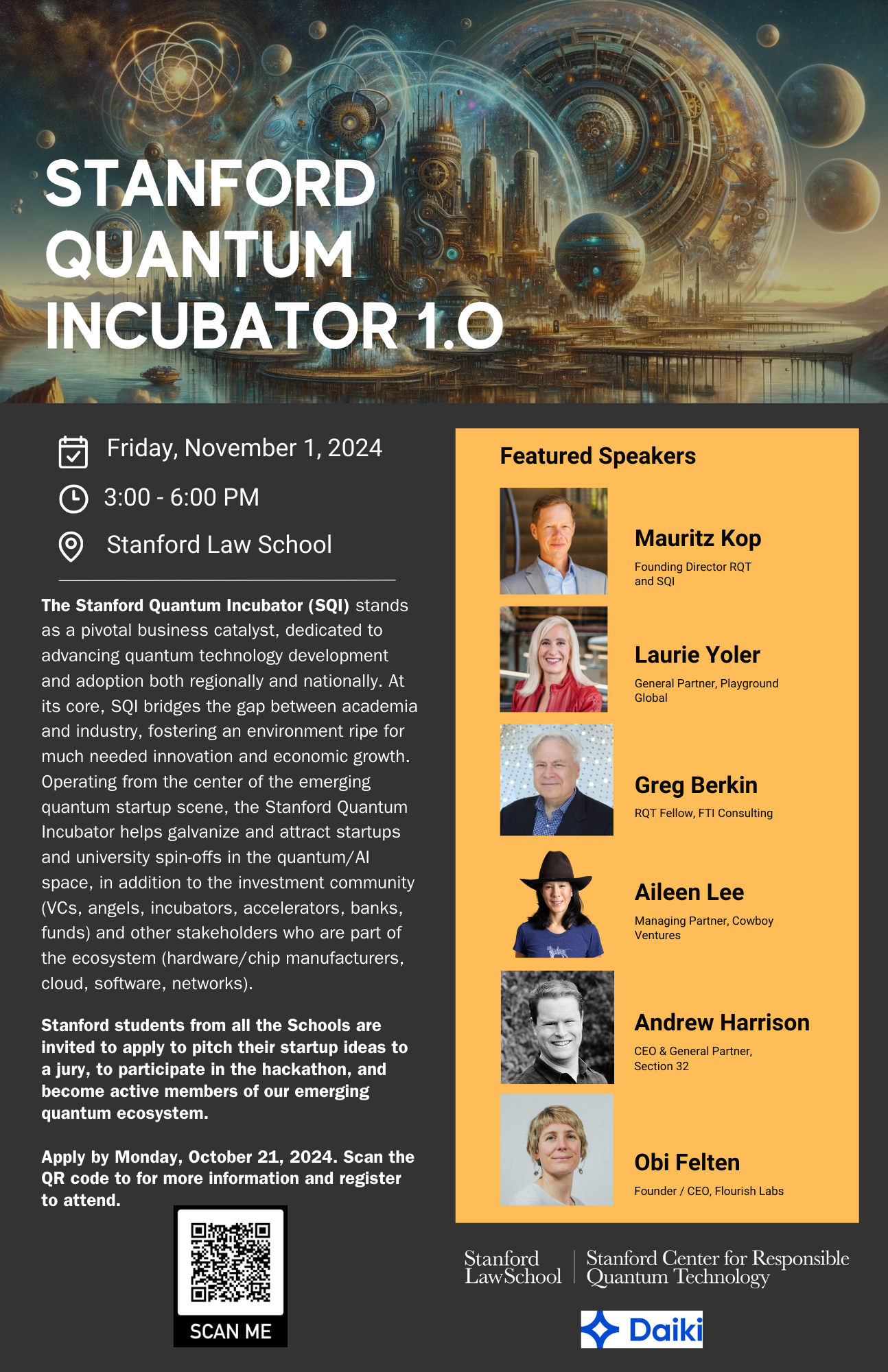
Stanford Quantum Incubator Workshop 1.0, November 1, 2024, at Stanford Law School

On November 1, 2024, the Stanford Quantum Incubator (SQI) convened its pilot workshop at Stanford Law School: a half-day of startup pitches, a hackathon, and venture-community networking, built to test whether a responsible quantum and AI startup ecosystem could be assembled deliberately from the ground up. Founded by Mauritz Kop and sponsored by the Stanford Center for Responsible Quantum Technology and the governance company Daiki, the incubator sits at an unusual address—inside a law school—where commercialization and responsible-innovation questions are treated as a single design problem.

An incubator inside a law school

Most technology incubators live in engineering quadrangles or business schools. SQI's decision to anchor itself in Stanford Law School signals a thesis about second-generation quantum technology: that its legal, ethical, social, and policy implications should be engaged before products ship, not litigated after. The center had already built that conviction into its research and convening program; the incubator carried it into entrepreneurship, framing responsible innovation as a competitive feature rather than a compliance cost.

Pitch, hackathon, and a values-laden ecosystem

Workshop 1.0 was participatory by design. Students from across Stanford—physics, computer science, medicine, business—were invited to apply by October 21, 2024, to pitch ventures to a jury of investment professionals, join a hackathon, and become members of the emerging ecosystem. Organized by SQI Fellows Greg Berkin and Bradley Horowitz, the workshop drew an investment-community jury that Kop thanked—Mark Lemley, David Hornik, Laurie Yoler, Obi Felten, Aileen Lee, Andrew Harrison, and Ching-Yu Hu among them—with speakers Alex Waldherr, Katie Liu, and Victor Wei addressing topics from novel quantum-computing chip architectures to responsible quantum technology in pharma and healthcare. The explicit goal was to build a local, values-laden ecosystem of quantum competency—competence and conscience grown together rather than sequenced.

Why early-stage governance matters for quantum

The incubator launched at a moment when second-generation quantum technologies—computing, cryptography, sensing, simulation, networking, and communication—were beginning to cross from the laboratory into markets spanning healthcare, finance, manufacturing, logistics, defense, and space. Because these technologies depend on engineered control over fragile quantum states that decohere easily, the questions of how to commercialize, secure, and govern them arrive at the same time as the first products. Convening founders, investors, and researchers at the earliest stage is one way to ensure those questions are asked while the answers can still shape the technology, a logic that also runs through the center's work on quantum and AI in healthcare and the life sciences.

A proof of concept

As an inaugural event, Workshop 1.0 functioned as a proof of concept for a deliberate, interdisciplinary model of quantum entrepreneurship—one that pairs commercial ambition in the emerging quantum market with values designed in rather than bolted on. The pilot offered an early template for SQI's stated aim of bridging Stanford's research strength and the venture ecosystem forming around it.

Meer lezen
Stanford Quantum Incubator Launched at Stanford Law School

Stanford, March 31, 2024—Today, we are thrilled to announce the launch of the Stanford Quantum Incubator (SQI)—a Silicon Valley business catalyst dedicated to advancing quantum technology development and adoption both regionally, nationally, and beyond. Situated at the prestigious Stanford Law School, the Stanford Quantum Incubator stands as a pivotal force, bridging the critical gap between academia and industry to foster an environment ripe for much-needed innovation and economic growth.

Stanford Quantum Incubator: Bridging Academia and Industry

Operating from the center of the emerging quantum startup scene, the Stanford Quantum Incubator will help galvanize and attract startups and university spin-offs in the quantum and AI space. It will also serve as a nexus for the broader investment community—including venture capitalists, angel investors, accelerators, banks, and funds—and other essential stakeholders, from hardware manufacturers to cloud and software providers.

The launch of SQI comes at a pivotal moment for the United States. In the wake of the 2022 Biden Executive Orders on Quantum, the CHIPS and Science Act, and the 2023 Executive Order on the Safe, Secure, and Trustworthy Development and Use of Artificial Intelligence, the imperative to cultivate a competitive and responsible quantum ecosystem has never been more pronounced. These government directives are accelerating investment in quantum information science (QIS) and catalyzing a host of new opportunities for public-private collaboration. It is essential that the quantum community capitalizes on this momentum.

We start the Stanford Quantum Incubator at a time when groundbreaking innovations in second-generation quantum technologies are making their way from the lab into the markets. These advancements span quantum computing, cryptography, sensing, simulation, and networking, with transformative applications in sectors such as Life Sciences and Healthcare, Finance, Cybersecurity, Manufacturing, Logistics, Automotive, Defense, and Space.

Inaugural Stanford SQI Fellows Bring a Wealth of Venture Capital Expertise

The success of this ambitious endeavor is anchored by the wisdom and experience of its leadership and advisors. The Stanford Quantum Incubator is honored to introduce its inaugural Fellows, a group of distinguished leaders from the worlds of venture capital, technology, and cybersecurity. The SQI team consists of Fellows Bradley Horowitz, David Hornik, Greg Berkin, and SQI Founding Director Mauritz Kop

A Catalyst for Responsible Quantum Innovation

Building on decades of combined entrepreneurial experience, SQI will develop a comprehensive suite of student/founder mentorship and support services designed to propel startups and scale-ups to success. Guidance will span sustainable business models, legal compliance, performance benchmarking, intellectual property portfolio optimization, and technology transfer. The incubator will directly address the multifaceted ethical, legal, societal, and policy challenges (Quantum-ELSPI) inherent in developing quantum hardware, software, and quantum-classical hybrids.

Central to SQI’s mission is a profound commitment to collaboration. Operating within a quadruple helix model that unites academics, industry professionals, policymakers, and end-users, SQI is positioned to become the epicenter of forward-looking, exponential quantum innovation. To this end, plans are underway to host a recurring networking workshop, in partnership with respected VC tech incubators, to both operationalize the Responsible Quantum Technology (RQT) framework and foster a globally leading, values-based quantum ecosystem.

SQI Networking Event at Stanford Law

The inaugural SQI Networking Event at Stanford Law School is set for November 1, 2024. This workshop aims to establish a local, values-based quantum network that aligns with the RQT framework, positioning the Bay Area at the heart of quantum advancement. The event promises to be an exclusive gathering, featuring presentations from luminaries in the field, startup pitches, and ample opportunities for networking. By encouraging investment and deal flow, this process will amplify responsible quantum technology development, with a clear goal of producing multiple quantum unicorns by 2030.

As we stand on the cusp of the Quantum Age, the Stanford Quantum Incubator invites the broader Silicon Valley innovation cluster to join in this pioneering, interdisciplinary endeavor. A quality-labeled ‘Quantum Made in US’ paradigm, infused with AI and quantum talent and a culture of boundless possibility, can help American companies become leaders in making scalable quantum applications that create real business value and benefit society. By facilitating university-market collaboration, SQI is poised to be an effective catalyst for leadership in the imminent quantum revolution.

For those eager to contribute to and participate in this exciting venture, we encourage you to reach out to Mauritz Kop, Founding Director of the Stanford Center for RQT, for more information. Together, we can unlock the boundless potential of quantum technology and AI, creating a future that benefits us all.

Meer lezen