
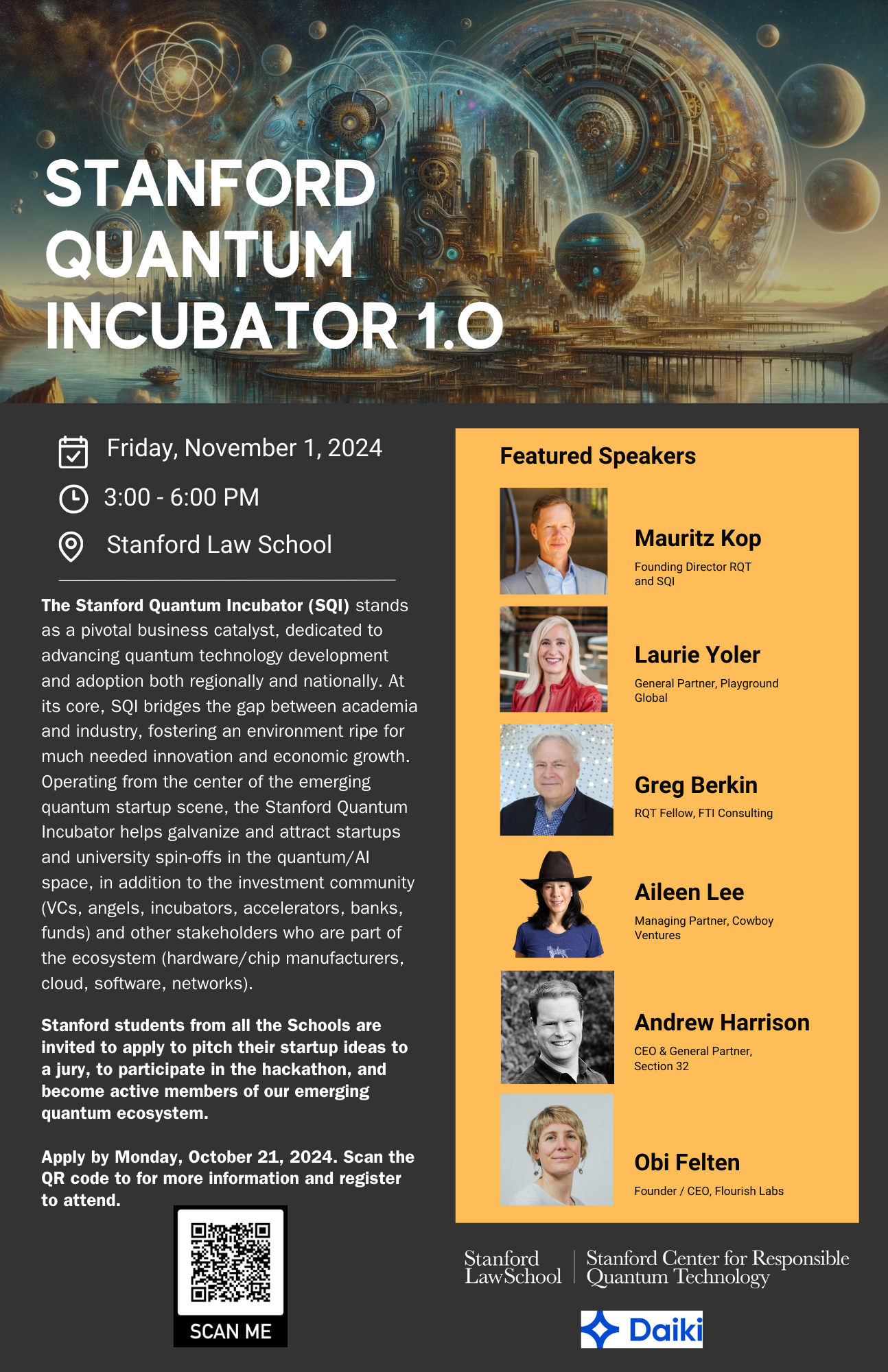
On November 1, 2024, the Stanford Quantum Incubator (SQI) convened its pilot workshop at Stanford Law School: a half-day of startup pitches, a hackathon, and venture-community networking, built to test whether a responsible quantum and AI startup ecosystem could be assembled deliberately from the ground up. Founded by Mauritz Kop and sponsored by the Stanford Center for Responsible Quantum Technology and the governance company Daiki, the incubator sits at an unusual address—inside a law school—where commercialization and responsible-innovation questions are treated as a single design problem.
An incubator inside a law school
Most technology incubators live in engineering quadrangles or business schools. SQI's decision to anchor itself in Stanford Law School signals a thesis about second-generation quantum technology: that its legal, ethical, social, and policy implications should be engaged before products ship, not litigated after. The center had already built that conviction into its research and convening program; the incubator carried it into entrepreneurship, framing responsible innovation as a competitive feature rather than a compliance cost.
Pitch, hackathon, and a values-laden ecosystem
Workshop 1.0 was participatory by design. Students from across Stanford—physics, computer science, medicine, business—were invited to apply by October 21, 2024, to pitch ventures to a jury of investment professionals, join a hackathon, and become members of the emerging ecosystem. Organized by SQI Fellows Greg Berkin and Bradley Horowitz, the workshop drew an investment-community jury that Kop thanked—Mark Lemley, David Hornik, Laurie Yoler, Obi Felten, Aileen Lee, Andrew Harrison, and Ching-Yu Hu among them—with speakers Alex Waldherr, Katie Liu, and Victor Wei addressing topics from novel quantum-computing chip architectures to responsible quantum technology in pharma and healthcare. The explicit goal was to build a local, values-laden ecosystem of quantum competency—competence and conscience grown together rather than sequenced.
Why early-stage governance matters for quantum
The incubator launched at a moment when second-generation quantum technologies—computing, cryptography, sensing, simulation, networking, and communication—were beginning to cross from the laboratory into markets spanning healthcare, finance, manufacturing, logistics, defense, and space. Because these technologies depend on engineered control over fragile quantum states that decohere easily, the questions of how to commercialize, secure, and govern them arrive at the same time as the first products. Convening founders, investors, and researchers at the earliest stage is one way to ensure those questions are asked while the answers can still shape the technology, a logic that also runs through the center's work on quantum and AI in healthcare and the life sciences.
A proof of concept
As an inaugural event, Workshop 1.0 functioned as a proof of concept for a deliberate, interdisciplinary model of quantum entrepreneurship—one that pairs commercial ambition in the emerging quantum market with values designed in rather than bolted on. The pilot offered an early template for SQI's stated aim of bridging Stanford's research strength and the venture ecosystem forming around it.
Meer lezen