
Mauritz Kop Delivers Keynote on Global Quantum Governance Frameworks at the World Quantum Summit in Washington DC
By Editor
Washington, DC, May 2, 2025—At the World Quantum Summit, held during DC Climate Week, Mauritz Kop, Founder of the Stanford Center for Responsible Quantum Technology, delivered a keynote address titled Global Quantum Governance Frameworks. Speaking in the year marking both the centennial of quantum mechanics and the International Year of Quantum Science and Technology, Kop set out a single leitmotif: that the world should work together to "Unlock Quantum for Societal Progress." The argument that followed moves from a diagnosis of today's fragmented compliance landscape to a concrete institutional proposal—an Atomic Agency for Quantum and AI—building directly on the case he and his colleagues have made for an Atomic Agency for Quantum-AI.

Global quantum governance frameworks — Mauritz Kop's keynote at the World Quantum Summit (illustrative editorial image).
Quantum's temperament demands tailored governance
Kop's opening premise is that quantum technology is not simply a faster computer. Its physics—superposition, entanglement, the no-cloning of unknown states—gives it what he called a "unique temperament and characteristics" that, in his framing, "demand tailored governance frameworks." Responsible Quantum Technology (RQT), the framework he founded at Stanford, is designed to ensure that research and innovation meet societal demands and enhance planetary welfare. The practical problem is that developers and vendors of quantum and hybrid systems must already comply with what Kop described as a "fragmented web of emerging regional and global requirements"—from technology-specific export-control rules to sector regulations in finance, healthcare, energy, and defense, layered with standards, certifications, and quality-management systems.
His response is twofold. First, the world should develop unified quantum interoperability standards to avoid a bipolar order and what he termed a "quantum splinternet." Second, governance should be organized around RQT principles and benchmarks, so that quantum applications adhere to legal and ethical standards for developers and users alike. The aim, he argued, is a powerful new generation of useful and safe quantum applications that benefit all groups of society at the planetary level.
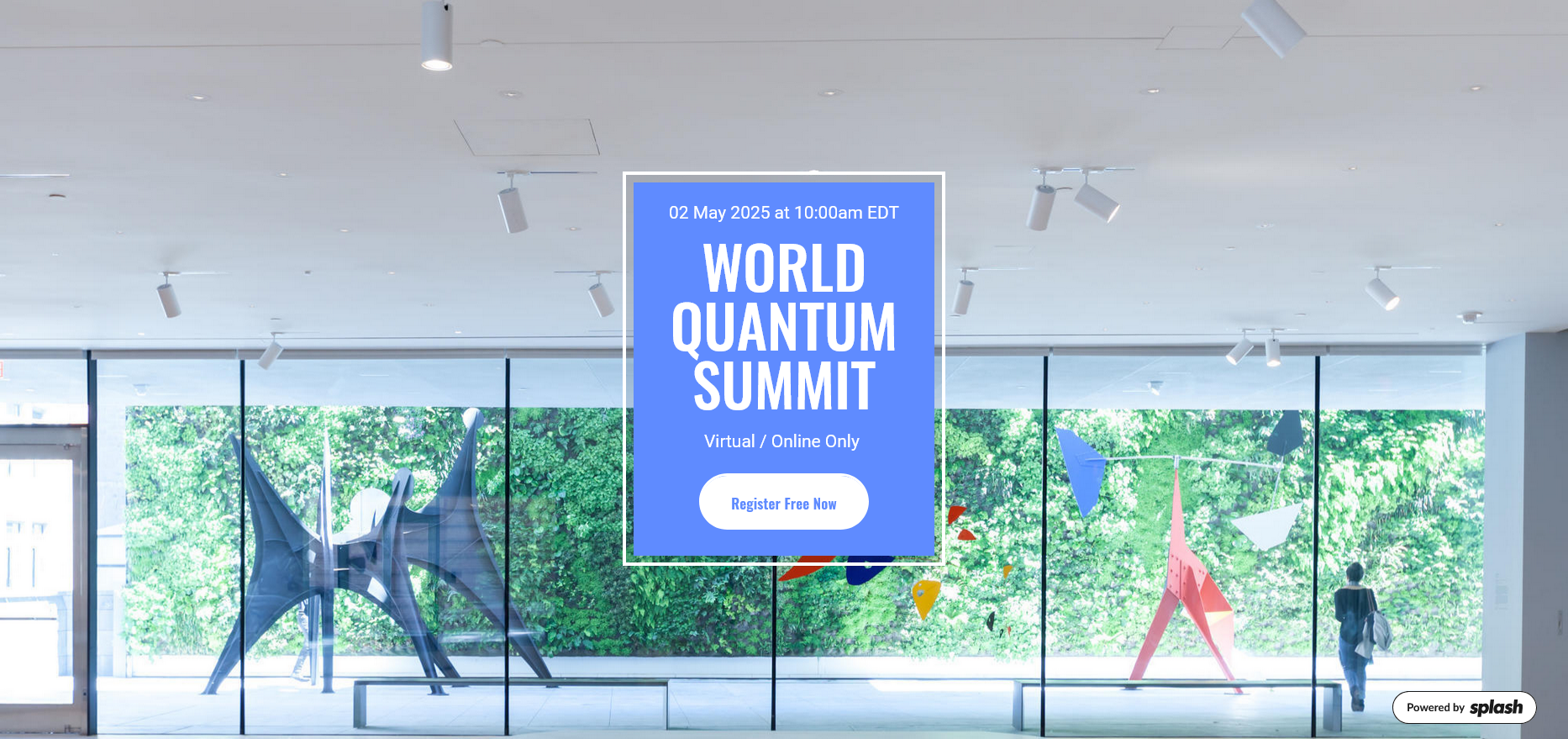
The World Quantum Summit, held May 2, 2025 during DC Climate Week.
Benefits and risks, mapped by quantum domain
To make governance work, Kop urged examining both the benefits and the risks of quantum technology across each domain—computation, cryptography and simulation, sensing and metrology, communication and networking, and materials and devices—and within each industrial sector. On the benefits side, he tied responsible quantum innovation to the United Nations Sustainable Development Goals, pointing to use cases such as quantum and AI for scientific research, drug discovery, and longer-range weather forecasting, and quantum simulation for improved battery chemistry, carbon capture, and sustainable materials.
The risk ledger is equally specific. The most debated quantum risk, Kop noted, is the prospect of quantum algorithms breaking current cryptographic protocols. Preparing cybersecurity infrastructures for "Q-day"—when a sufficiently capable machine running Shor's algorithm would break today's public-key cryptography such as RSA (symmetric schemes like AES are weakened but not broken, and can be mitigated with larger keys)—is therefore vital. He stressed quantum's dual-use character: simulation that could yield groundbreaking vaccines or catalysts might also be turned toward biological or chemical weapons, and miniaturized quantum sensors that serve environmental goals could be repurposed for surveillance and human-rights infringement. Fragmented technical standards along geopolitical lines, he warned, would compound these hazards, which is why rights-respecting governance frameworks are needed to keep quantum technologies from becoming vectors of techno-authoritarian diffusion.
Quantum-ELSPI and the principled approach
Like semiconductors, AI, nanotechnology, synthetic biology, and nuclear fission before it, quantum brings interrelated ethical, legal, socio-economic, and policy implications—what Kop has named Quantum-ELSPI. The governing question, he said, is one of technological justice: how to ensure that all of humankind can reap the benefits of these technologies equitably, with safe and responsible access. Quantum governance, in his definition, means guiding development and deployment in a way that is transparent, accountable, and aligned with societal values—setting ethical standards, minimizing harms, and keeping norms congruent with a liberal-democratic vision grounded in civil liberties, human rights, and the rule of law.
Kop framed the moment as the start of the next governance cycle. Drawing on the dimensions of Responsible Research and Innovation—anticipation, reflexivity, inclusion, and responsiveness—he argued that a technological revolution requires not only a culturally sensitive applied ethics but a recalibration of legal frameworks. Regulating quantum, in his words, is "a balancing act between underregulation and overregulation," abiding by norms such as proportionality and subsidiarity while still affording legal certainty. On the socio-economic side, he invoked post-Rawlsian theories of distributive justice, adapted for the quantum era, to argue that quantum's burdens and gains should be equitably distributed across society.
Ten principles, and letting innovation breathe
The keynote then turned to the operational layer: the Ten Principles for Responsible Quantum Innovation, organized into three functional categories—safeguarding, engaging, and advancing (the SEA structure)—published in IOP Quantum Science and Technology. The thesis Kop emphasized is that the way to safeguard society is by advancing quantum technology, taking a deliberately pro-innovation stance. "The key," he said, "is to let innovation breathe while creating guardrails." Complementing hard-law instruments such as high-risk market-entrance certification, he pointed to tools with high plasticity—legal sandboxes and self-regulatory impact-assessment instruments that monitor, validate, and audit quantum applications across their life cycle using robust RQT benchmarking and verification metrics. Policymakers, he argued, must create the right incentives so that companies adopt what he called an Apollonian attitude of harmony, progress, and logic rather than a Dionysian drive toward disorder and dominance.
Global cooperation over a quantum arms race
Kop devoted a substantial portion of the address to international cooperation, calling the trend toward isolating U.S. and Chinese fundamental-physics research "concerning." Achieving large-scale, fault-tolerant quantum computers, he argued, requires collective global expertise, and broad export controls can stifle the mineral and device supply chains on which the field depends. His prescription is an R&D posture of "as open as possible, as closed as necessary," particularly in fundamental research, standardization, and early next-generation development. To avoid a quantum divide and ensure equitable access for Majority World countries, he called for pluralistic innovation mechanisms combining antitrust enforcement, collaborative intellectual-property structures, and fair-trade conditions—the same standards-first logic he and colleagues set out in their standards-first future for quantum governance in Science. A winner-takes-all outcome, he insisted, must be avoided economically, politically, and ethically.
Toward an Atomic Agency for Quantum and AI
The keynote concluded with its most ambitious proposal. As quantum and AI converge, Kop argued, proactive universal governance is "not merely an ideal, but a pragmatic imperative." He sketched the vision of a globally harmonized "Quantum Acquis Planétaire"—a binding body of quantum law expressing common rights, principles, and obligations incorporated into all nations' legal systems. The institutional steps he proposed are concrete: a UN Quantum Treaty modeled on precedents such as the 2024 UN AI Resolution and the 1968 Nuclear Non-Proliferation Treaty, designed to align quantum advancement with the Sustainable Development Goals; and, to oversee compliance and manage non-proliferation risk, an "Atomic Agency for Quantum/AI" inspired by the International Atomic Energy Agency's safeguards model. Coupled with a CERN-style platform for international resource pooling—or a nuclear-fusion-megaproject equivalent for quantum—these measures would, in his account, steward quantum advancement for the shared benefit of humanity. It is, he said, "work that demands our urgent and collaborative focus starting today."
For an audience of policymakers, industry leaders, and civil-society actors, the takeaway was that the governance architecture for the quantum age must be designed now—before second-generation, agentic systems outpace the law—and that the design should be standards-first, rights-respecting, and global by construction. Readers can explore the underpinning framework in the Quantum-ELSPI pillar.
Last updated: June 7, 2026.