

Innovation, Quantum-AI Technology & Law

Blog over Kunstmatige Intelligentie, Quantum, Deep Learning, Blockchain en Big Data Law

Blog over juridische, sociale, ethische en policy aspecten van Kunstmatige Intelligentie, Quantum Computing, Sensing & Communication, Augmented Reality en Robotica, Big Data Wetgeving en Machine Learning Regelgeving. Kennisartikelen inzake de EU AI Act, de Data Governance Act, cloud computing, algoritmes, privacy, virtual reality, blockchain, robotlaw, smart contracts, informatierecht, ICT contracten, online platforms, apps en tools. Europese regels, auteursrecht, chipsrecht, databankrechten en juridische diensten AI recht.

Berichten met de tag Ten Principles
A Principled Approach to Quantum Technology: The Stanford RQT Framework and Its Ten Principles

Quantum hardware is advancing faster than the rules meant to govern it. In A Principled Approach to Quantum Technologies (posted as a preprint on SSRN), Mauritz Kop—Founder of the Stanford Center for Responsible Quantum Technology—surveys the 2024–2025 wave of breakthroughs from Google, IBM, D-Wave, Quantinuum, and Microsoft, and argues that the governance gap should be closed now, through the Stanford RQT framework and its Ten Principles for Responsible Quantum Innovation, rather than by waiting for comprehensive regulation.

Capability is outpacing governance

The paper reads the hardware moment carefully: Google's 105-qubit Willow crossing the below-threshold error-correction milestone; IBM's modular roadmap; D-Wave's 4,400-plus-qubit Advantage2 and its 2025 supremacy claim on a materials-simulation problem; Quantinuum and Microsoft's progress on logical qubits; and Microsoft's Majorana 1 topological chip, presented as a scientific advance still facing real scaling challenges. The trajectory—rising capability across computing, simulation, sensing, networking, and quantum/AI hybrids—is what makes governance urgent, because the field still lacks unified interoperability standards, certification, benchmarking, and quantum-ready quality-management systems.

Quantum-ELSPI and dual use

The governance frame is Quantum-ELSPI: the ethical, legal, socio-economic, and policy implications of quantum technology. Because second-generation quantum systems directly harness superposition, entanglement, and tunneling, their dual-use character is acute—quantum simulation can yield vaccines or weapons, sensors can serve the environment or surveillance—and a sufficiently capable machine could break today's encryption, making preparation for "Q-day" through post-quantum cryptography and NIST standards a present-tense task. The paper draws an explicit lesson from nuclear technology—society justifies medical and energy uses while doing little about the destructive extreme—an asymmetry quantum governance should not repeat. The deeper lessons come from a community Kop helped build, surveyed in the second annual Stanford Responsible Quantum Technology Conference.

The RQT framework and SEA

The constructive answer is Responsible Quantum Technology, operationalized through Ten Principles organized under safeguarding, engaging, and advancing (SEA) quantum technologies, society, and humankind—the aim being to safeguard society through advancing quantum technology, a responsible but pro-innovation stance. The framework also folds in the four dimensions of Responsible Research and Innovation—anticipation, reflexivity, inclusion, and responsiveness—and treats regulation as a balancing act, invoking the Collingridge dilemma to argue for anticipatory governance before the technology becomes locked in. Absent formal regulation beyond security and export controls, stakeholders are urged to adopt self-regulatory quantum-technology-assessment tools to monitor, validate, and audit applications across their life cycle—an approach the paper frames as both a public good and a first-mover advantage. Kop developed this institutional home as the center's founder, whose launch at Stanford set the agenda the paper now systematizes. Its governing maxim—quantum R&D kept "as open as possible, and as closed as necessary"—frames a deliberate path through the current regulatory vacuum.

Meer lezen
Mauritz Kop Delivers Keynote on Global Quantum Governance Frameworks at the World Quantum Summit in Washington DC

At the World Quantum Summit in Washington, DC, held during DC Climate Week on May 2, 2025, Mauritz Kop, Founder of the Stanford Center for Responsible Quantum Technology, delivered a keynote on Global Quantum Governance Frameworks. The address landed in a symbolic year—the centennial of quantum mechanics and the International Year of Quantum Science and Technology—and made a single, sustained argument: that quantum's distinctive physics demands tailored governance, and that the world should cooperate to unlock quantum for societal progress rather than fracture into rival blocs.

A fragmented compliance web—and a standards-first answer

Kop's diagnosis is that developers of quantum and hybrid systems already face a fragmented web of regional and global requirements, from export controls to sector-specific rules supported by standards, certifications, and quality-management systems. His remedy is unified quantum interoperability standards to avert a "quantum splinternet," paired with the Responsible Quantum Technology (RQT) framework and its benchmarks. This standards-first posture—building technical consensus before locking in less adaptable legislation—runs through his scholarship on responsible quantum innovation, including the Ten Principles for Responsible Quantum Innovation published in IOP Quantum Science and Technology.

Benefits, risks, and Quantum-ELSPI

The keynote mapped quantum's promise and peril by domain. On the benefit side, Kop aligned responsible quantum innovation with the UN Sustainable Development Goals—drug discovery, weather forecasting, battery chemistry, carbon capture. On the risk side, he flagged "Q-day," when current RSA and AES encryption fails, alongside dual-use ambiguity in quantum simulation and sensing. These interrelated ethical, legal, socio-economic, and policy implications form what he calls Quantum-ELSPI, the lens through which he argues quantum should be governed in line with civil liberties, human rights, and the rule of law.

An Atomic Agency for the quantum age

The address built toward an institutional proposal: a globally harmonized "Quantum Acquis Planétaire," a UN Quantum Treaty modeled on the 2024 UN AI Resolution and the 1968 Nuclear Non-Proliferation Treaty, and an "Atomic Agency for Quantum/AI" inspired by the IAEA's safeguards model, complemented by CERN-style international resource pooling. The keynote is distinct from Kop's role as a speaker for the International Year of Quantum Science and Technology 2025: that recognition concerns the year's designation, whereas this address sets out the specific governance architecture he believes the quantum age now requires. His central claim is that the architecture must be designed today—before second-generation, agentic quantum and AI systems outpace the law—and that it should be standards-first, rights-respecting, and global by construction, so that quantum technology serves a collective future of widespread, equitably distributed prosperity.

Meer lezen
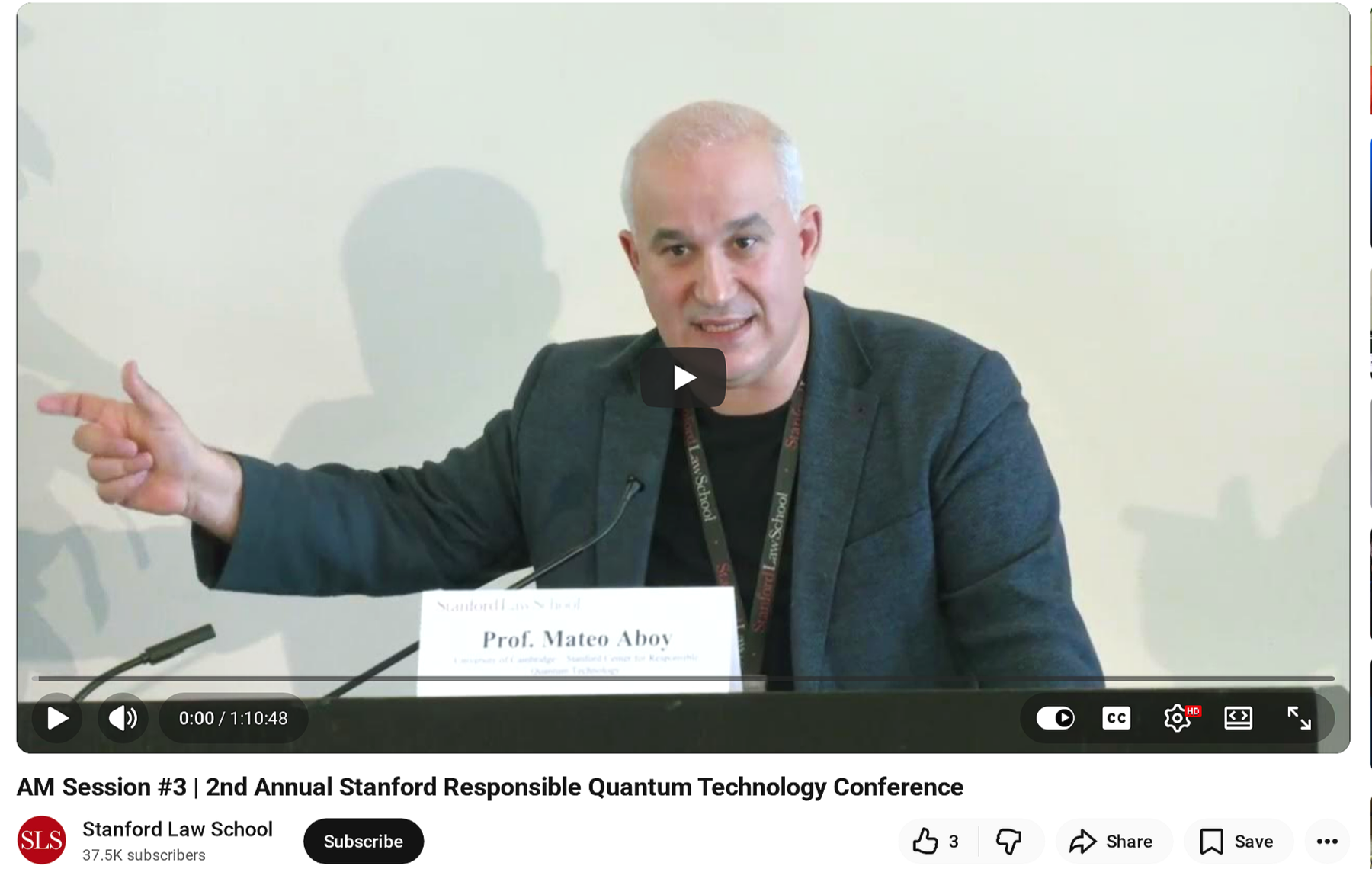
Stanford RQT 2.0: Inside the Second Stanford Responsible Quantum Technology Conference at Stanford Law School, Chaired by Mauritz Kop

The second annual Stanford Responsible Quantum Technology Conference, chaired by Mauritz Kop at Stanford Law School, took a question that an inaugural event had to argue into existence and treated it instead as settled—then spent the day pressure-testing how to answer it. This is the chair's record of how the conference came together and unfolded, from the welcome address to the concluding panel on quantum geopolitics. A separate write-up summarizes the conference's core themes; the account here follows the program itself.

An address that respects the mechanics

Kop opened by recording the institutional debts behind the day and by stating the project's governing discipline: conceptualizing responsible quantum technology “without breaking the laws of physics.” The year's theme, quantum simulation—studying one quantum system by building another that obeys the same rules—anchored the framing. Because an unknown quantum state can be neither copied nor measured without disturbance, the mechanics are not ornament around the legal argument; they are its premise, shaping every downstream question about verification, security, and trust. The Center's stance, he said, is deliberately and modestly techno-optimistic: pro-innovation, calibrated to keep policymakers from lagging the science.

A program built to be argued with

The day moved from responsible-innovation foundations—the Nature Physics call, the SEA framework of safeguarding, engaging, and advancing society, and the Ten Principles for Responsible Quantum Innovation—through materials science, an industry applications panel, a healthcare and life-sciences panel, and empirical studies of the quantum patent landscape. A governance session set out a phased, FDA-style proposal for quantum technology and invited its critics to stress-test it in real time. International perspectives followed, from a global capacity-building listening tour to supply-chain criticality, a Dutch innovation strategy, and a European Commission view. Disagreement was the design, not a defect: panelists openly contested whether quantum is genuinely novel for law, whether an agency model would help or merely slow new entrants, and whether standards should lead where statutes cannot keep pace.

What a second edition signals

That a conference reached its second edition is itself a datum about a maturing field. The institutional fabric—Stanford Law School, the moderating faculty, two University of Copenhagen and Novo Nordisk Foundation research programs, and an industry sponsor—shows responsible quantum technology as an institutional achievement rather than an individual one. The chair closed where he began, on “the cusp of the second quantum revolution,” and framed the combined work as a research agenda spanning a golden triangle of academia, industry, and policy. The encryption question supplied the day's one near-consensus risk: a capable quantum computer would break widely deployed RSA, Diffie-Hellman, and elliptic-curve public-key systems, making the migration to quantum-safe methods a present task. For the field's intellectual lineage, see the underlying Nature Physics call for responsible quantum technology.

Meer lezen