Innovation, Quantum-AI Technology & Law

Blog over Kunstmatige Intelligentie, Quantum, Deep Learning, Blockchain en Big Data Law

Blog over juridische, sociale, ethische en policy aspecten van Kunstmatige Intelligentie, Quantum Computing, Sensing & Communication, Augmented Reality en Robotica, Big Data Wetgeving en Machine Learning Regelgeving. Kennisartikelen inzake de EU AI Act, de Data Governance Act, cloud computing, algoritmes, privacy, virtual reality, blockchain, robotlaw, smart contracts, informatierecht, ICT contracten, online platforms, apps en tools. Europese regels, auteursrecht, chipsrecht, databankrechten en juridische diensten AI recht.

Berichten met de tag National Security
Call for Applications: CIGI Quantum Nexus Emerging Scholars Program for Canadian Strategic Advantage

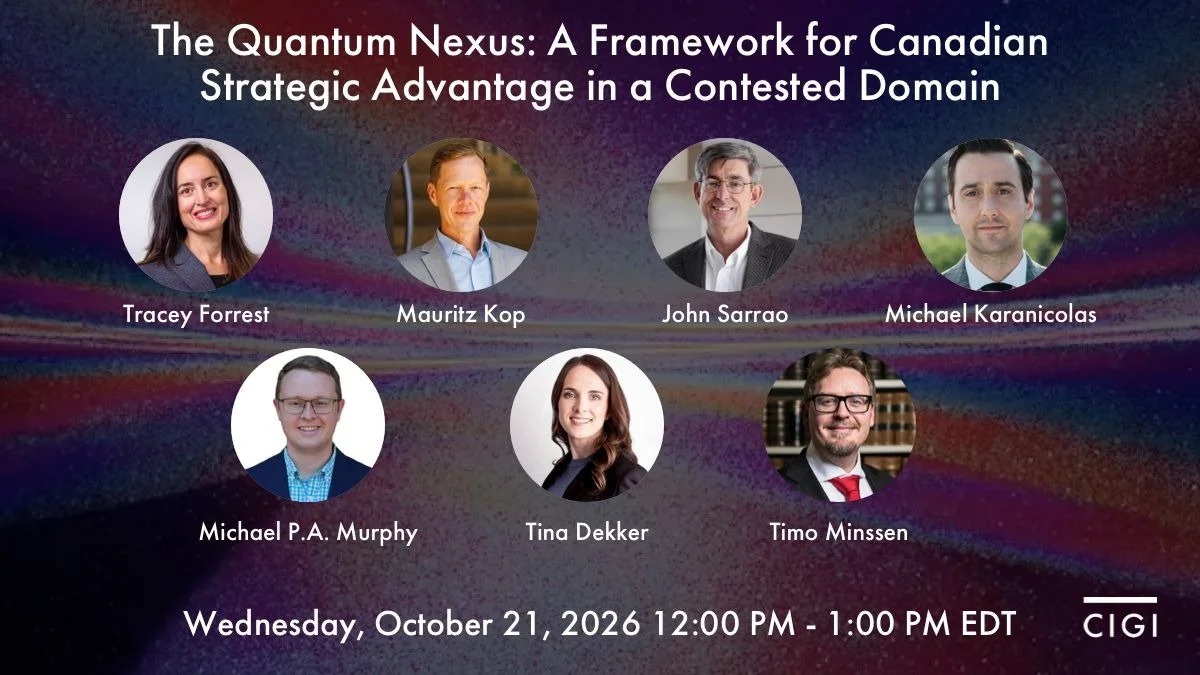
The Centre for International Governance Innovation (CIGI) is accepting applications for a competitive emerging scholars program attached to The Quantum Nexus: A Framework for Canadian Strategic Advantage in a Contested Domain, a research project supported by the Department of National Defence's MINDS program and led by CIGI Senior Fellow Mauritz Kop. The deadline is July 15, 2026.

A mentorship cohort with a mission

Four to six emerging scholars from across Canada—undergraduates through post-docs, from any discipline—join a virtual program from September to December 2026. The format is deliberately personal: a one-on-one mentorship session with the Principal Investigator, an online international expert workshop in October, and a group masterclass on emerging-technology governance and publication development in November. No prior quantum expertise is required, and applications from equity-deserving groups are strongly encouraged; the program is built on the conviction that good governance of emerging technologies needs many kinds of minds. It is the same conviction that brought a Canadian quantum governance delegation to Stanford to prepare Canada's G7 presidency.

From analytical note to CIGI report

This is a publication program, not a lecture series. Every participant develops a 1,200–1,500-word analytical note on an assigned subtopic within one of six themes—spanning intellectual property and export controls, post-quantum cryptography migration, critical materials and supply chains, quantum-AI convergence, standards and allied interoperability, and the application of the LSI test (least trade-restrictive, security-sufficient, innovation-preserving) to a real case. The notes are contributed to the project's final CIGI report as a dedicated Emerging Scholars annex—a substantive contribution at the start of a research career.

Dates and deadlines

Applying takes one PDF: a 300–500-word expression of interest naming the theme you want to work on, a CV, and one reference letter, sent to programs@cigionline.org (subject line: Emerging Scholars Application: DND MINDS Project). Applications close July 15, 2026; acceptances follow in mid-August; the program runs September through December. For emerging scholars who want to help shape how the quantum age is governed, this is the opening.

Meer lezen
NATO StratCom Features Mauritz Kop as Subject Matter Expert in Workshop Video on Quantum and Cognitive Sovereignty

The NATO Strategic Communications Centre of Excellence engaged Mauritz Kop as a subject-matter expert for its Riga workshop The Integrity of Reality and Cognitive Sovereignty—via a thirty-minute video interview recorded as study material for participants and as input to the Centre's threatcasting work.

A video briefing for Riga

Held in early June 2026, in the week of the Centre's flagship Riga StratCom Dialogue, the workshop examined what happens to shared truth when both conflict and communication are increasingly automated. Kop's recorded interview adds the layer the strategic-communications field is only beginning to map: the quantum layer. His opening line does the analytical work of a whole briefing—the past is not yet stable. The argument extends the case he made when the Hoover Institution invited him to speak on quantum, democracy, and authoritarianism.

Three quantum pressures on the mind's privacy

The interview names three converging pressures on cognitive sovereignty: civic-scale quantum sensing that, in principle, could resolve subsurface and interior spaces from public rights-of-way—what Kop calls the X-Ray City scenario; quantum-enhanced biosensing and brain-computer interfaces that open the inference of mental states; and the temporal instability of the cryptographic record under harvest-now, decrypt-later collection. For the first two, Kop argues for capability protection—prohibition-grade guardrails at the infrastructure layer, not consent forms after deployment.

Why communicators should care about cryptography

An adversary who can retroactively forge or contest the signed record does not need to fabricate convincingly—only to seed doubt at scale. The interview's prescription is precision over speed: the LSI test for every proposed control, standards-first governance, and verifiable allied migration to post-quantum cryptography as the strategic-communications measure rarely recognized as one.

Meer lezen
CNAS Interviews Mauritz Kop for The Entanglement Edge Quantum Networking Report

The Center for a New American Security has published The Entanglement Edge: U.S. Strategic Priorities in Quantum Networking—and Mauritz Kop briefed the CNAS research team on quantum networking and cybersecurity in November 2025, as part of the expert interviews behind it.

The entanglement edge, soberly measured

The report by Constanza M. Vidal Bustamante and Morgan Peirce declines the hype on both sides. Quantum key distribution is a niche complement, not a replacement, for post-quantum cryptography; China's 10,000-kilometer QKD network is real infrastructure but not next-generation readiness; and America's task is to fund what compounds—interconnects, benchmarks, supply chains, PQC migration—while declining to subsidize theater.

Where Kop's briefing landed

Kop gave the researchers an administrable rule: "PQC by default"—QKD only where incremental assurance can be proven over cost and complexity, quantum random-number generators widely for stronger entropy. His briefing pressed the shift from guidance to verifiable outcomes: a federal transition lead with a public dashboard, procurement requiring validated FIPS 203/204/205 modules, crypto-agility drills, and allied "one test, many markets" certification so the coalition's cryptographic baseline cannot fracture into a quantum splinternet. It is the operational sequel to the positions he brought to the U.S. Department of State on quantum technology and foreign policy.

What planners should take away

The harvest-now, decrypt-later campaigns are already running; the contest that decides their outcome is over verification—whose security architecture can be tested, certified, and trusted across an alliance. Reports built on dozens of expert interviews, rather than vendor decks, are how that architecture gets designed before the deadline arrives.

Meer lezen
Stanford and Los Alamos Researchers Publish Critical Quantum Minerals Dashboard

Quantum computers are usually discussed in the vocabulary of physics—qubits, coherence, error correction. A new Stanford–Los Alamos preprint argues that the decisive vocabulary of the next decade may instead be geological: niobium, nickel, indium, tantalum, helium-3. Min-Ha Lee, Alan J. Hurd, Jolante Wieke van Wijk, and Mauritz Kop map the critical minerals and materials that every serious quantum platform silently depends on, and show how concentrated mining, refining, and qualification chokepoints can convert commercial dependence into strategic vulnerability.

Why a dashboard, and why now

The Stanford–Los Alamos team's central proposal is a Quantum Criticality and Critical Minerals (QCCM) dashboard: a continuously updated, allied decision-support instrument—grounded in the preprint's two-level criticality screening—that tracks concentration, substitutability, qualification bottlenecks, stockpiling gaps, and geopolitical stress signals across quantum computing, sensing, and networking. The argument is institutional rather than technical—static national critical-minerals lists, however valuable, refresh on bureaucratic timelines, while administrative export-control actions move markets in weeks. When China added bismuth to its dual-use control list in February 2025, the spot price rose roughly tenfold within two months. An instrument that registers such signals continuously is the difference between awareness and resilience.

Two use cases, one lesson

The authors develop the argument through two concrete cases. The first is niobium, the backbone of superconducting qubits: roughly ninety percent of world production comes from Brazil, the United States imports all of it, and Chinese state-linked groups have spent a decade quietly acquiring the assets. The second is the space-qualified single-photon detector, where radiation and thermal stress can degrade a quantum communications link into insecurity long before the hardware visibly fails. The lesson is the same in both: criticality lives at every layer of the stack—ore, refining, isotopes, components, qualification—and a strategy that only counts qubits will miss it. The same blind spot extends to national stockpiles, which exclude by statute the gases and isotopes—helium-3 above all—on which dilution refrigeration and quantum sensing actually run.

Materials policy as quantum statecraft

What elevates this preprint beyond supply-chain analysis is its placement of materials within the architecture of quantum statecraft: supply assurance and post-quantum cryptography migration as twin pillars of security, standards-aligned governance as the multiplier, and allied coordination as the operating system. It is a natural companion to the geostrategic analysis in the Oxford lecture on quantum threats, extending that argument from algorithms and adversaries down to the periodic table. For governments drafting quantum strategies, for industry qualifying components, and for scholars of economic security, the message is direct: the quantum age will be built from materials the democratic world does not currently control—and managing that fact deserves an instrument of its own.

Meer lezen
Quantum Nexus LSI Test Published by Vanderbilt JET Law

Most technology law arrives too late: the architecture ships, the market consolidates, and legislators are left regulating what already exists. A new essay in Vanderbilt's Journal of Entertainment & Technology Law argues that quantum technology presents the opposite—and far rarer—situation, and explains what the law should do with it. Quantum law is being written before quantum technology has fully arrived, and that timing is not a defect to apologize for but an opportunity to seize.

A test with three prongs

At the center of the essay stands the LSI test, a doctrinal instrument for dual-use governance that asks of every state intervention whether it is the least trade-restrictive, security-sufficient, and innovation-preserving measure available. The shift in emphasis is subtle but consequential: the question is no longer whether a government possesses a restrictive tool—export control, outbound investment screening, patent secrecy—but whether it is deploying the narrowest one that actually works. Between the romantics of total openness and the reflexes of total restriction, the test stakes out a defensible middle ground the essay calls security-sufficient openness.

Patents and export controls, one system

The essay's second contribution is diagnostic. Intellectual property and national security are conventionally treated as separate fields with separate experts and separate statutes. In quantum practice they behave as one entangled legal control plane: a single patent disclosure can simultaneously raise eligibility questions under Alice, research-security questions under the export-control regime, and commercialization questions under Bayh-Dole and the federal acquisition rules. Reading them together is not an academic nicety—it is the only way to see where over-securitization would quietly strangle the startups, standards participation, and allied interoperability on which democratic quantum leadership depends, a dynamic explored across the MINDS quantum strategy research at CIGI.

From a six-paragraph essay to a coalition playbook

Behind the essay stands the full Quantum Nexus Article—a book-length treatment on arXiv that develops the LSI test into an implementable coalition playbook: empirically anchored criteria, differentiated guardrails with red-zone domains where denial is the default, and secure closed-loop enclaves for high-sensitivity collaborative research. The stakes are framed without euphemism: U.S. assessments now call for a Quantum First posture by 2030, China's program advances under military-civil fusion, and the choice before democratic legislators is whether the coming wall of quantum regulation will be disciplined by doctrine or improvised under pressure. For lawyers, the essay is a preview of their next decade; for policymakers, it is a usable standard; and for the quantum community, it is an argument that the rules now being written deserve the same precision as the systems they will govern.

Meer lezen
EPJ Quantum Technology Publishes Quantum Criticality Index Study by Cho, Kop and Lee

EPJ Quantum Technology has published a peer-reviewed framework by Dongyoun Cho, Mauritz Kop, and Min-Ha Lee that gives policymakers something the quantum field has lacked: a Quantum Criticality Index designed to flag supply-chain chokepoints before they harden into strategic crises.

A tri-axial index for fragile supply chains

Quantum hardware depends on inputs most governments have never inventoried—helium-3, isotopically enriched silicon-28, thin-film lithium niobate, superconducting niobium, dilution refrigerators from a handful of specialist suppliers. The QCI scores each input on supply risk, substitutability, and strategic significance, then adds an artificial neural network foresight layer that detects trend shifts and stress-tests scenarios: demand surges, export restrictions, regional shocks. Static critical-minerals lists update too slowly for a technology that scales architecture by architecture; the QCI is built to move at the field's own pace.

The molybdenum case

Preliminary QCI results flagged molybdenum's concentration risk publicly in May 2024; in February 2025, China placed the metal under export licensing, with global price effects the paper documents. The index had flagged the chokepoint before the shock—one episode that neatly illustrates the argument for criticality-based foresight. The same anticipatory logic drives the geostrategic work Kop contributes to the Eric Schmidt-backed von Neumann Commission on quantum-AI geostrategy.

Hardware shield, software shield

The framework's strategic claim is that supply-chain assurance and post-quantum cryptography migration are twin pillars of quantum security: PQC protects the data, the QCI protects the physical capability to build the machines. Diagnosis feeds decision feeds delivery—allied procurement, targeted licensing, calibrated stockpiling, verifiable assurance. Quantum statecraft, the paper argues, begins with knowing your own dependencies better than your rivals know them.

Meer lezen
Mauritz Kop Principal Investigator of MINDS Quantum Strategy Grant at CIGI

Waterloo, February 18, 2026—The Centre for International Governance Innovation (CIGI) has awarded Mauritz Kop a new leadership role as Principal Investigator (incoming) of a MINDS Targeted Engagement Grant on Quantum Strategy. The grant advances a central proposition of his recent work: quantum technologies are no longer best understood as a narrow scientific frontier or a conventional innovation file. They have become a strategic domain in which law, industrial policy, intellectual property, defense planning, and geopolitical competition now converge.

That convergence matters because quantum capability is being built in an era of systemic rivalry, supply-chain vulnerability, and technological coercion. In that environment, democratic states cannot afford to treat quantum merely as a research ecosystem problem. They must govern it as part of a broader strategy for safeguarding the democratic industrial commons: the shared base of talent, infrastructure, know-how, trusted supply chains, standards, and institutions on which long-run security, prosperity, and coalition advantage depend.

What MINDS in Defence and Security Is and Why This Grant Fits

The MINDS program—Mobilizing Insights in Defence and Security—is a Canadian Department of National Defence initiative designed to strengthen evidence-based defense policy thinking and foster the next generation of defense and security experts. Its Targeted Engagement Grants provide non-recurring support for projects such as workshops, roundtables, research, and publications, and they are assessed primarily against the annual Defence Policy Challenges.

The current 2025-2026 MINDS challenge set is especially well aligned with the subject matter of this grant. The official challenge framework emphasizes several critical priorities: securing Canada’s sovereignty and continental defense posture; attracting advanced-technology talent across the defense sector; and strengthening the defense industrial base through resilient supply chains and dual-use technologies such as quantum and artificial intelligence. Furthermore, the framework addresses the pressures of strategic competition—including adversarial exploitation of vulnerabilities—and the accelerating adoption of pan-domain, emerging technologies where interoperability, trust, and responsible governance must be preserved.

Strategic Leadership and Human Capital

Kop’s fellowship at CIGI has centered on the governance of transformative technologies, especially quantum technology, AI, dual-use export controls, national security, and intellectual property. The new grant builds directly on that portfolio, but with a more operational mandate. As incoming Principal Investigator, his role will be to provide the project’s strategic and intellectual leadership: conceptualizing the workshop, defining the central themes and policy questions, structuring the panels for direct relevance to Canadian defense audiences, chairing the main event, moderating key expert sessions, identifying high-level contributors, and guiding the project’s analytical outputs.

The Quantum Nexus Paper Behind the Grant

The grant builds on Kop’s recent paper, The Nexus of Quantum Technology, Intellectual Property, and National Security: An LSI Test for Securing the Quantum Industrial Commons, now available on arXiv.

In that paper, he argues that quantum technologies have moved from laboratory structures to the geopolitical stage, and that democratic states therefore need a governance model that is neither naively open nor reflexively protectionist. The paper's contribution is an implementable coalition playbook, offering empirically anchored criteria, templates, and differentiated guardrails - including red zone domains where denial is the default - to avoid both over-securitization and under-securitization. Properly applied, LSI reduces the risk of a self-defeating hard decoupling from China while establishing standards-first interoperability as a stabilizing eigenstate of the international order and enabling RQT by design to shape trusted adoption pathways beyond the coalition, including in the majority world.

Meer lezen

An LSI Test for Securing the Quantum Industrial Commons

Mauritz Kop—Founder of the Stanford Center for Responsible Quantum Technology and a CIGI Senior Fellow—has posted as a preprint a book-length Article that reframes quantum strategy as a problem of disciplined openness. The Nexus of Quantum Technology, Intellectual Property, and National Security argues that democracies should pursue neither closure nor laissez-faire, but "security-sufficient openness," screened through a single administrable test. It is a strategic companion to the cryptographic argument set out in "A Bletchley Park for the Quantum Age."

Deterrence by denial for democratic resilience

The Article's organizing idea is responsible quantum technology reframed as values-based deterrence by denial: a legal, ethical, and institutional control plane that protects the shared "quantum industrial commons"—talent, tooling, standards, supply chains, and the research base—against authoritarian appropriation. Deterrence by denial aims to make hostile gains too slow or costly to be worthwhile, rather than relying on the threat of retaliation, and the Article presents it as the least escalatory way to preserve crisis stability. It situates the analysis against an approaching strategic "event horizon," citing the U.S.-China Economic and Security Review Commission's call for a "Quantum First by 2030" posture and parallel White House initiatives to secure critical inputs.

The LSI test

The central contribution is the LSI test, which asks whether any given control is least-trade-restrictive, security-sufficient, and innovation-preserving. The test is built to avoid two failure modes: over-securitization, which chills publication, standards leadership, and venture formation, and under-securitization, which leaks crown-jewel capabilities that are slow to reacquire. LSI is applied across a "pillarized" quantum stack—computing, sensing, simulation, networking, communication, quantum-AI hybrids, and enabling materials—and to its upstream dependencies in patent and trade-secret doctrine, government-funded IP and data rights, export controls, investment screening, and cryptographic baselines including post-quantum cryptography and crypto-agility. The framing borrows from physics with care: because the relevant systems are genuinely probabilistic, the Article uses the "Eight Worlds" scenario method to keep governance robust across divergent futures.

A coalition playbook against a "Silicon Curtain"

Rather than stop at theory, the Article assembles an implementable coalition playbook—administrable criteria, templates, and differentiated guardrails, including red-zone domains where denial is the default—and integrates instruments of economic statecraft such as a strategic critical-minerals reserve and a Quantum Criticality Index. Its closing warning is that mishandled securitization could raise a self-defeating "Silicon Curtain" between allied innovators; the constructive alternative is standards-first interoperability treated as a stabilizing feature of the international order. The work has been posted as a preprint on arXiv and is announced on AIRecht in the Nexus paper announcement.

Meer lezen
The Nexus of Quantum Technology, Intellectual Property, and National Security

Some moments in technology policy demand a text that turns scattered anxieties into administrable law. For the collision of quantum technology, intellectual property, and national security, Mauritz Kop's book-length Article on arXiv makes that move: The Nexus of Quantum Technology, Intellectual Property, and National Security: An LSI Test for Securing the Quantum Industrial Commons—a work that reads today's probabilistic security environment like a wavefunction of plausible futures, and asks which policy choices will collapse it into an outcome democracies can live with.

The claim: security-sufficient openness

The Article's central claim is that the United States and its allies should pursue security-sufficient openness, operationalized through an LSI test: every intervention—an export control, an outbound-investment screen, a patent-secrecy order—must be the least trade-restrictive, security-sufficient, innovation-preserving measure available, whether the actor is a state or a private firm. Between total openness, which hands strategic capabilities to rivals mobilized under military-civil fusion, and total restriction, which strangles the science, the test stakes out the only ground that is defensible in both senses of the word.

Red zones, enclaves, and economic statecraft

What makes the work more than a framework essay is its machinery. The Article delivers an implementable coalition playbook: empirically anchored criteria, templates, and differentiated guardrails—including red-zone domains where denial is the default—plus secure closed-loop enclaves where allied researchers can pursue high-sensitivity R&D without choosing between secrecy and collaboration. The instruments of economic statecraft that democracies have increasingly been deploying are integrated here into a single disciplined doctrine, with the U.S. assessments calling for a Quantum First posture by 2030 supplying the deadline.

What is at stake

The Article names the twin failure modes precisely. Over-securitize, and democracies erect a self-defeating Silicon Curtain—suppressing publication, standards participation, and startup formation until the alliance walls itself off from its own innovation. Under-securitize, and strategically meaningful capabilities in computing, sensing, and cryptanalysis diffuse to adversaries faster than open societies can respond. Threading that needle is the geostrategic design problem of the decade—the same problem Kop works on as an expert at the Eric Schmidt-backed von Neumann Commission on quantum-AI geostrategy. Properly applied, the LSI test secures the quantum industrial commons without suffocating the scientific commons beneath it—and extends trusted adoption pathways to the majority world. This post walks through the Article's argument, its playbook, and what both mean for the lawyers and legislators who will write the quantum statutes of the late 2020s.

Meer lezen
CIGI Publishes Global Quantum Policy Brief by Mauritz Kop and Tracey Forrest

Waterloo, 5 February 2026—The Centre for International Governance Innovation (CIGI) has published a new policy brief, Global Quantum Governance: From Principles to Practice, authored by Mauritz Kop and Tracey Forrest. The brief is written for policy makers, regulators, standards bodies, and industry actors facing a practical transition: quantum technologies are moving from laboratory milestones toward deployment pathways where governance choices—especially around cybersecurity and cross-border infrastructure—become difficult to reverse.

Download the Policy Brief here: https://www.cigionline.org/documents/3746/PB_No.222_Kop_and_Forrest.pdf

Why this brief on quantum governance, and why now

The brief’s central timing claim is that near-term milestones—particularly post-quantum cryptography (PQC) migration and quantum networking—create a governance tipping point. After that point, certain security and societal harms may be costly (or impossible) to remediate. In the brief’s framing, PQC migration is not merely an engineering update; it is a “temporal rights and resilience” imperative because present-day decisions about crypto-agility, key life-cycle management, and data minimization determine whether sensitive data remains protected against future adversaries.

This urgency is paired with a structural diagnosis: national initiatives—including the EU’s proposed Quantum Act—are important, but insufficient on their own given quantum’s dual-use characteristics, global supply chains, and asymmetric capabilities across states and firms. The authors argue for a governance architecture that is “standards-first” and internationally coordinated, capable of sustaining what they call “security-sufficient openness,” and overseen by an International Quantum Agency.

The brief’s recommendations in practical terms

The brief concludes with a multi-pronged path “from principles to practice,” emphasizing four implementable priorities:

  1. Strengthen foundations through standards and PQC execution: align cryptographic profiles across sectors; update procurement so crypto-agility, key life-cycle management, and “harvest now, decrypt later” mitigation become baseline requirements; and adopt “cryptographic resilience” via agile standards, testing, and incident playbooks.

  2. Harmonize among allies: coordinate export controls, investment screening, and supply-chain security via mechanisms such as a proposed G7 Quantum Technology Point of Contact Group and narrowly scoped license-exception approaches in Five Eyes/AUKUS-style arrangements, while avoiding poorly designed measures that impose high compliance costs and chill benign collaboration.

  3. Incentivize global collaboration and capacity building: federate national quantum clouds, SDG-oriented demonstrators, and regional test networks under common governance rules; and consider, longer-term, a “CERN for Quantum” that provides shared access anchored in transparency and equitable access, including for Global South partners.

  4. Institutionalize foresight and bounded algorithmic regulation: resource international foresight capacities—within an IQA-type body or linked observatories—to update risk scenarios and stress-test legal frameworks, while experimenting with limited, well-governed AI-assisted monitoring and red-teaming to inform accountable human decision makers.

Takeaway for AIRecht’s readership

For legal and policy practitioners, the brief’s message is that quantum governance is entering a phase where operational artifacts—standards, benchmarks, procurement baselines, and interoperability profiles—will increasingly determine real-world rights, liabilities, and security outcomes. PQC migration and quantum networking are treated as the near-term proving ground for whether democracies can coordinate “security-sufficient openness” at scale.

For innovators and investors, the brief underscores that governance is not a brake on quantum progress but a design constraint that—if addressed early—can preserve global interoperability, reduce fragmentation, and support responsible diffusion of quantum capability without deepening geopolitical divides.

Meer lezen
War on the Rocks Publishes "A Bletchley Park for the Quantum Age"

Washington DC, Nov. 6, 2025—War on the Rocks has published a major new commentary by Stanford RQT’s Mauritz Kop, titled “A Bletchley Park for the Quantum Age.” The article translates his broader research on quantum governance into a concrete, operational blueprint for post-quantum cryptography (PQC) migration across the United States and its allies.

Appearing in a venue read closely by practitioners in defence, intelligence, and foreign policy, the piece draws a deliberate conceptual line from the World War II codebreaking effort at Bletchley Park to today’s challenge of securing democratic communications. It argues that Bletchley Park was more than a geographic location; it was a method—an integrated system of science, engineering, operations, and alliance management. Kop contends that a similar methodology is required now to protect national security systems against cryptanalytically relevant quantum computers.

The Enigma Machine utilized a complex series of electromechanical rotors to produce a polyalphabetic substitution cipher, creating an encryption standard that was widely deemed unbreakable by contemporary adversaries. Defeating this system required the Allies to operationalize abstract mathematics into industrial capability, a feat that fundamentally altered the trajectory of the war.

The article situates PQC migration not as a narrow information technology upgrade, but as a core tenet of United States and allied quantum-AI grand strategy. It highlights how flagship programmes such as the United States Department of Defense’s Replicator initiative must be made “quantum-ready” to avoid becoming silently obsolete once large-scale quantum computers arrive.

Professor Kop extends his gratitude to War on the Rocks editor Lieutenant Colonel Walter ‘Rick’ Landgraf, PhD, whose precise editorial work helped sharpen the argument and tailor it to the publication’s strategic readership.

The Core Argument: A Bletchley Method for Post-Quantum Cryptography Migration

The essay begins from a straightforward technical premise. Once fault-tolerant quantum computers exist, Shor’s algorithm will efficiently factor large integers and compute discrete logarithms, thereby breaking the public-key cryptosystems—such as RSA and elliptic-curve cryptography—on which secure communication currently relies. In parallel, Grover’s algorithm will provide a quadratic speed-up in brute-force search, effectively halving the security margin of many symmetric-key schemes.

In this setting, the world’s cryptographic infrastructure cannot simply be patched at the margins. It requires a comprehensive, carefully managed transition to new, quantum-resistant algorithms.

Kop proposes that the United States and its allies apply a “Bletchley method” to this problem by tightly linking:

  1. Domestic execution of PQC migration, and

  2. An allied, standards-based certification compact that prevents fragmentation.

Defensively, this means post-quantum cryptography by default and certified interoperability across critical systems. Politically, it means that Washington earns the right to lead abroad by delivering verifiable results at home.

The framework is organised around two distinct but mutually reinforcing tracks:

  • Track One – “Ultra at Home”: rigorous domestic execution, and

  • Track Two – “Allied Codebook Abroad”: international architecture designed to avoid a “quantum splinternet.”

Meer lezen
Mauritz Kop Teaches Quantum Governance at the United States Air Force Academy

Mauritz Kop, Founder of the Stanford Center for Responsible Quantum Technology, returned to the United States Air Force Academy—where he serves as guest professor—to teach cadets a class titled Responsible Quantum Technology: Establishing a Legal-Ethical Framework. The session began with the physics and moved to the geostrategic, legal, and ethical architecture the field will need as it matures, addressing two questions the cadets had prepared: why govern quantum before it is mature, and what framework best balances innovation against risk.

From the mechanics to the law

The lecture grounded its policy argument in the physics of the second quantum revolution. Where classical systems encode definite bits, quantum systems exploit superposition, entanglement, and tunneling to unlock new categories of capability across computing, sensing, simulation, and networking—from drug discovery and novel materials to jam-resistant navigation and physically grounded secure communications. The same properties that make the technology powerful, Kop argued, strain a legal order built on certainty, locality, and linear causality, which is why quantum governance calls for a tailored, sui generis approach rather than a retrofit of existing rules. The themes extend the line of work Kop set out in Establishing a Legal-Ethical Framework for Quantum Technology.

Why govern before maturity

On the cadets' first question, Kop drew on the Collingridge dilemma—control is easiest early, when knowledge is limited but options remain open—and on his metaphor of a quantum event horizon, a threshold beyond which technological lock-in makes the path far harder to redirect. Acting while the technology is still malleable, he argued, is not a brake on innovation but a precondition for steering it toward democratic values, public trust, and the legal certainty that long-horizon research and investment depend on.

A two-pillar framework

To the second question, Kop offered an integrated two-pillar response: agile, risk-based regulation that tiers obligations by an application's risk, paired with a strategic industrial and security policy that builds national capacity—funding across the lab-to-market pipeline, supply-chain resilience for critical minerals and components, talent development, and shared research infrastructure. This is the operational form of the Responsible Quantum Technology framework, organized under the SEA principles of safeguarding, engaging, and advancing the technology, and aimed at steering innovation rather than slowing it.

Dual-use and deterrence

For future Air Force and Space Force officers, the dual-use character of quantum technology was the connecting thread. The most acute near-term concern is the cryptographic threat—"Q-Day" and "Harvest Now, Decrypt Later"—which makes the migration to post-quantum cryptography a present-tense security task. Set against great-power competition, Kop's prescription is deliberate stewardship: embedding democratic values into standards early, protecting research from state-sponsored theft, and cooperating with allies, themes he has also brought to venues including the Hoover Institution. The class closed on the conviction that technology's trajectory is a matter of choice, and that engaging its technical, strategic, legal, and ethical dimensions is a core professional responsibility for the officers who will shape these systems.

Meer lezen