Innovation, Quantum-AI Technology & Law

Blog over Kunstmatige Intelligentie, Quantum, Deep Learning, Blockchain en Big Data Law

Blog over juridische, sociale, ethische en policy aspecten van Kunstmatige Intelligentie, Quantum Computing, Sensing & Communication, Augmented Reality en Robotica, Big Data Wetgeving en Machine Learning Regelgeving. Kennisartikelen inzake de EU AI Act, de Data Governance Act, cloud computing, algoritmes, privacy, virtual reality, blockchain, robotlaw, smart contracts, informatierecht, ICT contracten, online platforms, apps en tools. Europese regels, auteursrecht, chipsrecht, databankrechten en juridische diensten AI recht.

Berichten met de tag Cybersecurity
CNAS Interviews Mauritz Kop for The Entanglement Edge Quantum Networking Report

The Center for a New American Security has published The Entanglement Edge: U.S. Strategic Priorities in Quantum Networking—and Mauritz Kop briefed the CNAS research team on quantum networking and cybersecurity in November 2025, as part of the expert interviews behind it.

The entanglement edge, soberly measured

The report by Constanza M. Vidal Bustamante and Morgan Peirce declines the hype on both sides. Quantum key distribution is a niche complement, not a replacement, for post-quantum cryptography; China's 10,000-kilometer QKD network is real infrastructure but not next-generation readiness; and America's task is to fund what compounds—interconnects, benchmarks, supply chains, PQC migration—while declining to subsidize theater.

Where Kop's briefing landed

Kop gave the researchers an administrable rule: "PQC by default"—QKD only where incremental assurance can be proven over cost and complexity, quantum random-number generators widely for stronger entropy. His briefing pressed the shift from guidance to verifiable outcomes: a federal transition lead with a public dashboard, procurement requiring validated FIPS 203/204/205 modules, crypto-agility drills, and allied "one test, many markets" certification so the coalition's cryptographic baseline cannot fracture into a quantum splinternet. It is the operational sequel to the positions he brought to the U.S. Department of State on quantum technology and foreign policy.

What planners should take away

The harvest-now, decrypt-later campaigns are already running; the contest that decides their outcome is over verification—whose security architecture can be tested, certified, and trusted across an alliance. Reports built on dozens of expert interviews, rather than vendor decks, are how that architecture gets designed before the deadline arrives.

Meer lezen
Stanford and Los Alamos Researchers Publish Critical Quantum Minerals Dashboard

Quantum computers are usually discussed in the vocabulary of physics—qubits, coherence, error correction. A new Stanford–Los Alamos preprint argues that the decisive vocabulary of the next decade may instead be geological: niobium, nickel, indium, tantalum, helium-3. Min-Ha Lee, Alan J. Hurd, Jolante Wieke van Wijk, and Mauritz Kop map the critical minerals and materials that every serious quantum platform silently depends on, and show how concentrated mining, refining, and qualification chokepoints can convert commercial dependence into strategic vulnerability.

Why a dashboard, and why now

The Stanford–Los Alamos team's central proposal is a Quantum Criticality and Critical Minerals (QCCM) dashboard: a continuously updated, allied decision-support instrument—grounded in the preprint's two-level criticality screening—that tracks concentration, substitutability, qualification bottlenecks, stockpiling gaps, and geopolitical stress signals across quantum computing, sensing, and networking. The argument is institutional rather than technical—static national critical-minerals lists, however valuable, refresh on bureaucratic timelines, while administrative export-control actions move markets in weeks. When China added bismuth to its dual-use control list in February 2025, the spot price rose roughly tenfold within two months. An instrument that registers such signals continuously is the difference between awareness and resilience.

Two use cases, one lesson

The authors develop the argument through two concrete cases. The first is niobium, the backbone of superconducting qubits: roughly ninety percent of world production comes from Brazil, the United States imports all of it, and Chinese state-linked groups have spent a decade quietly acquiring the assets. The second is the space-qualified single-photon detector, where radiation and thermal stress can degrade a quantum communications link into insecurity long before the hardware visibly fails. The lesson is the same in both: criticality lives at every layer of the stack—ore, refining, isotopes, components, qualification—and a strategy that only counts qubits will miss it. The same blind spot extends to national stockpiles, which exclude by statute the gases and isotopes—helium-3 above all—on which dilution refrigeration and quantum sensing actually run.

Materials policy as quantum statecraft

What elevates this preprint beyond supply-chain analysis is its placement of materials within the architecture of quantum statecraft: supply assurance and post-quantum cryptography migration as twin pillars of security, standards-aligned governance as the multiplier, and allied coordination as the operating system. It is a natural companion to the geostrategic analysis in the Oxford lecture on quantum threats, extending that argument from algorithms and adversaries down to the periodic table. For governments drafting quantum strategies, for industry qualifying components, and for scholars of economic security, the message is direct: the quantum age will be built from materials the democratic world does not currently control—and managing that fact deserves an instrument of its own.

Meer lezen
War on the Rocks Publishes "A Bletchley Park for the Quantum Age"

Washington DC, Nov. 6, 2025—War on the Rocks has published a major new commentary by Stanford RQT’s Mauritz Kop, titled “A Bletchley Park for the Quantum Age.” The article translates his broader research on quantum governance into a concrete, operational blueprint for post-quantum cryptography (PQC) migration across the United States and its allies.

Appearing in a venue read closely by practitioners in defence, intelligence, and foreign policy, the piece draws a deliberate conceptual line from the World War II codebreaking effort at Bletchley Park to today’s challenge of securing democratic communications. It argues that Bletchley Park was more than a geographic location; it was a method—an integrated system of science, engineering, operations, and alliance management. Kop contends that a similar methodology is required now to protect national security systems against cryptanalytically relevant quantum computers.

The Enigma Machine utilized a complex series of electromechanical rotors to produce a polyalphabetic substitution cipher, creating an encryption standard that was widely deemed unbreakable by contemporary adversaries. Defeating this system required the Allies to operationalize abstract mathematics into industrial capability, a feat that fundamentally altered the trajectory of the war.

The article situates PQC migration not as a narrow information technology upgrade, but as a core tenet of United States and allied quantum-AI grand strategy. It highlights how flagship programmes such as the United States Department of Defense’s Replicator initiative must be made “quantum-ready” to avoid becoming silently obsolete once large-scale quantum computers arrive.

Professor Kop extends his gratitude to War on the Rocks editor Lieutenant Colonel Walter ‘Rick’ Landgraf, PhD, whose precise editorial work helped sharpen the argument and tailor it to the publication’s strategic readership.

The Core Argument: A Bletchley Method for Post-Quantum Cryptography Migration

The essay begins from a straightforward technical premise. Once fault-tolerant quantum computers exist, Shor’s algorithm will efficiently factor large integers and compute discrete logarithms, thereby breaking the public-key cryptosystems—such as RSA and elliptic-curve cryptography—on which secure communication currently relies. In parallel, Grover’s algorithm will provide a quadratic speed-up in brute-force search, effectively halving the security margin of many symmetric-key schemes.

In this setting, the world’s cryptographic infrastructure cannot simply be patched at the margins. It requires a comprehensive, carefully managed transition to new, quantum-resistant algorithms.

Kop proposes that the United States and its allies apply a “Bletchley method” to this problem by tightly linking:

  1. Domestic execution of PQC migration, and

  2. An allied, standards-based certification compact that prevents fragmentation.

Defensively, this means post-quantum cryptography by default and certified interoperability across critical systems. Politically, it means that Washington earns the right to lead abroad by delivering verifiable results at home.

The framework is organised around two distinct but mutually reinforcing tracks:

  • Track One – “Ultra at Home”: rigorous domestic execution, and

  • Track Two – “Allied Codebook Abroad”: international architecture designed to avoid a “quantum splinternet.”

Meer lezen
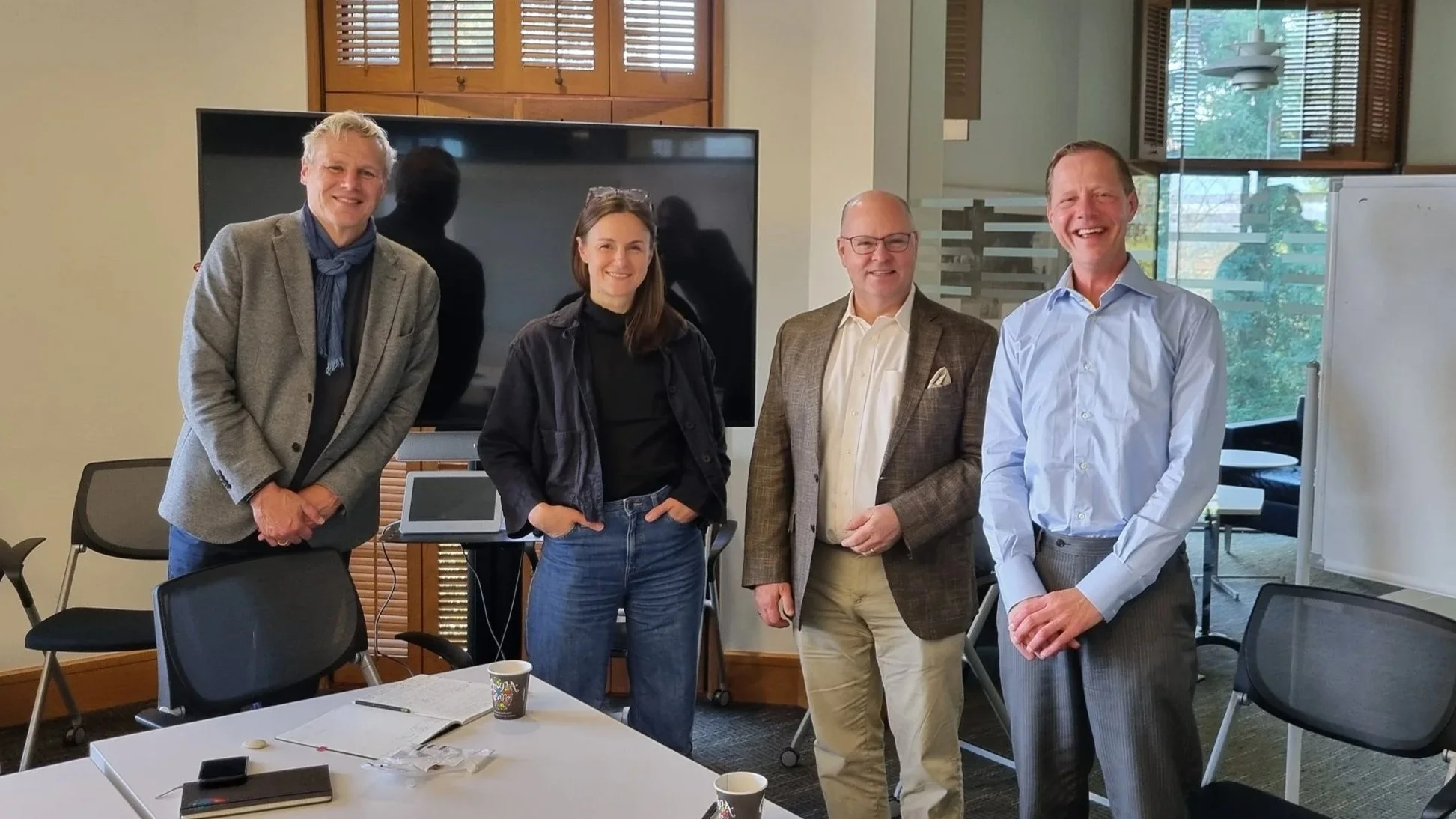
Mauritz Kop and Mark Lemley Host High-Level EU Cybersecurity Delegation at Stanford Law

Stanford, CA – On February 26, 2024, the Stanford Center for Responsible Quantum Technology (RQT), a leading interdisciplinary hub operating under the aegis of the Stanford Program in Law, Science & Technology, had the distinct honor of hosting a high-level cybersecurity delegation from the European Commission. The meeting, led by the Center’s Founding Director, Mauritz Kop, and Professor Mark A. Lemley, Director of the Stanford Program in Law, Science & Technology, underscored the growing importance of transatlantic dialogue in shaping the future of digital security and responsible innovation in the quantum age.

The Stanford Center for RQT is dedicated to steering the development and application of quantum technologies toward outcomes that are not only innovative but also equitable, transparent, and beneficial for society at large. Its mission is to proactively address the complex ethical, legal, societal, policy and interoperability implications of quantum advancements, fostering a global ecosystem grounded in democratic values and human rights. The Center was officially inaugurated on December 6, 2023, by His Excellency Mark Rutte, then Prime Minister of the Netherlands and the current Secretary General of NATO, a testament to the geopolitical significance of its work. This recent meeting with the EU delegation builds on that foundation, reinforcing the Center’s role as a crucial bridge between Silicon Valley’s technological frontier and the world’s leading policymakers.

The dialogue centered on some of the most pressing challenges and opportunities at the intersection of quantum technology and cybersecurity, including building global capacity for responsible innovation and aligning EU and US national security strategies.

The EU Cybersecurity Delegation at Stanford RQT

The European Commission’s Cybersecurity Delegation was led by Gerard de Graaf, the Senior Envoy for Digital to the U.S. and Head of the European Union Office in San Francisco. A veteran of the European Commission with a distinguished career spanning several key digital policy areas, Mr. de Graaf is at the forefront of the EU’s efforts to promote a human-centric, ethical, and secure digital transition. His role involves strengthening transatlantic cooperation on digital regulation, from data governance and AI to cybersecurity and platform accountability. Mr. de Graaf, who was also present at the Center’s inauguration, has been a pivotal figure in shaping the EU’s landmark digital policies, including the General Data Protection Regulation (GDPR) and the Digital Services Act (DSA). His leadership in the San Francisco office is instrumental in fostering dialogue between European regulators and the heart of the global tech industry.

Accompanying Mr. de Graaf were Joanna Smolinska, Deputy Head of the EU Office in San Francisco and a key figure in transatlantic tech diplomacy, and Ilse Rooze, a Seconded National Expert at the EU Office who brings deep expertise in digital policy and international relations.

Representing Stanford were Mauritz Kop and Professor Mark A. Lemley. Mr. Kop is a pioneering scholar in the governance of emerging technologies, with a focus on quantum, AI, and intellectual property. As the Founding Director of the RQT Center, his work is dedicated to creating robust legal and ethical frameworks to ensure that transformative technologies are developed and deployed responsibly. Professor Lemley is the William H. Neukom Professor of Law at Stanford Law School and one of the world's most cited scholars in intellectual property and technology law. His extensive work on innovation, competition, and the digital economy provides a critical legal and economic lens through which to view the challenges of the quantum era.

The Quantum Cybersecurity Challenge: Preparing for Q-Day

A central theme of the discussion was the looming threat that fault-tolerant quantum computers pose to global cybersecurity. The immense processing power of these future machines will render much of the world’s current cryptographic infrastructure obsolete. This critical juncture, often referred to as “Q-Day” or the “Quantum Apocalypse,” is the moment when a quantum computer will be capable of breaking widely used encryption standards like RSA and ECC, which protect everything from financial transactions and government communications to personal data and critical infrastructure.

The implications of Q-Day are profound. Malicious actors could potentially decrypt vast archives of stolen encrypted data—a scenario known as "harvest now, decrypt later." This retroactive decryption capability poses a severe threat to long-term data security, national security, and economic stability.

In his opening remarks, Mauritz Kop emphasized the urgency of a proactive, coordinated global response. The conversation explored the transition to Post-Quantum Cryptography (PQC), a new generation of cryptographic algorithms designed to be resistant to attacks from both classical and quantum computers. The U.S. National Institute of Standards and Technology (NIST) is in the final stages of standardizing a suite of PQC algorithms, a process closely watched by governments and industries worldwide. The delegation discussed the immense logistical, technical, and financial challenges of migrating global IT systems to these new technical standards—a process that is expected to take more than a decade and require unprecedented public-private collaboration.

The discussion also touched upon other quantum security technologies, such as Quantum Key Distribution (QKD), which uses the principles of quantum mechanics to create secure communication channels. While PQC focuses on developing new mathematical problems that are hard for quantum computers to solve, QKD offers a physics-based approach to security. The participants explored how these different technologies could complement each other in a future-proof security architecture.

Meer lezen