
From Kananaskis to Évian: Will the G7 Govern Quantum, or Keep Describing It?
AIRecht Editor
When G7 leaders gather in Évian-les-Bains from June 15 to 17, 2026, quantum technology is once again on the leaders' agenda, for a second consecutive year. That continuity alone marks a shift: for most of the past decade, quantum policy lived quietly in science ministries and research councils, far from any summit. In a new CIGI op-ed, From Kananaskis to Évian, Stanford and CIGI legal scholar Mauritz Kop argues that the conceptual groundwork for responsible quantum governance is essentially done — and that what remains is the harder, less glamorous work of implementation.
Published by the Centre for International Governance Innovation (CIGI), the piece poses a direct question to the leaders meeting in France: does the G7 intend to govern quantum technology, or to keep describing it? Its answer is a practical agenda — five decisions that would move the summit from shared values to working machinery. The argument extends a line of work Kop and his colleagues have developed for years, including the CIGI policy brief on global quantum governance he authored with Tracey Forrest.
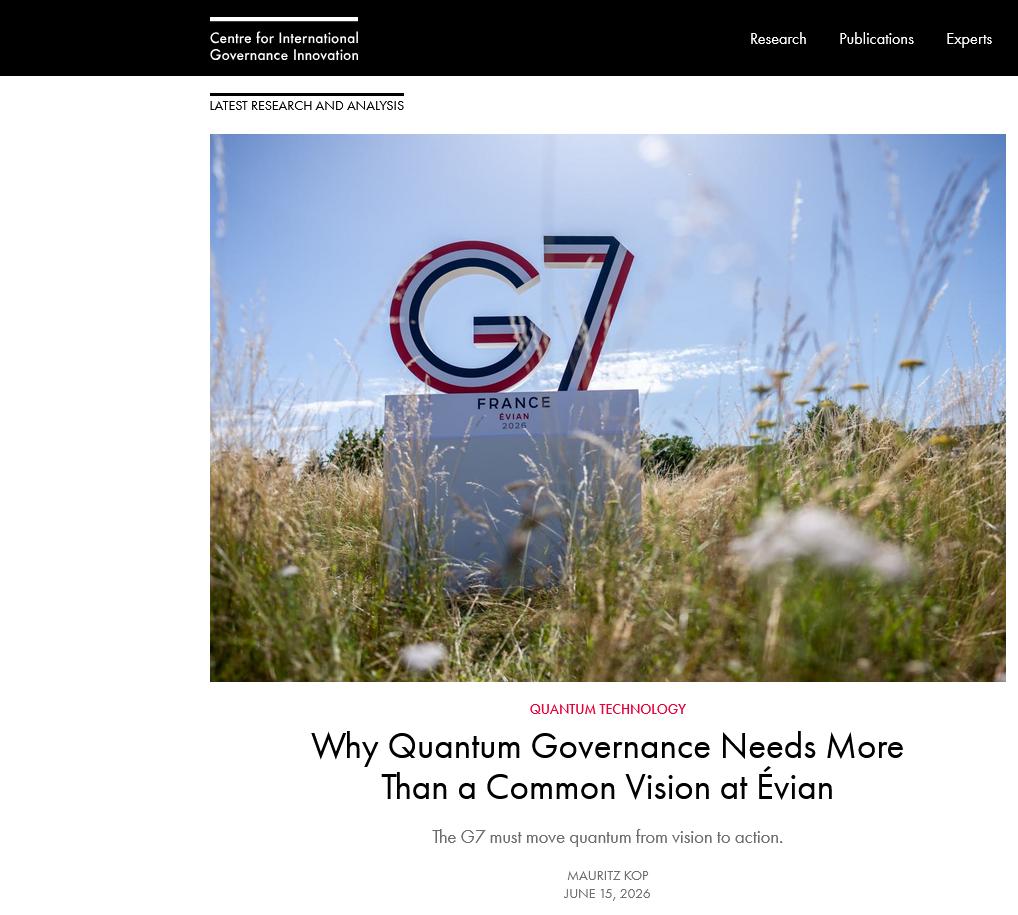
Kop's op-ed on the CIGI website, June 15, 2026.
From Kananaskis to Évian: The Groundwork Is Done
At Kananaskis in June 2025, the G7 adopted the Common Vision for the Future of Quantum Technologies, formally placing quantum on the leaders' agenda and naming the right concerns — secure supply chains, research integrity, trusted ecosystems and the timely adoption of quantum-resilient security. Kop credits Kananaskis as an important step, but observes that its machinery was light: it created a joint working group and announced voluntary research calls, yet it set no timelines, no benchmarks, no procurement commitments and no mechanism for holding members to implementation.
The declaratory layer has since filled in. On May 28, 2026, the Council of the OECD adopted its Recommendation on Quantum Technologies — what the OECD describes as the first intergovernmental standard for the responsible development and use of these systems, built around democratic values, secure technology access, collaboration and accountability. The principles are sound — and, Kop notes, increasingly familiar. They reflect a broader convergence around responsible quantum innovation, including the Ten Principles for Responsible Quantum Innovation developed at Stanford and the legal-ethical framework for quantum technology Kop proposed at Yale in 2021.
National assessments point the same way. As the op-ed notes, a multidisciplinary expert panel of the Council of Canadian Academies, chaired by the late Raymond Laflamme, spent two years examining the responsible adoption of quantum technologies and, in Kop's reading, reached conclusions G7 governments can act on today. Between the Kananaskis vision, the OECD Recommendation and a growing shelf of national strategies, the G7 does not lack agreed language. As Kop puts it, a further statement of shared values at Évian would cost little and change less. What remains is implementation — and implementation is precisely what voluntary coordination delivers slowly, unevenly, or never. The United Kingdom reached a similar point in 2024, when the Regulatory Horizons Council took Kop's advice on regulating quantum technology applications.
Quantum Is Leaving the Laboratory
The stakes have widened because quantum technology is no longer only a competitiveness or national-security question. It is becoming part of the infrastructure for planetary-scale challenges — secure communications, climate and energy systems, health, agriculture, financial stability and supply-chain resilience. Much of that capability remains prospective: the fault-tolerant machines that might transform drug design or climate modeling do not yet exist. For Kop that is the strongest argument for building the governance architecture now, while the field is still fluid enough to shape, rather than after the defaults have hardened.
The institutions responsible for financial stability already treat the shift as systemic. The Banque de France and the Bank of Canada co-chair the G7 central banks' Quantum Technologies Working Group, which published its first reference report in May 2026 on the implications of quantum computing for the financial system. When central banks begin mapping quantum risk, the subject has left the laboratory — and, on Kop's reading, a policy response that waits for fault-tolerant hardware risks arriving a decade late.
Five Decisions for Évian
Kop's central contribution is to translate the convergence into a short list of decisions leaders can actually take in France. Each one converts a shared value into a benchmark, a deadline or a procurement rule.
1. Post-Quantum Cryptography Migration Milestones
The first decision concerns post-quantum cryptography. Because a sufficiently powerful quantum computer running Shor's algorithm could break the public-key cryptography that protects today's communications, encrypted data harvested and stored now can be decrypted later — the "harvest-now, decrypt-later" threat that makes migration a present-tense problem with an unknown deadline. The engineering case is hardening, too: in the op-ed, Kop points to Caltech-led work on reconfigurable neutral-atom architectures, which he reads as indicating that some cryptographically relevant attacks may become possible with orders of magnitude fewer qubits than earlier assumptions implied, while Google has set 2029 as the target for completing its own cryptographic migration. When a leading vendor gives itself three years, governments that have given themselves ten should take notice. Kop urges leaders to converge on shared migration milestones for critical infrastructure, require cryptographic inventories and crypto-agility in public procurement, and report progress annually against dates rather than intentions.
2. Trusted and Resilient Quantum Supply Chains
The second decision is trusted and resilient supply chains. Quantum capability rests on fragile upstream inputs — cryogenics, photonics, specialized lasers, isotopically enriched materials and precision fabrication tools. Kananaskis acknowledged the dependency; the follow-through requires a joint chokepoint assessment, coordinated diversification and trusted-partner sourcing, and agreement on the narrow set of inputs that warrants stronger controls. Resilience also runs through people: with China converting scale in science and industrial policy into quantum capability, the G7's answer lies in pooled training pipelines, secure research exchanges and talent pathways that treat allied mobility as a strategic asset.
3. Standards-Based Governance
The third decision is standards-based governance. Standards bodies are where the technical defaults of the quantum era — interoperability, certification, benchmarking and assurance — will be set. If G7 members engage these venues separately, they will inherit defaults written by dominant vendors, less aligned coalitions, or whoever shows up first. A common position on quantum standards, backed by procurement, would do more for trusted ecosystems than any communiqué — a point Kop and colleagues developed at length in their standards-first approach to quantum governance in Science.
4. Dual-Use Coordination and the LSI Test
The fourth decision is dual-use coordination. Export controls on quantum technologies are increasingly adopted member by member, with diverging thresholds and licensing practices that risk fragmenting allied markets without necessarily slowing determined adversaries. What is needed, Kop argues, is a shared analytical discipline: the least trade-restrictive, security-sufficient and innovation-preserving (LSI) test, developed in his work on securing the quantum industrial commons. The test asks whether a control is the narrowest measure that still meets the security objective, so that policy protects the quantum industrial commons without strangling it.
5. Vigilance on Market Power
The fifth decision concerns market power. Early quantum advantage is concentrating in a small number of firms and states that control compute access, patent portfolios and scarce talent. Left unattended, Kop warns, the transition risks reproducing the concentration dynamics of the cloud and artificial-intelligence economy. As Kop and Tracey Forrest argue, and as his earlier empirical work on intellectual property and market power in quantum computing showed, who benefits from quantum is a design question — and it is being answered now, by default, in favor of capital-, compute- and talent-rich incumbents.
From Vision to Machinery
None of this requires a treaty. It requires leaders to upgrade the mandate of the working group they created at Kananaskis, converting it into a delivery body with named products: a common post-quantum cryptography milestone schedule, a chokepoint assessment, a standards road map, a dual-use controls playbook and a market-structure report — each with a deadline, a responsible institution and an obligation to report back to leaders at the 2027 summit. Finance ministers, Kop suggests, should fold the central banks' quantum work into the same reporting line. The value lies in that administrative discipline: turning summit language into routines, reporting lines and incentives that outlast the summit itself.
The standing objection — that the G7 moves by consensus and consensus favors caution — does not survive the record. The G7 built a coordinated sanctions architecture in months and launched the Hiroshima AI Process on artificial intelligence within a year. Quantum has had its agenda-setting summit and its principles instrument; it should not need a third round of declaratory politics.
The Window Is Still Open
Évian will show whether the G7's members can convert agreement into working machinery while the transition is still governable. As Kop frames it, governance built from explicit controls, lifecycle gates, documentation and assurance can be audited and scaled, while principles alone cannot — they are the necessary baseline, not a substitute for implementation. A third year of well-crafted language, Kop warns, would tell its own story: that the G7 has chosen commentary over governance, and that the defaults of the quantum age will be written elsewhere.
The window for writing the rules of the road is still open. It will not stay open forever — and the most consequential decisions, on cryptography, supply chains, standards, dual-use controls and market structure, are exactly the ones that get harder to take once the technology and its incumbents have settled into place. This analysis follows Kop's op-ed, work that came about with the support of the Centre for International Governance Innovation in Waterloo, where Kop serves as Senior Fellow and Principal Investigator.
Last updated: June 17, 2026