
Call for Applications: CIGI Quantum Nexus Emerging Scholars Program for Canadian Strategic Advantage
By Editor
Waterloo, ON, June 5, 2026—The Centre for International Governance Innovation (CIGI) has opened a call for applications for a competitive emerging scholars program connected to The Quantum Nexus: A Framework for Canadian Strategic Advantage in a Contested Domain—a research project supported by the Department of National Defence's Mobilizing Insights in Defence and Security (DND MINDS) program, with Mauritz Kop, CIGI Senior Fellow, as Principal Investigator. The program supports the next generation of scholars and policy thinkers working where quantum technologies, intellectual property, and national security meet. Applications close on July 15, 2026.

The Quantum Nexus emerging scholars cohort: mentorship under a shared northern sky.
A national cohort for the quantum policy generation
Selected participants join a small cohort of four to six emerging scholars from across Canada for a virtual mentorship and publication program running from September to December 2026. Each participant receives a one-on-one mentorship session with Kop, takes part in an online international expert workshop with researchers and practitioners on October 21, 2026, and attends a group masterclass on emerging-technology governance and publication development, chaired by Kop, on November 4, 2026. The program's written deliverable is concrete: every scholar develops a 1,200–1,500-word analytical note on an assigned subtopic, which is contributed to the project's final CIGI report as an Emerging Scholars annex. All program activities are conducted online.
The program extends the research agenda Kop has been building at CIGI since his appointment as Principal Investigator of the DND MINDS quantum strategy grant: governance challenges raised by quantum technologies and their convergence with artificial intelligence (AI), including post-quantum cryptography migration, dual-use considerations, and supply-chain resilience—and, at its core, the tension between open scientific collaboration and the protection of strategically sensitive technologies and intellectual assets.
Six themes at the quantum nexus
The program is organized around six themes, with final subtopics confirmed by the project leads:
1. Quantum, intellectual property, dual-use and export controls
2. Post-quantum cryptography migration
3. Critical materials and quantum supply chains
4. Quantum-AI convergence
5. Quantum standards, procurement and allied interoperability
6. Applying the least trade-restrictive, security-sufficient, innovation-preserving (LSI) test to a case study
The suggested readings frame the intellectual program. Kop's book-length Article The Nexus of Quantum Technology, Intellectual Property, and National Security, posted as a preprint on arXiv, catalogued by the NASA Astrophysics Data System—and discussed in depth in our companion post on the Nexus Article—introduces the LSI test for securing the quantum industrial commons. The second anchor text, CIGI Policy Brief No. 222, Global Quantum Governance: From Principles to Practice, co-authored with Tracey Forrest, translates that framework into policy practice. Selected applicants receive a fuller, subtopic-specific reading list before the workshop.
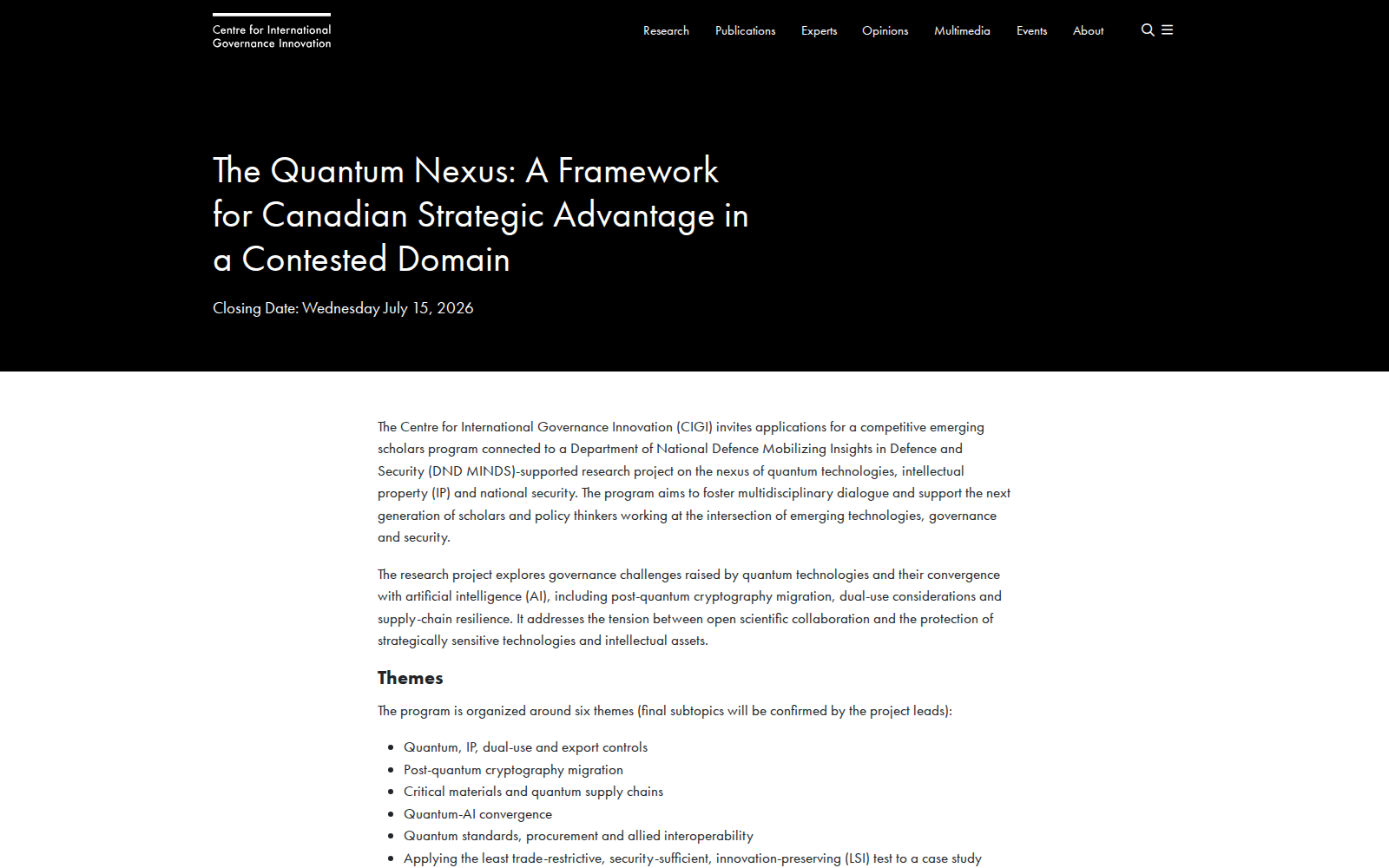
CIGI's call for applications for The Quantum Nexus Emerging Scholars Program — applications close July 15, 2026.
Who can apply
Applications are open to individuals based in Canada—undergraduate and master's students, Ph.D. candidates, and post-doctoral researchers alike. Prior expertise in quantum technologies and their societal impact is not required: applicants from all disciplinary and educational backgrounds are encouraged to apply, and the program strongly encourages applications from individuals belonging to equity-deserving groups. Effective governance of emerging technologies benefits from a diversity of disciplinary perspectives, lived experiences, and approaches to knowledge production.
Applying is deliberately lightweight: a single PDF containing a short expression of interest (300–500 words) indicating which theme the applicant wishes to engage with and why, a current CV, and one reference letter, sent to programs@cigionline.org with the subject line Emerging Scholars Application: DND MINDS Project. Selected applicants are then assigned a specific subtopic within their chosen theme—the analytical note is developed inside the program, not as a precondition for admission. Notification of acceptance follows in mid-August 2026.
Why this program, why now
The call sits within CIGI's Responsible Technology program, which develops conceptual frameworks and policy recommendations that position emerging technologies on a path to strengthen global security, prosperity, and resilience. For Canada, the timing is not incidental. Choices about export controls, standards participation, procurement, and research security are being made now, while quantum computing architectures and alliance arrangements are still in formation—and a country that trains its next generation of governance thinkers early can contribute to those choices while the field is still forming, rather than inheriting them. That conviction has run through Kop's work with Canadian institutions, from his Senior Fellowship at CIGI to the seminars and briefs that preceded this project.
For students and early-career researchers anywhere in Canada who want to work on the major governance questions raised by quantum technologies—with mentorship, an international expert network, and a publication route into a CIGI report—the door is open until July 15, 2026.
Last updated: June 5, 2026.