Innovation, Quantum-AI Technology & Law

Blog over Kunstmatige Intelligentie, Quantum, Deep Learning, Blockchain en Big Data Law

Blog over juridische, sociale, ethische en policy aspecten van Kunstmatige Intelligentie, Quantum Computing, Sensing & Communication, Augmented Reality en Robotica, Big Data Wetgeving en Machine Learning Regelgeving. Kennisartikelen inzake de EU AI Act, de Data Governance Act, cloud computing, algoritmes, privacy, virtual reality, blockchain, robotlaw, smart contracts, informatierecht, ICT contracten, online platforms, apps en tools. Europese regels, auteursrecht, chipsrecht, databankrechten en juridische diensten AI recht.

Berichten met de tag Dual-Use
From Kananaskis to Évian: Will the G7 Govern Quantum, or Keep Describing It?

When G7 leaders meet in Évian-les-Bains from June 15 to 17, 2026, quantum technology sits on the leaders' table for a second consecutive year. In a new CIGI op-ed, Stanford and CIGI legal scholar Mauritz Kop argues that the era of shared values and summit language has run its course: between the Kananaskis Common Vision and the OECD Recommendation on Quantum Technologies, the conceptual groundwork is done. What remains is implementation — and implementation is what voluntary coordination delivers slowly, unevenly, or never.

From a Common Vision to Working Machinery

Kananaskis named the right concerns in June 2025 but built light machinery — no timelines, no benchmarks, no procurement commitments. A year on, Kop puts the question to Évian directly: does the G7 intend to govern quantum, or to keep describing it? His answer is not another principles instrument but a delivery body with named products and deadlines, reporting back to leaders at the 2027 summit.

Five Decisions for Évian

The piece sets out five decisions leaders can take in France: post-quantum cryptography migration milestones for critical infrastructure; trusted and resilient quantum supply chains; standards-based governance backed by procurement; dual-use coordination through a least trade-restrictive, security-sufficient and innovation-preserving (LSI) test; and vigilance on the market structure of an industry already concentrating around a few compute-, patent- and talent-rich incumbents.

Each decision turns a value into something auditable. The "harvest-now, decrypt-later" threat makes cryptographic migration a present-tense problem with an unknown deadline; when Google gives itself until 2029, governments that have given themselves ten years should take notice. The same logic runs through supply-chain chokepoints, technical standards and export controls — defaults that will be written by someone, and better written deliberately than by accident.

The Window Is Still Open

Quantum is leaving the laboratory and becoming strategic infrastructure, a shift central banks already treat as systemic. The window for writing the rules of the road remains open, Kop warns, but it will not stay open forever. For the legal and policy background to the dual-use argument, see our coverage of the LSI test for securing the quantum industrial commons.

Meer lezen
Quantum Nexus LSI Test Published by Vanderbilt JET Law

Most technology law arrives too late: the architecture ships, the market consolidates, and legislators are left regulating what already exists. A new essay in Vanderbilt's Journal of Entertainment & Technology Law argues that quantum technology presents the opposite—and far rarer—situation, and explains what the law should do with it. Quantum law is being written before quantum technology has fully arrived, and that timing is not a defect to apologize for but an opportunity to seize.

A test with three prongs

At the center of the essay stands the LSI test, a doctrinal instrument for dual-use governance that asks of every state intervention whether it is the least trade-restrictive, security-sufficient, and innovation-preserving measure available. The shift in emphasis is subtle but consequential: the question is no longer whether a government possesses a restrictive tool—export control, outbound investment screening, patent secrecy—but whether it is deploying the narrowest one that actually works. Between the romantics of total openness and the reflexes of total restriction, the test stakes out a defensible middle ground the essay calls security-sufficient openness.

Patents and export controls, one system

The essay's second contribution is diagnostic. Intellectual property and national security are conventionally treated as separate fields with separate experts and separate statutes. In quantum practice they behave as one entangled legal control plane: a single patent disclosure can simultaneously raise eligibility questions under Alice, research-security questions under the export-control regime, and commercialization questions under Bayh-Dole and the federal acquisition rules. Reading them together is not an academic nicety—it is the only way to see where over-securitization would quietly strangle the startups, standards participation, and allied interoperability on which democratic quantum leadership depends, a dynamic explored across the MINDS quantum strategy research at CIGI.

From a six-paragraph essay to a coalition playbook

Behind the essay stands the full Quantum Nexus Article—a book-length treatment on arXiv that develops the LSI test into an implementable coalition playbook: empirically anchored criteria, differentiated guardrails with red-zone domains where denial is the default, and secure closed-loop enclaves for high-sensitivity collaborative research. The stakes are framed without euphemism: U.S. assessments now call for a Quantum First posture by 2030, China's program advances under military-civil fusion, and the choice before democratic legislators is whether the coming wall of quantum regulation will be disciplined by doctrine or improvised under pressure. For lawyers, the essay is a preview of their next decade; for policymakers, it is a usable standard; and for the quantum community, it is an argument that the rules now being written deserve the same precision as the systems they will govern.

Meer lezen
The Nexus of Quantum Technology, Intellectual Property, and National Security

Some moments in technology policy demand a text that turns scattered anxieties into administrable law. For the collision of quantum technology, intellectual property, and national security, Mauritz Kop's book-length Article on arXiv makes that move: The Nexus of Quantum Technology, Intellectual Property, and National Security: An LSI Test for Securing the Quantum Industrial Commons—a work that reads today's probabilistic security environment like a wavefunction of plausible futures, and asks which policy choices will collapse it into an outcome democracies can live with.

The claim: security-sufficient openness

The Article's central claim is that the United States and its allies should pursue security-sufficient openness, operationalized through an LSI test: every intervention—an export control, an outbound-investment screen, a patent-secrecy order—must be the least trade-restrictive, security-sufficient, innovation-preserving measure available, whether the actor is a state or a private firm. Between total openness, which hands strategic capabilities to rivals mobilized under military-civil fusion, and total restriction, which strangles the science, the test stakes out the only ground that is defensible in both senses of the word.

Red zones, enclaves, and economic statecraft

What makes the work more than a framework essay is its machinery. The Article delivers an implementable coalition playbook: empirically anchored criteria, templates, and differentiated guardrails—including red-zone domains where denial is the default—plus secure closed-loop enclaves where allied researchers can pursue high-sensitivity R&D without choosing between secrecy and collaboration. The instruments of economic statecraft that democracies have increasingly been deploying are integrated here into a single disciplined doctrine, with the U.S. assessments calling for a Quantum First posture by 2030 supplying the deadline.

What is at stake

The Article names the twin failure modes precisely. Over-securitize, and democracies erect a self-defeating Silicon Curtain—suppressing publication, standards participation, and startup formation until the alliance walls itself off from its own innovation. Under-securitize, and strategically meaningful capabilities in computing, sensing, and cryptanalysis diffuse to adversaries faster than open societies can respond. Threading that needle is the geostrategic design problem of the decade—the same problem Kop works on as an expert at the Eric Schmidt-backed von Neumann Commission on quantum-AI geostrategy. Properly applied, the LSI test secures the quantum industrial commons without suffocating the scientific commons beneath it—and extends trusted adoption pathways to the majority world. This post walks through the Article's argument, its playbook, and what both mean for the lawyers and legislators who will write the quantum statutes of the late 2020s.

Meer lezen
Mauritz Kop Teaches Quantum Governance at the United States Air Force Academy

Mauritz Kop, Founder of the Stanford Center for Responsible Quantum Technology, returned to the United States Air Force Academy—where he serves as guest professor—to teach cadets a class titled Responsible Quantum Technology: Establishing a Legal-Ethical Framework. The session began with the physics and moved to the geostrategic, legal, and ethical architecture the field will need as it matures, addressing two questions the cadets had prepared: why govern quantum before it is mature, and what framework best balances innovation against risk.

From the mechanics to the law

The lecture grounded its policy argument in the physics of the second quantum revolution. Where classical systems encode definite bits, quantum systems exploit superposition, entanglement, and tunneling to unlock new categories of capability across computing, sensing, simulation, and networking—from drug discovery and novel materials to jam-resistant navigation and physically grounded secure communications. The same properties that make the technology powerful, Kop argued, strain a legal order built on certainty, locality, and linear causality, which is why quantum governance calls for a tailored, sui generis approach rather than a retrofit of existing rules. The themes extend the line of work Kop set out in Establishing a Legal-Ethical Framework for Quantum Technology.

Why govern before maturity

On the cadets' first question, Kop drew on the Collingridge dilemma—control is easiest early, when knowledge is limited but options remain open—and on his metaphor of a quantum event horizon, a threshold beyond which technological lock-in makes the path far harder to redirect. Acting while the technology is still malleable, he argued, is not a brake on innovation but a precondition for steering it toward democratic values, public trust, and the legal certainty that long-horizon research and investment depend on.

A two-pillar framework

To the second question, Kop offered an integrated two-pillar response: agile, risk-based regulation that tiers obligations by an application's risk, paired with a strategic industrial and security policy that builds national capacity—funding across the lab-to-market pipeline, supply-chain resilience for critical minerals and components, talent development, and shared research infrastructure. This is the operational form of the Responsible Quantum Technology framework, organized under the SEA principles of safeguarding, engaging, and advancing the technology, and aimed at steering innovation rather than slowing it.

Dual-use and deterrence

For future Air Force and Space Force officers, the dual-use character of quantum technology was the connecting thread. The most acute near-term concern is the cryptographic threat—"Q-Day" and "Harvest Now, Decrypt Later"—which makes the migration to post-quantum cryptography a present-tense security task. Set against great-power competition, Kop's prescription is deliberate stewardship: embedding democratic values into standards early, protecting research from state-sponsored theft, and cooperating with allies, themes he has also brought to venues including the Hoover Institution. The class closed on the conviction that technology's trajectory is a matter of choice, and that engaging its technical, strategic, legal, and ethical dimensions is a core professional responsibility for the officers who will shape these systems.

Meer lezen
Columbia Law Publishes 'Towards a European Quantum Act' Study by Mauritz Kop

In a landmark academic contribution, Columbia Law School’s prestigious Columbia Journal of European Law (CJEL) is publishing a comprehensive study by Mauritz Kop, a leading scholar in the field of quantum technology governance. Titled "Towards a European Quantum Act: A Two-Pillar Framework for Regulation and Innovation," the paper, published in Volume 31, Issue 1 (Fall 2025), presents a forward-looking and robust framework for the European Union to navigate the complexities of the quantum age. This timely publication in a top ranked journal guided by the intellectual stewardship of renowned Columbia Law professors Anu Bradford and George Bermann, is set to significantly influence the burgeoning transatlantic dialogue on the future of quantum technology.

The full citation for the paper is: Mauritz Kop – Towards a European Quantum Act: A Two-Pillar Framework for Regulation and Innovation (Sept 9, 2025), Volume 31, Issue No. 1, Columbia Journal of European Law, Columbia Law School (2025), final edition forthcoming. Pre-print versions are available on SSRN, arXiv, ResearchGate, the Website of the European Commission, and AIRecht.

The Columbia Journal of European Law: A Bastion of Transatlantic Legal Scholarship

Founded in 1994, the Columbia Journal of European Law has established itself as a leading academic publication dedicated to the study of European law from a transatlantic perspective. Its mission is to provide a forum for the exchange of ideas between scholars, practitioners, and policymakers on both sides of the Atlantic. The journal’s history is deeply intertwined with the development of the European Union and the evolving relationship between the EU and the United States. It has consistently published groundbreaking scholarship on a wide range of topics, from competition law and trade to human rights and constitutional law.

The journal's ranking among the top international and European law journals is a testament to its quality and influence. CJEL is currently the single most cited European law journal in the world. It is widely recognized for its rigorous academic standards and its commitment to publishing innovative and policy-relevant research. The journal’s association with Columbia Law School, one of the world’s leading law schools, further enhances its prestige. Columbia Law, located on Amsterdam Avenue in Morningside Heights, Manhattan, New York City, is an Ivy League institution consistantly ranked 3rd in the country - its name carries weight. You can find more information about the journal on its official website: https://cjel.law.columbia.edu/ and its Scholastica page: https://columbia-journal-of-european-law.scholasticahq.com/. For more on the journal's history, the Wikipedia page is a useful resource, and updates can be found on their LinkedIn profile.

CJEL Guided by Star Professors Anu Bradford and George Bermann

The intellectual rigor and policy relevance of Kop's study are a reflection of the Journal’s guidance and mentorship of two of Columbia Law School's most distinguished scholars: Anu Bradford and George Bermann.

Professor Bradford, the Henry L. Moses Professor of Law and International Organization, is a world-renowned expert on the "Brussels Effect," a term she coined to describe the European Union's unilateral power to regulate global markets. Her work has profoundly shaped our understanding of the EU's role in the world and its ability to set global standards for technology and other industries. Her insights into the EU’s regulatory power are clearly reflected in Kop’s proposal for a European Quantum Act.

Professor George Bermann is the Walter Gellhorn Professor of Law and the Jean Monnet Professor of European Union Law at Columbia Law School. A leading authority on European law, international arbitration, and comparative law, Professor Bermann has been instrumental in shaping the field of European law studies in the United States. His deep understanding of the intricacies of EU law and governance provides a solid foundation for Kop’s ambitious legislative proposal. The combined expertise of these two scholars has undoubtedly enriched the paper, ensuring its legal and political feasibility.

"Towards a European Quantum Act": A Two-Pillar Framework

Kop's paper argues that the European Union has a unique opportunity to shape the global governance of quantum technologies. He proposes a comprehensive "European Quantum Act" based on a two-pillar framework:

Pillar 1: Agile, NLF-Style Regulation: This pillar focuses on creating a flexible and adaptive regulatory framework, similar to the EU’s New Legislative Framework (NLF) for products. It would establish a risk-based approach to regulating quantum technologies, with stricter rules for high-risk applications and more flexibility for low-risk ones. This approach, Kop argues, would allow for innovation to flourish while ensuring that fundamental rights and safety are protected. A key element of this pillar is the "standards-first" philosophy, which prioritizes the development of technical standards as a primary mechanism for embedding democratic values into the very architecture of quantum technologies.

Pillar 2: Ambitious, Chips Act-Style Industrial Policy: This pillar calls for a proactive and ambitious industrial policy to support the development of a competitive and resilient European quantum ecosystem. Drawing inspiration from the U.S. and EU Chips Acts, Kop proposes a range of measures, including funding for research and development, support for startups and SMEs, and the creation of a European quantum infrastructure. This pillar aims to ensure that Europe can compete with the United States and China in the global quantum race.

A Standards-First Approach to Secure a Democratic Future

A central tenet of Kop's proposal is the "standards-first" approach. He argues that technical standards are not merely technical tools but are "vessels for values." By proactively shaping the standards for quantum technologies, the EU can embed its democratic values, such as privacy, fairness, and accountability, into the core of the technology. This approach would not only ensure that quantum technologies are developed and used in a responsible manner but would also give the EU a competitive advantage in the global market for trustworthy quantum systems.

This concept builds upon a recent study published in the prestigious journal Science, senior-authored by Kop. The study, titled "Quantum technology governance: A standards-first approach," was first-authored by Mateo Aboy of Cambridge University, with co-authorship from Urs Gasser, a leading scholar at the Technical University of Munich and Harvard University, and I. Glenn Cohen, Vice Dean of Harvard Law School and Faculty Director of the Petrie-Flom Center for Health Law Policy, Biotechnology, and Bioethics. This foundational work, which can be accessed here at Science, provides the rigorous academic underpinnings for leveraging standards as a primary tool for responsible technology governance.

The paper, initiated by the Stanford Center for Responsible Quantum Technology, suggests the creation of a Quantum Technology Quality Management System (QT-QMS), which would be developed in partnership with international bodies like ISO/IEC and IEEE. This system would provide a certifiable CE mark for quantum systems, signaling their compliance with EU standards and values.

Meer lezen

Mauritz Kop Awarded Senior Fellowship at Leading G7 Think Tank CIGI Waterloo

Mauritz Kop, founder of the Stanford Center for Responsible Quantum Technology (RQT) and a guest professor at the US Air Force Academy (USAFA), has been appointed a senior fellow at the Centre for International Governance Innovation (CIGI), a leading Canadian G7 think tank with a global reputation for impactful research and policy advice. This fellowship marks a significant new chapter in Professor Kop's work, allowing for a deeper dive into the intricate and rapidly evolving nexus of quantum technology, artificial intelligence (AI), intellectual property (IP) law, competition policy, and national security. The initial project will focus on developing a comprehensive roadmap for navigating this complex landscape, building on previous engagement with CIGI and long-standing academic and professional connections with Canada.

Mauritz Kop Appointed Senior Fellow at CIGI: A New Chapter in Quantum Governance and Global Security

This CIGI senior fellow appointment is not just a personal honour, but a testament to the growing global recognition of the urgent need for innovative governance models to steer the development of powerful dual-use technologies towards beneficial outcomes for humanity. The challenges are immense, but so are the opportunities. In a world grappling with geopolitical instability and the disruptive potential of emerging technologies, CIGI’s mission to build bridges from knowledge to power has never been more critical. Kop is thrilled to contribute to this mission and to collaborate with CIGI’s distinguished team of experts.

Building on a Foundation: The Dual-Use Project and Previous Engagements

Professor Kop's journey with CIGI began prior to this fellowship, with a seminar delivered on the governance of dual-use quantum technologies. That lecture, titled “Responsible Quantum AI Governance: From Ethical Principles to Global Frameworks,” set the stage for the work he is about to undertake. In that presentation, he argued that we are approaching a “Quantum Event Horizon”—a critical juncture beyond which our ability to shape the trajectory of advanced quantum and AI systems may be irrevocably lost. The core of Kop's argument was that traditional governance models and diplomatic efforts are insufficient to address the systemic challenges posed by a global, high-stakes race for quantum supremacy.

The seminar explored the necessity of a multi-layered governance strategy. This includes not only the development of robust international legal frameworks and oversight bodies, drawing inspiration from nuclear non-proliferation treaties, but also the integration of “Quantum-Resistant Constitutional AI” to hardwire universal values into the technology itself. This dual approach, grounded in the principles of responsible innovation, is essential to mitigate the risks of misuse by state and non-state actors, and to ensure that these technologies serve to enhance, rather than undermine, democratic societies.

The positive reception to these ideas and the stimulating discussions that followed with the CIGI community laid the groundwork for this senior fellowship. It became clear that there was a shared understanding of the stakes involved and a common commitment to forging a path towards a safe and equitable quantum future. This fellowship provides the ideal platform to transition from articulating these principles to developing concrete, actionable policy recommendations.

A New Frontier: IP, Competition Law, Quantum, Dual-Use, and National Security

Professor Kop's first project as a CIGI Senior Fellow will be an in-depth analysis of the critical nexus between quantum technology, AI, IP policy, and national security strategy. The convergence of quantum and AI capabilities presents unprecedented challenges for global innovation and strategic stability, most notably the looming threat of “Q-Day,” when a sufficiently powerful quantum computer could break most of the public-key cryptography that underpins our digital world.

This project will draw lessons from historical precedents, particularly the governance of nuclear technology, to inform the development of novel frameworks for quantum governance. A key component of the research will be a comparative analysis of quantum IP strategies across the dominant tech blocs, examining how different approaches to patents, trade secrets, and state secrets are shaping the global quantum race.

Meer lezen
Mauritz Kop Consults UNESCO and OECD on Ethics and Quantum Technology Policy

Paris, January 9, 2025— As quantum technologies advance at a rapid pace, global institutions are turning to leading experts to help shape the ethical and policy frameworks that will govern this transformative era. Mauritz Kop, a prominent scholar in the field of quantum law and governance Founding Director of the Stanford Center for Responsible Quantum Technology, has been actively consulting with two of the world's foremost international bodies: the United Nations Educational, Scientific and Cultural Organization (UNESCO) and the Organisation for Economic Co-operation and Development (OECD). His contributions are helping to build a global consensus on the responsible development and deployment of quantum technologies.

Expert Opinions for UNESCO and its World Commission on the Ethics of Scientific Knowledge and Technology (COMEST)

UNESCO, through its World Commission on the Ethics of Scientific Knowledge and Technology (COMEST), is at the forefront of establishing global ethical norms for emerging technologies. COMEST is an advisory body composed of leading international scholars tasked with formulating ethical principles to guide decision-makers beyond purely economic considerations.

Recognizing his expertise, COMEST invited Mauritz Kop to an exclusive Expert Hearing on May 13, 2024. This session was convened to gather insights for the Commission's forthcoming landmark report on the "Ethics of the Research, Development and Deployment of Quantum Computing Technologies." Together with three other experts who each presented different perspectives, Kop was asked to present his research on Responsible Quantum Technology, quantum-ELSPI (Ethical, Legal, Societal, and Policy Implications), and bespoke governance frameworks for Quantum Information Science (QIS). His scholarship - often co-authored with RQT Fellows such as Mateo Aboy, Eline de Jong, Mark Brongersma, and Raymond Laflamme, provides the Commission with state-of-the-art analysis of the ethical and governance challenges, helping to enrich the foundation of their upcoming report.

Stanford Law’s Mauritz Kop Provides Recommendations on UNESCO Preliminary Draft: 'Ethics of Quantum Computing'

Following the request to participate in the expert hearing, Stanford Law’s Mauritz Kop was formally invited to provide written recommendations on the "Preliminary Draft Report on the Ethics of Quantum Computing" on January 9, 2025. This invitation underscores the value of his contributions to the Commission's work. While the draft itself remains confidential, its direction can be understood through its public predecessor, the "Concept note of the World Commission on the Ethics of Scientific Knowledge and Technology (COMEST) on the ethics of quantum computing," published on July 24, 2024.

The concept note lays out a comprehensive vision for the ethical governance of quantum computing. It correctly asserts that while quantum technology is still in its early stages, the time to establish ethical guardrails is now, learning from the reactive approach taken with other technologies like social media. The note emphasizes that quantum technology is not neutral; its development and use have profound social and political impacts.

Mauritz Kop Invited by OECD to Speak on Global Policy and National Strategies for Responsible Quantum Technology Development

In addition to his work with UNESCO, Mauritz Kop was invited by the OECD to contribute his expertise to its Global Forum on Technology (GFTech) event, "Future in flux? Global policy issues and national strategies for responsible quantum technology development," held in November 2023. The event was originally scheduled to take place in Tel Aviv, Israel, but was moved to a virtual format due to regional unrest.

Looking Ahead: The International Year of Quantum Science and Technology 2025

The work of UNESCO and the OECD is particularly timely, as the United Nations has officially declared 2025 the International Year of Quantum Science and Technology (IYQ 2025). This global initiative, led by UNESCO, marks the 100th anniversary of the development of modern quantum mechanics and aims to raise global awareness of the importance of quantum science and its applications.

Meer lezen
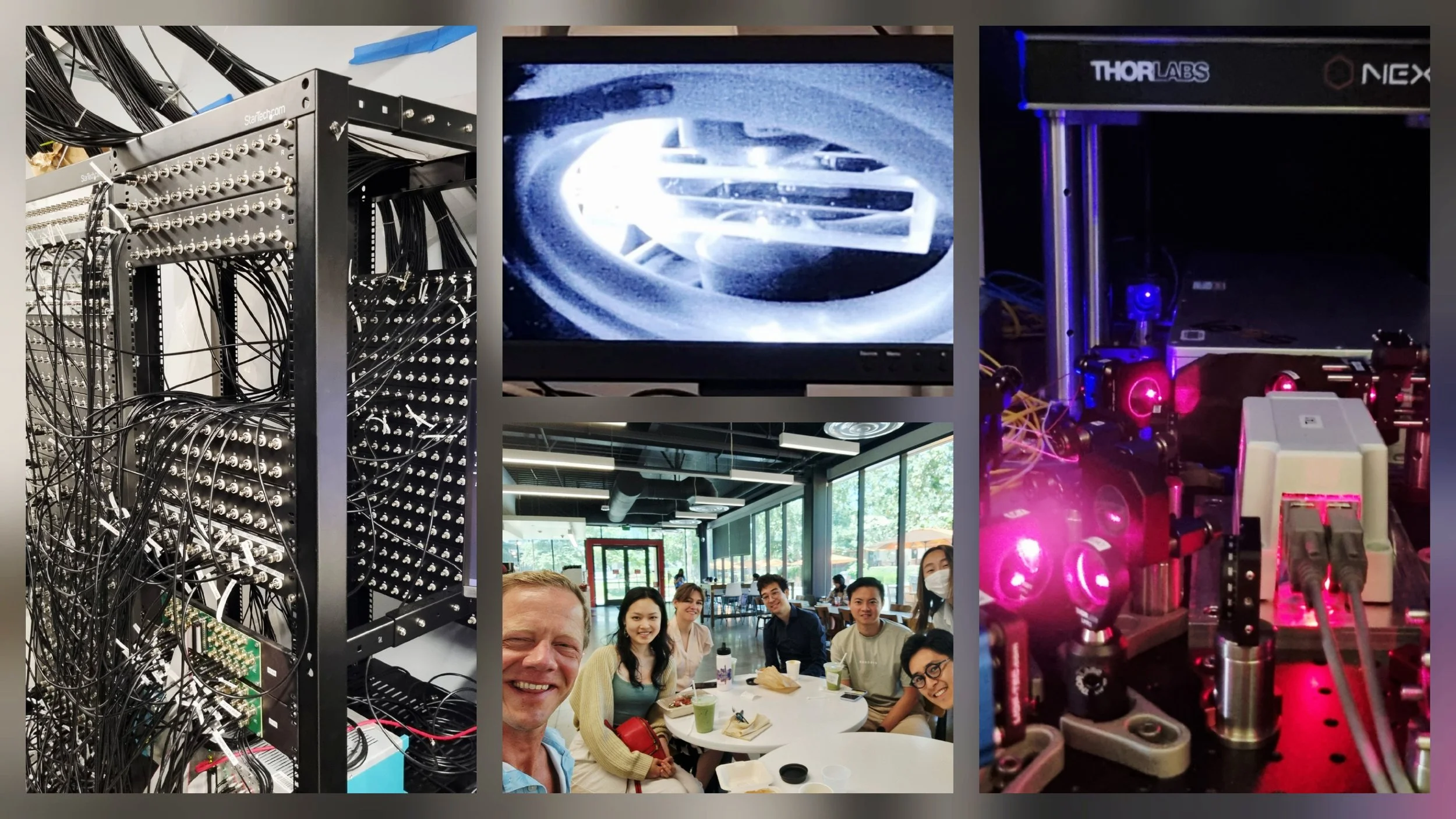
Stanford Law’s Jin-Hee Lee, Katie Liu and Mauritz Kop visit Caltech Quantum Research Center

Pasadena, CA – On July 6, 2024, a team from the Stanford Center for Responsible Quantum Technology (RQT) embarked on a research field trip to the California Institute of Technology (Caltech), one of the world's preeminent hubs for quantum science research. This visit, part of an ongoing collaboration between the two world-leading institutions, was a crucial exercise in bridging the gap between the deeply technical world of quantum research and the complex legal, ethical, and societal frameworks required to govern it. The delegation, consisting of RQT Founding Director Mauritz Kop, RQT Fellow Jin-Hee Lee, and Research Assistant to the Director Katie Liu, traveled from Stanford to the heart of Southern California to engage directly with the scientists and engineers who are building the future of quantum. The visit was hosted by RQT Fellow Franz Pfanner, a PhD candidate at Caltech, and focused on the groundbreaking work being done at Caltech's Institute for Quantum Information and Matter (IQIM).

The day was dedicated to exploring the groundbreaking work being done at Caltech's Institute for Quantum Information and Matter (IQIM), a flagship research center led by Professor Manuel Endres, within the university's prestigious Division of Physics, Mathematics and Astronomy. This visit underscores the RQT Center's commitment to fostering a deeply interdisciplinary dialogue, ensuring that the development of responsible quantum governance is informed by a hands-on understanding of the technology itself.

The Epicenter of Quantum Innovation: Caltech's IQIM

Caltech stands as a global powerhouse in quantum research, and at its core is the Institute for Quantum Information and Matter (IQIM). Under the leadership of Professor Manuel Endres, IQIM is dedicated to exploring the frontiers of quantum science, from the fundamental physics of quantum information to the development of novel quantum materials and devices. The institute's work is organized around several Major Activities (MAs), each tackling a different facet of the quantum puzzle.

Bridging Quantum Theory and Society: The Stanford RQT Projects

The visit to Caltech provided a rich technical context for the work being done by the Stanford RQT team, whose projects are focused on the human and societal dimensions of this emerging technological revolution.

Jin-Hee Lee, an RQT Fellow, is pioneering research in the nascent field of Quantum Human-Computer Interaction (Q-HCI). Her project addresses a critical, yet often overlooked, aspect of the quantum future: how will humans interact with these powerful and counterintuitive machines? As quantum computers move beyond the binary logic of classical computing and into the probabilistic realm of qubits and superposition, the interfaces through which we engage with them must be completely re-imagined. Jin-Hee's work, guided by the ELSPI (Ethical, Legal, Social, and Policy Implications) framework, aims to ensure that these interfaces are not only functional but also accessible, intuitive, and ethically designed, preventing the creation of a new digital divide and keeping humanity at the center of the quantum age.

Katie Liu, a Research Assistant at the RQT Center, is focusing on the intersection of quantum technology and neuroscience. Her project, "Responsible Quantum AI in Healthcare – Neurotechnology and Beyond," explores the transformative potential of quantum AI (QAI) to enhance diagnostics and treatments for complex neurological conditions like Alzheimer's and Parkinson's disease. Using the SEA (Safeguarding, Engaging, Advancing) principles as her guide, Katie is investigating how quantum algorithms can analyze the vast datasets generated by neuroimaging and real-time brain monitoring to create personalized treatment plans. Her research also addresses the profound ethical challenges of this work, from ensuring patient data privacy through quantum-resistant encryption to mitigating the dual-use risks of advanced neurotechnology.

A Cross-pollination of Disciplines and a Moment of Reflection

Following the intellectually stimulating day at Caltech, the Stanford delegation visited The Huntington Library, Art Museum, and Botanical Gardens, taking time to reflect in the serene beauty of the Chinese Garden. The garden, with its intricate design and harmonious balance of natural and man-made elements, served as a powerful metaphor for the work ahead: building a responsible quantum future requires a similar blend of technical ingenuity, ethical foresight, and a deep appreciation for the human values we seek to preserve and enhance.

The journey to a quantum-enabled world is just beginning. But as the collaboration between institutions like Stanford and Caltech demonstrates, by working together across disciplines, we can ensure that this powerful new chapter in human history is written not with reckless abandon, but with wisdom, responsibility, and a shared commitment to the common good.

Meer lezen
Mauritz Kop Reviews Der Derian’s Project Q: War, Peace and Quantum Mechanics

Stanford University, April 1, 2024—In an era defined by rapid technological acceleration, the quantum revolution looms as perhaps the most profound and least understood transformation on the horizon. It is a domain where the esoteric principles of physics—superposition, entanglement, and uncertainty—are migrating from theoretical blackboards to the geopolitical chessboard. It is this critical, and often unsettling, intersection of science, society, and security that James Der Derian’s consequential new documentary, Project Q: War, Peace and Quantum Mechanics, masterfully explores. Having been graciously invited by the film’s producers at Bullfrog Films to review this important work as the Founding Director of the Stanford Center for Responsible Quantum Technology, Mauritz Kop found it to be an essential primer for what may well be the defining technological challenge of the 21st century.

The film serves as a crucial vehicle for fostering what Mauritz Kop calls ‘quantum literacy’—a foundational understanding of not just the science, but the societal, ethical, and political ramifications of quantum technologies, and their inherent dual-use nature. Der Derian, a distinguished scholar of international relations and director of the Centre for International Security Studies at the University of Sydney, is uniquely positioned to guide this inquiry. He eschews a purely technical exposition, instead weaving a narrative that brings together a diverse chorus of voices: leading physicists, philosophers, national security experts, artists, and historians. This multidisciplinary approach is the film’s greatest strength, transforming a subject that could easily be arcane and inaccessible into a deeply human and urgent conversation.

A Summary of the Film: The Quantum Conundrum

Project Q dives headfirst into the rapidly advancing world of quantum science, highlighting the massive investments by governments, corporations, and universities while probing the unanswered questions about humankind's quantum future. The documentary skillfully unpacks the foundational elements of quantum mechanics for a lay audience. It introduces concepts like complementarity, Niels Bohr’s principle that objects can exhibit contradictory properties, such as being both a wave and a particle, but not simultaneously. It visualizes superposition through the famous Schrödinger's cat analogy, where a particle—or a cat in a box—can exist in multiple states at once until the moment it is observed.

Project Q in Sydney: A Conclave for the Quantum Age

The documentary is inextricably linked to the real-world initiative from which it takes its name. Project Q, based at the University of Sydney, is an ambitious undertaking to bridge the gap between the scientists building the quantum future and the humanists, policymakers, and public who will inhabit it. A ‘quantum risk lab’'. The project’s home is the Q Station in Sydney, a former quarantine station with a history of isolating and managing existential threats. This setting serves as a poignant backdrop, a physical manifestation of the need to grapple with the potentially world-altering implications of quantum technology before they arrive unchecked.

A Must-Watch Call for Quantum Literacy

Project Q is a documentary of profound importance and timeliness. It is a wake-up call, an invitation to a global conversation that has been largely confined to laboratories and classified government briefings. Der Derian has crafted a film that is both intellectually rigorous and deeply accessible, challenging its audience to think critically about the path we are on. By exploring both the risks and benefits of quantum innovation, the film offers a vital multidisciplinary perspective on how this emerging suite of technologies might reshape global peace, security, and politics.

Meer lezen