
Mauritz Kop at Co-Opting AI: Quantum: The EU AI Act as a Model for Quantum Regulation, the LSI Test, and Lessons From the GDPR (Video)
By our Editor
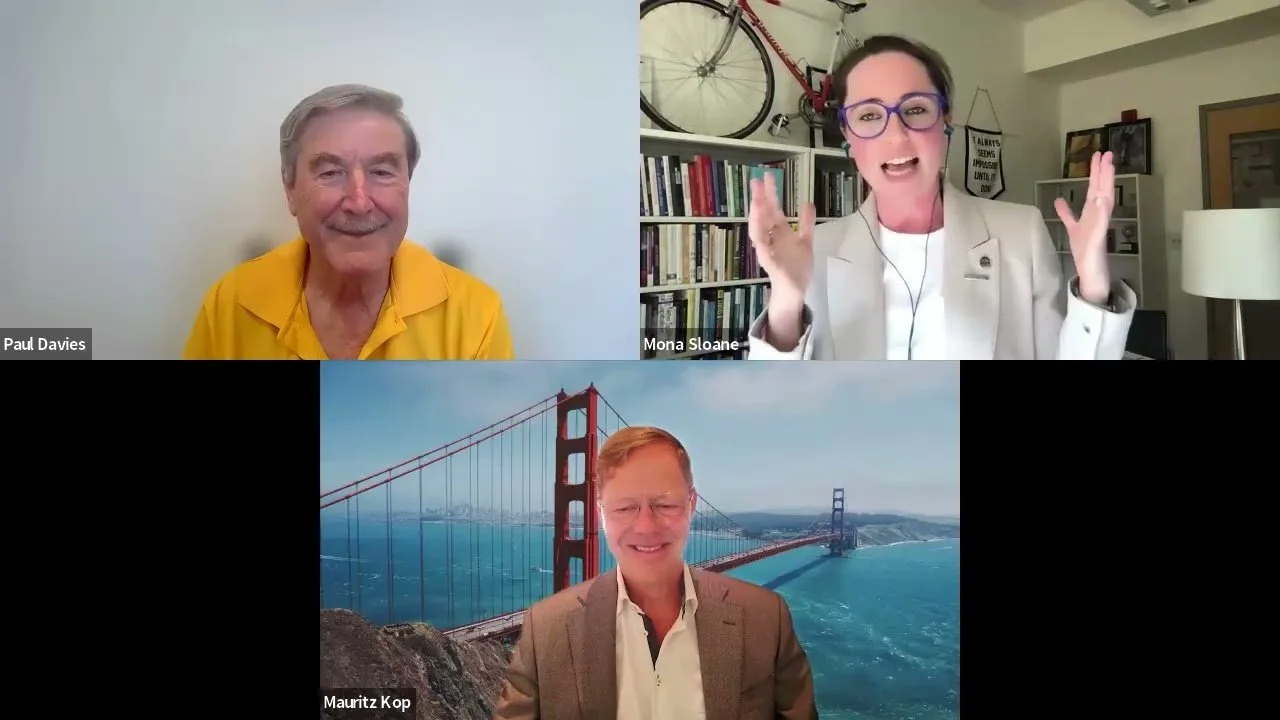
The recording of Co-Opting AI: Quantum, the public conversation held online on Wednesday, October 28, 2026, is now available on the YouTube channel of UVA's Digital Technology for Democracy Lab. Prof. Mauritz Kop, Founder of the Stanford Center for Responsible Quantum Technology (Stanford RQT), and the theoretical physicist Paul Davies of Arizona State University spoke with Professor Mona Sloane, who convenes the series, hosted by the Digital Technology for Democracy Lab, NYU's Institute for Public Knowledge, and Sloane Lab. AIRecht announced the invitation earlier this month. For readers of this blog the hour turned on one legal question: what the law learned from regulating artificial intelligence that it can now apply to quantum technology.
Paul Davies Sets the Scene: Quantum Apocalypse and the Confidentiality of Thought
Davies opened with the centenary of quantum mechanics, which "started in earnest in 1926," and with the distinction between the quantum 1.0 on which today's electronics and AI already run and the quantum 2.0 that puts superposition and entanglement to work. His provocation was a confidentiality problem. Encrypted banking, payment, and email data that an adversary has already collected could be read once that adversary has a fully functional, large-scale quantum computer. "We may be on the verge of a quantum apocalypse," he said. Later he described a quantum sensing helmet that measures the magnetic fields produced by the brain and asked: "If even our thoughts are not confidential, what sort of world have we got coming down the track?" For lawyers, both remarks concern how long confidentiality obligations must last and how far data protection must reach, up to the signals of the human brain.
Kop's Provocation: Access, Power, and the Collingridge Dilemma
Kop began with access: "Decisions about access to quantum technologies will shape who can benefit from them and who controls their use." Leadership in quantum technology, he argued, could give states enduring power over what he calls the world's digital operating system, and early choices in standards, infrastructure, and supply chains can entrench that power for decades. The Collingridge dilemma describes the legislator's position: "We can still influence a development but cannot yet know its full consequences." His response is regulatory experimentation, with rules tested in regulatory sandboxes and adjusted as evidence comes in.
He connected that position to his work on medicine. In Hippocratic Quantum, published at Harvard this year, Kop applies the four duties of medicine, autonomy, beneficence, non-maleficence, and justice, to quantum medicine. His example at Virginia was a hospital that holds information its patients expect to remain confidential for decades and must replace vulnerable cryptography without interrupting care, while the patients have little influence over its preparations. A genome encrypted in 2026 and decrypted in 2040 may still belong to a living patient. Preparing systems with post-quantum cryptography, Kop said, "can deny an adversary the benefit of a quantum attack, which is a form of deterrence by denial." He added that post-quantum cryptography is itself dual use, since any adversary, from a lone hacker to an authoritarian regime or a rogue AI, can use it to protect its own communications.
The EU AI Act's Pyramid of Criticality as a Model for Quantum Regulation
The passage that Sloane singled out was Kop's comparison with the EU AI Act. "I was really drawn in by your comparison to the EU AI Act for the potentials that you see for regulating quantum," she told him. Kop, who advised the European Commission on the AI Act in 2021, described the regulation as a product safety regime built on a pyramid of criticality: unacceptable uses are banned, and high-risk systems need a conformity assessment and CE marking before they can enter the market. "Quantum I think could benefit from that structure," he said. In his design the rules would be sector-specific and stricter for health, energy, finance, and defense than for entertainment, with the risk tiers revised every year in the way the American national laboratories, such as Los Alamos and SLAC, revise their research risk matrix, instead of through new sweeping legislation.
The legal basis he has proposed for Europe is a European Quantum Act with two pillars, risk-based regulation and industrial and security policy. "Europe really needs industrial policy," he said. Technical implementation would follow the standards-first approach that Kop and his colleagues set out in Science in 2025. Kop ended his prepared remarks with his aim: "I want democratic institutions to protect scientific freedom and give citizens a say in how quantum technologies are used."
Export Controls, the Silicon Curtain, and the LSI Test
On trade law, Kop warned that broad trade controls "risk building a Silicon Curtain and weakening scientific relationships on which democracies also depend." Secrecy, patents, and export controls protect capabilities but can restrict access and collaboration, and open innovation and fair competition need antitrust rules, patent pools, and clearinghouses, while know-how needs protection against coordinated theft of intellectual property. For these decisions he developed the LSI test: least trade-restrictive, security-sufficient, innovation-preserving. The test selects the least trade-restrictive measure that meets the security objective and then assesses its effects on research, competition, and the diffusion of knowledge. In legal terms, the LSI test is a proportionality test with a built-in subsidiarity check that places legal friction at the layer of the quantum stack where it can affect the targeted capability. Kop said the test combines the two by examining the choice of actor and instrument. AIRecht covered its publication in the Vanderbilt Journal of Entertainment and Technology Law, and Kop discussed it with five experts at the CIGI Quantum Nexus panel on October 21.
Earlier in his provocation Kop set out the Ten Principles for Responsible Quantum Innovation, which he wrote with Mateo Aboy, Urs Gasser, Luciano Floridi, the late Raymond Laflamme, and others, and which are organized into safeguarding, engaging, and advancing. In his application of that framework, democracies protect society and quantum technologies through proportionate controls, cooperation, and technological leadership. "I always want democratic innovation to stay ahead of authoritarian innovation," he said.
Lessons From Earlier Governance Cycles: GDPR, Nuclear Safeguards, and Surgical Rules
Sloane asked whether quantum governance can learn from the way AI was handled. "This is the latest technological governance cycle, and we're still in the middle of the AI governance cycle," Kop answered. "You should always try to learn from previous governance cycles and learn from your failures and successes." He listed nanotechnology, AI, biotechnology, and nuclear safeguards as sources, and raised a planetary non-proliferation body for quantum AI as an option, noting that many states are reluctant to cede authority to an international body. Because of quantum's physical uniqueness, he said, "governance should always evolve and be adaptive."
Kop then drew a lesson from European data protection. Under the GDPR, he observed, startups "didn't even know where to start their compliance anymore." His conclusion for quantum: "I think it's very important when we design our governance guardrails not to overdo it." Innovation needs room, especially in a race in which the United States wants to be quantum first before this power reaches authoritarian regimes, a tension he said "we have to balance," and he would be "very surgical and sensible about the governance interventions" he designs.
What the Conversation Means for AI and Technology Lawyers
Risk tiers, conformity assessment, sandboxes, data protection, and export control are instruments that technology lawyers already apply to AI systems, and Kop's proposals adapt them to a technology whose consequences are still uncertain. Kop set out the legal-ethical framework behind these proposals in his 2021 Yale Journal of Law and Technology article, Establishing a Legal-Ethical Framework for Quantum Technology.