
Prof. Mauritz Kop Invited to Co-Opting AI: Quantum at the University of Virginia, With Paul Davies, Shohini Ghose, and Host Mona Sloane
By our Editor
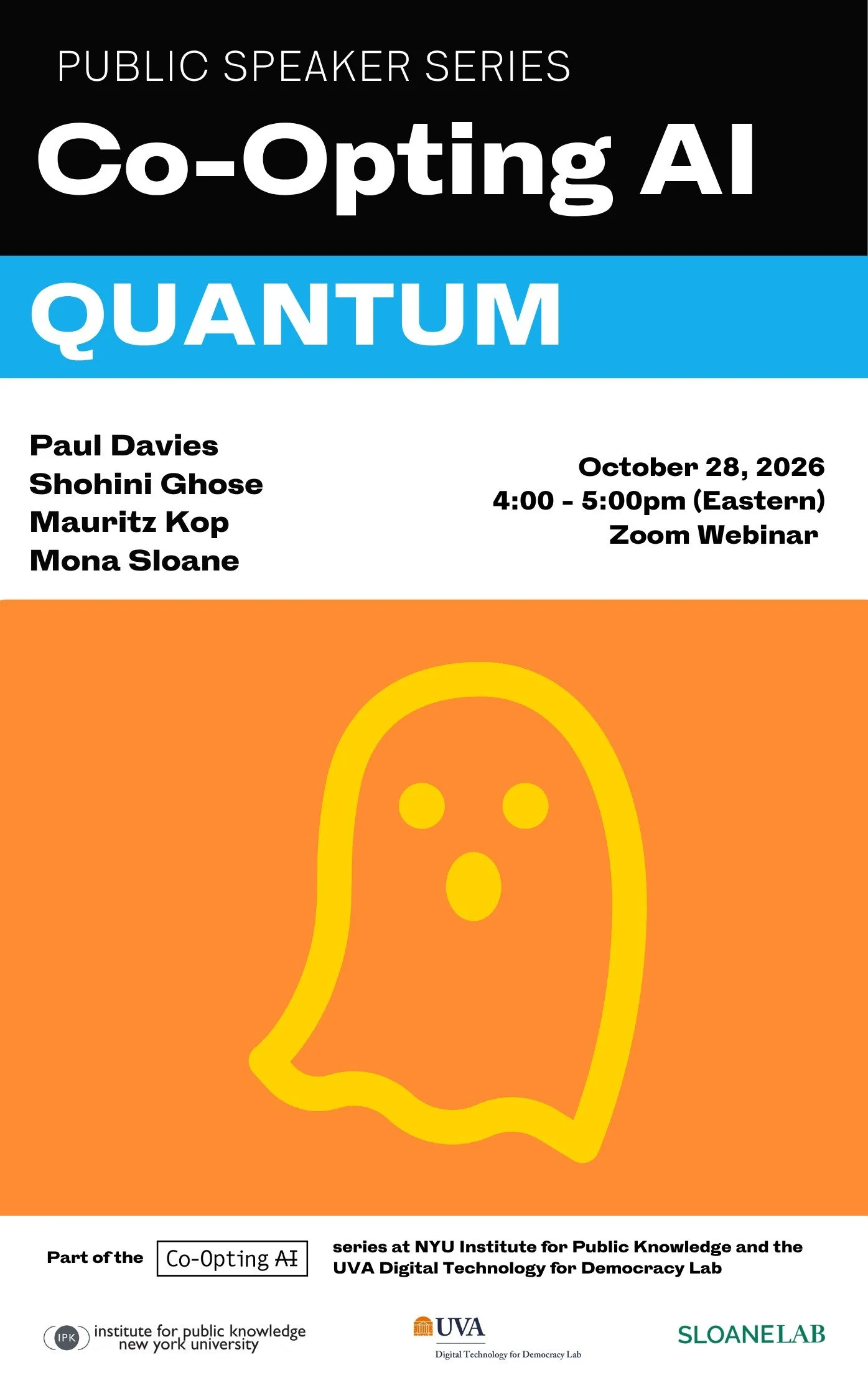
Charlottesville, Virginia, October 8, 2026. Prof. Mauritz Kop, Founder of the Stanford Center for Responsible Quantum Technology (Stanford RQT), has been invited to speak at Co-Opting AI: Quantum, a public conversation hosted by the University of Virginia's Digital Technology for Democracy Lab, NYU's Institute for Public Knowledge, and Sloane Lab. The online event takes place on Wednesday, October 28, 2026, from 4:00 to 5:15 PM Eastern Time. Kop shares the program with the theoretical physicist and cosmologist Paul Davies of Arizona State University and the quantum physicist Shohini Ghose of Wilfrid Laurier University, with Professor Mona Sloane of the University of Virginia as host. For readers of AIRecht, the invitation marks a moment we have followed for years: the questions that law and ethics asked about artificial intelligence are now being asked about quantum technology, in the same rooms and by the same communities.
What Co-Opting AI: Quantum Will Examine on October 28, 2026
The organizers describe the theme in one sentence: quantum computing is arriving into institutions, supply chains, and geopolitical formations shaped by AI, and the event will examine what that inheritance means for how quantum computing develops as a technological and social phenomenon. Quantum computing enters a world in which AI has already reorganized data markets, cloud infrastructure, chip supply chains, export controls, and the relationship between technology companies and the state.
That inheritance also raises legal questions. The contracts, liability rules, procurement standards, and intellectual property regimes built around AI will shape who owns quantum capabilities, who can access them, and who answers for the harm they may cause. The session is open to the public and will be recorded; everyone who registers through the University of Virginia receives a notice when the video is available.
Mona Sloane's Co-Opting AI Series: Public Conversations on AI and Society Since April 2019
Co-Opting AI is a virtual public speaker series that interrogates and demystifies artificial intelligence, convened by Mona Sloane, Assistant Professor of Data Science and Media Studies at the University of Virginia, Faculty Co-Lead of the Digital Technology for Democracy Lab, and Technology Editor of Public Books. The series started at NYU's Institute for Public Knowledge in April 2019 with an episode titled Machines, featuring Solon Barocas, Meredith Broussard, and Finn Brunton, and it has run online since April 2020. Each episode takes one theme and gathers leading scholars and practitioners around it. The quantum episode is the series' fifty-fifth, and its first on quantum technology.
The archive reads like a map of the AI governance debate. Alondra Nelson, Virginia Eubanks, Sasha Costanza-Chock, and Amanda Levendowski spoke on Justice in 2019. Meredith Whittaker joined the Conflict episode the same year. Sandra Wachter of the Oxford Internet Institute discussed the GDPR in 2020, Kara Swisher spoke on Journalism, and Danielle Keats Citron and Jasmine McNealy took up Privacy in 2025. In April 2026 the Geopolitics episode brought together Pablo Chavez, Chinasa T. Okolo, and Nick Srnicek; in September 2026 Amelia Acker and Nanna Bonde Thylstrup examined Archives. The full archive lives on the Co-Opting AI series page.
The series has a companion in print. Sloane edits the Co-Opting AI book series at the University of California Press, which opened in May 2026 with her own book, Predicted: How AI Is Restructuring Social Life. The Digital Technology for Democracy Lab itself is a cross-university initiative at the University of Virginia, administered by the Karsh Institute of Democracy, that studies how digital technologies can challenge and also fortify democratic institutions.
Paul Davies and Shohini Ghose: the Physicists Joining Kop on the Virtual Stage
Paul Davies is Regents' Professor at Arizona State University, director of the Beyond Center for Fundamental Concepts in Science, and co-director of the Cosmology Initiative. His research spans the origin of the universe, the quantum properties of black holes, and the nature of time. His honors include the Templeton Prize, and asteroid 6870 Pauldavies carries his name. His latest book, Quantum 2.0: The Weird Physics Driving a New Revolution in Technology, explains for a broad audience why the second quantum revolution matters.
Shohini Ghose is Professor of Physics and Computer Science and NSERC Chair for Women in Science and Engineering at Wilfrid Laurier University, where she directs the Laurier Centre for Women in Science. She served on the inaugural Advisory Council for Canada's National Quantum Strategy, was Chief Technology Officer of the Quantum Algorithms Institute, and was named in 2025 among UNESCO's Quantum 100 global innovators. A TED Senior Fellow whose talks and videos have received more than ten million views, she wrote Her Space, Her Time, winner of the 2023 Science Writers and Communicators of Canada Award. Asteroid 8913 Shohinighose carries her name.
Davies brings the foundations of physics and cosmology, Ghose brings quantum information science and national strategy, and Kop brings law, ethics, and policy. Sloane, a sociologist of technology, hosts and moderates the conversation.
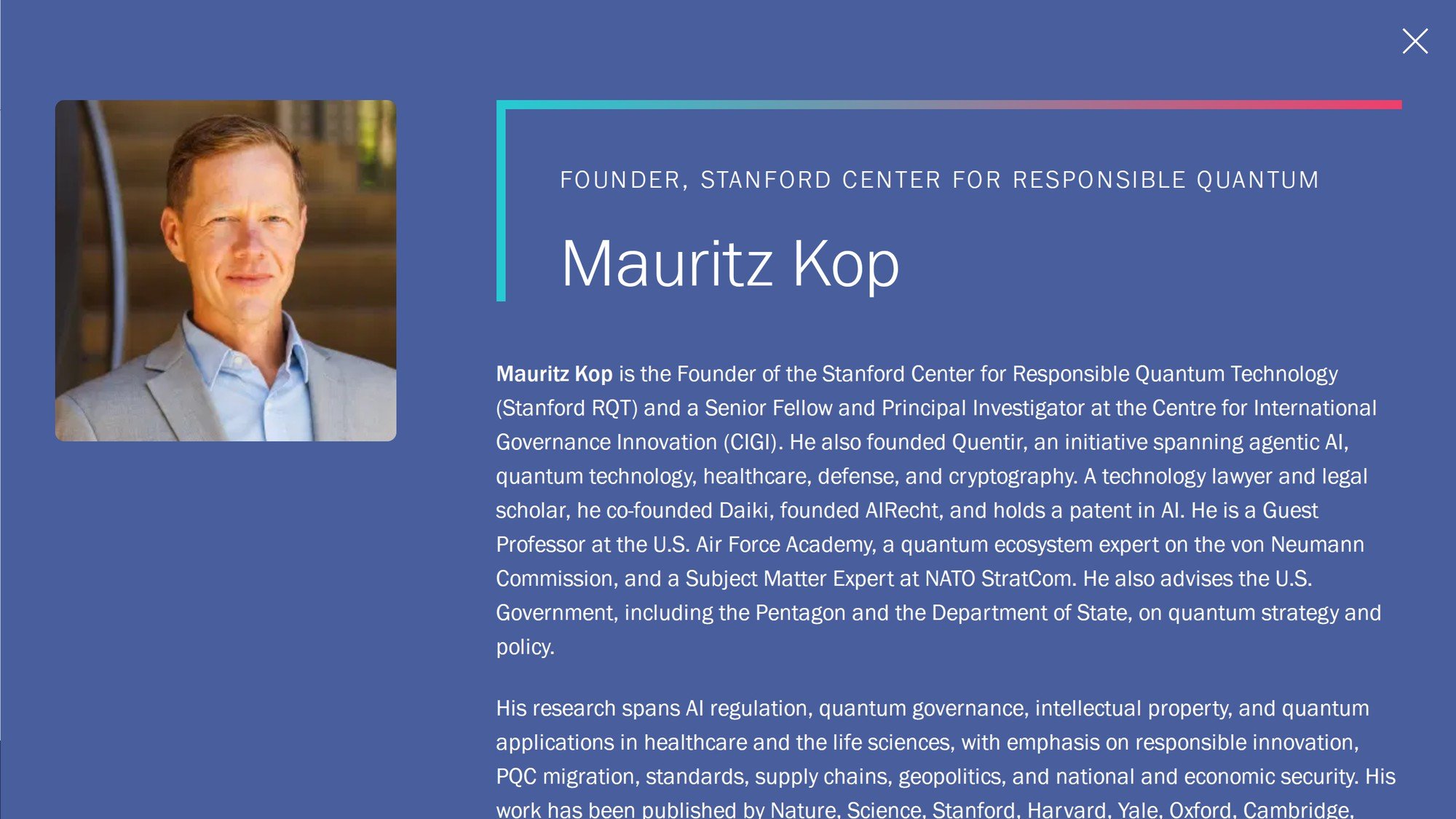
What Kop Brings From Stanford RQT: the Legal-Ethical Framework, Ten Principles, and Quantum-ELSPI
Kop's contribution rests on a body of scholarship that began with a question few lawyers asked in 2021: what legal and ethical framework should govern quantum technology before it reaches the market? His answer appeared in the Yale Journal of Law and Technology as Establishing a Legal-Ethical Framework for Quantum Technology. The article proposed that quantum governance should learn from AI governance early, while the technology is still malleable.
The work that followed built the field of responsible quantum technology. With Raymond Laflamme, Urs Gasser, I. Glenn Cohen, Mateo Aboy, Eline De Jong, Timo Minssen, Mark Brongersma, Teresa Quintel, and Luciano Floridi, Kop co-wrote Towards Responsible Quantum Technology (Harvard Berkman Klein Center, 2023), which introduced the guiding principles of safeguarding, engaging, and advancing. The same group then published Ten Principles for Responsible Quantum Innovation in Quantum Science and Technology (IOP, 2024). Gasser, De Jong, and Kop issued A call for responsible quantum technology in Nature Physics in 2024, and in August 2025 Aboy, Gasser, Cohen, and Kop proposed a standards-first approach to quantum technology governance in Science.
Kop also developed Quantum-ELSPI, the study of the ethical, legal, socio-economic, and policy implications of quantum technology, as a research field and set it out in the journal Digital Society in 2023. In 2025 Stanford University Libraries created a permanent repository for the Stanford RQT scholarship, and in 2026 the OECD Recommendation on Quantum Technologies built on the principles first developed at Stanford RQT. Stanford RQT, which Kop led as Executive Director from 2023 to 2025, was inaugurated by Mark Rutte, now Secretary General of NATO, and its work informed the G7 Kananaskis quantum policy agenda. These are the sources a law-and-AI audience can read before October 28.
From Oxford to Washington: the Talks and Advisory Work Behind the Invitation
The University of Virginia invitation continues a long series of lectures and keynotes. In November 2025 Kop joined a panel at the University of Oxford on quantum supremacy, strategy, and international order, hosted by the Department of Politics and International Relations. In January 2025 he gave the keynote on quantum governance frameworks at the International Quantum Forum at the Technical University of Munich, hosted by the TUM Think Tank's Quantum Social Lab and the TUM Center for Culture and the Arts as part of TUM's QuantWorld initiative. At Stanford Law School he chaired the inaugural Stanford Responsible Quantum Technology Conference in 2023 and its second edition in 2024.
The policy community has asked for the same expertise. Kop spoke at the CNAS Quantum Roundtable on research security and intellectual property in 2023 and briefed CNAS researchers for their 2026 quantum networking report. He advised Yale Law School's Lowenstein Human Rights Project on quantum technology and human rights, and in 2025 gave a quantum governance seminar at CIGI, the Centre for International Governance Innovation, where he is now a Senior Fellow and Principal Investigator of the Quantum Nexus project. The project builds on his LSI test for quantum technology, intellectual property, and national security; the paper that sets out the test is indexed in the NASA Astrophysics Data System at the Center for Astrophysics | Harvard & Smithsonian. He has also advised U.S. Senators on regulating AI and quantum technology, and in 2024 the U.S. Department of State consulted him on quantum technology and foreign policy strategy.
His essays in War on the Rocks carry the same work to the national security community. A Bletchley Park for the Quantum Age (November 2025) called for validated-only federal procurement of post-quantum cryptography, and Before Q-Day: The Race to Quantum First (July 2026, with Joseph Federici) argued for one accountable office for quantum readiness. Kop is a Guest Professor at the U.S. Air Force Academy, a quantum ecosystem expert on the von Neumann Commission, and a Subject Matter Expert at NATO StratCom, and he advises the U.S. Government, including the Pentagon and the Department of State, on quantum strategy and policy.
Why Lawyers and AI Governance Professionals Should Register for October 28
The Co-Opting AI series asks bigger questions about technology, society, inequality, and justice. Quantum technology raises those questions in sharper form. It promises breakthroughs in medicine, materials, and energy, and it threatens the public-key cryptography that protects contracts, health records, and state secrets. Lawyers who advise on AI governance today will be asked about quantum readiness tomorrow, and the frameworks they learned from the EU AI Act, the GDPR, and the NIST standards will be their starting point.
AIRecht congratulates Mona Sloane and her colleagues at the University of Virginia and NYU on bringing quantum into this series, and we look forward to the conversation with Paul Davies and Shohini Ghose. For organizations that already want to check how their own AI contracts allocate responsibility, the AIRecht contract scan gives a structured first reading.
Last updated: October 8, 2026