
Innovation, Quantum-AI Technology & Law

Blog over Kunstmatige Intelligentie, Quantum, Deep Learning, Blockchain en Big Data Law

Blog over juridische, sociale, ethische en policy aspecten van Kunstmatige Intelligentie, Quantum Computing, Sensing & Communication, Augmented Reality en Robotica, Big Data Wetgeving en Machine Learning Regelgeving. Kennisartikelen inzake de EU AI Act, de Data Governance Act, cloud computing, algoritmes, privacy, virtual reality, blockchain, robotlaw, smart contracts, informatierecht, ICT contracten, online platforms, apps en tools. Europese regels, auteursrecht, chipsrecht, databankrechten en juridische diensten AI recht.

Berichten met de tag Co-Opting AI
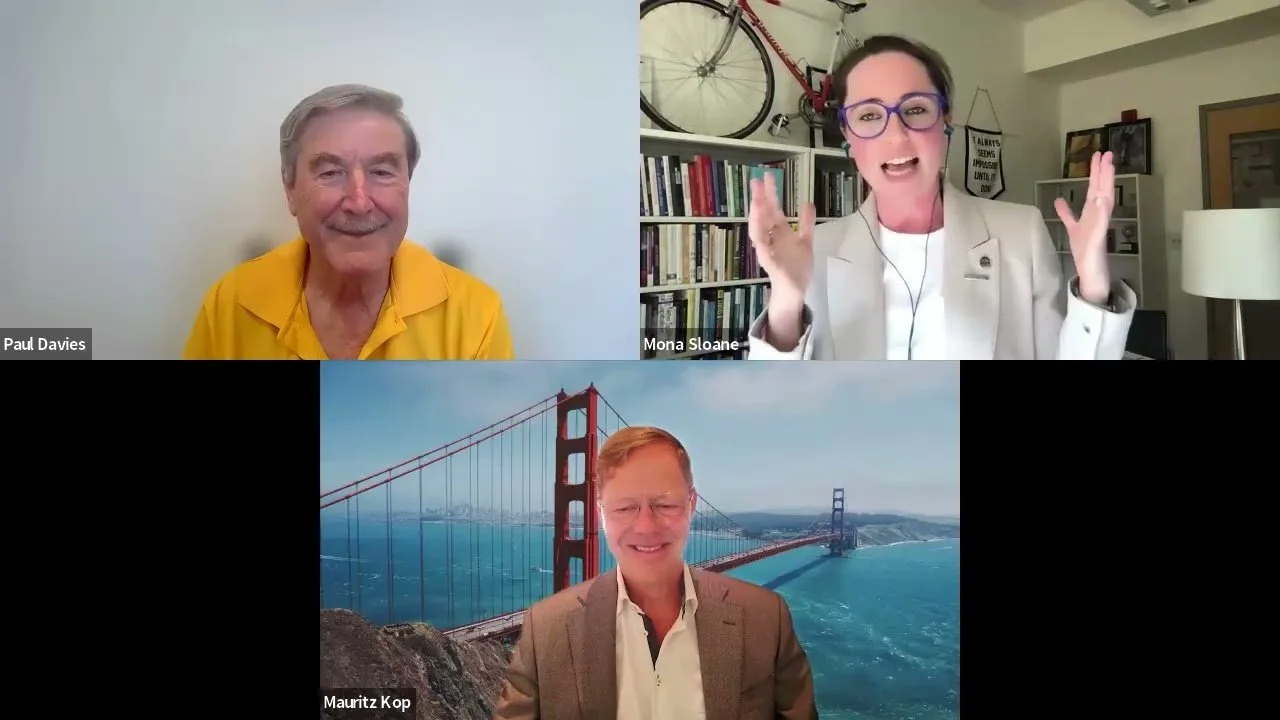
Mauritz Kop at Co-Opting AI: Quantum: The EU AI Act as a Model for Quantum Regulation, the LSI Test, and Lessons From the GDPR (Video)

Prof. Mauritz Kop and Paul Davies at Co-Opting AI: Quantum, October 28, 2026

The recording of Co-Opting AI: Quantum, the public conversation held online on October 28, 2026, is now available. Prof. Mauritz Kop, Founder of the Stanford Center for Responsible Quantum Technology, and the theoretical physicist Paul Davies spoke with Professor Mona Sloane, who convenes the series, hosted by UVA's Digital Technology for Democracy Lab, NYU's Institute for Public Knowledge, and Sloane Lab. Davies warned of a quantum apocalypse for encrypted data that adversaries have already collected. Kop opened his own provocation with the question of access: "Decisions about access to quantum technologies will shape who can benefit from them and who controls their use." He argued that preparing systems with post-quantum cryptography can deny an adversary the benefit of a quantum attack, and used a hospital that must protect patient genomes for decades to show who carries the burden of that preparation.

The EU AI Act as a Model for Quantum Regulation, and the LSI Test

Sloane singled out Kop's comparison with the EU AI Act. Kop, who advised the European Commission on the Act in 2021, proposed its pyramid of criticality for quantum technology: sector-specific rules, stricter for health, energy, finance, and defense, with risk tiers revised every year in the way the American national laboratories revise their research risk matrix. For export controls he set out his LSI test, a proportionality test with a built-in subsidiarity check that selects the least trade-restrictive measure meeting the security objective and then assesses its effects on research, competition, and the diffusion of knowledge. In the discussion he drew on the GDPR and earlier governance cycles, from nanotechnology to nuclear safeguards, to ask for surgical guardrails that let innovation breathe; his prepared remarks ended with the aim that democratic institutions protect scientific freedom and give citizens a say in how quantum technologies are used.

Meer lezen
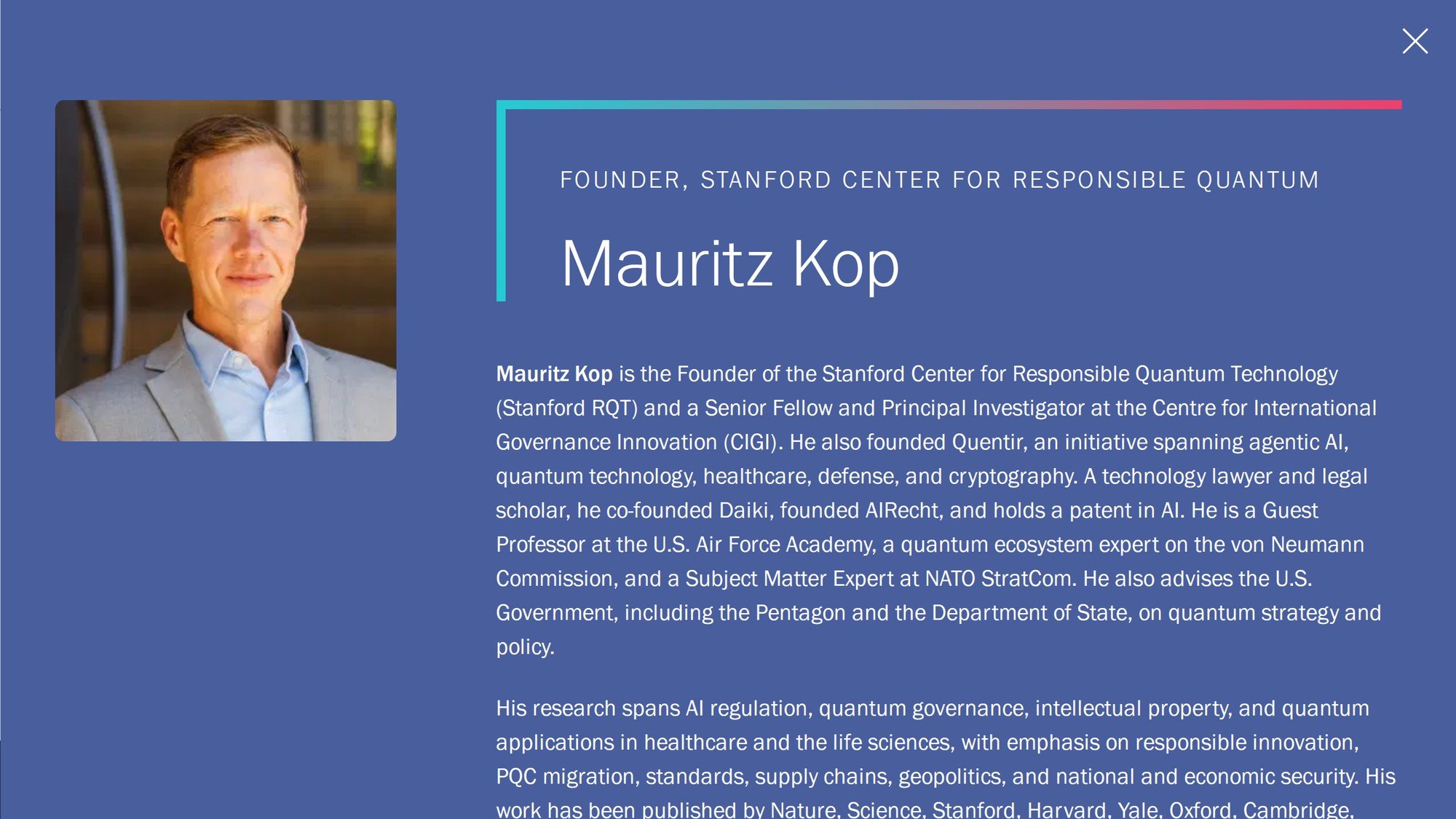
Prof. Mauritz Kop Invited to Co-Opting AI: Quantum at the University of Virginia, With Paul Davies, Shohini Ghose, and Host Mona Sloane

Prof. Mauritz Kop, Founder of the Stanford Center for Responsible Quantum Technology, has been invited to speak at Co-Opting AI: Quantum, a public conversation hosted by the University of Virginia's Digital Technology for Democracy Lab, NYU's Institute for Public Knowledge, and Sloane Lab. The online event takes place on Wednesday, October 28, 2026, from 4:00 to 5:15 PM Eastern Time, with the physicists Paul Davies of Arizona State University and Shohini Ghose of Wilfrid Laurier University, and with Professor Mona Sloane as host.

Episode 55 of Mona Sloane's Co-Opting AI Series Turns to Quantum

Mona Sloane's Co-Opting AI series has gathered leading scholars on technology and society since April 2019, from Alondra Nelson and Virginia Eubanks on Justice to Sandra Wachter on the GDPR and Danielle Keats Citron on Privacy. The quantum episode is the series' fifty-fifth and its first on quantum technology. The organizers frame it around one idea: quantum computing is arriving into institutions, supply chains, and geopolitical formations shaped by AI, and that inheritance will shape how quantum develops as a technological and social phenomenon. For lawyers who work on AI governance, this is the moment the familiar questions of liability, access, and accountability move to the next technology.

Stanford RQT Scholarship and Kop's Talks From Oxford to Washington

Kop brings the body of work that defined responsible quantum technology: the Yale Journal of Law and Technology article on a legal-ethical framework for quantum technology, the Ten Principles for Responsible Quantum Innovation, the Nature Physics call for responsible quantum technology, the Science article on standards-first governance, and the Quantum-ELSPI research field. The invitation follows his talks at Oxford, TU Munich, CNAS, CIGI, and Stanford Law School, his two War on the Rocks essays, and his advisory work for the U.S. Government, including the Pentagon and the Department of State. The session is open to the public and will be recorded for those who register.

Meer lezen