Innovation, Quantum-AI Technology & Law

Blog over Kunstmatige Intelligentie, Quantum, Deep Learning, Blockchain en Big Data Law

Blog over juridische, sociale, ethische en policy aspecten van Kunstmatige Intelligentie, Quantum Computing, Sensing & Communication, Augmented Reality en Robotica, Big Data Wetgeving en Machine Learning Regelgeving. Kennisartikelen inzake de EU AI Act, de Data Governance Act, cloud computing, algoritmes, privacy, virtual reality, blockchain, robotlaw, smart contracts, informatierecht, ICT contracten, online platforms, apps en tools. Europese regels, auteursrecht, chipsrecht, databankrechten en juridische diensten AI recht.

Berichten met de tag LSI Test
The Nexus of Quantum Technology, Intellectual Property, and National Security

Some moments in technology policy demand a text that turns scattered anxieties into administrable law. For the collision of quantum technology, intellectual property, and national security, Mauritz Kop's book-length Article on arXiv makes that move: The Nexus of Quantum Technology, Intellectual Property, and National Security: An LSI Test for Securing the Quantum Industrial Commons—a work that reads today's probabilistic security environment like a wavefunction of plausible futures, and asks which policy choices will collapse it into an outcome democracies can live with.

The claim: security-sufficient openness

The Article's central claim is that the United States and its allies should pursue security-sufficient openness, operationalized through an LSI test: every intervention—an export control, an outbound-investment screen, a patent-secrecy order—must be the least trade-restrictive, security-sufficient, innovation-preserving measure available, whether the actor is a state or a private firm. Between total openness, which hands strategic capabilities to rivals mobilized under military-civil fusion, and total restriction, which strangles the science, the test stakes out the only ground that is defensible in both senses of the word.

Red zones, enclaves, and economic statecraft

What makes the work more than a framework essay is its machinery. The Article delivers an implementable coalition playbook: empirically anchored criteria, templates, and differentiated guardrails—including red-zone domains where denial is the default—plus secure closed-loop enclaves where allied researchers can pursue high-sensitivity R&D without choosing between secrecy and collaboration. The instruments of economic statecraft that democracies have increasingly been deploying are integrated here into a single disciplined doctrine, with the U.S. assessments calling for a Quantum First posture by 2030 supplying the deadline.

What is at stake

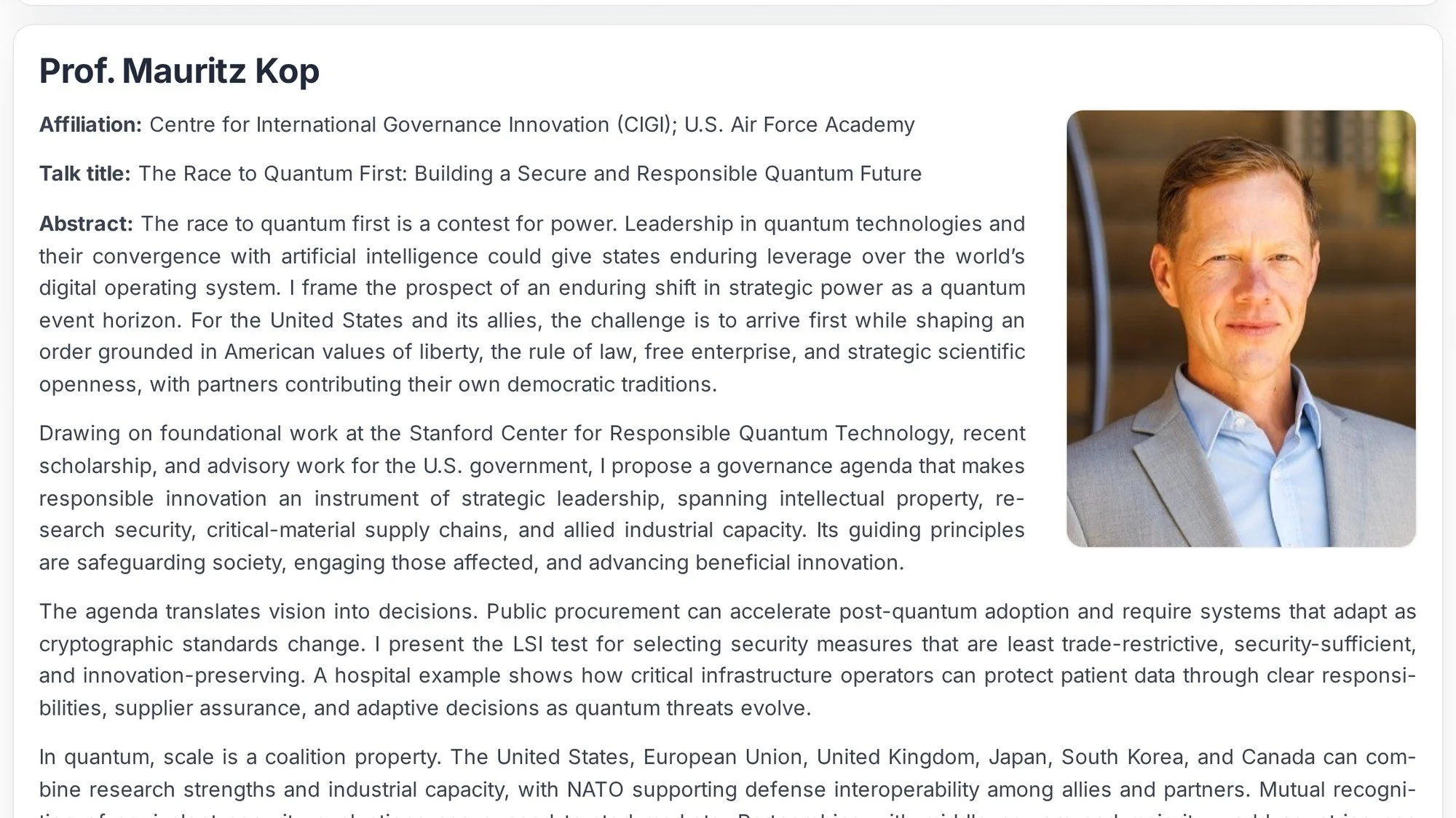
The Article names the twin failure modes precisely. Over-securitize, and democracies erect a self-defeating Silicon Curtain—suppressing publication, standards participation, and startup formation until the alliance walls itself off from its own innovation. Under-securitize, and strategically meaningful capabilities in computing, sensing, and cryptanalysis diffuse to adversaries faster than open societies can respond. Threading that needle is the geostrategic design problem of the decade—the same problem Kop works on as an expert at the Eric Schmidt-backed von Neumann Commission on quantum-AI geostrategy. Properly applied, the LSI test secures the quantum industrial commons without suffocating the scientific commons beneath it—and extends trusted adoption pathways to the majority world. This post walks through the Article's argument, its playbook, and what both mean for the lawyers and legislators who will write the quantum statutes of the late 2020s.

Meer lezen
Quantum Nexus LSI Test Published by Vanderbilt JET Law

Most technology law arrives too late: the architecture ships, the market consolidates, and legislators are left regulating what already exists. A new essay in Vanderbilt's Journal of Entertainment & Technology Law argues that quantum technology presents the opposite—and far rarer—situation, and explains what the law should do with it. Quantum law is being written before quantum technology has fully arrived, and that timing is not a defect to apologize for but an opportunity to seize.

A test with three prongs

At the center of the essay stands the LSI test, a doctrinal instrument for dual-use governance that asks of every state intervention whether it is the least trade-restrictive, security-sufficient, and innovation-preserving measure available. The shift in emphasis is subtle but consequential: the question is no longer whether a government possesses a restrictive tool—export control, outbound investment screening, patent secrecy—but whether it is deploying the narrowest one that actually works. Between the romantics of total openness and the reflexes of total restriction, the test stakes out a defensible middle ground the essay calls security-sufficient openness.

Patents and export controls, one system

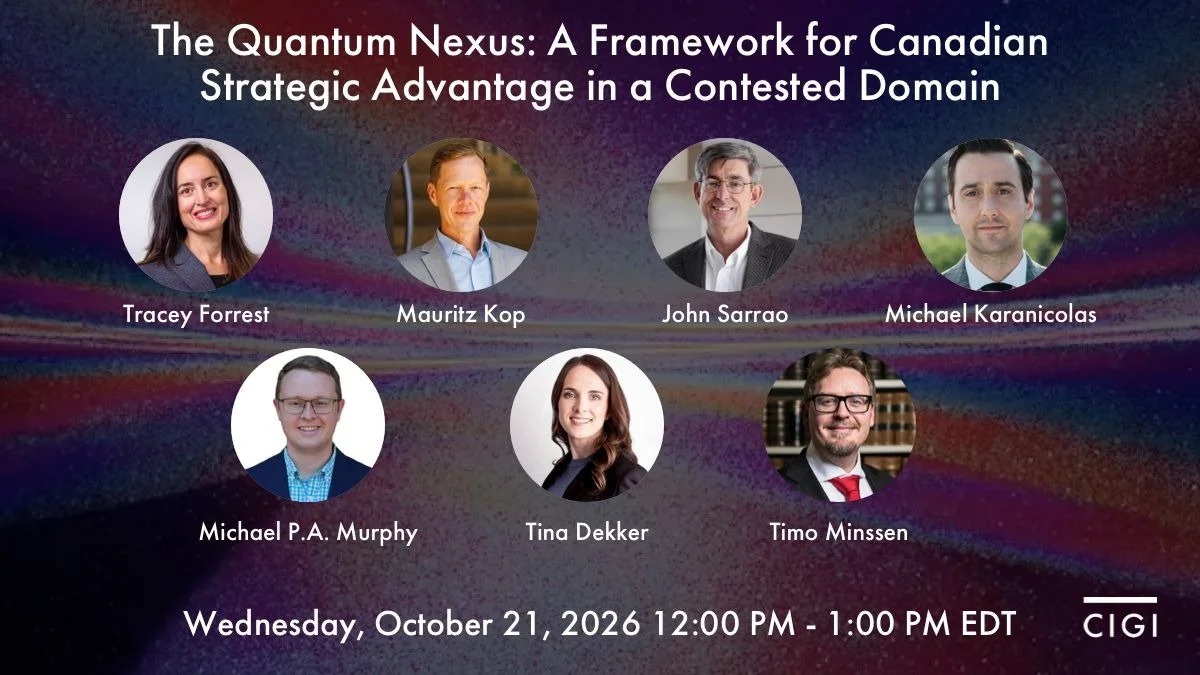
The essay's second contribution is diagnostic. Intellectual property and national security are conventionally treated as separate fields with separate experts and separate statutes. In quantum practice they behave as one entangled legal control plane: a single patent disclosure can simultaneously raise eligibility questions under Alice, research-security questions under the export-control regime, and commercialization questions under Bayh-Dole and the federal acquisition rules. Reading them together is not an academic nicety—it is the only way to see where over-securitization would quietly strangle the startups, standards participation, and allied interoperability on which democratic quantum leadership depends, a dynamic explored across the MINDS quantum strategy research at CIGI.

From a six-paragraph essay to a coalition playbook

Behind the essay stands the full Quantum Nexus Article—a book-length treatment on arXiv that develops the LSI test into an implementable coalition playbook: empirically anchored criteria, differentiated guardrails with red-zone domains where denial is the default, and secure closed-loop enclaves for high-sensitivity collaborative research. The stakes are framed without euphemism: U.S. assessments now call for a Quantum First posture by 2030, China's program advances under military-civil fusion, and the choice before democratic legislators is whether the coming wall of quantum regulation will be disciplined by doctrine or improvised under pressure. For lawyers, the essay is a preview of their next decade; for policymakers, it is a usable standard; and for the quantum community, it is an argument that the rules now being written deserve the same precision as the systems they will govern.

Meer lezen