

Innovation, Quantum-AI Technology & Law

Blog over Kunstmatige Intelligentie, Quantum, Deep Learning, Blockchain en Big Data Law

Blog over juridische, sociale, ethische en policy aspecten van Kunstmatige Intelligentie, Quantum Computing, Sensing & Communication, Augmented Reality en Robotica, Big Data Wetgeving en Machine Learning Regelgeving. Kennisartikelen inzake de EU AI Act, de Data Governance Act, cloud computing, algoritmes, privacy, virtual reality, blockchain, robotlaw, smart contracts, informatierecht, ICT contracten, online platforms, apps en tools. Europese regels, auteursrecht, chipsrecht, databankrechten en juridische diensten AI recht.

Berichten met de tag supply chains
Stanford and Los Alamos Researchers Publish Critical Quantum Minerals Dashboard

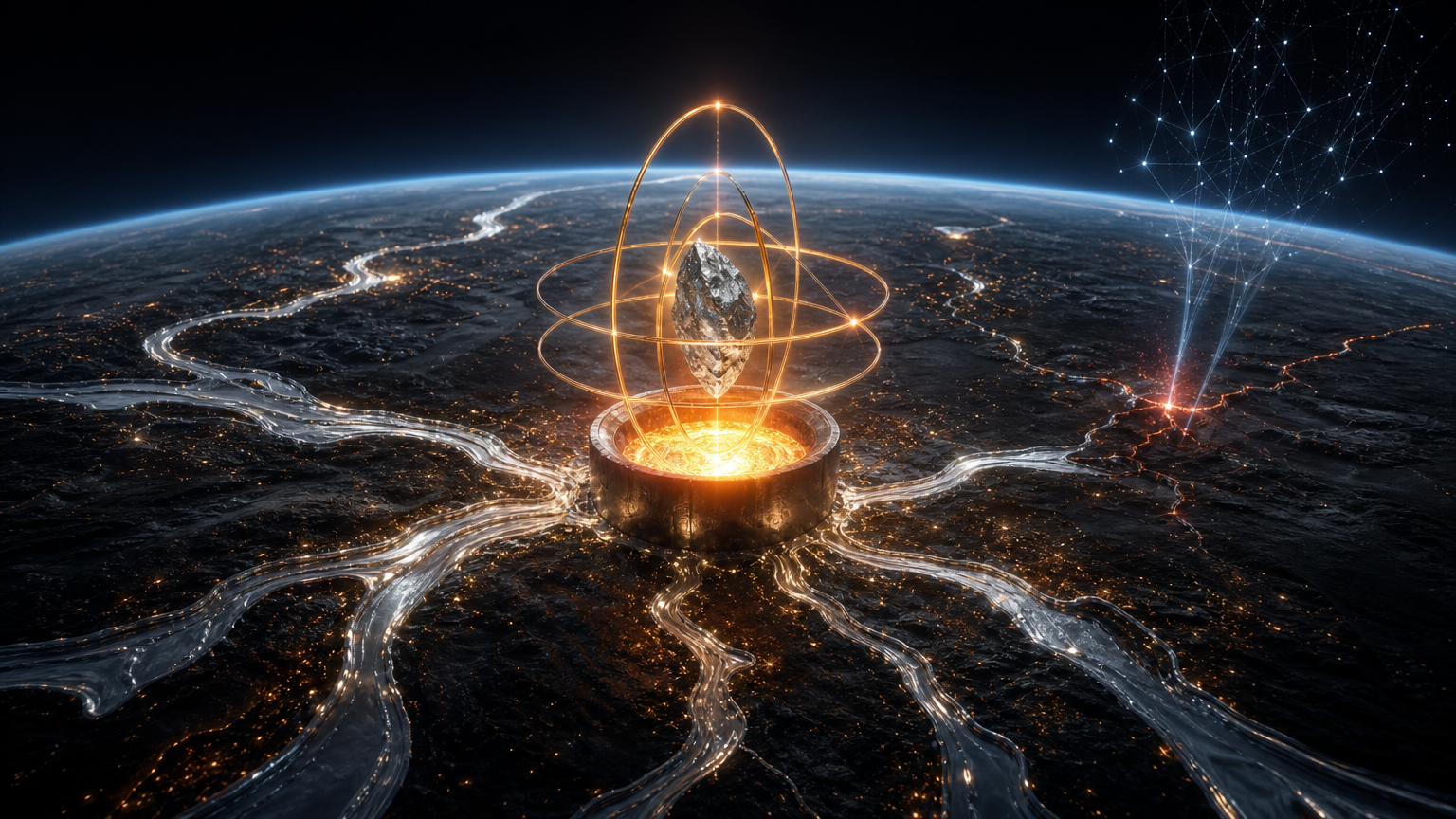
Quantum computers are usually discussed in the vocabulary of physics—qubits, coherence, error correction. A new Stanford–Los Alamos preprint argues that the decisive vocabulary of the next decade may instead be geological: niobium, nickel, indium, tantalum, helium-3. Min-Ha Lee, Alan J. Hurd, Jolante Wieke van Wijk, and Mauritz Kop map the critical minerals and materials that every serious quantum platform silently depends on, and show how concentrated mining, refining, and qualification chokepoints can convert commercial dependence into strategic vulnerability.

Why a dashboard, and why now

The Stanford–Los Alamos team's central proposal is a Quantum Criticality and Critical Minerals (QCCM) dashboard: a continuously updated, allied decision-support instrument—grounded in the preprint's two-level criticality screening—that tracks concentration, substitutability, qualification bottlenecks, stockpiling gaps, and geopolitical stress signals across quantum computing, sensing, and networking. The argument is institutional rather than technical—static national critical-minerals lists, however valuable, refresh on bureaucratic timelines, while administrative export-control actions move markets in weeks. When China added bismuth to its dual-use control list in February 2025, the spot price rose roughly tenfold within two months. An instrument that registers such signals continuously is the difference between awareness and resilience.

Two use cases, one lesson

The authors develop the argument through two concrete cases. The first is niobium, the backbone of superconducting qubits: roughly ninety percent of world production comes from Brazil, the United States imports all of it, and Chinese state-linked groups have spent a decade quietly acquiring the assets. The second is the space-qualified single-photon detector, where radiation and thermal stress can degrade a quantum communications link into insecurity long before the hardware visibly fails. The lesson is the same in both: criticality lives at every layer of the stack—ore, refining, isotopes, components, qualification—and a strategy that only counts qubits will miss it. The same blind spot extends to national stockpiles, which exclude by statute the gases and isotopes—helium-3 above all—on which dilution refrigeration and quantum sensing actually run.

Materials policy as quantum statecraft

What elevates this preprint beyond supply-chain analysis is its placement of materials within the architecture of quantum statecraft: supply assurance and post-quantum cryptography migration as twin pillars of security, standards-aligned governance as the multiplier, and allied coordination as the operating system. It is a natural companion to the geostrategic analysis in the Oxford lecture on quantum threats, extending that argument from algorithms and adversaries down to the periodic table. For governments drafting quantum strategies, for industry qualifying components, and for scholars of economic security, the message is direct: the quantum age will be built from materials the democratic world does not currently control—and managing that fact deserves an instrument of its own.

Meer lezen
EPJ Quantum Technology Publishes Quantum Criticality Index Study by Cho, Kop and Lee

EPJ Quantum Technology has published a peer-reviewed framework by Dongyoun Cho, Mauritz Kop, and Min-Ha Lee that gives policymakers something the quantum field has lacked: a Quantum Criticality Index designed to flag supply-chain chokepoints before they harden into strategic crises.

A tri-axial index for fragile supply chains

Quantum hardware depends on inputs most governments have never inventoried—helium-3, isotopically enriched silicon-28, thin-film lithium niobate, superconducting niobium, dilution refrigerators from a handful of specialist suppliers. The QCI scores each input on supply risk, substitutability, and strategic significance, then adds an artificial neural network foresight layer that detects trend shifts and stress-tests scenarios: demand surges, export restrictions, regional shocks. Static critical-minerals lists update too slowly for a technology that scales architecture by architecture; the QCI is built to move at the field's own pace.

The molybdenum case

Preliminary QCI results flagged molybdenum's concentration risk publicly in May 2024; in February 2025, China placed the metal under export licensing, with global price effects the paper documents. The index had flagged the chokepoint before the shock—one episode that neatly illustrates the argument for criticality-based foresight. The same anticipatory logic drives the geostrategic work Kop contributes to the Eric Schmidt-backed von Neumann Commission on quantum-AI geostrategy.

Hardware shield, software shield

The framework's strategic claim is that supply-chain assurance and post-quantum cryptography migration are twin pillars of quantum security: PQC protects the data, the QCI protects the physical capability to build the machines. Diagnosis feeds decision feeds delivery—allied procurement, targeted licensing, calibrated stockpiling, verifiable assurance. Quantum statecraft, the paper argues, begins with knowing your own dependencies better than your rivals know them.

Meer lezen
Mauritz Kop Speaks at Oxford University on Quantum Threats

Oxford University, 10 November 2025—This afternoon, Professor Mauritz Kop joined distinguished colleagues at the University of Oxford for a high-level panel discussion titled “Quantum Supremacy: Technology, Strategy, and International Order.” Hosted by the Department of Politics and International Relations (DPIR) and the Oxford Emerging Threats & Technology Working Group (ETG), the event convened a diverse audience of scholars, policymakers, and industry leaders to dissect the rapidly evolving landscape of quantum technologies.

Moderated by Sarah Chen, the session moved beyond the hyperbolic headlines often associated with quantum computing to address the granular realities of strategy, governance, and international security. Alongside Kop, the panel featured Dr. Simson Garfinkel of BasisTech, Angus Lockhart of SECQAI, and Professor Michael Holynski of the UK Quantum Technology Research Hub. The resulting dialogue offered a dense, forward-looking examination of quantum threats and opportunities—ranging from the precision of quantum sensing and the urgency of post-quantum cryptography (PQC) to the geopolitical friction points of supply-chain resilience and the risk of sub-optimal governance lock-in.

The Mission of Oxford’s Emerging Threats & Technology Working Group

The context for this discussion was set by the unique mandate of the host organization. The Emerging Threats & Technology Working Group at Oxford University stands as one of the few academic platforms systematically examining how critical and emerging technologies (CETs) reshape the security environment. Meeting regularly to assess the national-security implications of technologies such as artificial intelligence, quantum computing, directed energy, and space systems, the Group brings together participants from academia, industry, and government in a hybrid format.

This institutional design is consequential. By convening interdisciplinary seminars and publishing detailed session reports, Oxford Emerging Threats builds a community capable of treating quantum technology not merely as a laboratory curiosity or a narrow industrial race, but as a systems problem. Within this forum, quantum is framed as a variable that touches deterrence, alliance cohesion, human rights, and the resilience of critical infrastructures. For Stanford RQT (Responsible Quantum Technology), represented by Kop, this mandate aligns closely with the necessity to develop governance, standards, and strategic frameworks that keep quantum innovation compatible with an open, rules-based international order.


Reframing the Narrative: From Quantum Supremacy to Allied Quantum Assurance

In his opening remarks, Kop challenged the utility of the term “quantum supremacy” when applied to state actors. While the term has technical validity in describing a computational threshold, legally and strategically it acts as a misleading metaphor. Kop argued that for democratic states, the more relevant concept is assurance: the ability of allies to deploy quantum-era capabilities in a way that is verifiable, interoperable, and resilient, while simultaneously preserving an open international order.

To operationalize this, Kop proposed the framework of Allied Quantum Assurance, a strategy built upon recognizing that the world is currently crossing a “quantum event horizon.” Much like an astrophysical event horizon represents a point of no return, the current governance tipping point implies that early decisions on standards, export controls, supply chains, and research security will lock allies into long-lasting path dependencies.

The immediate driver of this urgency is the “harvest-now, decrypt-later” (HNDL) risk—a metaphorical “Q-Day” scenario where data exfiltrated today is decrypted by a future, Shor-capable quantum computer. This reality reframes strategic stability: whereas classical nuclear deterrence rests on mutually assured destruction, quantum security centers on deterrence-by-denial, achieved through informational assurance and operational resilience.

Meer lezen
Dutch Ambassador to the US and Consul General visit Stanford Center for Responsible Quantum Technology

Stanford, CA, October 11, 2024— Today, the Stanford Center for Responsible Quantum Technology, situated within Stanford Law School, had the distinct honor of hosting a high-level delegation from the Kingdom of the Netherlands. Stanford RQT Founding Director Mauritz Kop had the pleasure of welcoming Her Excellency Birgitta Tazelaar, Ambassador of the Kingdom of the Netherlands to the United States, and the Honorable Theo Peters, Consul General of the Netherlands in San Francisco, for a series of critical discussions at the intersection of technology, governance, and international security.

The delegation, which also included Attaché for Innovation, Science and Technology Coen Damen, Senior Advisor for Innovation, Technology & Science Tyrone Pater, and Economic Affairs Associate Jasmijn Al Kenany, engaged with our Center on the most pressing challenges and opportunities presented by exponential technologies. This visit underscores the deepening transatlantic dialogue on responsible innovation and the shared commitment of the United States and the Netherlands to forging a future where technological advancement aligns with democratic values and global stability.

A Delegation of Diplomatic Experience

The breadth of the delegation’s expertise provided a rich foundation for our conversations. Ambassador Tazelaar brings three decades of diplomatic experience in political affairs, human rights, and development cooperation. Her distinguished career includes serving as Deputy Director-General for International Cooperation at the Dutch Ministry of Foreign Affairs, Director of the North Africa and Middle East Department, and as a political counselor at the Dutch Embassy in London, where her portfolio included NATO and nuclear security issues. This extensive background in navigating complex geopolitical landscapes proved invaluable to our discussions on international treaties and security frameworks for emerging technologies.

Consul General Theo Peters, who represents the Netherlands across the 13 westernmost states, has a wide-ranging background covering security policy, political affairs, and economic trade. A core part of his mission is to connect the Dutch government and its innovation ecosystem with key partners on the US West Coast, particularly in high-tech sectors. His academic credentials, including an MPA from the Harvard Kennedy School, and prior diplomatic postings in Tokyo and as Ambassador to Senegal and several other West African nations, provided a global perspective on innovation models and economic security.

Cybersecurity, strategic competition and innovation policy

The delegation's specialists brought further focus. Mr. Damen's work on innovation policies, space, and cyber, and his professional interest in how state policy can foster balanced and ecologically sound economic growth, directly informed our dialogue on national strategies. Mr. Pater, also a Tech Diplomacy Fellow at the UC Berkeley Risk & Security Lab, focuses on how like-minded countries can collaboratively stimulate research in critical areas like AI and cybersecurity to address international strategic competition and enhance research and economic security. Ms. Al Kenany, who is pursuing a Master of Science in Cyber Governance at Leiden University, contributed a vital perspective on the role of tech diplomacy in strengthening international relations and ensuring that the benefits of emerging technologies are democratized while safeguarding global security.

Meer lezen