
Quantum Days Canada: CCA Panel on Quantum Technologies
By Editor
Ottawa, Canada, January 18, 2023—Mauritz Kop joined a public session of the Council of Canadian Academies (CCA) expert panel on quantum technologies at Quantum Days, Canada's national virtual quantum technology conference, held January 17–19, 2023 and organized by Deep Tech Canada. The panel had been formed, in the words of the conference's own announcement, "at the request of the National Research Council Canada and Innovation, Science and Economic Development Canada," and was chaired by Professor Raymond Laflamme. In his note ahead of the session, Kop wrote that he would "give a brief overview of the Ethical, Legal, Social and Policy Implications of Quantum Technology"—the program of work he has anchored under the heading Quantum-ELSPI.

Quantum Days Canada: the CCA expert-panel session on quantum technologies (illustrative editorial image).
A government-commissioned panel, convened by the CCA, on the record
The session was not a freestanding talk but a window into an active study. The CCA—an independent, not-for-profit body that conducts evidence syntheses for Canadian decision-makers—had been asked by federal sponsors, including the National Research Council of Canada and Innovation, Science and Economic Development Canada (ISED), to convene an expert panel on quantum technologies. As the conference described it, the Quantum Days appearance "will include members of the CCA expert panel who will discuss the mandate of the panel, key questions, and priorities." It was, in effect, a mid-study public airing of a national assessment while that assessment was still being written.
That framing matters for how the panel's claims should be read. A government-commissioned expert panel speaks with deliberative authority but not yet with conclusions; in January 2023 the panel was mapping the terrain—commercialization potential, Canada's place in the global quantum value chain, and the ethical, legal, social, and policy implications of adoption—rather than issuing recommendations. The session participants named in contemporaneous coverage of the panel were Raymond Laflamme, Jeff Kinder, Mauritz Kop, and Jacqueline Bartlett.
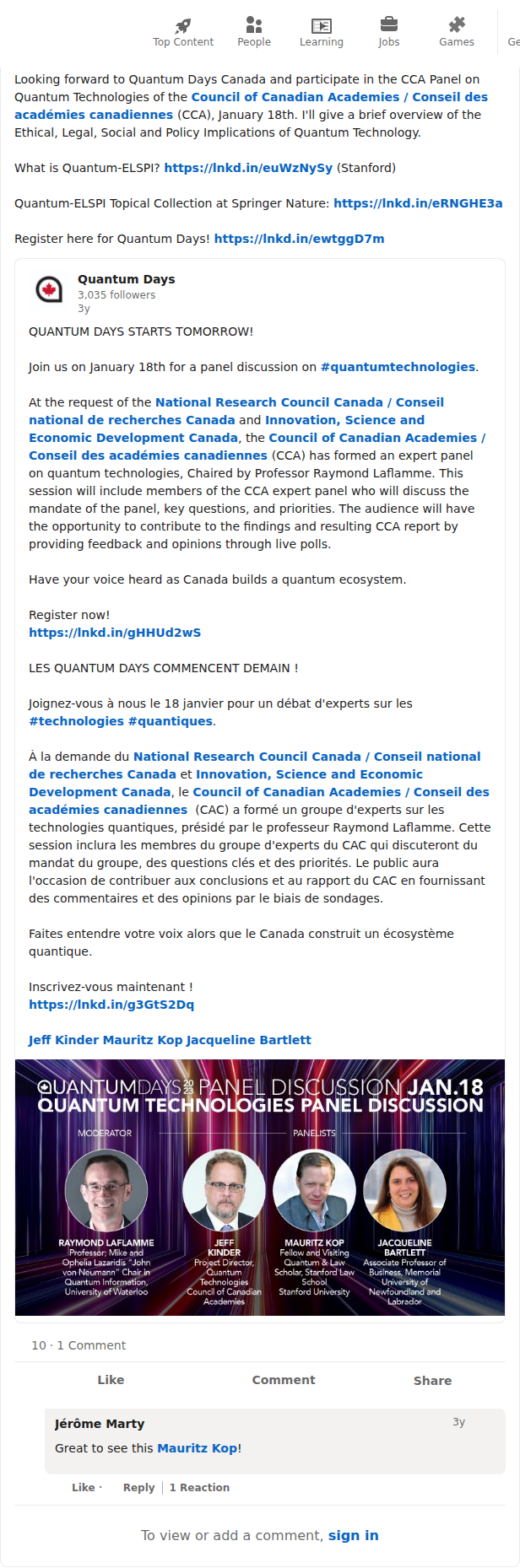
Mauritz Kop's LinkedIn announcement of the CCA panel at Quantum Days 2023, January 2023.
Live polls, public input, and a study that listens before it concludes
The most distinctive feature of the session was procedural. Rather than presenting findings, the panel invited the audience into the evidence base: "The audience will have the opportunity to contribute to the findings and resulting CCA report by providing feedback and opinions through live polls," the conference announced, adding the civic invitation, "Have your voice heard as Canada builds a quantum ecosystem." Public-input mechanisms of this kind are easy to stage and hard to do well, but they reflect a substantive commitment in responsible quantum governance: that the people who will live with a technology's consequences should help frame the questions asked of it, not merely receive the answers.
For Kop, that commitment is not incidental. A recurring theme in his Quantum-ELSPI work is distributive—that the prosperity quantum technologies may bring should be broadly shared, and that equitable access is itself a design question rather than an afterthought. In the panel discussion he pressed the practical edges of that idea: whether codes of conduct and guidelines for responsible quantum design should be adopted, and how to agree on ethics across cultures when ethical norms are themselves culturally contingent. These are the questions that a live-poll format is well suited to surface, because they have no single technically correct answer.
Why the legal and policy lens belongs at a quantum conference
Quantum technologies invite governance precisely because their physics is unfamiliar. Computation that exploits superposition and entanglement does not merely run existing algorithms faster; for specific problems it changes what is computationally tractable, with downstream consequences for cryptography, for sensing, and for the security assumptions baked into existing law and infrastructure. And because an arbitrary unknown quantum state cannot be copied—the no-cloning theorem—quantum communication alters what interception even means, which in turn unsettles legal categories built around the copying and interception of information. Translating those properties into proportionate rules is the work of the ethical, legal, social, and policy lens that Kop brought to the panel.
At the time of the session, Kop was a Fellow at Stanford Law School's Transatlantic Technology Law Forum (TTLF) and a member of the CCA expert panel; his research focused on the ethical, legal, social, and policy implications of quantum technology. The dedicated center he would go on to found at Stanford for responsible quantum technology was still ahead of him in 2023. What the Quantum Days session captured, then, was an early public statement of an agenda—responsible quantum innovation framed as a question of guidelines, equitable access, and cross-cultural ethics—that would shortly find its way into formal Canadian policy analysis.
From a public panel toward a national report
The Quantum Days session is one step in a longer process. The same CCA expert panel, under the same chair, is carrying its study forward through 2023, working toward a national assessment of quantum adoption in Canada, with Kop among its members. The shape of the exercise is already visible: a government-commissioned body opens its questions to the public mid-study, gathers input through live polls and discussion, and aims to translate that deliberation into evidence for decision-makers. It is an early example of how responsible quantum governance might be both expert-led and publicly grounded.
For an emerging technology whose risks and benefits are still being negotiated, the Quantum Days panel offers a notable approach: a national academy treating quantum policy not as a finished product to be announced, but as a public question to be worked out in the open.
Editor's note (later update): the panel's work culminated in the CCA's Quantum Potential report on the responsible adoption of quantum technologies in Canada, published on November 30, 2023, with Kop among its panel members. Its themes carried forward into Canada's continued engagement with responsible-quantum governance—including the Canadian quantum-governance delegation that Kop and Mark Lemley hosted at Stanford in 2024 to inform Canada's G7 presidency.
Last updated: June 6, 2026.