
Mauritz Kop and Mateo Aboy Present QT and Law Research at Lund Quantum Conference
By AIRecht Editor
Lund, Sweden, May 2, 2022—In late April 2022, Mauritz Kop—then a Transatlantic Technology Law Forum (TTLF) Fellow and Visiting Scholar at Stanford Law School—and Mateo Aboy, Principal Research Scholar at the University of Cambridge, presented their research on the intersection of intellectual property law and quantum computing at The Quantum Law Conference, hosted by Lund University. Titled The Legal Dimensions of Quantum Computing, the conference was organized by Valentin Jeutner, Associate Professor in the Department of Law at Lund University and Principal Investigator of The Quantum Law Project, funded under WASP-HS, the Wallenberg Foundations' initiative for humanistic and social-scientific research in AI and autonomous systems. The event brought together legal scholars and technology experts to examine the emerging legal questions raised by the quantum age.

Quantum intellectual property law at Lund University (illustrative editorial image).
A first research home for the law of quantum technology
The Quantum Law Project at Lund University's Faculty of Law is among the first research efforts dedicated specifically to the legal implications of quantum computing. Holding a conference on the subject in April 2022 was, at the time, an early move: the legal scholarship on quantum technology was thin, and most policy attention was still fixed on artificial intelligence. Kop's contribution sat within that broader agenda. His work feeds the Quantum-ELSPI (Ethical, Legal, Social, and Policy Implications) research program, which he is taking forward as a guest-edited topical collection in Springer Nature's journal Digital Society, edited by Professor Luciano Floridi of Oxford University. The animating question at Lund was direct: is the existing intellectual property system equipped for the quantum revolution, or might it stifle the very innovation it is meant to encourage?
A mixed-method approach: theory tested against patent data
The presentation paired a theoretical framework with a data-driven empirical study—an unusual combination in IP scholarship, and one intended to give policymakers an empirical evidence base. The theoretical strand, led by Kop, examined the risk of IP overprotection in quantum computing. It argued that a strategic mixture of overlapping rights—what Kop calls a "rainbow of IP rights," layering patents, copyrights, trade secrets, and related protections—could, in principle, secure near-perpetual advantage for first movers, raising entry barriers for quantum startups and concentrating market power.
That qualitative claim was then put to an empirical test through a patent-landscape study led by Aboy, which analyzed patenting trends in the quantum computing subfield to ask whether "patent thicket" and "anticommons" scenarios were in fact materializing. The distinction matters legally because a great deal of practical quantum know-how—tacit fabrication processes, calibration recipes, control software—resists conventional reverse engineering for reasons of sheer engineering complexity, and so tends to migrate into secrecy rather than into the public, examinable record of the patent system. The physics offers a suggestive analogy here: the no-cloning theorem holds that an unknown quantum state cannot be perfectly copied, a reminder that some quantum information is, by its nature, resistant to faithful duplication. That dynamic shapes what a patent dataset can and cannot reveal about real market power.
Key findings: a counter-intuitive picture
The empirical results, as presented at the conference, were in several respects counter-intuitive:
No current overprotection. The patent data suggested that, at least so far, the patent system in quantum technology was not producing the kind of overprotection that would choke innovation.
An expanding information commons. A substantial volume of quantum patent information was entering the publicly available disclosure record—through non-granted applications and expired patents—creating an expanding "quantum computing information commons" that can itself foster further innovation. (Public disclosure is not the same as freedom to operate: live claims, patent families, and continuations may still apply.)
The trade-secret caveat. The "Achilles heel" of the analysis is secrecy. Innovations protected as trade secrets, or classified as state secrets, do not appear in patent datasets, so a complete picture of market power requires ongoing qualitative analysis alongside the quantitative work.
A balanced system. The presentation concluded that IP law alone cannot resolve every market concern. It must operate in concert with competition law to correct market skewness, and policymakers should pursue a balanced approach that supports healthy competition and sustainable innovation.
Where the research will appear
The theoretical and market-power strand is forthcoming as a peer-reviewed article by Mauritz Kop, Mateo Aboy, and Timo Minssen, "Intellectual property in quantum computing and market power: a theoretical discussion and empirical analysis," in the Journal of Intellectual Property Law & Practice (Oxford University Press). A companion patent-landscape study by Mateo Aboy, Timo Minssen, and Mauritz Kop, "Mapping the Patent Landscape of Quantum Technologies: Patenting Trends, Innovation and Policy Implications," is forthcoming in IIC – International Review of Intellectual Property and Competition Law (Springer). The patent-landscape study reads patenting activity across second-generation quantum technologies—quantum simulation, sensing and metrology, computation, and communication—as an innovation indicator with policy implications.
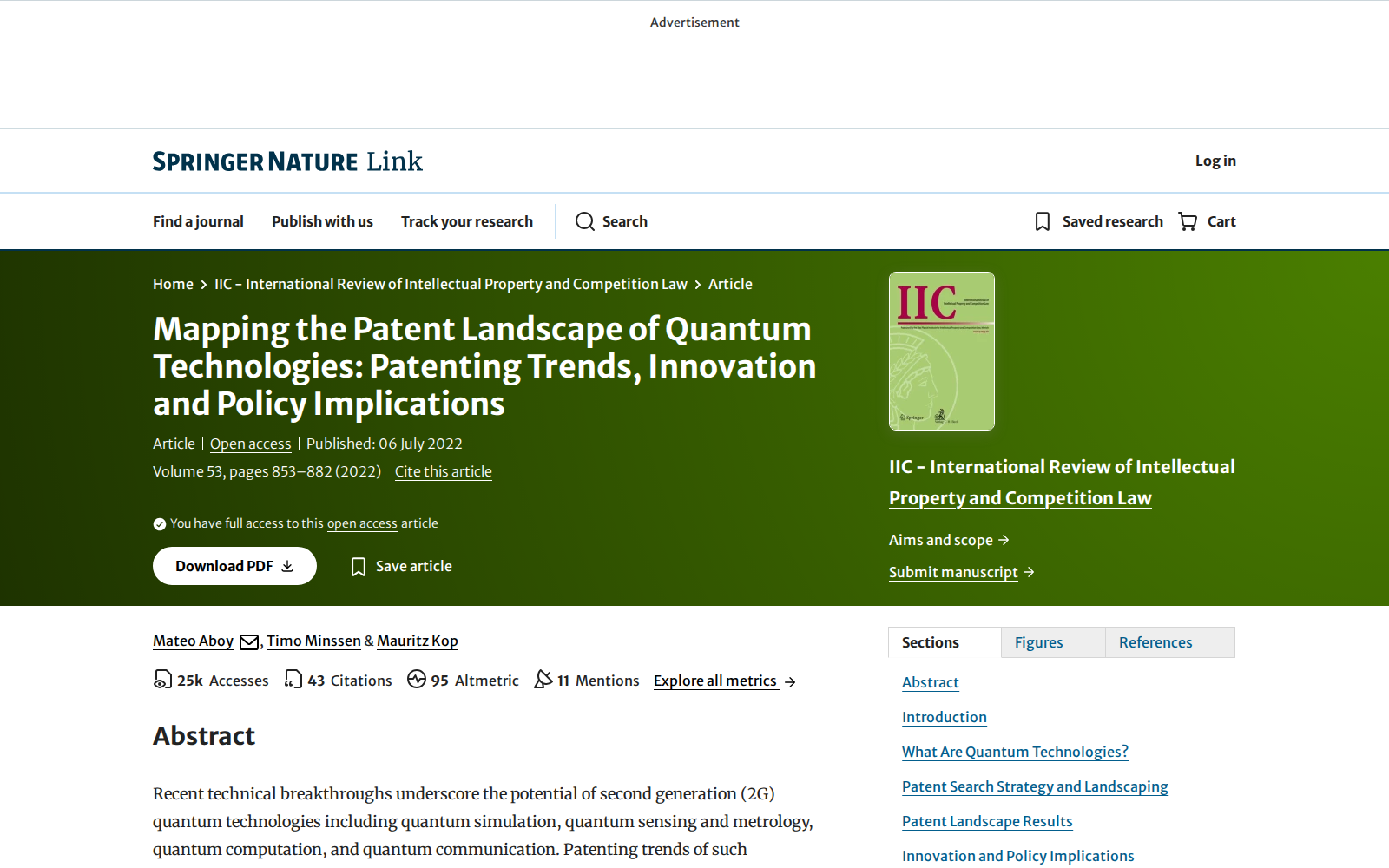
The patent-landscape study by Aboy, Minssen and Kop in IIC (Springer), 2022.
A transatlantic, evidence-based agenda
The collaboration—drawing on Stanford, Cambridge, and the Center for Advanced Studies in Biomedical Innovation Law (CeBIL) at the University of Copenhagen, where Timo Minssen is Professor of Law and Founding Director—reflects a deliberately transatlantic, evidence-based approach to quantum-IP policy. Its through-line is the search for a middle ground between under- and overprotection: enough predictability to attract investment, enough openness to keep the field competitive. That balancing exercise connects the Lund work to Kop's longer-running argument that regulating transformative technology in the quantum age calls for calibrated IP, standardization, and a commitment to sustainable innovation—rather than a reflexive race to maximal protection. The reference activity record for the conference is archived on the Lund University research portal.
Last updated: June 6, 2026.
Watch / cite / read further
Download Presentation PDF. Lund Conference April 2022 – Quantum Computing & Intellectual Property Law
Bluebook. Mauritz Kop, Lund Conference April 2022 – Quantum Computing & Intellectual Property Law (lecture slides / keynote material).
APA. Kop, M. (Lund). Lund Conference April 2022 – Quantum Computing & Intellectual Property Law [Lecture slides / keynote material]. AIRecht.
Read further, Lund quantum-IP blog, Oxford JIPLP quantum-IP article, and AGCM competition-law blog.