
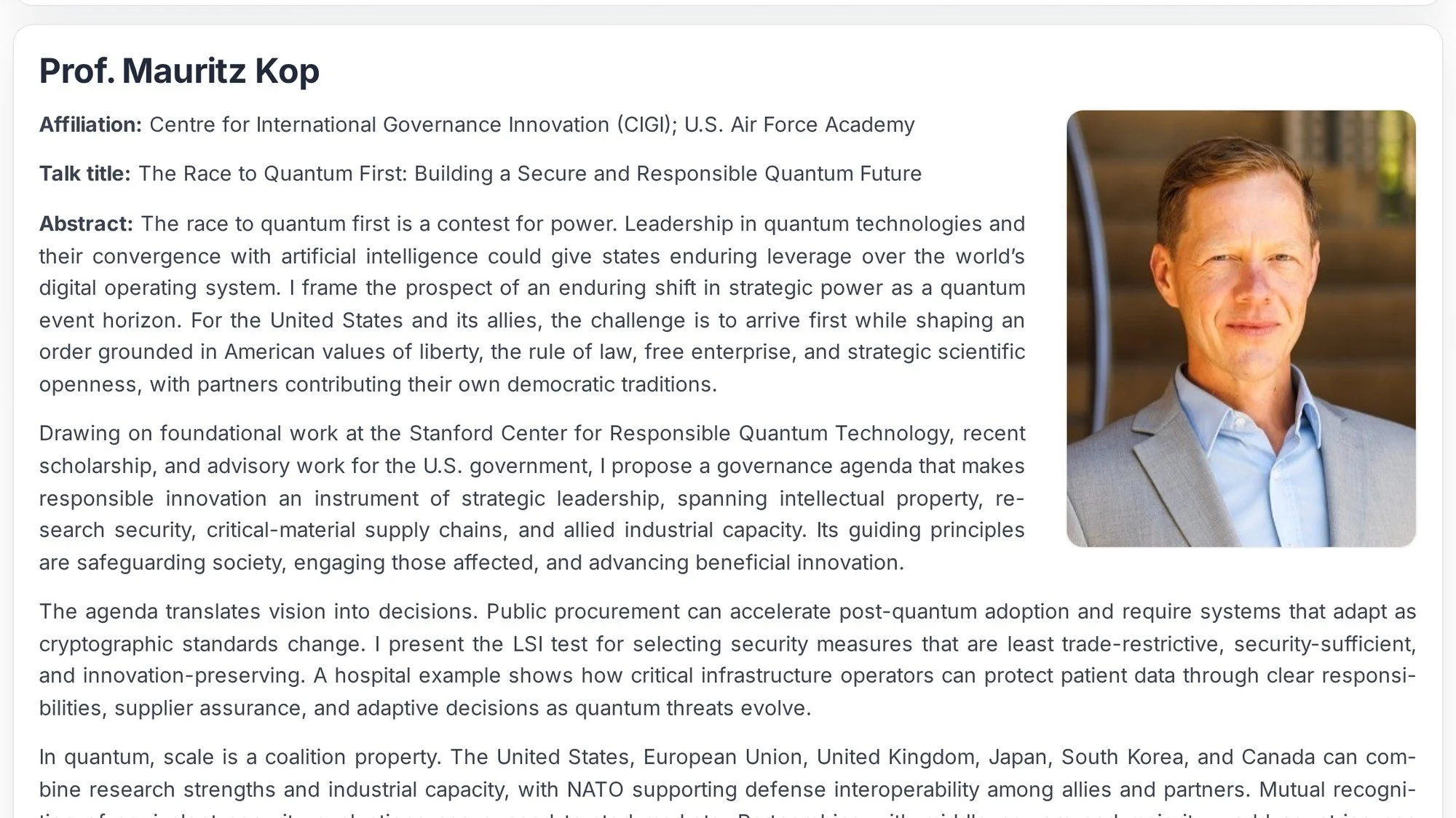
Prof. Mauritz Kop has been invited to speak at ACM PQQS 2026, the inaugural ACM Conference on Post-Quantum and Quantum-based Security, held from November 2 to 4, 2026 in Silicon Valley near San Jose. Kop, Founder of the Stanford Center for Responsible Quantum Technology, is listed with his affiliations at CIGI and the U.S. Air Force Academy, and his talk is titled The Race to Quantum First: Building a Secure and Responsible Quantum Future.
A New ACM SIGSAC Venue With Boneh, Babbush, Preneel, and NIST
ACM's security community launched PQQS as a new annual venue for post-quantum cryptography, quantum cryptography, and the security of quantum computing systems. General Chair Elisa Bertino and program chairs Rei Safavi-Naini and Ashish Kundu assembled a program of twenty-six peer-reviewed papers, keynotes by Dan Boneh, Ryan Babbush of Google Quantum AI, Renato Renner, and Ramana Kompella, invited talks by Bart Preneel, Reza Nejabati, Vipul Goyal, Yevgeniy Dodis, and J.R. Rao, and a panel with NIST's Dustin Moody and Michele Mosca. One of the call's four topic areas covers post-quantum migration policy, regulation, and ecosystem readiness.
Procurement, the LSI Test, and a European Quantum Act
Kop's talk proposes a governance agenda in which responsible innovation becomes an instrument of strategic leadership for the United States and its allies. Public procurement can accelerate post-quantum adoption, and the LSI test from his Nexus paper, indexed in the Harvard-Smithsonian NASA Astrophysics Data System, selects security measures that are least trade-restrictive, security-sufficient, and innovation-preserving. A hospital example shows how operators can protect patient data, and a European Quantum Act architecture would strengthen the EU as a capable allied partner. The talk also weighs a lean, U.S.-led verification body inspired by IAEA safeguards. It builds on Stanford RQT's foundational papers, on his two War on the Rocks essays on the race to quantum first, and on his advisory work for the U.S. Government, including the Pentagon and the Department of State.
Meer lezen