
Prof. Mauritz Kop Invited to Speak at the Inaugural ACM PQQS 2026 in Silicon Valley on the Race to Quantum First
By our Editor
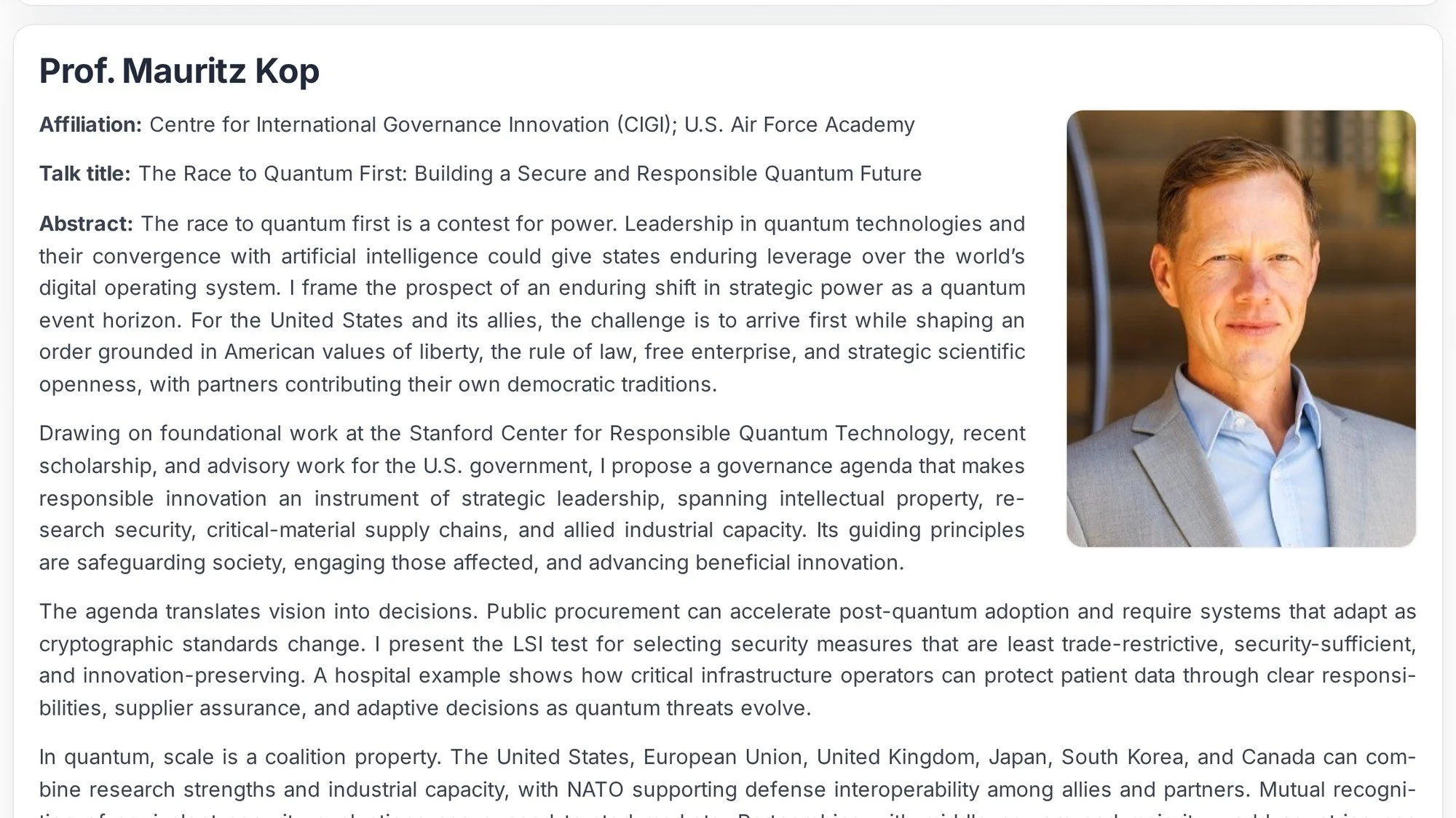
San Jose, California, October 8, 2026. Prof. Mauritz Kop has been invited to speak at ACM PQQS 2026, the inaugural ACM Conference on Post-Quantum and Quantum-based Security, which takes place from November 2 to 4, 2026 in Silicon Valley. Kop, Founder of the Stanford Center for Responsible Quantum Technology (Stanford RQT), is listed on the program with his affiliations at the Centre for International Governance Innovation (CIGI) and the U.S. Air Force Academy. His talk is titled The Race to Quantum First: Building a Secure and Responsible Quantum Future. In a program built largely by cryptographers, physicists, and security engineers, it is the talk devoted to law, geopolitics, and quantum governance.
ACM PQQS 2026: the First ACM SIGSAC Conference on Post-Quantum and Quantum-Based Security
The Association for Computing Machinery's Special Interest Group on Security, Audit and Control (SIGSAC), the community behind the ACM CCS conference, launched PQQS as a new annual venue for research at the intersection of cybersecurity, post-quantum cryptography, quantum cryptography, and quantum computing systems and infrastructures. The first edition convenes at the Embassy Suites by Hilton Milpitas Silicon Valley, a short drive from San Jose. Elisa Bertino of Purdue University serves as General Chair and chairs the steering committee, which includes Moti Yung of Google and Columbia University and Cristina Nita-Rotaru of Northeastern University. Rei Safavi-Naini of the University of Calgary and Ashish Kundu of Cisco Research chair the program committee.
The scientific core of the conference is a double-blind, peer-reviewed call for papers. Twenty-six papers were accepted for the ACM proceedings, on topics ranging from lattice and isogeny cryptography and hash-based signatures to quantum key distribution networks, quantum cloud security, and migration case studies from central banking and finance. One of the four topic areas in the call is devoted to deployment, policy, and ecosystem readiness: certification, compliance, and regulatory frameworks, the economic impact of quantum migration, and standardization guidance. The final day, November 4, is reserved as an industry-academia day on real deployments, standards, and compliance. The National Science Foundation and Cisco support the conference as sponsors.
Keynotes by Dan Boneh, Ryan Babbush, Renato Renner, and Ramana Kompella, and a Panel With NIST's Dustin Moody
The keynote program brings together leading names in cryptography and quantum information. Dan Boneh of Stanford University heads the applied cryptography group, co-directs the computer security lab, and received the 2014 ACM Prize. Ryan Babbush, Director of quantum algorithms and applications research at Google Quantum AI, speaks on The impending threat of quantum cryptanalysis, covering new quantum algorithms against elliptic-curve cryptography. Renato Renner of ETH Zurich works on quantum information theory and the security of quantum key distribution, and Ramana Kompella leads Cisco Research.
Kop shares the invited-speaker program with five distinguished colleagues: Bart Preneel of KU Leuven, past president of the International Association for Cryptologic Research and winner of the 2014 RSA Award for Excellence in Mathematics, on post-quantum migration and policy; Reza Nejabati of Cisco on a quantum-enhanced internet; Vipul Goyal of NTT Research and Carnegie Mellon University on quantum uncloneability; Yevgeniy Dodis of New York University on secure messaging in the post-quantum world, including Signal's transition; and J.R. Rao, IBM Fellow and CTO for security research, on securing quantum-centric supercomputing. A panel on the transition to quantum-safe security brings together Dustin Moody, who leads the NIST post-quantum cryptography project, and Michele Mosca of the University of Waterloo and evolutionQ, who helped create the Open Quantum Safe project.
Why a Cryptography Conference Invites a Legal Scholar in 2026
Preneel's abstract notes that governments are introducing post-quantum migration deadlines around 2030 and 2031, that hardware replacement is far more costly than software updates, and that diverging national policies risk fragmenting global markets. One of the accepted papers reports on crypto-agility experiments at a central bank, and another proposes a post-quantum ledger protocol for financial institutions. Many of the open questions the engineering community now faces concern deadlines, liability, procurement, certification, and international coordination.
Those are the questions Kop has studied since his first quantum law publications. A migration deadline is a legal instrument, a procurement clause allocates risk between buyer and vendor, and the mutual recognition of security evaluations decides whether a product certified in one allied country can be sold in another. Bringing that perspective into an ACM SIGSAC venue gives cryptographers and security engineers a shared vocabulary with regulators, and it gives lawyers direct access to the people who build the systems.
What Kop's Talk Proposes: Public Procurement, the LSI Test, and a Hospital Example
The abstract opens with a clear thesis: the race to quantum first is a contest for power, and leadership in quantum technologies and their convergence with AI could give states enduring leverage over the world's digital operating system. Kop frames that prospect as a quantum event horizon. For the United States and its allies, the challenge is to arrive first while shaping an order grounded in liberty, the rule of law, free enterprise, and strategic scientific openness. Drawing on Stanford RQT's foundational work, recent scholarship, and his advisory work for the U.S. Government, he proposes an agenda that makes responsible innovation an instrument of strategic leadership across intellectual property, research security, critical-material supply chains, and allied industrial capacity.
Public procurement can accelerate post-quantum adoption and require systems that adapt as cryptographic standards change, a line that runs back to Kop's November 2025 essay in War on the Rocks, A Bletchley Park for the Quantum Age, which called on the General Services Administration, the Office of Management and Budget, and agency acquisition chiefs to buy only validated post-quantum cryptography. In August 2026 GSA announced that it leads the federal transition to quantum-resistant technology.
The talk also presents the LSI test for selecting security measures that are least trade-restrictive, security-sufficient, and innovation-preserving. Kop set out the test in his 2026 paper on the nexus of quantum technology, intellectual property, and national security, which anchors his CIGI Quantum Nexus project, and presented it in an essay for the JETLaw Blog of Vanderbilt's Journal of Entertainment and Technology Law in April 2026. The paper is indexed in the NASA Astrophysics Data System at the Center for Astrophysics | Harvard & Smithsonian, which brings the legal test to the physics and astronomy research community, as AIRecht reported in August 2026.
The talk includes a hospital example that shows how critical infrastructure operators can protect patient data through clear responsibilities, supplier assurance, and adaptive decisions as quantum threats evolve. Readers of AIRecht will recognize the line from Kop's Hippocratic Quantum essay for Harvard Law School's Petrie-Flom Center, which argued that health data must be protected for its full lifetime, including against decryption by future quantum computers.
A European Quantum Act and an IAEA-Inspired Verification Body: the Coalition Architecture in the Talk
The abstract also turns to alliances. In Kop's phrase, scale in quantum is a coalition property. The United States, the European Union, the United Kingdom, Japan, South Korea, and Canada can combine research strengths and industrial capacity, with NATO supporting defense interoperability. Mutual recognition of equivalent security evaluations can expand trusted markets, and partnerships with middle powers and majority-world countries can strengthen adoption while giving those countries a role in shaping the emerging order.
For European readers the most relevant proposal is a European Quantum Act architecture that would strengthen the EU as a sovereign and capable allied partner by linking industrial ambition to accountable deployment. Kop developed the two-pillar model in Towards a European Quantum Act, published in the Columbia Journal of European Law, and he provided policy recommendations on the EU Quantum Act to the European Commission. The talk also weighs the merits and limits of a lean, U.S.-led international body inspired by IAEA safeguards that could verify commitments on cryptographically relevant quantum capabilities. Kop argued for a comparable institution, an Atomic Agency for Quantum and AI, in his keynote at the World Quantum Summit in Washington, D.C. in May 2025. The central claim is that responsible governance can help democracies gain and sustain technological advantage, and that the strategic prize is the capacity to shape the infrastructure others adopt and the standards they trust.
From Stanford Law School to Silicon Valley: the Talks and Publications Behind the Invitation
The invitation builds on a long series of appearances. Kop chaired the Stanford Responsible Quantum Technology Conferences at Stanford Law School in 2023 and 2024 and founded the Stanford Quantum Incubator. Stanford RQT, which he led as Executive Director from 2023 to 2025, informed the G7 Kananaskis quantum policy agenda. He spoke at the University of Oxford in November 2025, gave the keynote at TU Munich's International Quantum Forum in January 2025, taught quantum governance at the U.S. Air Force Academy, and briefed the Center for a New American Security for its 2026 quantum networking report. In 2024 the U.S. Department of State consulted him on quantum technology and foreign policy strategy, and he advises the U.S. Government, including the Pentagon, on quantum strategy and policy.
The publications that support the San Jose talk include the 2021 Yale Journal of Law and Technology article Establishing a Legal-Ethical Framework for Quantum Technology, the Ten Principles for Responsible Quantum Innovation (IOP, 2024), the Nature Physics call for responsible quantum technology (2024), the standards-first proposal in Science (2025), and the War on the Rocks essay Before Q-Day: The Race to Quantum First, written with Joseph Federici and published on July 20, 2026. Stanford University Libraries preserves the Stanford RQT body of work in a permanent repository.
AIRecht congratulates Elisa Bertino, Rei Safavi-Naini, Ashish Kundu, and the ACM SIGSAC community on launching this conference. Early registration closes on October 12, 2026, and student travel grants are available through the conference website. Organizations preparing their own post-quantum migration can start with a structured reading of their technology contracts in the AIRecht contract scan.
Last updated: October 8, 2026