Innovation, Quantum-AI Technology & Law

Blog over Kunstmatige Intelligentie, Quantum, Deep Learning, Blockchain en Big Data Law

Blog over juridische, sociale, ethische en policy aspecten van Kunstmatige Intelligentie, Quantum Computing, Sensing & Communication, Augmented Reality en Robotica, Big Data Wetgeving en Machine Learning Regelgeving. Kennisartikelen inzake de EU AI Act, de Data Governance Act, cloud computing, algoritmes, privacy, virtual reality, blockchain, robotlaw, smart contracts, informatierecht, ICT contracten, online platforms, apps en tools. Europese regels, auteursrecht, chipsrecht, databankrechten en juridische diensten AI recht.

Berichten in Quantum governance
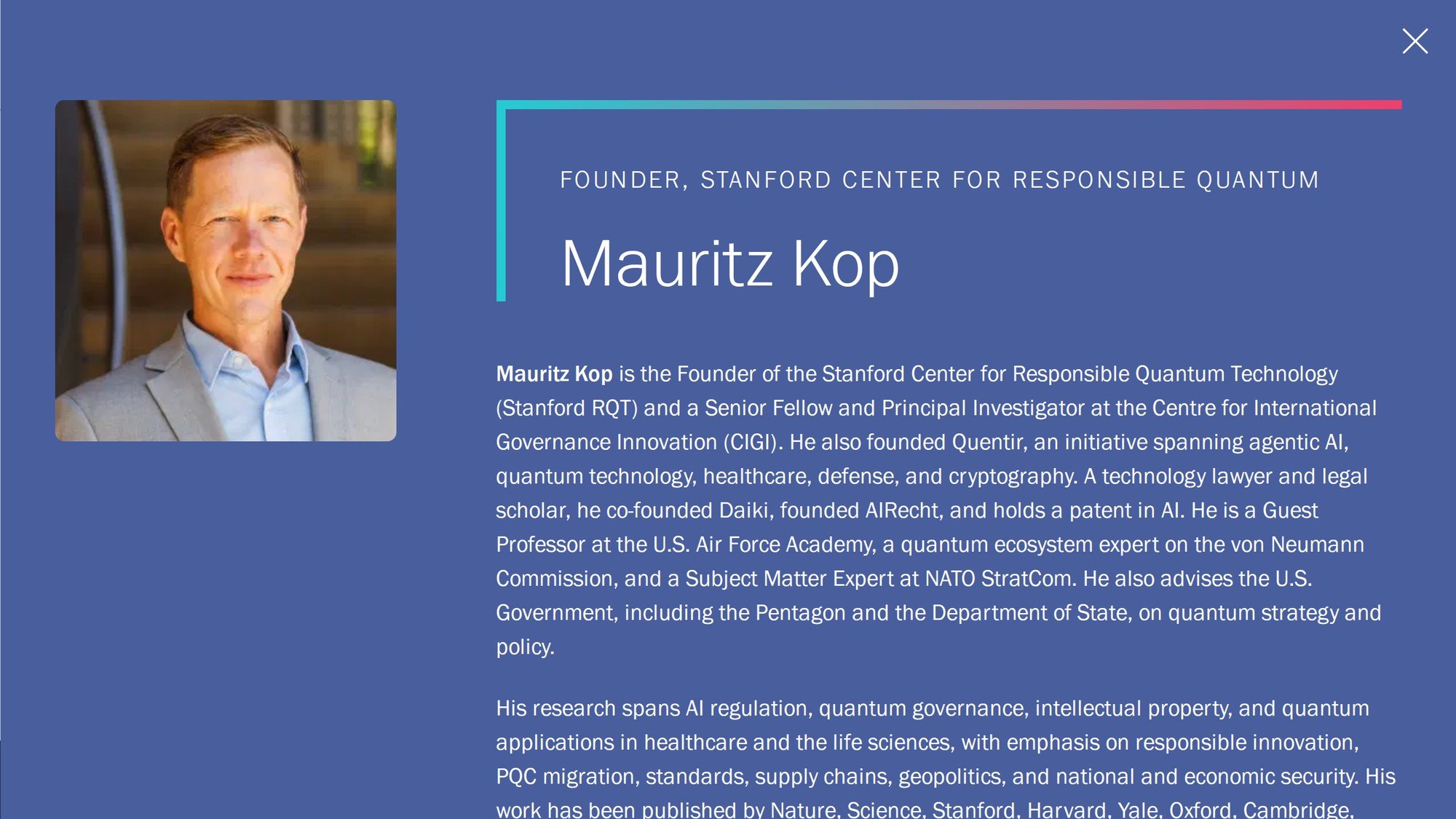
Prof. Mauritz Kop Invited to Speak at Quantum Innovation 2026 in Nagoya on Responsible Quantum Innovation and the Post-Quantum Transition

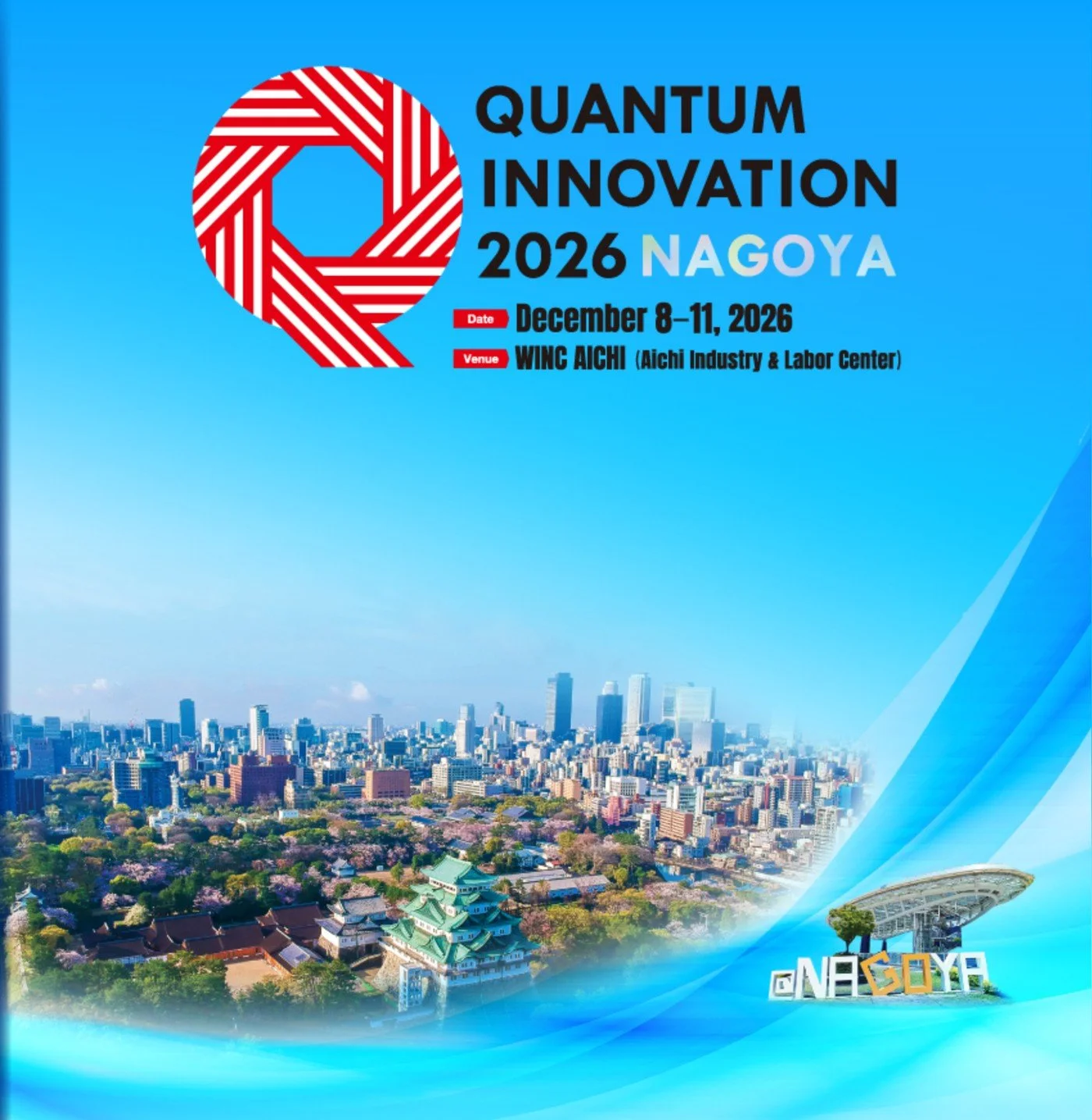
Prof. Mauritz Kop has been invited to speak at Quantum Innovation 2026, the International Symposium on Quantum Science, Technology and Innovation, held from December 8 to 11, 2026 at WINC AICHI in Nagoya. The symposium is organized by Japan's Quantum Technology Innovation Hubs with the support of the Government of Japan and JST. Kop closes the session on Practical Quantum Computing on December 8 with a talk on the legal and governance side of quantum security, titled Before Q-Day: Responsible Quantum Innovation, Standards, and the Post-Quantum Transition.

Japan's National Quantum Symposium Comes to Nagoya

Co-organized by Japan's Cabinet Office, three ministries, JST, RIKEN, AIST, NICT, Q-STAR, and leading universities, and sponsored by Fujitsu, Toyota, Toshiba, and Hitachi, the symposium covers quantum computing, sensing, and cryptography over four days, with a closing day on Japan's Moonshot goal of a fault-tolerant quantum computer. The program spans quantum computing, the post-quantum transition, and quantum networks. Keynotes come from Dorit Aharonov, Amir Yacoby, and Hoi-Kwong Lo, and the invited speakers include Elham Kashefi, Google Quantum AI, IonQ, Intel, and RIKEN. A Japan-Netherlands matchmaking workshop on December 9 links the Dutch and Japanese ecosystems, and Kop will also visit a quantum computer in Japan with the delegation. Participation is free; registration closes on November 22.

Standards, Certification, and the LSI Test for the Post-Quantum Transition

Following two talks on quantum cryptanalysis, Kop speaks from 5:40 to 6:10 PM Japan time on responsible quantum innovation, standards, and the post-quantum transition. He brings Stanford RQT's foundational work, the Quantum-ELSPI framework, and the LSI test from his Nexus paper, which asks that security measures be least trade-restrictive, security-sufficient, and innovation-preserving. Nagoya joins his forthcoming engagements at CIGI, the University of Virginia, and ACM. Our article also profiles Japan's quantum computers at RIKEN, Fujitsu, Quantinuum, and IBM, and a panel on certifying quantum key distribution.

Meer lezen
Prof. Mauritz Kop Chairs CIGI Quantum Nexus Workshop and Roundtable on Quantum, Intellectual Property, and National Security

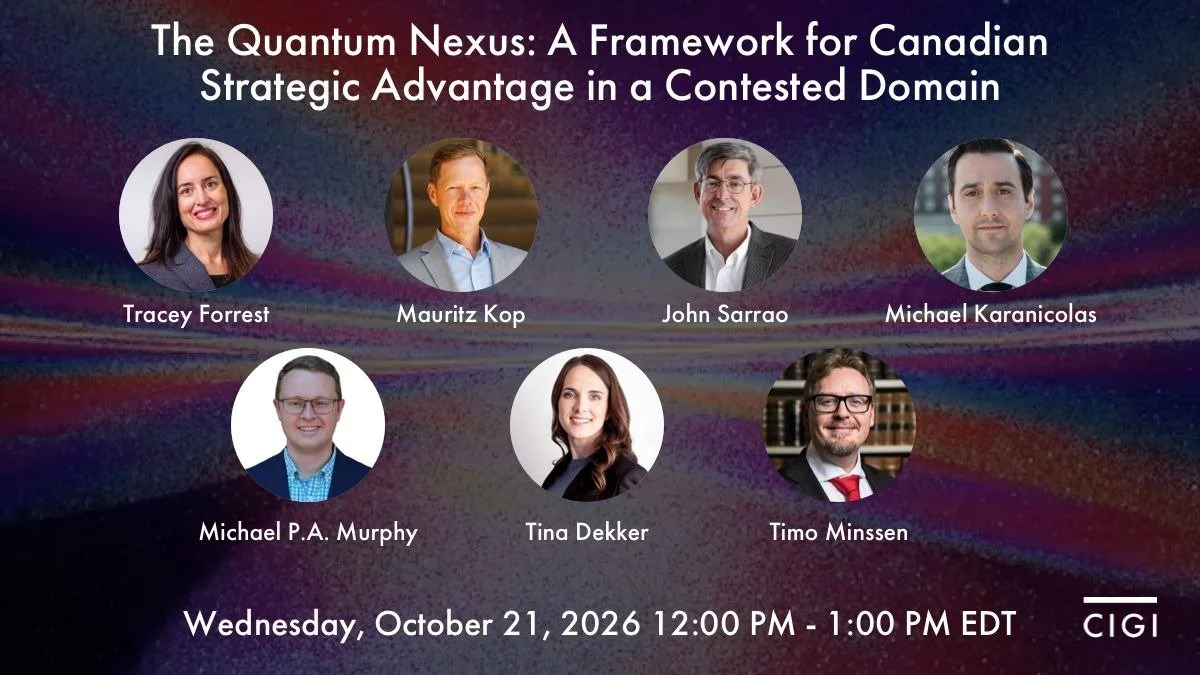
On Wednesday, October 21, 2026, Prof. Mauritz Kop chairs the CIGI Quantum Nexus workshop in Waterloo: a public online expert panel from 12:00 to 1:00 PM Eastern Time, followed by a closed-door roundtable. As Senior Fellow and Principal Investigator at the Centre for International Governance Innovation, Kop leads the project The Quantum Nexus: A Framework for Canadian Strategic Advantage in a Contested Domain, funded through the Department of National Defence's MINDS program.

Five Panelists, a Senior Roundtable, and Six Emerging Scholars

The panel brings together John Sarrao (SLAC National Accelerator Laboratory), Michael Karanicolas (Dalhousie University), Tina Dekker, Michael P. A. Murphy (Queen's University), and Timo Minssen (University of Copenhagen), with CIGI's Tracey Forrest. The roundtable, held under the CIGI Rule, includes the Privy Council Office's Dominic Rochon, the Canadian Intellectual Property Office's Konstantinos Georgaras, former U.S. Assistant Secretary of Commerce Kevin J. Wolf, Michele Mosca, Larry Diamond, and Los Alamos physicist Alan J. Hurd. Six emerging scholars from universities across Canada, personally selected and mentored by Kop, join the day and will write analytical notes for the project's final CIGI report.

The LSI Test and Kop's Work With Canada Since 2022

The workshop builds on Kop's Nexus paper, indexed in the Harvard-Smithsonian NASA Astrophysics Data System, and its LSI test for security measures that are least trade-restrictive, security-sufficient, and innovation-preserving. It continues his work on the Council of Canadian Academies expert panel chaired by the late Raymond Laflamme, his CIGI policy brief with Tracey Forrest, and his War on the Rocks essays. Our article also traces CIGI's history, from its founding by BlackBerry's Jim Balsillie, with a founding gift from Mike Lazaridis, to its role among G7 think tanks. The public panel will be recorded, and registration for the online session is open to everyone on the CIGI event page.

Meer lezen
Prof. Mauritz Kop Invited to Speak at the Inaugural ACM PQQS 2026 in Silicon Valley on the Race to Quantum First

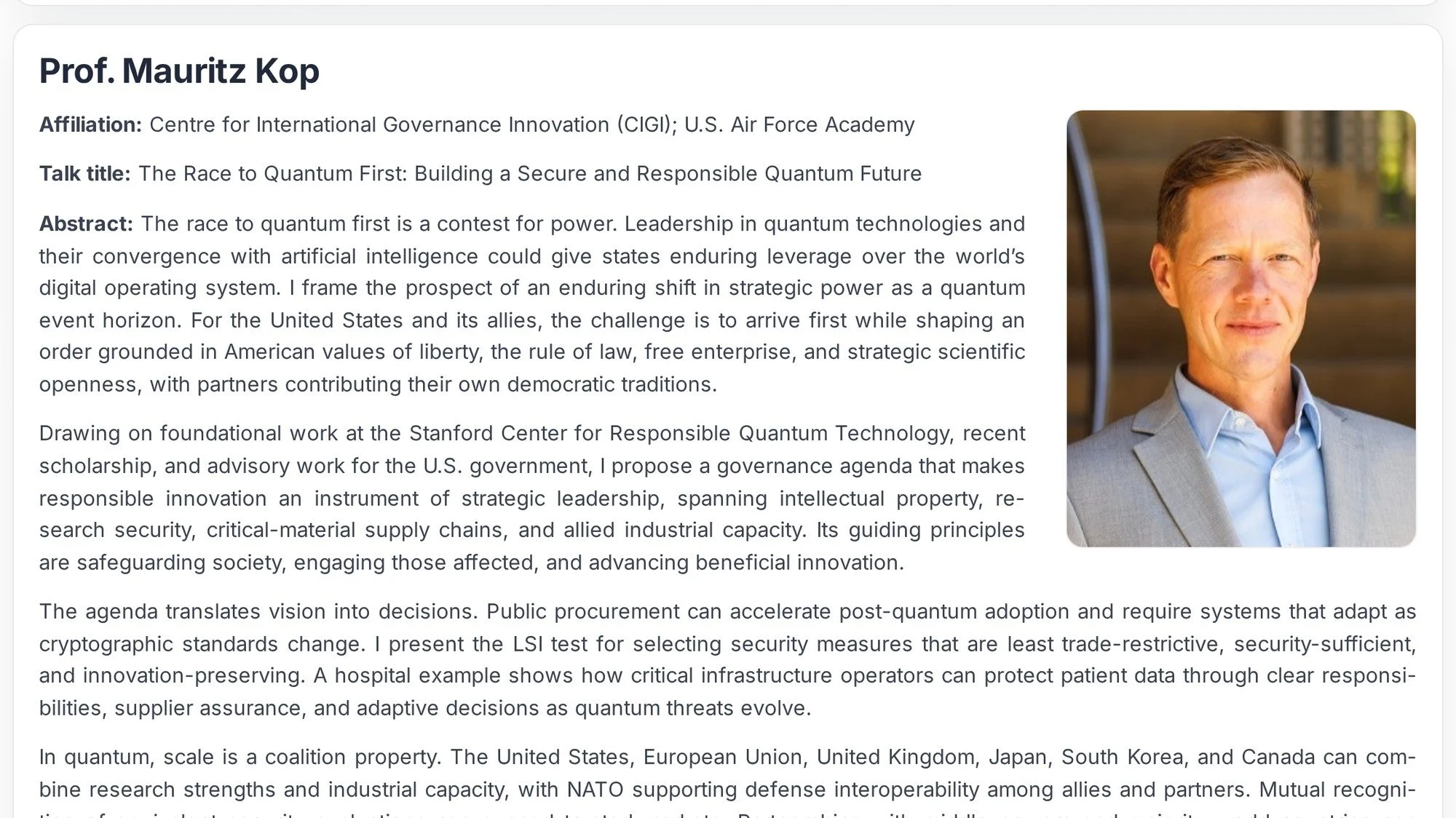
Prof. Mauritz Kop has been invited to speak at ACM PQQS 2026, the inaugural ACM Conference on Post-Quantum and Quantum-based Security, held from November 2 to 4, 2026 in Silicon Valley near San Jose. Kop, Founder of the Stanford Center for Responsible Quantum Technology, is listed with his affiliations at CIGI and the U.S. Air Force Academy, and his talk is titled The Race to Quantum First: Building a Secure and Responsible Quantum Future.

A New ACM SIGSAC Venue With Boneh, Babbush, Preneel, and NIST

ACM's security community launched PQQS as a new annual venue for post-quantum cryptography, quantum cryptography, and the security of quantum computing systems. General Chair Elisa Bertino and program chairs Rei Safavi-Naini and Ashish Kundu assembled a program of twenty-six peer-reviewed papers, keynotes by Dan Boneh, Ryan Babbush of Google Quantum AI, Renato Renner, and Ramana Kompella, invited talks by Bart Preneel, Reza Nejabati, Vipul Goyal, Yevgeniy Dodis, and J.R. Rao, and a panel with NIST's Dustin Moody and Michele Mosca. One of the call's four topic areas covers post-quantum migration policy, regulation, and ecosystem readiness.

Procurement, the LSI Test, and a European Quantum Act

Kop's talk proposes a governance agenda in which responsible innovation becomes an instrument of strategic leadership for the United States and its allies. Public procurement can accelerate post-quantum adoption, and the LSI test from his Nexus paper, indexed in the Harvard-Smithsonian NASA Astrophysics Data System, selects security measures that are least trade-restrictive, security-sufficient, and innovation-preserving. A hospital example shows how operators can protect patient data, and a European Quantum Act architecture would strengthen the EU as a capable allied partner. The talk also weighs a lean, U.S.-led verification body inspired by IAEA safeguards. It builds on Stanford RQT's foundational papers, on his two War on the Rocks essays on the race to quantum first, and on his advisory work for the U.S. Government, including the Pentagon and the Department of State.

Meer lezen
Prof. Mauritz Kop Invited to Co-Opting AI: Quantum at the University of Virginia, With Paul Davies, Shohini Ghose, and Host Mona Sloane

Prof. Mauritz Kop, Founder of the Stanford Center for Responsible Quantum Technology, has been invited to speak at Co-Opting AI: Quantum, a public conversation hosted by the University of Virginia's Digital Technology for Democracy Lab, NYU's Institute for Public Knowledge, and Sloane Lab. The online event takes place on Wednesday, October 28, 2026, from 4:00 to 5:15 PM Eastern Time, with the physicists Paul Davies of Arizona State University and Shohini Ghose of Wilfrid Laurier University, and with Professor Mona Sloane as host.

Episode 55 of Mona Sloane's Co-Opting AI Series Turns to Quantum

Mona Sloane's Co-Opting AI series has gathered leading scholars on technology and society since April 2019, from Alondra Nelson and Virginia Eubanks on Justice to Sandra Wachter on the GDPR and Danielle Keats Citron on Privacy. The quantum episode is the series' fifty-fifth and its first on quantum technology. The organizers frame it around one idea: quantum computing is arriving into institutions, supply chains, and geopolitical formations shaped by AI, and that inheritance will shape how quantum develops as a technological and social phenomenon. For lawyers who work on AI governance, this is the moment the familiar questions of liability, access, and accountability move to the next technology.

Stanford RQT Scholarship and Kop's Talks From Oxford to Washington

Kop brings the body of work that defined responsible quantum technology: the Yale Journal of Law and Technology article on a legal-ethical framework for quantum technology, the Ten Principles for Responsible Quantum Innovation, the Nature Physics call for responsible quantum technology, the Science article on standards-first governance, and the Quantum-ELSPI research field. The invitation follows his talks at Oxford, TU Munich, CNAS, CIGI, and Stanford Law School, his two War on the Rocks essays, and his advisory work for the U.S. Government, including the Pentagon and the Department of State. The session is open to the public and will be recorded for those who register.

Meer lezen
Rijksbrede Quantumstrategie van 5 oktober 2026: het PQC-tijdpad tot 2035, quantumveilige eisen bij rijksinkoop uiterlijk eind 2028 en de NAVO Quantum Technology Roadmap

Op 5 oktober 2026 stuurde het kabinet de Rijksbrede Quantumstrategie naar de Tweede Kamer. Het meest concrete hoofdstuk gaat over post-quantumcryptografie: een tijdpad waarin rijksoverheidsorganisaties hun versleuteling stap voor stap quantumveilig maken. Uiterlijk eind 2026 staat het quantumrisico in hun risicomanagement en hebben zij een eigen cryptografiebeleid. Uiterlijk eind 2027 is er een (concept-)migratieplanning. Uiterlijk eind 2030 zijn toepassingen met een hoog risico gemigreerd, en uiterlijk eind 2035 volgt het gemiddelde risico.

Waarom eind 2028 telt voor leveranciers

Uiterlijk eind 2028 moeten rijksorganisaties bij inkoop en aanbesteding eisen kunnen stellen over quantumveilige cryptografie, met aandacht voor contractmanagement. Software die in 2028 wordt ingekocht, draait vaak tot ver na 2030. Een leverancier die nu een cryptografische inventaris, crypto-agility en een migratiepad met data kan laten zien, staat sterker bij de volgende aanbesteding. Het artikel bevat vijf vragen die een aanbestedende dienst vanaf 2028 redelijkerwijs kan stellen.

Wat het tijdpad wel en niet verplicht

Het tijdpad is intern rijksbeleid en schept zelf geen wettelijke plicht voor bedrijven. Daarnaast geldt sinds 15 augustus 2026 de Cyberbeveiligingswet voor essentiële en belangrijke entiteiten, en uiterlijk eind 2028 komen er rijksrichtlijnen om essentiële bedrijven richting te geven over de migratie. De strategie zet QKD voor informatiebeveiliging bij de Rijksoverheid op dit moment niet in, vanwege bezwaren van meerdere Europese veiligheidsdiensten.

Ontcijferen en de NAVO-roadmap

Dezelfde strategie ziet in een toekomstige quantumcomputer kansen voor politie en inlichtingendiensten om versleutelde criminele communicatie te ontcijferen. Dat is een beleidsvoornemen zonder nieuwe bevoegdheid: het Wetboek van Strafvordering en de Wiv 2017 blijven de grens trekken. De NAVO publiceerde op 29 september 2026 een samenvatting van haar Quantum Technology Roadmap, met een proefverbinding tussen Brussel en Mons in het vierde kwartaal van 2027 en zonder einddatum voor PQC. Nederland zit tot en met mei 2027 de Transatlantic Quantum Community van de NAVO voor.

Meer lezen
EBA, EIOPA en ESMA op 23 september 2026: frontier-AI, quantumcomputing en niet-EU-leveranciers als risico voor banken en verzekeraars. Wat DORA en de AI Act vragen

Wat de Europese toezichthouders op 23 september 2026 publiceerden

EBA, EIOPA en ESMA publiceerden op 23 september 2026 hun gezamenlijke risico-update voor het najaar (JC 2026 29). Het rapport is een samenvatting van de risicobeoordeling die de drie toezichthouders voorleggen aan de Financial Stability Table van het Economisch en Financieel Comité. Het behandelt drie thema's: de afhankelijkheid van de Europese financiële sector van partijen buiten de EU, de samenhang van die afhankelijkheid met cyber- en AI-risico, en private credit. Volgens een enquête van de EBA noemt ongeveer 80 procent van de banken de afhankelijkheid van ICT-dienstverleners buiten de EU/EER de grootste uitdaging. Cloud, software, betalingsverkeer, clearing en kredietbeoordelingen lopen voor een groot deel via ondernemingen buiten de Unie.

Frontier-AI en quantumcomputing als risico voor de financiële sector

De toezichthouders schrijven dat frontier-AI-modellen kwetsbaarheden in IT-systemen met grote snelheid en op grote schaal kunnen vinden en uitbuiten, ook nog onbekende zero-day-lekken. Over quantumcomputing staat er dat een geavanceerde quantumcomputer cryptografie kan ondermijnen die communicatie, transacties, databases en blockchains beveiligt, dat die dreiging zich eerder kan voordoen dan een bruikbare commerciële toepassing, en dat gegevens die vandaag worden onderschept later kunnen worden ontsleuteld. Wie op een klein aantal leveranciers buiten de EU steunt, loopt die risico's via schakels die hij niet zelf beheert. Het artikel legt de verbinding met Herstatt-risico, het afwikkelingsrisico dat zichtbaar werd bij de sluiting van Bankhaus Herstatt op 26 juni 1974: tegenpartijen hadden hun Duitse marken betaald en ontvingen de dollars in New York nooit.

Wat DORA en de AI Act nu al vragen

DORA (Verordening (EU) 2022/2554) geldt sinds 17 januari 2025 en regelt in de artikelen 28 tot en met 31 het beheer van ICT-derdenrisico, concentratierisico, de minimale inhoud van contracten en het Europese toezicht op kritieke ICT-aanbieders. Artikel 6, lid 4, van Gedelegeerde Verordening (EU) 2024/1774 verplicht instellingen om in hun encryptiebeleid op te nemen hoe zij hun cryptografie waar nodig aanpassen op basis van ontwikkelingen in de cryptoanalyse; een vaste overstapdatum voor post-quantumalgoritmen staat er niet in. De AI Act voegt eisen toe aan AI-systemen met een hoog risico (artikel 15) en aan aanbieders van modellen die als model met een systeemrisico zijn geclassificeerd (artikelen 51 en 55), met overgangstermijnen tot 2 augustus 2027 voor modellen die al vóór 2 augustus 2025 in de handel waren. Het artikel eindigt met vijf vragen voor bestuur en inkoop bij een ICT-contract onder DORA, over datalocatie, concentratie, post-quantumcryptografie, AI-componenten en exit, en legt uit waarom dit rapport voor Nederlandse banken, verzekeraars, pensioenfondsen en hun leveranciers een ijkpunt is.

Meer lezen
Genesis Q (DOE, 17 september 2026): 215 miljoen dollar, in fase II pas bij 100 aangetoonde logische qubits. Wat dit betekent voor Europese quantuminkoop onder Richtlijn 2014/24/EU

Wat het DOE op 17 september 2026 uitzette

Het Amerikaanse Department of Energy kondigde op 17 september 2026 de Quantum Genesis Q Competition aan: tot 215 miljoen dollar, met in fase I vaste bedragen tot 1,5 miljoen dollar per deelnemer voor vroege mijlpalen en in fase II een pot van 100 miljoen dollar voor wie een foutbestendige quantumcomputer met ten minste 100 logische qubits demonstreert, plus bonuspotten van 50 miljoen dollar voor 150 en 200 logische qubits. Aanvragen sluiten op 19 oktober 2026. Van het bedrag is in 2026 slechts 2,5 miljoen dollar beschikbaar; de rest hangt af van het Congres. Naast de prijs financiert het DOE een apart keuringstestbed van 45 miljoen dollar bij de nationale laboratoria, los van de prijzenpot. In het rapport van de SCAC Quantum Subcommittee van september 2026 bepleiten geïnterviewde partijen onafhankelijke, reproduceerbare benchmarks die steeds tegen de beste klassieke methode worden afgezet, en inkoop op basis van aangetoonde prestaties in plaats van alleen roadmaps van leveranciers.

Waarom de definitie van een logische qubit het prijzengeld verdeelt

Een logische qubit is een prestatieclaim die afhangt van de foutcorrectiecode, de codeafstand, de decoder en het foutmodel. Twee leveranciers kunnen met dezelfde fysieke qubits tot verschillende aantallen komen. Wie de definitie in de stukken schrijft, bepaalt wie wint. Het artikel legt de constructie naast de Longitude Act van 1714, waarin het Britse parlement een prijs uitloofde die pas na een proefvaart en een oordeel van de Board of Longitude werd uitbetaald, en laat zien dat het conflict tussen Harrison en de Board over de acceptatievoorwaarden de waarschuwing is die in 2026 nog geldt.

Wat Europese en Nederlandse inkopers hiermee kunnen

Richtlijn 2014/24/EU kent met het innovatiepartnerschap van artikel 31 en de prestatiegerichte specificaties van artikel 42 de instrumenten om betaling aan een gedemonstreerd resultaat te koppelen; de Aanbestedingswet 2012 neemt ze over in de artikelen 2.31a, 2.75 en 2.76. Het gelijkheids- en transparantiebeginsel eisen dan wel dat de meetmethode vooraf vastligt en niet tijdens de rit wordt bijgesteld; de keurende partij vooraf benoemen is een praktische aanbeveling om belangenconflicten te vermijden. De Quantum Europe Strategy van 2 juli 2025 beloofde een Quantum Act die de gemeenschappelijke benchmark zou kunnen dragen; die verordening is er nog niet. Het Nationaal Groeifonds werkt bij Quantum Delta NL al met fasen van 54, 228 en 333 miljoen euro en met mijlpalen als subsidieverplichting in de beschikking van 18 december 2025; die gepubliceerde beschikking noemt zelf geen door een onafhankelijk laboratorium bevestigd aantal logische qubits als betalingsvoorwaarde. Het artikel sluit af met vijf vragen die elke Europese quantuminkoper of subsidiegever nu in de stukken moet zetten, van de codeafstand tot de eigendom van de meetdata.

Meer lezen