

Innovation, Quantum-AI Technology & Law

Blog over Kunstmatige Intelligentie, Quantum, Deep Learning, Blockchain en Big Data Law

Blog over juridische, sociale, ethische en policy aspecten van Kunstmatige Intelligentie, Quantum Computing, Sensing & Communication, Augmented Reality en Robotica, Big Data Wetgeving en Machine Learning Regelgeving. Kennisartikelen inzake de EU AI Act, de Data Governance Act, cloud computing, algoritmes, privacy, virtual reality, blockchain, robotlaw, smart contracts, informatierecht, ICT contracten, online platforms, apps en tools. Europese regels, auteursrecht, chipsrecht, databankrechten en juridische diensten AI recht.

Berichten in Governance
Mauritz Kop Advises Yale Law School's Lowenstein Human Rights Project on Quantum Technology and Human Rights

In November 2022, the Lowenstein Project at Yale Law School—the student-led human rights group founded in 1981 under the Schell Center for International Human Rights—reached out to Mauritz Kop for his expertise on quantum technology and human rights. The team was working on a background policy memorandum, in association with the Seoul National University Artificial Intelligence Policy Initiative and the Korean Mission to the United Nations in Geneva, to support a proposed new U.N. Special Rapporteurship on human rights in the development of new technologies. Their question was practical and revealing: how does a layperson "get smart" on quantum?

Lawyers seeking to make a hard field legible

The outreach was, in the project's own words, "primarily focused on the research process, especially from a lay perspective." The questions concerned method, not conclusions—where to begin, how to sequence the material, which kinds of technical understanding human rights applications actually require, and whom else to consult. Kop shared his insights into that process. He did not draft the memorandum and the engagement should not be overstated: it was a scholar helping advocates reach the threshold of understanding from which rights questions can be posed precisely rather than rhetorically.

Why the physics has to come first

Quantum is harder to make legible than artificial intelligence or social media, and easy to discuss in metaphors that mislead. Getting smart on it means grasping superposition, entanglement, and measurement—features with no classical analogue—well enough that rights claims become testable rather than atmospheric. A concrete worry about a future quantum computer breaking today's public-key encryption is a disciplined claim; generalized anxiety about "quantum" doing something powerful and unspecified is not. The difference is exactly what a layperson must cross to draft credible norms.

Quantum literacy as a precondition for rights protection

The episode is small but structural. The U.N. human rights system can only fashion meaningful safeguards for a technology its drafters understand; an instrument written from metaphor risks protecting the wrong things, or nothing. That is why responsible quantum governance has to be interdisciplinary from the start, with lawyers, ethicists, and physicists working together—a case Kop and colleagues have made across the responsible-quantum-technology literature, including the Ten Principles for Responsible Quantum Innovation. The Lowenstein outreach is that argument running in reverse: advocates recognizing that they had to learn the technology before they could protect against it.

A small request, a durable lesson

To be precise about the record: Kop answered the project's research-process questions; he was not an author of the memorandum, and whether a new Special Rapporteurship is ultimately established is a matter for the Human Rights Council. The durable point is narrower and more interesting—that human rights advocates building a case at the United Nations turned to a quantum scholar to make the field legible first. Quantum literacy is becoming a precondition for rights-protective governance, not an optional supplement to it.

Meer lezen
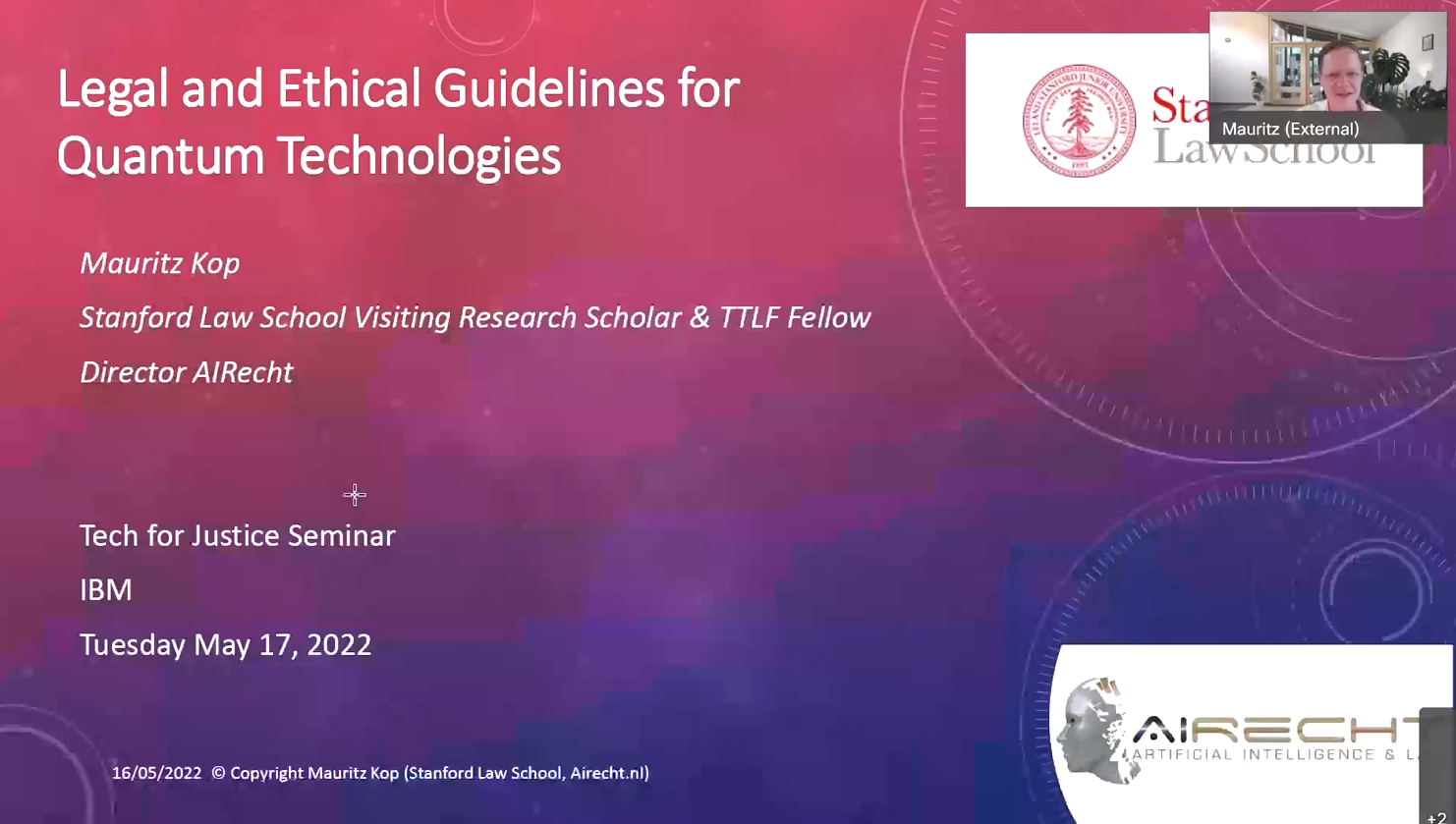
IBM Invites Mauritz Kop for Lecture on Quantum Ethics

New York, May 17, 2022—The development of quantum technology represents a significant advance in computational capability, with the potential to reshape industries, accelerate scientific discovery, and address complex problems. As with other transformative technologies, its power introduces a range of responsibilities. The relevant questions are not only about the technical capabilities of quantum mechanics, but also about the appropriate uses of the technology.

Reflecting this, IBM, a leading company in the quantum field, convened a seminar on May 17, 2022, for its New York and San Francisco teams to focus on the legal and ethical dimensions of this emerging field. The invited speaker for the event was Mauritz Kop, a visiting scholar at Stanford Law School, who presented his work on establishing a governance framework for quantum technologies to an audience of researchers, engineers, and policymakers.

The event was part of IBM's Tech for Justice initiative, a cross-divisional program dedicated to using technology to address systemic biases and advance social equity. Situating the conversation about quantum ethics within this framework indicates an understanding that principles of fairness, accountability, and transparency should be integrated into new technologies from an early stage.

The session was hosted by Dr. Aminat Adebiyi, a Research Staff Member, Experimentalist, and Maker at IBM, and moderated by Dr. Mira Wolf-Bauwens. Kop's collaboration with Wolf-Bauwens includes their shared work on the World Economic Forum's foundational principles for quantum computing, a project that highlights the role of multi-stakeholder cooperation in this area.

The Quantum Vanguard: IBM's Technological Position

To understand the context of the ethical discussion, it is useful to consider the technological landscape. IBM Quantum is one of the leading organizations in quantum computing and has achieved notable milestones in the field. Central to its strategy is the development of universal fault-tolerant quantum computers based on superconducting transmon qubits. This approach, which involves creating and manipulating quantum states in circuits cooled to cryogenic temperatures, has enabled IBM to build increasingly powerful and stable quantum processors.

Charting a Course for Responsible Quantum Development: A Summary of the Lecture

The material presented in the lecture builds upon a body of foundational research by Kop. His work in the Yale Journal of Law & Technology first proposed a comprehensive legal-ethical framework and a set of ten guiding principles for quantum technology. In the Stanford Law School Transatlantic Technology Law Forum, he explored the crucial roles of intellectual property and standardization in fostering sustainable innovation. Furthermore, in Physics World, published by the Institute of Physics, he articulated the necessity of a dedicated field of "quantum ethics," urging the physics community to engage directly with the social and moral implications of their work. Lastly, together with Luciano Floridi at Oxford, Kop conceptualized the Quantum-ELSPI framework as the ethical, legal, social, and policy implications of the suite of quantum technologies. The lecture for IBM synthesized and advanced these core themes.

Kop's lecture, "Legal and Ethical Guidelines for Quantum Technologies," was structured around the thesis that there is a timely opportunity to establish governance for quantum technology. In contrast to the development of the internet or artificial intelligence, where regulation often followed widespread adoption, it is possible to proactively embed democratic values and human rights principles into the architecture of quantum systems.

Interactive Discussion and Call to Action

The lecture was followed by an engaging Q&A session that highlighted the deep commitment of the IBM technical community to responsible innovation. The questions posed by participants explored the practical challenges and nuances of implementing ethical frameworks. Key themes of the discussion included the tangible impact of tech regulation to date, the specific processes needed to assess quantum's potential societal effects, and the distinct yet complementary roles of government and private enterprise in setting and adhering to standards.

Participants were keen to understand how a framework could effectively infuse 'humanism' into every aspect of technology development and how regulation could be used proactively to shape an emerging field for the better. The dialogue also addressed the most significant challenges facing quantum regulation specifically and the strategies required to overcome them.

Meer lezen
Mauritz Kop Consults Senator Mark Warner on AI & Quantum Technology Policy

Washington D.C., January 4, 2022—As the United States Congress grapples with the complex challenges of regulating artificial intelligence and quantum technology, leading policymakers are seeking expert guidance to inform a robust and forward-thinking national strategy. On January 4, 2022, Mauritz Kop, a distinguished scholar in the field of technology law and governance, was consulted by the legal team of U.S. Senator Mark Warner (D-VA) to provide strategic insights on both AI and quantum technology policy.

This consultation highlights the growing recognition in Washington of the need for deep, interdisciplinary expertise to navigate the geopolitical, economic, and security dimensions of these transformative technologies. Senator Warner's team reached out to Kop based on his influential scholarship, including his extensive work at Stanford on the EU AI Act and the need for a strategic democratic tech alliance, his advisory role for the European Commission led by Ursula von der Leyen on the AI Act and Data Act, and his foundational article in the Yale Journal of Law & Technology proposing a comprehensive legal-ethical framework for quantum technology.

Senator Mark Warner: A Leader on Technology and National Security

Senator Mark Warner's engagement on these issues is both significant and timely. As the Chairman of the Senate Select Committee on Intelligence, he is at the forefront of addressing the national security implications of emerging technologies. His work involves overseeing the U.S. Intelligence Community and ensuring it is equipped to handle the threats and opportunities of the 21st century, where technological competition with nations like China is a central concern.

The Senate Select Committee on Intelligence has a broad mandate that includes analyzing intelligence on the technological capabilities of foreign powers and assessing the vulnerabilities of U.S. critical infrastructure. Senator Warner has been a vocal proponent of developing a national strategy for AI and quantum to maintain the United States' competitive edge and to ensure that these technologies are developed and deployed in a manner consistent with democratic values. This consultation with Mauritz Kop reflects the Senator's commitment to drawing on leading academic research to shape sound, bipartisan policy.

AI Policy: A Transatlantic, Risk-Based Approach that Lets Innovation Breathe

A key focus of the consultation was Kop's analysis of the European Union's AI Act. His Stanford publications argue for a balanced, pro-innovation regulatory model that can serve as a blueprint for international cooperation. Good governance and sensible legislation should incentivize desired behavior and simultaneously create breathing room for sustainable, beneficial innovation to flourish.

Quantum Governance: Establishing a Legal-Ethical Framework

The discussion also delved into the governance of quantum technology, drawing on Kop's seminal work in the Yale Journal of Law & Technology. Recognizing that quantum is rapidly moving from the theoretical to the practical, he stressed the urgency of establishing a legal-ethical framework before the technology is widely deployed and locked-in.

The consultation with Senator Warner's office represents a critical intersection of academic scholarship and high-level policymaking. As the United States charts its course in the era of AI and quantum, the insights provided by experts like Mauritz Kop are invaluable in ensuring that the nation's strategy is not only competitive but also responsible, ethical, and firmly rooted in democratic principles.

Meer lezen