
Prof. Mauritz Kop Invited to Speak at Quantum Innovation 2026 in Nagoya on Responsible Quantum Innovation and the Post-Quantum Transition
By our Editor
Nagoya, Japan, October 9, 2026. Prof. Mauritz Kop has been invited to speak at Quantum Innovation 2026, the International Symposium on Quantum Science, Technology and Innovation, which takes place from December 8 to 11, 2026 at WINC AICHI in Nagoya. The symposium is organized by the research institutes and universities of Japan's Quantum Technology Innovation Hubs and supported by the Government of Japan and the Japan Science and Technology Agency (JST). Kop, Founder of the Stanford Center for Responsible Quantum Technology (Stanford RQT), closes the session on Practical Quantum Computing on Tuesday, December 8, with a talk titled Before Q-Day: Responsible Quantum Innovation, Standards, and the Post-Quantum Transition. For AIRecht readers, the invitation brings the legal and governance dimensions of the post-quantum transition to a symposium spanning quantum computing, sensing, cryptography, and communication.
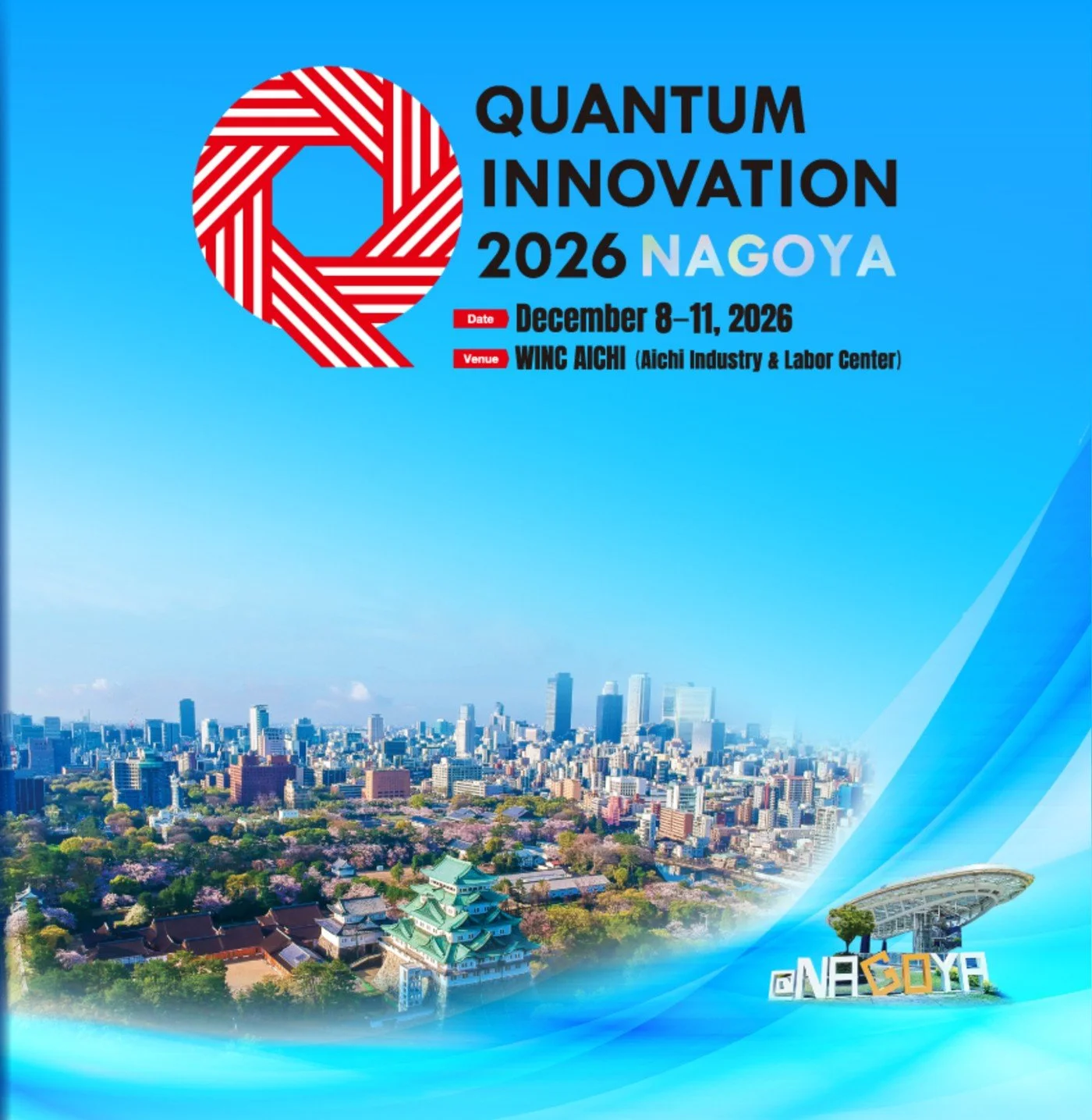
Quantum Innovation 2026 in Nagoya: Japan's National Quantum Symposium, December 8 to 11
Quantum Innovation has been held every year since 2021, in Tokyo until 2024 and in Osaka in 2025. The 2026 edition moves to Nagoya and runs for four days, adding a full day on the Moonshot Research and Development Program's goal of a fault-tolerant quantum computer. Three tracks cover quantum computing, quantum sensing, and quantum cryptography and communication. The General Chair is Shigeki Kiyonaka of Nagoya University, and the quantum computing track is chaired by François Le Gall of Nagoya University with Shu Tanaka of Keio University as vice chair. Participation is free; advance registration closes at 11:59 PM Japan time on November 22, 2026, or earlier if capacity is reached.
The co-organizers include Japan's Cabinet Office, three ministries (Education, Culture, Sports, Science and Technology; Internal Affairs and Communications; and Economy, Trade and Industry), the Japan Science and Technology Agency, the national research institutes RIKEN, AIST, NICT, NIMS, and QST, the Okinawa Institute of Science and Technology, the industry alliance Q-STAR, five universities including the University of Tokyo and Kyoto University, and the Tokai National Higher Education and Research System. Fujitsu is the Diamond sponsor, and Toyota, Toshiba, Hitachi, and Bluefors are among the Platinum sponsors.
Japan's Quantum Technology Innovation Hubs: a Model of Public-Private Coordination
The organizing network itself is part of the story. Japan established its Quantum Technology Innovation Hubs in February 2021 to connect industry, academia, and government in basic research, technology demonstration, industrialization, intellectual property management, and the training of quantum talent. The hubs are coordinated through a portal hosted by RIKEN. For lawyers and policymakers, they show how a government can align research funding, intellectual property, and industrial policy across ministries and companies, a theme that runs through Kop's own work on the legal control plane for quantum technology.
The symposium is also the centerpiece of Japan Quantum Week 2026, a nationwide program of workshops and symposia. On December 9, the Embassy of the Kingdom of the Netherlands in Japan hosts a Japan-Netherlands Quantum Matchmaking Workshop at the same venue, a welcome link between the Dutch and Japanese quantum ecosystems. During his stay, Kop will also visit a quantum computer in Japan together with the delegation, an opportunity to see Japanese quantum hardware at first hand.
Japan's Quantum Computers: RIKEN, Fujitsu, Quantinuum, IBM, and the Moonshot Goal
Japan's quantum systems include superconducting, trapped-ion, and neutral-atom computers. In April 2025 RIKEN and Fujitsu unveiled a 256-qubit superconducting quantum computer at RIKEN's Wako campus. RIKEN also hosts Quantinuum's trapped-ion system Reimei and, in Kobe, an IBM Quantum System Two next to the Fugaku supercomputer, while the Institute for Molecular Science in nearby Okazaki runs a neutral-atom machine. The symposium's final day is devoted to Goal 6 of Japan's Moonshot Research and Development Program, which aims at a fault-tolerant universal quantum computer by 2050. As these machines move toward practical use, questions of access, export control, intellectual property, and liability move from theory into contracts.
Kop's Talk on December 8: Responsible Quantum Innovation, Standards, and the Post-Quantum Transition
Kop speaks from 5:40 to 6:10 PM Japan time in Room 3, closing Session CP2 on Practical Quantum Computing (4:40 to 6:10 PM), according to the published program. He follows two talks on quantum cryptanalysis: André Schrottenloher of the University of Rennes on recent advances in quantum circuits for cryptanalysis, and Noboru Kunihiro of the University of Tsukuba on quantum cryptanalysis of public-key cryptography and the transition to post-quantum cryptography. The sequence runs from the attack to the remedy, and Kop's contribution addresses the governance instruments that make the remedy work in practice.
Kop will address responsible quantum innovation, standards, and the post-quantum transition. He brings to the session the Quantum-ELSPI framework, his work on the legal and technical control plane for quantum technology, and the LSI test from his Nexus paper, which asks that security measures such as export controls be least trade-restrictive, security-sufficient, and innovation-preserving.
Hardware developers in Japan, the United States, Canada, and Europe have published roadmaps toward fault-tolerant machines, and use cases in chemistry, medicine, energy, and defense are multiplying. The audience in Nagoya includes the engineers who build those machines, the companies that will sell them, and the officials who will buy and regulate them.
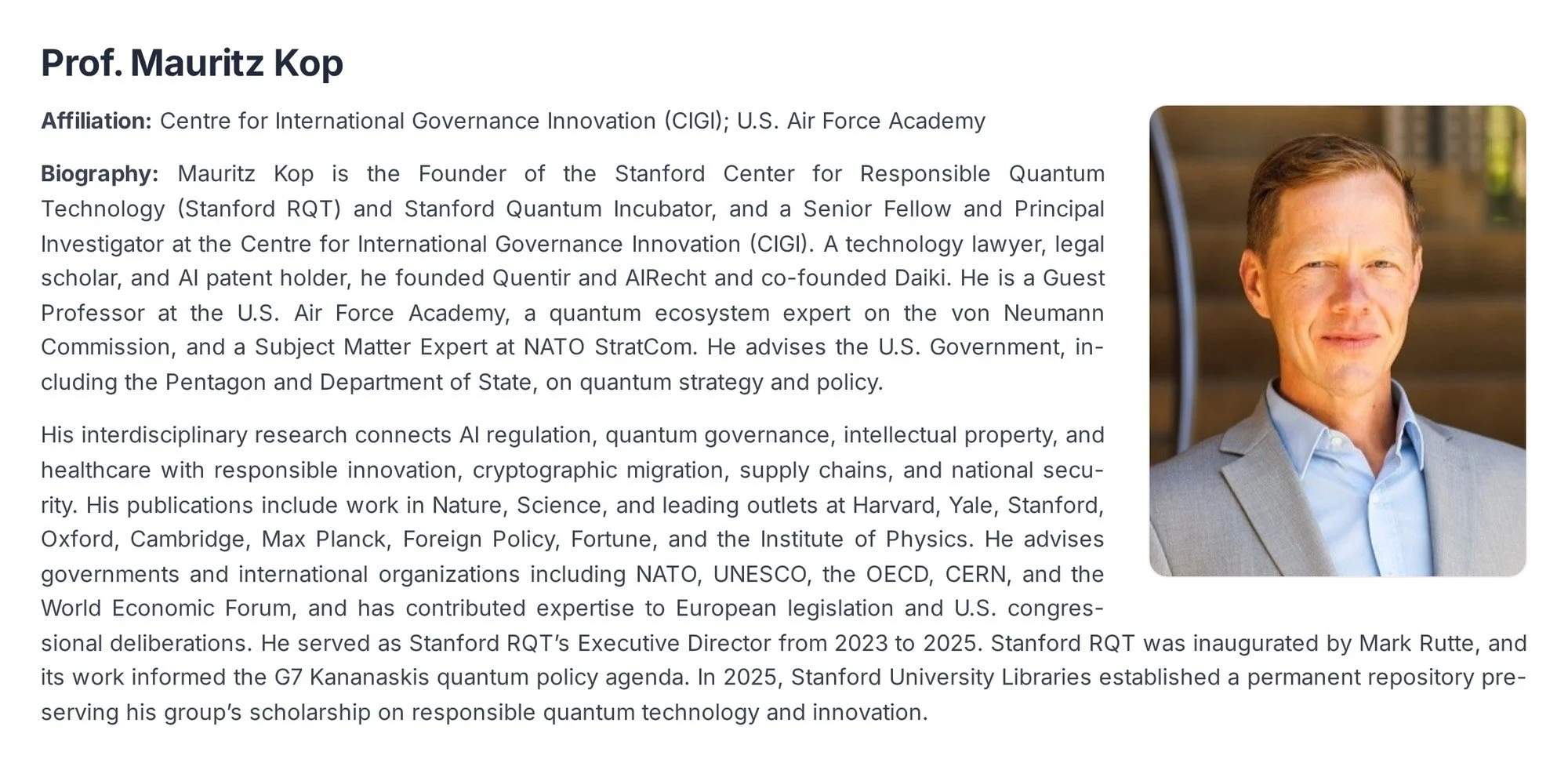
Keynotes by Dorit Aharonov, Amir Yacoby, and Hoi-Kwong Lo, and a Panel on Certifying Quantum Key Distribution
The keynote program brings three leaders of the field to Nagoya. Dorit Aharonov of the Hebrew University of Jerusalem, a pioneer of quantum complexity theory and fault tolerance, speaks on the road from quantum advantage to useful quantum computing. Amir Yacoby of Harvard University speaks on quantum sensing of quantum matter, and Hoi-Kwong Lo of the Centre for Quantum Technologies at the National University of Singapore, co-inventor of decoy-state and measurement-device-independent quantum key distribution, speaks on security challenges to quantum networks.
Among the invited speakers, Elham Kashefi of the University of Edinburgh, a leading authority on the verification of quantum computation, opens the foundations session with a talk on how we can trust a quantum computer. Kashefi and Kop served together on the Council of Canadian Academies expert panel on quantum technologies, chaired by the late Raymond Laflamme. For lawyers, the cryptography track ends with a session of particular interest: a panel on the certification of quantum key distribution modules, bridging security proofs and real-world deployment, with Lo and experts from IDQ, Fraunhofer, NEC Laboratories Europe, and Toshiba Europe. Certification is where technical security claims become legal assurances that buyers, insurers, and regulators can rely on.
From Stanford to Waterloo to Nagoya: the Work Behind the Invitation
Nagoya joins Kop's forthcoming engagements on quantum governance and security. In October 2026 Kop chairs the CIGI Quantum Nexus workshop and roundtable in Waterloo, speaks at the University of Virginia's Co-Opting AI: Quantum, and in November at ACM PQQS 2026 in Silicon Valley. Earlier stages in his career include the University of Oxford, the International Quantum Forum at TU Munich, and the Stanford Responsible Quantum Technology Conferences he chaired at Stanford Law School.
The scholarship behind the talk spans the field's foundations: the 2021 Yale Journal of Law and Technology framework, the Ten Principles for Responsible Quantum Innovation (IOP, 2024), the Nature Physics call for responsible quantum technology (2024), the standards-first approach in Science (2025), and the Nexus paper, indexed in the NASA Astrophysics Data System at the Center for Astrophysics | Harvard & Smithsonian. His War on the Rocks essays A Bletchley Park for the Quantum Age and Before Q-Day: The Race to Quantum First carry the same agenda into the national security debate. Kop is a Senior Fellow and Principal Investigator at CIGI and a Guest Professor at the U.S. Air Force Academy, and he advises governments and organizations including UNESCO, the OECD, the G7, CERN, and the World Economic Forum, as well as the U.S. Government, including the Pentagon and the Department of State.
What Certification and Standards Mean for Contracts and Compliance
For legal practice, the most practical part of the Nagoya program is its focus on standards, certification, and assurance. NIST finalized its first post-quantum cryptography standards in 2024, and governments in the United States, the United Kingdom, and the European Union have set migration timelines that run into the 2030s. Contracts for software, hardware, and cloud services will increasingly need clauses on cryptographic agility, supplier assurance, and certification against these standards, and procurement rules will ask vendors to prove what they claim. Kop's work on the legal control plane for quantum technology connects these technical standards to intellectual property, export controls, and liability, which is where lawyers will meet them.
Why Japan's Quantum Program Matters to European Lawyers and Policymakers
Japan is a key partner for Europe in quantum technology, and the two share a commitment to the rule of law, open science, and trusted standards. The Japan-Netherlands matchmaking workshop on December 9 reflects that partnership, and Kop brings a European perspective of his own: he provided policy recommendations to the European Commission on the AI Act, the Data Act, and the EU Quantum Act, and copyright expertise to the European Parliament. As the EU prepares its own Quantum Act and member states plan their post-quantum migration, Japan's coordinated approach offers useful lessons on governance, procurement, and intellectual property. AIRecht congratulates the organizers of Quantum Innovation 2026 and looks forward to the conversations in Nagoya.
Organizations preparing their own contracts for the post-quantum transition can start with the AIRecht contract scan.
Last updated: October 9, 2026