
Prof. Mauritz Kop Teaches Law & Emerging Tech Class at the United States Air Force Academy (USAFA)
AIRecht Editor
USAF Academy, Colorado, November 19, 2026. Prof. Mauritz Kop taught the Law and Emerging Tech class at the United States Air Force Academy (USAFA) today, joining the cadets in their seminar room by video link. His lecture, "Responsible Quantum Technology: A Legal-Ethical Framework for the Race to Quantum First," was his third in the course, after sessions in April 2024 and October 2025. The cadets, future officers of the Air Force and the Space Force, already know the basics of quantum computing, so the class went directly to the geostrategic, legal and ethical questions.
The cadets prepared with two of Kop's publications: his article on the LSI test for export controls, and "Before Q-Day: The Race to Quantum First," the migration blueprint he published with Joseph Federici in War on the Rocks. The readings came with two questions. Why regulate quantum technology before it is fully mature? And what kind of framework offers the most effective balance between fostering innovation and managing risk? This post summarizes how the lecture answered them.
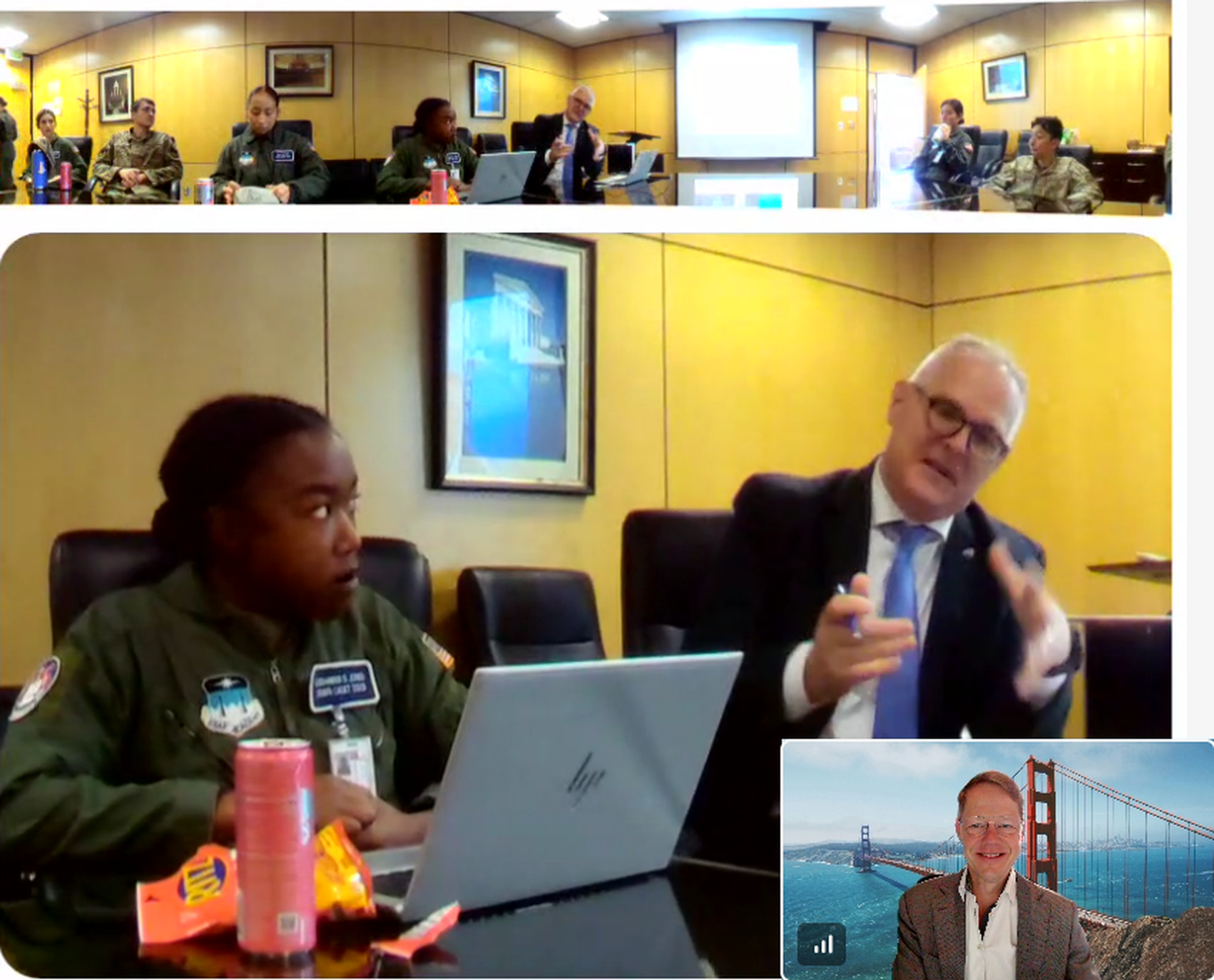
Cadets in the Law and Emerging Tech class at the United States Air Force Academy on November 19, 2026, with Prof. Mauritz Kop joining by video link (inset).
Why Regulate Quantum Technology Before It Matures
Kop began with the risks. Q-Day is usually defined as the moment a quantum computer can break the public-key cryptography in use today. In practice, he told the class, it will be a series of events, because different systems become vulnerable at different times and their owners need years to replace some of them. The same quantum simulation that designs a life-saving drug could model a dangerous pathogen, which makes dual use the central governance challenge. The societal risks that follow, which Kop listed in the Yale Journal of Law and Technology in 2021, are a quantum divide between companies and between countries, the loss of privacy and trust, and a quantum arms race. Kop placed these risks before what he calls the quantum event horizon, a governance tipping point beyond which quantum technologies shift strategic power in ways that are hard to reverse.
He then gave the cadets six reasons to act early. Control is easiest while options are still open, the insight of the Collingridge dilemma, so a government chooses a strategy now, tests rules in regulatory sandboxes and revises them as the evidence improves. Quantum technology brings risks of a new kind, for which laws built on factual certainty and linear causality were never designed. The most urgent is harvest now, decrypt later: adversaries collect encrypted data today and read it once a capable machine exists. Early intervention lets designers embed democracy, human rights, safety, fairness and privacy in architectures and standards, with the quantum impact assessment Kop proposed in 2020 as the practical instrument. Acting early also limits foreseeable harms and builds public trust, gives companies legal certainty about liability, intellectual property and market access, and gives the United States the credibility to lead on international standards.
Responsible Quantum Technology and the SEA Principles
The answer to those risks is Responsible Quantum Technology, the field that Kop and his colleagues helped shape at Stanford and called for in Nature Physics in 2024. With Mateo Aboy, Urs Gasser, Luciano Floridi, the late Raymond Laflamme and others he wrote the Ten Principles for Responsible Quantum Innovation, which organize responsibility as safeguarding, engaging and advancing quantum technology, society and humankind (SEA). In the lecture Kop applied the three to defense. Safeguarding covers export controls, secrecy, patents and cooperation among countries that share values, and post-quantum cryptography can deny an adversary the benefit of a quantum attack, a form of deterrence by denial. Engaging brings the public into quantum development, and advancing ties research to social goals.
Kop also brought in his recent work on quantum sensing for clinical use. In Hippocratic Quantum, published at Harvard this year, he applies the four duties of medicine to quantum medicine. The duty of non-maleficence makes post-quantum cryptography a clinical baseline, because a genome encrypted in 2026 and decrypted in 2040 can still belong to a living patient and their family.
Harvest Now, Decrypt Later and the 2026 Deadlines
The United States has now set its deadlines, and Kop walked the cadets through them. Executive Order 14412 and its implementing OMB memorandum require the federal government's most sensitive civilian systems to use post-quantum cryptography for key establishment by the end of 2030 and for digital signatures by the end of 2031. The final version of NIST IR 8547 deprecates RSA and elliptic-curve cryptography after 2030 and disallows their use under NIST standards after 2035. National security systems, the cadets' own, follow the NSA's CNSA 2.0 suite. Kop would give priority to information that must remain secret longest and to systems that take longest to replace, and he added that a citizen whose data sits in a cheap, outdated IT system deserves the same protection, because quantum safety is a basic human right.
Post-quantum cryptography is itself dual use, and Kop pointed to a hacking group that already hides its malware behind the new NIST standard. He drew the conclusion he first argued in "A Bletchley Park for the Quantum Age": allies need a concerted effort to validate and deploy quantum-resistant algorithms, and to keep breaking what adversaries deploy.
A Two-Pillar Framework: Light-Weight Regulation and Industrial Policy
For the second reading question Kop presented the two-pillar framework that he worked out for the European Union in "Towards a European Quantum Act", published at Columbia Law School. The first pillar is agile, risk-based regulation. Transplanting the EU AI Act to quantum technology would stifle innovation from the start, he said, so he prefers light-weight requirements per sector and use case that build on existing regulation, stricter for health, finance, defense and space than for entertainment. High-risk quantum systems would carry real obligations: a quantum impact assessment before deployment, transparency, human oversight, mandatory post-quantum cryptography and incident reporting. Those requirements follow a standards-first approach, set out in Science with Aboy, Gasser and Cohen, in which shared definitions and benchmarks inform later regulation.
The second pillar builds the national capability to lead: sustained funding, talent, shared testbeds and supply chains whose dependencies are mapped with the Quantum Criticality Index. Intellectual property belongs here as well. Secrecy, patents and export controls each protect a strategic capability and each limit follow-on innovation, and Kop's work with Aboy and Minssen on intellectual property and market power in quantum computing shows how overlapping rights can leave a handful of companies holding the essential ones.
Export Controls, the LSI Test and the Logical Qubit
Export controls are where the two pillars meet. Kop developed the LSI test for that decision: a measure must be least restrictive, security-sufficient and innovation-preserving. In legal terms it is a proportionality test with a built-in subsidiarity check. The regulator starts from a specific security objective, chooses the most surgical measure that still works, and then assesses the consequences for research, competition and the diffusion of knowledge. If those consequences are unacceptable, the measure is redesigned or the objective reconsidered. He applied the test to the export threshold of thirty-four physical qubits, paired with gate-error ceilings, that the United States and its allies adopted in 2024. A threshold written in physical qubits ages as error correction advances, so in his view the unit should become the logical qubit, with its error rate and circuit depth, and the number should follow from the stated security objective and be revised every year.
A Quantum-Ready Department of Defense and Allied Cooperation
The last part of the lecture addressed the cadets' own institution. Post-quantum cryptography must go into command-and-control links, satellite links and software update pipelines now, with cryptographic agility. Kop would put one cabinet-level office in charge of the national transition, while each department stays responsible for its own systems. "Before Q-Day" adds a senior director for quantum readiness at the National Security Council. Among allies Kop proposes a harmonized quantum acquis, and beyond them Qubits for Peace, a global framework in the tradition of Eisenhower's Atoms for Peace that builds on his earlier proposal for an atomic agency for quantum-AI.
Two Questions for the Cadets
Kop closed by handing the decisions to the class. Which system would they migrate first, the one that holds the longest-lived secrets, the one that takes longest to replace or the one that is most critical, and how would they justify that choice to a commander? And would they draw the export-control line at the first logical qubit, given what that line would mean for the shared science of the allies? His message to the cadets is also addressed to policymakers: the goal is to reach quantum first with free-world values built into the systems that others will adopt.
Last updated: November 19, 2026