
Innovation, Quantum-AI Technology & Law

Blog over Kunstmatige Intelligentie, Quantum, Deep Learning, Blockchain en Big Data Law

Blog over juridische, sociale, ethische en policy aspecten van Kunstmatige Intelligentie, Quantum Computing, Sensing & Communication, Augmented Reality en Robotica, Big Data Wetgeving en Machine Learning Regelgeving. Kennisartikelen inzake de EU AI Act, de Data Governance Act, cloud computing, algoritmes, privacy, virtual reality, blockchain, robotlaw, smart contracts, informatierecht, ICT contracten, online platforms, apps en tools. Europese regels, auteursrecht, chipsrecht, databankrechten en juridische diensten AI recht.

Berichten met de tag intellectual property
Mauritz Kop Presents Oxford JIPLP Article on Quantum Computing, IP and Market Power at IPSC 2022, Stanford Law School

IPSC 2022 at Stanford: at the first in-person Intellectual Property Scholars Conference after two virtual years (August 11–12, 2022), Mauritz Kop presented his Oxford JIPLP article Intellectual property in quantum computing and market power: a theoretical discussion and empirical analysis, co-authored with Mateo Aboy and Timo Minssen.

When IP stops doing its job

The theory: intellectual property exists to incentivize innovation, but excessive proliferation of exclusive rights over a foundational technology produces anticommons effects — overlapping thickets that raise transaction costs, deter follow-on research and concentrate first-mover market power. Quantum computing, built on decades of publicly funded science, is exactly where that risk bites hardest.

The patent data behind the argument

The empirics: the article analyzes the quantum-computing patent landscape — who files, where portfolios cluster, and what that implies for market structure in a field whose hardware, algorithms and error-correction methods may all carry exclusive rights. Theory says when proliferation harms innovation; the data say where quantum technology stands today.

A transatlantic collaboration, a Stanford homecoming

Kop, Aboy and Minssen connect European and American IP scholarship on quantum computing; for Kop the venue completed a circle, having spent early 2022 as visiting scholar at Stanford Law School. The presentation put the market-power findings before the scholars best placed to attack the methodology — which is what the IPSC works-in-progress format exists to do. And after two virtual editions, the 22nd IPSC's return to a physical Stanford conference room restored the corridor conversations that turn a panel question into a coauthorship.

Standards: the other half of ownership

Beyond patents, quantum interoperability standards will run on disclosure and licensing commitments from the very portfolio holders the article tracks. Whether those commitments are negotiated early, FRAND-style, or after positions harden will shape access to the technology as surely as any patent dispute — and the article's empirical map is groundwork for getting that negotiation right.

Third station of a research arc

From AI's data inputs (IPSC 2020) via waive-or-pledge quantum IP (IPSC 2021) to ownership structure and market power (2022): the sequence tracks a research line moving from machine learning's raw material to quantum computing's ownership structure, each stage workshopped in public before publication. That line later grew into an institutional one — see Stanford University launches the Stanford Center for Responsible Quantum Technology. If early patent concentration hardens into durable market power, access to the field's foundational capabilities narrows before the technology matures; making that risk empirically discussable, rather than rhetorical, is the article's lasting contribution.

Meer lezen

Mauritz Kop Presents Quantum: Waive or Pledge IP at IPSC 2021, Cardozo Law School

IPSC 2021 at Cardozo: on August 4, 2021, Mauritz Kop presented Quantum: Waive or Pledge IP at the Intellectual Property Scholars Conference, hosted online by Cardozo Law School — putting the intellectual-property architecture of quantum technology before the IP academy while the field's patent landscape was still forming.

A real policy dilemma in three words

Waive or pledge: if quantum computing's basic building blocks rest on decades of publicly funded research, should foundational exclusive rights be waived for defined categories — or kept but pledged, FRAND-style, against assertion? The presentation developed both instruments and their hybrids, from quantum-specific patent pledges to compulsory licensing and shorter, innovation-cycle-calibrated protection terms — an IP architecture for a technology whose patent landscape was consolidating faster than its governance.

Physics that unsettles doctrine

The no-cloning theorem forbids perfectly copying an arbitrary unknown quantum state — friction at the foundations for IP regimes predicated on the act of duplication. A law built around copying meets quantum states that cannot, even in principle, be copied; the legal-ethical groundwork for that collision is laid in Establishing a Legal-Ethical Framework for Quantum Technology.

From workshop draft to Berkeley Technology Law Journal

The critiqued draft matured into the Berkeley Technology Law Journal article mapping patents, trade secrets and copyright onto quantum hardware, algorithms and software — and arguing where bespoke instruments serve innovation better than one-size-fits-all exclusivity. The IPSC room's questions — incentives, successor liability, category definition — made the published version sturdier. That is what the works-in-progress format is for: short presentations, dense Q&A, no proceedings, everything in service of the draft.

Patent scholars meet information-law scholars

Cardozo's host program tilts the IPSC room toward information-law questions — data, platforms, access — so a waive-or-pledge proposal had to satisfy both the incentive logic of the patent scholars and the access logic of the information-law side. A proposal that survives both audiences is closer to policy-ready than one bred in either camp alone.

Arriving early, on purpose

In August 2021 quantum technology was still mostly a physics story in the legal academy. Presenting a worked-out IP architecture then put waive-or-pledge on the scholarly agenda while policy could still shape the landscape rather than litigate it afterward. The instrument-matching logic — pledge where the ecosystem polices itself, waive where concentration would gate basic science, keep compulsory licensing in reserve as the credible threat that keeps the voluntary instruments honest — has only gained relevance as the quantum patent landscape has consolidated since.

Meer lezen
Mauritz Kop Presents Machine Learning & EU Data Sharing Practices at IPSC 2020, Stanford Law School

IPSC 2020 at Stanford: Mauritz Kop presented Machine Learning & EU Data Sharing Practices at the Intellectual Property Scholars Conference — the works-in-progress forum where IP scholarship is stress-tested before journals see it. The 2020 edition, hosted by Stanford Law School, ran as virtual panels from July 15 through August 5 in the first pandemic summer.

Training data under four regimes at once

Machine learning is hungry, and in Europe its raw material sits under copyright, database rights, trade secrets and the GDPR simultaneously. The paper mapped that intersection — including the text-and-data-mining exceptions of the DSM directive — and asked which data-sharing arrangements actually let lawful European AI development proceed at scale.

An argument for coordination

Where exclusive rights and data-protection rules overlap without coordination, they tax exactly the data flows the EU's own artificial intelligence strategy depends on. That modernization argument, workshopped before a predominantly American IP audience with a different copyright baseline and fair-use culture, had to hold up under comparative fire — which is precisely what the IPSC format is for.

Part of the Stanford research agenda

The presentation belonged to Kop's research line at the Stanford-Vienna Transatlantic Technology Law Forum, which he had joined earlier that year — see Mauritz Kop becomes TTLF Fellow at Stanford University. The paper is preserved in the permanent Stanford RQT collection at the Stanford Law Library, and its data-protection companion piece appeared in the Harvard Journal of Law & Technology's digest — two halves of one question about Europe's machine-learning data rules.

A format built for critique

Short presentations, dense Q&A, no published proceedings: IPSC exists purely to make drafts better before journals see them. For interdisciplinary work spanning artificial intelligence, data governance and IP doctrine, an audience of doctrinalists, economists and technologists probes each weak point in turn — and a European paper before an American room must hold up under a different copyright baseline and fair-use culture besides.

Why it still matters

The training-data questions posed in that 2020 draft — who may train on what, and on which terms — have since moved to the center of AI regulation on both sides of the Atlantic. Opt-out patchworks under the text-and-data-mining exceptions, the GDPR's reach into model pipelines, the competitive pull of jurisdictions with cleaner data rules: each was on the table at that virtual Stanford panel before it reached the regulators' agenda. The workshop critique of that summer became part of the foundation the later debates built on — which is exactly what a works-in-progress conference is supposed to produce.

Meer lezen
Silicon Valley: AI Impact Assessment presented at Apple, Facebook and Stanford University

AIRecht presents ECP AIIA in Silicon Valley

On 23 August 2019, Mauritz Kop LL.M. had the honour to present the ECP AI Impact Assessment to front-running companies in Silicon Valley, in the amazing San Francisco Bay Area. AI should be a force for good and our Dutch risk-management tool can help with that. The AIIA is a first-of-its-kind guide for the development and implementation of artificial intelligence and includes 2 things: a practical Checklist from a legal, technical and ethical point of view (in line with the EU Trustworthy AI paradigm) and a concrete Code of Conduct for data scientists. On top of that, our AIRecht managing partner introduced the AIIA at Stanford University, in beautiful Palo Alto.

Stanford University Campus

Stanford University has a stunning campus. It offers exuberant nature, nice temperature and magnificent architecture. Innovation is in the air. During the graduation ceremony of a post-doctoral intellectual property course at Stanford Law School, Mauritz officially handed over an English hardcopy of the ECP AI Impact Assessment to Professor Siegfried Fina and Professor Roland Vogl, Program Directors at SLS. The Program focusses on ‘'Overview on U.S. IP Law’ with specific attention to high-tech IP issues, such as copyrights, trade secrets, patents, trademarks, licensing and venture capital. A wonderful place for learning, discovery, innovation, expression and discourse, at the highest academic level imaginable.

Transatlantic bridges

It was an incredibly inspiring visit to Silicon Valley. We have seen it with our own eyes now: the Bay Area truly is the innovation hub of the world, together with Massachusetts (Boston, Harvard, MIT). It offers excellent opportunities for tech start-ups to work together and brainstorm with the best qualified experts, and create partnerships with professionals in myriad industrial sectors and disciplines. We hope to be back soon to further strengthen EU-USA relationships, construct new partnerships, exchange talent and remove barriers to trade and collaboration across the Atlantic.

Meer lezen
Suzan Slijpen Conference Speaker at the National University of Ireland

Legal Aspects of AI in Healthcare

On 16 August 2019, Suzan Slijpen LL.M. had the honour to speak about the legal aspects of the development and use of artificial intelligence (a disruptive technology) in healthcare, at the AI in Medicine Conference organized by the Irish Association of Physicists in Medicine (IAPM). The conference took place in Galway, at the National University of Ireland (School of Physics, NUI Galway/ OÉ Gaillimh). Suzan is a senior legal consultant at AIRecht.nl, and specializes in eHealth & medical devices, pharmaceutical law, European food law and contract law, from an AI helicopterview. She is also founder and lawyer at boutique law office Slijpen Legal.

Key topics of the Artificial Intelligence in Medicine lecture

Key legal topics that Suzan addressed in her Artificial Intelligence in Medicine lecture:

1. AI & Robotics: Disruptive Technologies: Synergetic effects of 4th Industrial Revolution technologies like robotics, big data, quantum computing, Blockchain, Virtual Reality (VR) and Internet of Things (IoT).

2. eHealth and medical devices: legal classification.

3. Fundamental Rights: Safeguarding of Fundamental Rights in AI applications, Rights of Patients.

4. Ethics and responsible AI: 1791 French Revolution Values, HLEG Concept of Trustworthy AI.

5. Intellectual Property on AI and Health Apps: Licensing your IP.

6. Liability for damages caused by smart robots: who is liable for misdiagnosis by an AI algorithm?

7. Legislation and Jurisprudence.

8. AI Impact Assessment: remove roadblocks for AI.

Legislation and regulations regarding AI in Healthcare

Do you want to know more about legislation and regulations regarding AI in Healthcare, or Legal aspects of disruptive tech in Medicine? Or do you want to organize a workshop or conference yourself and invite us as a speaker or teacher? Then please contact us about the possibilities!

Meer lezen
European Parliament votes in favour of the new EU Copyright Directive

Today, the European Parliament voted in favour of the new EU Copyright Directive. This controversial IP legislation passed with 348 in favour, 274 against and 36 abstentions. Within 2 years (medio 2021), the Directive has to be implemented in the copyright legislations of the member States. However, articles 11 (now 15) and 13 (now 17) will do the EU internal market more harm than good.

Copyright expertise

Artificiële Intelligentie & Recht managing partner and IP lawyer Mauritz Kop delivered copyright expertise to the European Parliament during the legislative process.

Intellectual property law has become the new battleground for ideas on how the Digital Single Market strategy should deal with transformative innovation such as online platforms, big data, quantum computing and artificial intelligence. This potentially hinders rapid innovation and undermines the competitive position of Europe vis-à-vis China and the United States.

Consumer rights and competition/ antitrust law

Consumer welfare can be protected more effectively by consumer rights and competition/ antitrust law than by IP law. The introduction of additional rights (art. 15) results in an even more overcrowded and overgrown legal landscape, which could result in stagnation and legal uncertainty.

Meer lezen
Legal Status of Robots and AI in Healthcare - Symposium Academy Het Dorp

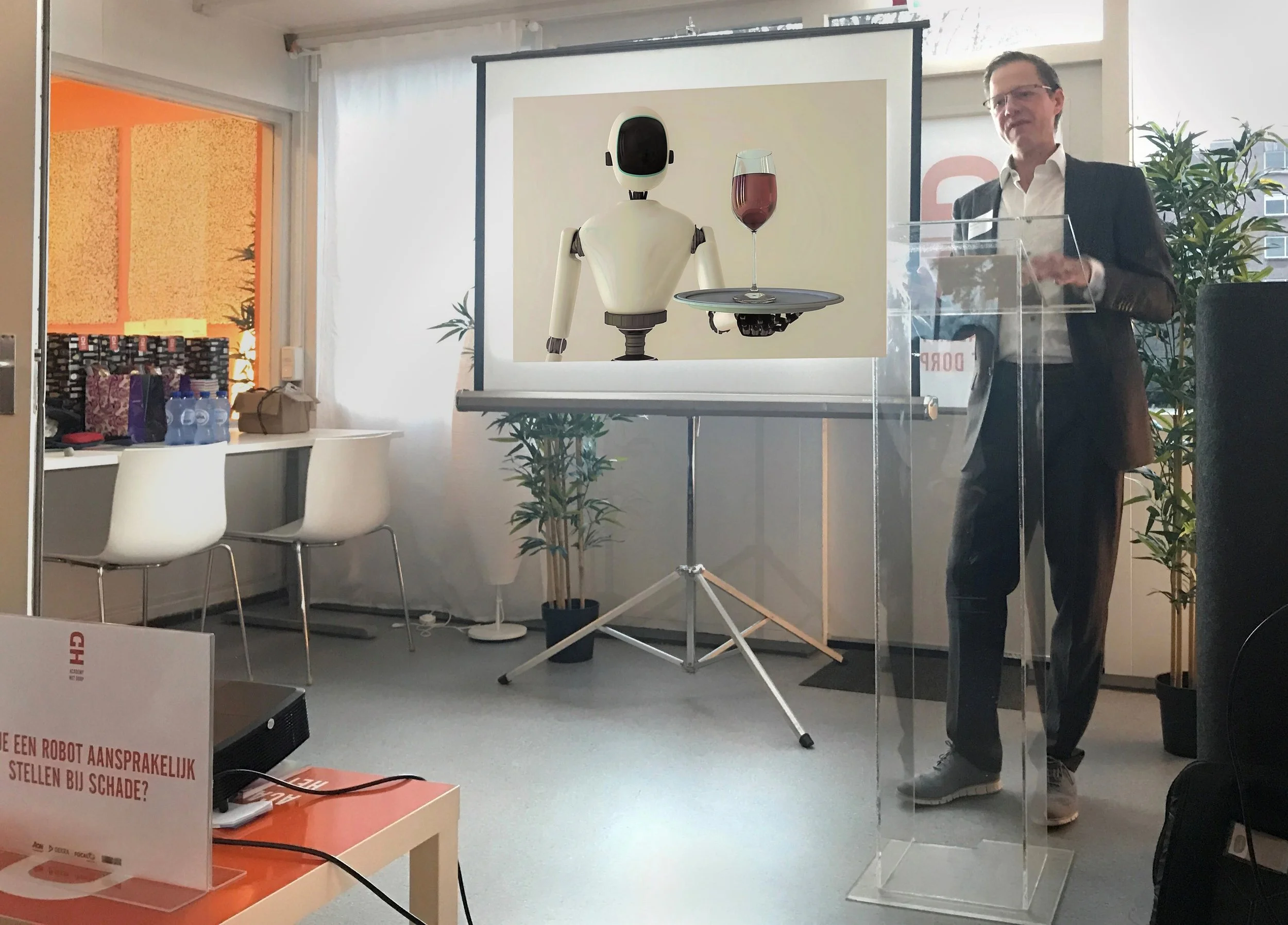
On December 3, 2018 our office Artificial Intelligence & Law delivered the lecture 'The legal status of smart robots: legal personality, intellectual property and fundamental rights'. On the occasion of the Symposium on robotisation and eHealth in the pharmaceutical industry, organized by Academy Het Dorp and Proeftuin Robotica. The central theme of this seminar on healthcare regulation was: Can you hold a robot liable in case of damages?

How should we deal with liability in robotics?

The following questions were addressed: Should robots equipped with AI have a separate legal status? How do you - as a developer/supplier and consumer/user/patient get a grip on liability for autonomous machines and artificial intelligence algorithms? How do we safeguard ethical principles and fundamental human rights? Who owns intellectual property rights in smart robots and copyrights on computer and AI generated works? How should we deal with liability in robotics?

Meer lezen
What are the main requirements for AI systems in Healthcare?

Main barriers to adoptation of Artificial Intelligence in healthcare.

Absence of a specific AI law, or clear legal framework from the perspective of both professional users (A) and patients (B).

When constructing such a framework, it is important to make a distinction between the various sub-areas of healthcare, such as research and development, professional care providers and recipients of care. Because each sub-area has different needs.

Barriers for professional users.

It is simply unclear for companies and private and academic research institutes in the medical sector what is and is not allowed in the field of AI, blockchain, computer & machine vision and robotics. Both at European level and at national level. This knowledge is important for the commodification of their inventions/creations. Two practical examples are permission from Farmatec and obtaining a CE-marking.

Requirements for sustained use of AI in healthcare.

Since traceability and transparency are key within any healthcare (and food-feed) system, blockchain could play an important role in sustained use of AI in healthcare.

A EU AI Directive or Regulation should be able to implement and/or adhere to principles of Eudralex (The body of European Union legislation in the pharmaceutical sector), Good Manufacturing Practices (GMP) and Good Distribution Practices (GDP) in particular.

Meer lezen