
Innovation, Quantum-AI Technology & Law

Blog over Kunstmatige Intelligentie, Quantum, Deep Learning, Blockchain en Big Data Law

Blog over juridische, sociale, ethische en policy aspecten van Kunstmatige Intelligentie, Quantum Computing, Sensing & Communication, Augmented Reality en Robotica, Big Data Wetgeving en Machine Learning Regelgeving. Kennisartikelen inzake de EU AI Act, de Data Governance Act, cloud computing, algoritmes, privacy, virtual reality, blockchain, robotlaw, smart contracts, informatierecht, ICT contracten, online platforms, apps en tools. Europese regels, auteursrecht, chipsrecht, databankrechten en juridische diensten AI recht.

Berichten met de tag fundamental rights
Quantum and the End of Privacy: Harvest-Now-Decrypt-Later, Quantum Sensing, and Forward-Dated Data Protection Law

Every privacy regime ever written shares one silent assumption: protection assessed today stays valid tomorrow. Quantum technology breaks that assumption twice, once by putting an expiry date on modern encryption and once by making the physically hidden measurable. This analysis maps both fronts and asks what a forward-dated privacy law would look like.

Two quantum clocks: decryption deadlines and quantum sensors

The first clock is cryptanalytic. Adversaries are recording encrypted traffic now, betting that future quantum computers will unlock it. This harvest-now-decrypt-later strategy has pushed NIST, the NSA, and the European Commission to set migration deadlines running from 2026 to 2035. Any data that must stay confidential longer than the migration takes is already exposed to that risk; if the ciphertext has been retained, only the disclosure date is open.

The second clock is metrological. Quantum gravimeters have located tunnels under real roads, and wearable magnetometers read the brain's faint magnetic signals while the wearer moves freely. This is quantum sensing: privacy intrusion without interception, where nothing is hacked because something is measured, and the physical obscurity that home and surveillance law rely on is gone before any legal safeguard applies.

How fragments collected over decades become one retroactive picture

Between these clocks sits an uncomfortable synthesis. Fragments harvested or measured across decades can be assembled retroactively by whoever gains the quantum edge first: the mosaic theory of intelligence law, extended into the future tense. The asymmetry between early quantum haves and have-nots becomes a fundamental-rights question, first examined when Mauritz Kop advised Yale Law School's Lowenstein Human Rights Project on quantum technology.

What forward-dated data protection law would change in practice

The governance proposal is concrete. Compare every dataset's sensitivity lifetime against its cryptosystem's security lifetime, and treat any mismatch as a present-day compliance gap under the GDPR's state-of-the-art standard. Calibrate post-quantum migration duties to data horizons, treat long-retained encrypted archives as liabilities, and regulate high-resolution remote sensing as the search it functionally is.

Chile's constitutional neurorights, UNESCO's 2025 neurotechnology recommendation, and the EU's coordinated post-quantum roadmap show that the pieces already exist. What is missing is the temporal frame that connects quantum computing, artificial intelligence, and privacy into a single question for regulators: protected until when, and against whom? The full analysis sets out the timelines, the case law, and the policy blueprint.

Meer lezen
Safeguards for accelerated market authorization of vaccines in Europe

by Suzan Slijpen & Mauritz Kop

This article has been published by the Stanford Law School ‘Center for Law and the Biosciences’, Stanford University, 15 March 2021. link to the full text: https://law.stanford.edu/2021/03/15/safeguards-for-accelerated-market-authorization-of-vaccines-in-europe/

Download the article here: Slijpen_Kop_Manufacturing Licenses and Market Authorization Vaccines EU-Stanford Law

The first COVID-19 vaccines have been approved

People around the globe are concerned about safety issues encircling the accelerated introduction of corona vaccines. In this article, we discuss the regulatory safeguards for fast-track market authorization of vaccines in Europe. In addition, we explain how the transmission of European Union law into national Member State legislation works. We then clarify what happens before a drug can be introduced into the European market. We conclude that governments should build bridges of mutual understanding between communities and increase trust in the safety of authorized vaccines across all population groups, using the right messengers.

Drug development normally takes several years

Drug development normally takes several years. The fact that it has been a few months now seems ridiculously short. How is the quality and integrity of the vaccine ensured? That people - on both sides of the Atlantic - are concerned about this is entirely understandable. How does one prevent citizens from being harmed by vaccines and medicines that do not work for everyone, because the admission procedures have been simplified too much?

The purpose of this article is to shed a little light upon the accelerated market authorization procedures on the European continent, with a focus on the situation in the Netherlands.

How a vaccine is introduced into the market

In June 2020, the Dutch government, in close cooperation with Germany, France and Italy, formed a Joint Negotiation Team which, under the watchful eye of the European Commission, has been negotiating with vaccine developers. Its objective: to conclude agreements with drug manufacturers at an early stage about the availability of vaccines for European countries. In case these manufacturers are to succeed in developing a successful vaccine for which the so-called Market Authorization (MA) is granted by EMA or CBG, this could lead to the availability of about 50 million vaccines (for the Netherlands alone).

Who is allowed to produce these vaccines?

Who is allowed to produce these vaccines? The Dutch Medicines Act is very clear about this. Only "market authorization holders" are allowed to manufacture medicines, including vaccines. These are parties that have gone through an extensive application procedure, who demonstrably have a solid pharmaceutical quality management system in place and have obtained a pharmaceutical manufacturing license (the MIA, short for Manufacturing and Importation Authorisation). This license is granted after assessment by the Health and Youth Care Inspectorate of the Ministry of Health, Welfare & Sport (IGJ) – by Farmatec. Farmatec is part of the CIBG, an implementing body of the Ministry of Health, Welfare and Sport (VWS). The M-license is mandatory for parties who prepare, or import medicines.

Read more at the Stanford Center for Law and the Biosciences!

Read more on manufacturing licenses, fast track procedures and market authorization by the European Medicines Agency (EMA) and the EC, harmonisation and unification of EU law, CE-markings, antigenic testing kits, mutations, reinfection, multivalent vaccines, mucosal immunity, Good Manufacturing Practices (GMP), pharmacovigilance, the HERA Incubator, clinical trials, compulsory vaccination regimes and continuous quality control at Stanford!

Meer lezen
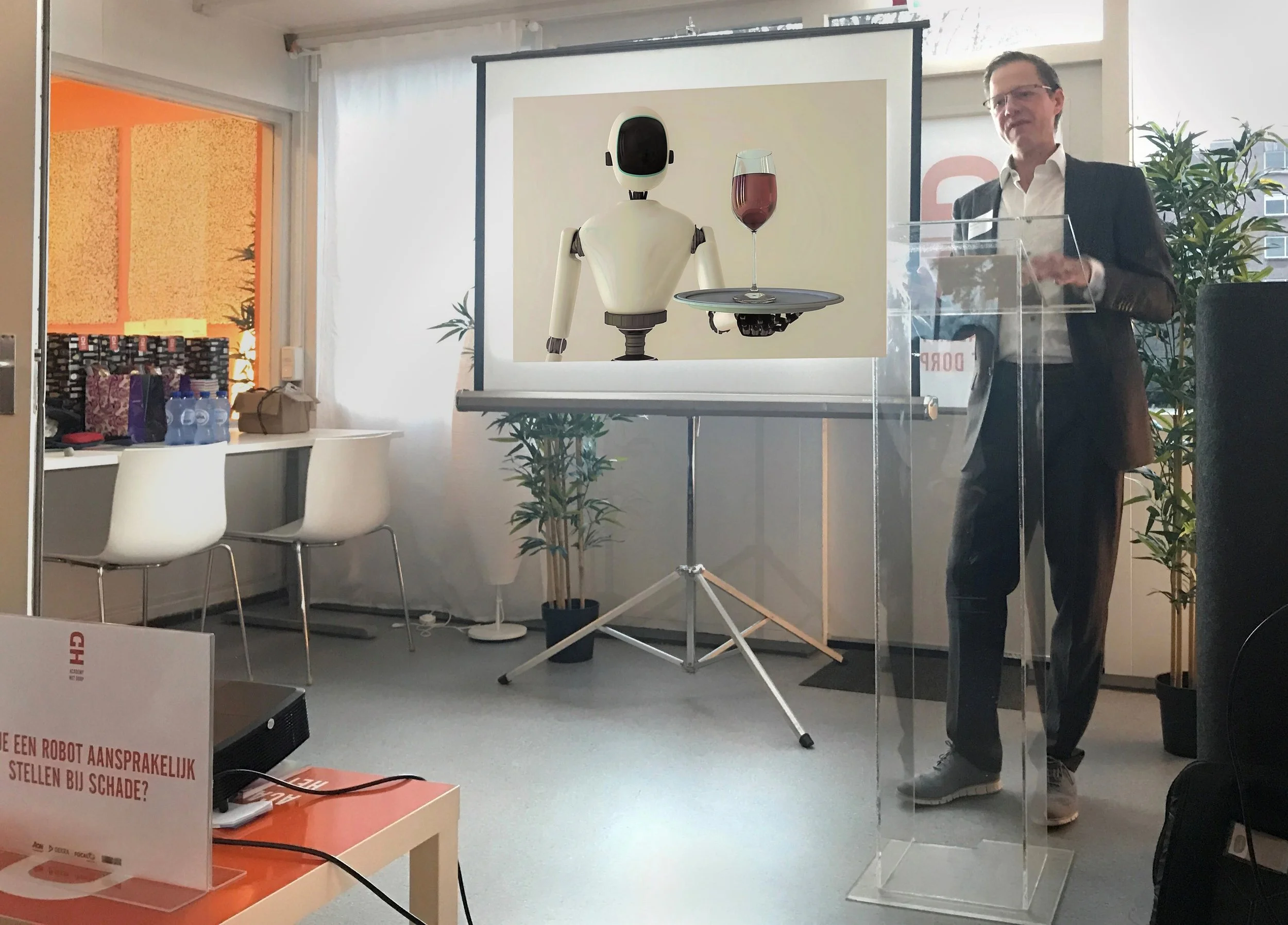
Legal Status of Robots and AI in Healthcare - Symposium Academy Het Dorp

On December 3, 2018 our office Artificial Intelligence & Law delivered the lecture 'The legal status of smart robots: legal personality, intellectual property and fundamental rights'. On the occasion of the Symposium on robotisation and eHealth in the pharmaceutical industry, organized by Academy Het Dorp and Proeftuin Robotica. The central theme of this seminar on healthcare regulation was: Can you hold a robot liable in case of damages?

How should we deal with liability in robotics?

The following questions were addressed: Should robots equipped with AI have a separate legal status? How do you - as a developer/supplier and consumer/user/patient get a grip on liability for autonomous machines and artificial intelligence algorithms? How do we safeguard ethical principles and fundamental human rights? Who owns intellectual property rights in smart robots and copyrights on computer and AI generated works? How should we deal with liability in robotics?

Meer lezen
What are the main requirements for AI systems in Healthcare?

Main barriers to adoptation of Artificial Intelligence in healthcare.

Absence of a specific AI law, or clear legal framework from the perspective of both professional users (A) and patients (B).

When constructing such a framework, it is important to make a distinction between the various sub-areas of healthcare, such as research and development, professional care providers and recipients of care. Because each sub-area has different needs.

Barriers for professional users.

It is simply unclear for companies and private and academic research institutes in the medical sector what is and is not allowed in the field of AI, blockchain, computer & machine vision and robotics. Both at European level and at national level. This knowledge is important for the commodification of their inventions/creations. Two practical examples are permission from Farmatec and obtaining a CE-marking.

Requirements for sustained use of AI in healthcare.

Since traceability and transparency are key within any healthcare (and food-feed) system, blockchain could play an important role in sustained use of AI in healthcare.

A EU AI Directive or Regulation should be able to implement and/or adhere to principles of Eudralex (The body of European Union legislation in the pharmaceutical sector), Good Manufacturing Practices (GMP) and Good Distribution Practices (GDP) in particular.

Meer lezen