
Innovation, Quantum-AI Technology & Law

Blog over Kunstmatige Intelligentie, Quantum, Deep Learning, Blockchain en Big Data Law

Blog over juridische, sociale, ethische en policy aspecten van Kunstmatige Intelligentie, Quantum Computing, Sensing & Communication, Augmented Reality en Robotica, Big Data Wetgeving en Machine Learning Regelgeving. Kennisartikelen inzake de EU AI Act, de Data Governance Act, cloud computing, algoritmes, privacy, virtual reality, blockchain, robotlaw, smart contracts, informatierecht, ICT contracten, online platforms, apps en tools. Europese regels, auteursrecht, chipsrecht, databankrechten en juridische diensten AI recht.

Berichten in Healthcare
Data delen als voorwaarde voor een succesvol AI-ecosysteem

Trainingsdatasets voor kunstmatige intelligentie: enkele juridische aspecten

Data delen (data sharing) of liever het vermogen om hoge kwaliteit trainingsdatasets te kunnen analyseren om een AI model -zoals een generative adversarial network- te trainen, is een voorwaarde voor een succesvol AI-ecosysteem in Nederland.

In ons turbulente technologische tijdperk nemen fysieke aanknopingspunten als papier of tastbare producten binnen de context van data -of informatie- in belang af. Informatie is niet langer aan een continent, staat of plaats gebonden. Informatietechnologie zoals kunstmatige intelligentie ontwikkelt zich in een dermate hoog tempo, dat de juridische problemen die daaruit voortvloeien in belangrijke mate onvoorspelbaar zijn. Hierdoor ontstaan -kort gezegd- problemen voor tech startups en scaleups.

In dit artikel een serie -mede in onderlinge samenhang te beschouwen aanbevelingen, suggesties en inventieve oplossingen om anno 2020 tot waardevolle nationale en Europese dataketens te komen.

Data donor codicil

Introductie van een Europees (of nationaal) data donor codicil waarmee een patiënt of consument vrijwillig data kan doneren aan de overheid en/of het bedrijfsleven, AVG-proof. Hier kunnen waardeketens worden gecreëerd door de sensor data van medische Internet of Things (IoT) apparaten en smart wearables van overheidswege te accumuleren. Anoniem of met biomarkers.

Data interoperabel en gestandaardiseerd

Unificatie van data uitwisselingsmodellen zodat deze interoperabel en gestandaardiseerd worden in het IoT. Een voorbeeld is een Europees EPD (Elektronisch Patiënten Dossier), i.e een Electronic Healthcare Record (EMR). AI certificering en standaardisatie (zoals ISO, ANSI, IEEE / IEC) dient bij voorkeur niet te worden uitgevoerd door private partijen met commerciële doelstellingen, maar door onafhankelijke openbare instanties (vergelijk het Amerikaanse FDA).

Machine generated (non) personal data

Een andere categorisering die we kunnen maken is enerzijds publieke (in handen van de overheid) machine generated (non) personal data, en private machine generated (non) personal data. Met machine generated data bedoelen we met name informatie en gegevens die continue door edge devices worden gegenereerd in het Internet of Things (IoT). Deze edge devices staan via edge (of fod) nodes (zenders) in verbinding met datacenters die samen met edge servers de cloud vormen. Deze architectuur noemen we ook wel edge computing.

Juridische dimensie

Data, of informatie heeft een groot aantal juridische dimensies. Aan data delen kleven potentieel intellectueel eigendomsrechtelijke (verbodsrecht en vergoedingsrecht), ethische, grondrechtelijke (privacy, vrijheid van meningsuiting), contractenrechtelijke en internationaal handelsrechtelijke aspecten. Juridisch eigendom op data bestaat anno 2020 niet omdat het -vanuit goederenrechtelijk oogpunt- niet als zaak wordt gekwalificeerd. Data heeft wel vermogensrechtelijke aspecten.

Meer lezen
Intellectual Property at Stanford Law School

USA IP Law at Stanford University

Stanford Law School has a long-standing tradition of sharing its expertise in Intellectual Property, Science and Technology law with legal professionals from around the world. In August 2019, AIRecht managing partner and strategic IP specialist Mauritz Kop had the pleasure to be part of a pre-selected international group of highly talented IP lawyers, counsels and scholars who had the opportunity to bring their professional skills to the next level and study complex IP issues related to Silicon Valley’s hi-tech industry, during an intensive international certificate summer program on U.S. IP law. The international professional American Intellectual Property Law Program at Stanford University is co-directed by Prof. Siegfried Fina, Prof. Mark Lemley and Dr. Roland Vogl.

SLS: A World’s Leading Law School at an Ivy Plus League University

Stanford University is an Ivy Plus League university. Ivy League schools such as Harvard, Yale, Princeton, MIT and Columbia University are viewed as the most prestigious, ranked among the best universities worldwide and have connotations of academic excellence. SLS is one of the world’s leading law schools. The Faculty draws international top talent to its magnificent campus. Stanford Law School’s Program in Law, Science & Technology (LST) has been ranked regularly among the top three intellectual property law programs in the United States, together with the IP Programs (LL.M. and J.D.) of the University of California-Berkeley and the University of New York.

Meer lezen
Silicon Valley: AI Impact Assessment presented at Apple, Facebook and Stanford University

AIRecht presents ECP AIIA in Silicon Valley

On 23 August 2019, Mauritz Kop LL.M. had the honour to present the ECP AI Impact Assessment to front-running companies in Silicon Valley, in the amazing San Francisco Bay Area. AI should be a force for good and our Dutch risk-management tool can help with that. The AIIA is a first-of-its-kind guide for the development and implementation of artificial intelligence and includes 2 things: a practical Checklist from a legal, technical and ethical point of view (in line with the EU Trustworthy AI paradigm) and a concrete Code of Conduct for data scientists. On top of that, our AIRecht managing partner introduced the AIIA at Stanford University, in beautiful Palo Alto.

Stanford University Campus

Stanford University has a stunning campus. It offers exuberant nature, nice temperature and magnificent architecture. Innovation is in the air. During the graduation ceremony of a post-doctoral intellectual property course at Stanford Law School, Mauritz officially handed over an English hardcopy of the ECP AI Impact Assessment to Professor Siegfried Fina and Professor Roland Vogl, Program Directors at SLS. The Program focusses on ‘'Overview on U.S. IP Law’ with specific attention to high-tech IP issues, such as copyrights, trade secrets, patents, trademarks, licensing and venture capital. A wonderful place for learning, discovery, innovation, expression and discourse, at the highest academic level imaginable.

Transatlantic bridges

It was an incredibly inspiring visit to Silicon Valley. We have seen it with our own eyes now: the Bay Area truly is the innovation hub of the world, together with Massachusetts (Boston, Harvard, MIT). It offers excellent opportunities for tech start-ups to work together and brainstorm with the best qualified experts, and create partnerships with professionals in myriad industrial sectors and disciplines. We hope to be back soon to further strengthen EU-USA relationships, construct new partnerships, exchange talent and remove barriers to trade and collaboration across the Atlantic.

Meer lezen
Cursus AI, Data, Privacy en Innovatie in de Zorg

Suzan Slijpen, Sander Ruiter en Mauritz Kop over AI in de Zorg

Op 31 oktober 2019 gaven Suzan Slijpen, Sander Ruiter en Mauritz Kop een cursus AI, Data, Privacy en Innovatie in de Zorg in het Maasstad Ziekenhuis Rotterdam. Wij waren daar te gast op uitnodiging van Quint Wellington Redwood, een leading consultancy firm die organisaties ondersteunt bij het ontwerpen en operationaliseren van hun digitale strategie waarbij mensen, processen en technologie centraal staan.

Gebruik van patiëntgegevens, medische hulpmiddelen, datadelen, privacy & AI in het ziekenhuis

Doel van cursus was om helderheid te scheppen in de wettelijke regels over het gebruik van patiëntgegevens, datadelen, eigendom van trainingsdatasets, medical devices, privacy en artificiële intelligentie in het ziekenhuis. AIRecht werd ingeschakeld om expertise te geven over dit complexe en uitdagende onderwerp. Om barrières weg te nemen voor innovatie. Onder de aanwezigen waren het Maasstad Ziekenhuis Rotterdam management team, de CISO (Chief Information Security Officer), enkele artsen, radiologen en verpleegkundigen. Ook waren er data scientists uitgenodigd van Parnassia Groep, specialisten in geestelijke gezondheid.

Keynote Digitale Zorg - Medical Devices, Patiëntdata, MDR & AVG

Nieuwe Europese regelgeving (MDR) voor Medical Devices waaronder zorgrobots, medische producten, hulpmiddelen en medische software vanuit een AI-helicopterview, die in 2020 in Nederland van kracht wordt. Verhouding tussen de AVG en de MDR. Gebruik en uitwisseling van patiëntdata, informatiebeveiliging en digitale zorg: wat mag er wel en niet op basis van de Europese Privacywetgeving (AVG/GDPR)?

Meer lezen
Suzan Slijpen Conference Speaker at the National University of Ireland

Legal Aspects of AI in Healthcare

On 16 August 2019, Suzan Slijpen LL.M. had the honour to speak about the legal aspects of the development and use of artificial intelligence (a disruptive technology) in healthcare, at the AI in Medicine Conference organized by the Irish Association of Physicists in Medicine (IAPM). The conference took place in Galway, at the National University of Ireland (School of Physics, NUI Galway/ OÉ Gaillimh). Suzan is a senior legal consultant at AIRecht.nl, and specializes in eHealth & medical devices, pharmaceutical law, European food law and contract law, from an AI helicopterview. She is also founder and lawyer at boutique law office Slijpen Legal.

Key topics of the Artificial Intelligence in Medicine lecture

Key legal topics that Suzan addressed in her Artificial Intelligence in Medicine lecture:

1. AI & Robotics: Disruptive Technologies: Synergetic effects of 4th Industrial Revolution technologies like robotics, big data, quantum computing, Blockchain, Virtual Reality (VR) and Internet of Things (IoT).

2. eHealth and medical devices: legal classification.

3. Fundamental Rights: Safeguarding of Fundamental Rights in AI applications, Rights of Patients.

4. Ethics and responsible AI: 1791 French Revolution Values, HLEG Concept of Trustworthy AI.

5. Intellectual Property on AI and Health Apps: Licensing your IP.

6. Liability for damages caused by smart robots: who is liable for misdiagnosis by an AI algorithm?

7. Legislation and Jurisprudence.

8. AI Impact Assessment: remove roadblocks for AI.

Legislation and regulations regarding AI in Healthcare

Do you want to know more about legislation and regulations regarding AI in Healthcare, or Legal aspects of disruptive tech in Medicine? Or do you want to organize a workshop or conference yourself and invite us as a speaker or teacher? Then please contact us about the possibilities!

Meer lezen
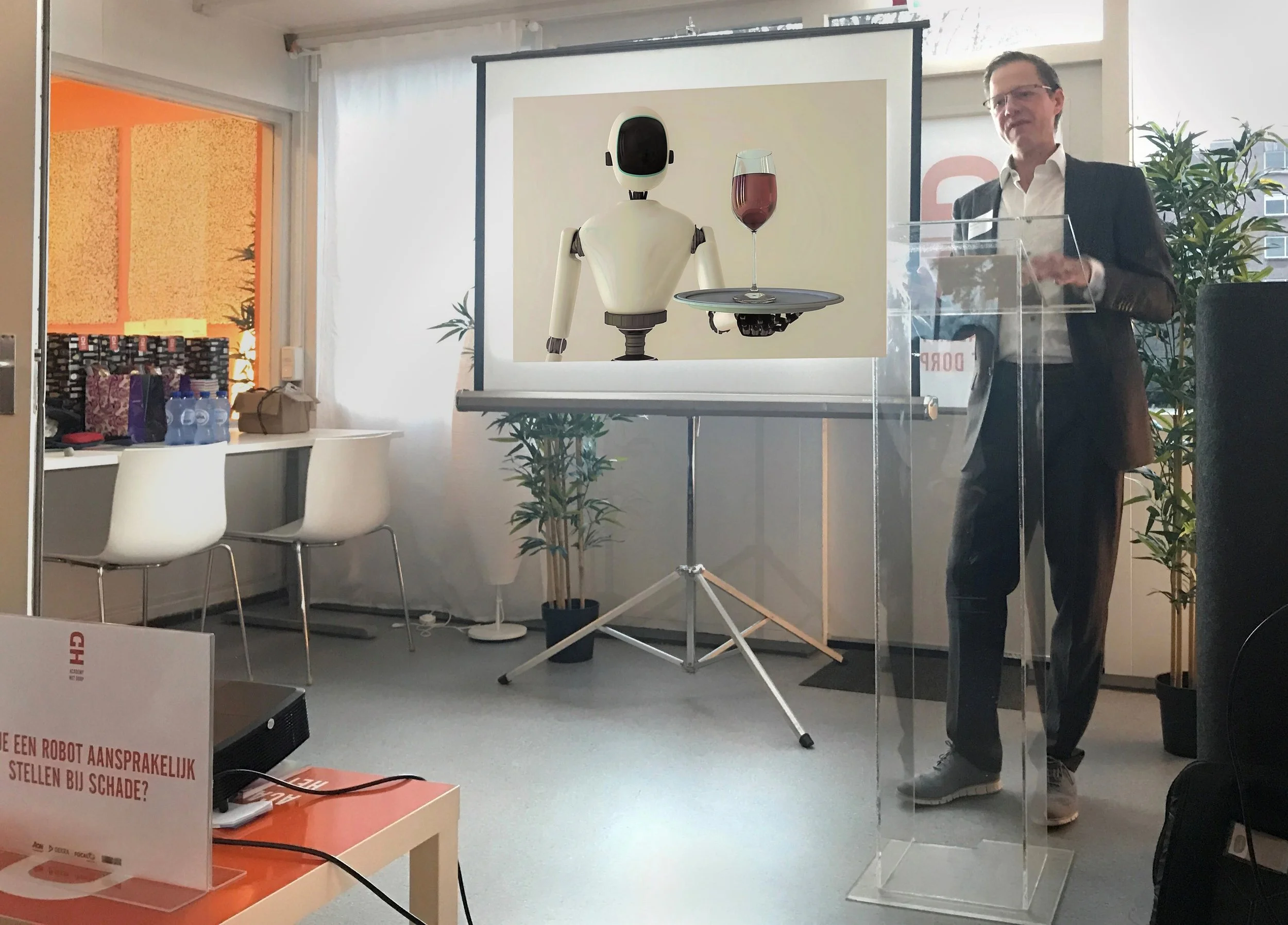
Legal Status of Robots and AI in Healthcare - Symposium Academy Het Dorp

On December 3, 2018 our office Artificial Intelligence & Law delivered the lecture 'The legal status of smart robots: legal personality, intellectual property and fundamental rights'. On the occasion of the Symposium on robotisation and eHealth in the pharmaceutical industry, organized by Academy Het Dorp and Proeftuin Robotica. The central theme of this seminar on healthcare regulation was: Can you hold a robot liable in case of damages?

How should we deal with liability in robotics?

The following questions were addressed: Should robots equipped with AI have a separate legal status? How do you - as a developer/supplier and consumer/user/patient get a grip on liability for autonomous machines and artificial intelligence algorithms? How do we safeguard ethical principles and fundamental human rights? Who owns intellectual property rights in smart robots and copyrights on computer and AI generated works? How should we deal with liability in robotics?

Meer lezen
What are the main requirements for AI systems in Healthcare?

Main barriers to adoptation of Artificial Intelligence in healthcare.

Absence of a specific AI law, or clear legal framework from the perspective of both professional users (A) and patients (B).

When constructing such a framework, it is important to make a distinction between the various sub-areas of healthcare, such as research and development, professional care providers and recipients of care. Because each sub-area has different needs.

Barriers for professional users.

It is simply unclear for companies and private and academic research institutes in the medical sector what is and is not allowed in the field of AI, blockchain, computer & machine vision and robotics. Both at European level and at national level. This knowledge is important for the commodification of their inventions/creations. Two practical examples are permission from Farmatec and obtaining a CE-marking.

Requirements for sustained use of AI in healthcare.

Since traceability and transparency are key within any healthcare (and food-feed) system, blockchain could play an important role in sustained use of AI in healthcare.

A EU AI Directive or Regulation should be able to implement and/or adhere to principles of Eudralex (The body of European Union legislation in the pharmaceutical sector), Good Manufacturing Practices (GMP) and Good Distribution Practices (GDP) in particular.

Meer lezen