
Innovation, Quantum-AI Technology & Law

Blog over Kunstmatige Intelligentie, Quantum, Deep Learning, Blockchain en Big Data Law

Blog over juridische, sociale, ethische en policy aspecten van Kunstmatige Intelligentie, Quantum Computing, Sensing & Communication, Augmented Reality en Robotica, Big Data Wetgeving en Machine Learning Regelgeving. Kennisartikelen inzake de EU AI Act, de Data Governance Act, cloud computing, algoritmes, privacy, virtual reality, blockchain, robotlaw, smart contracts, informatierecht, ICT contracten, online platforms, apps en tools. Europese regels, auteursrecht, chipsrecht, databankrechten en juridische diensten AI recht.

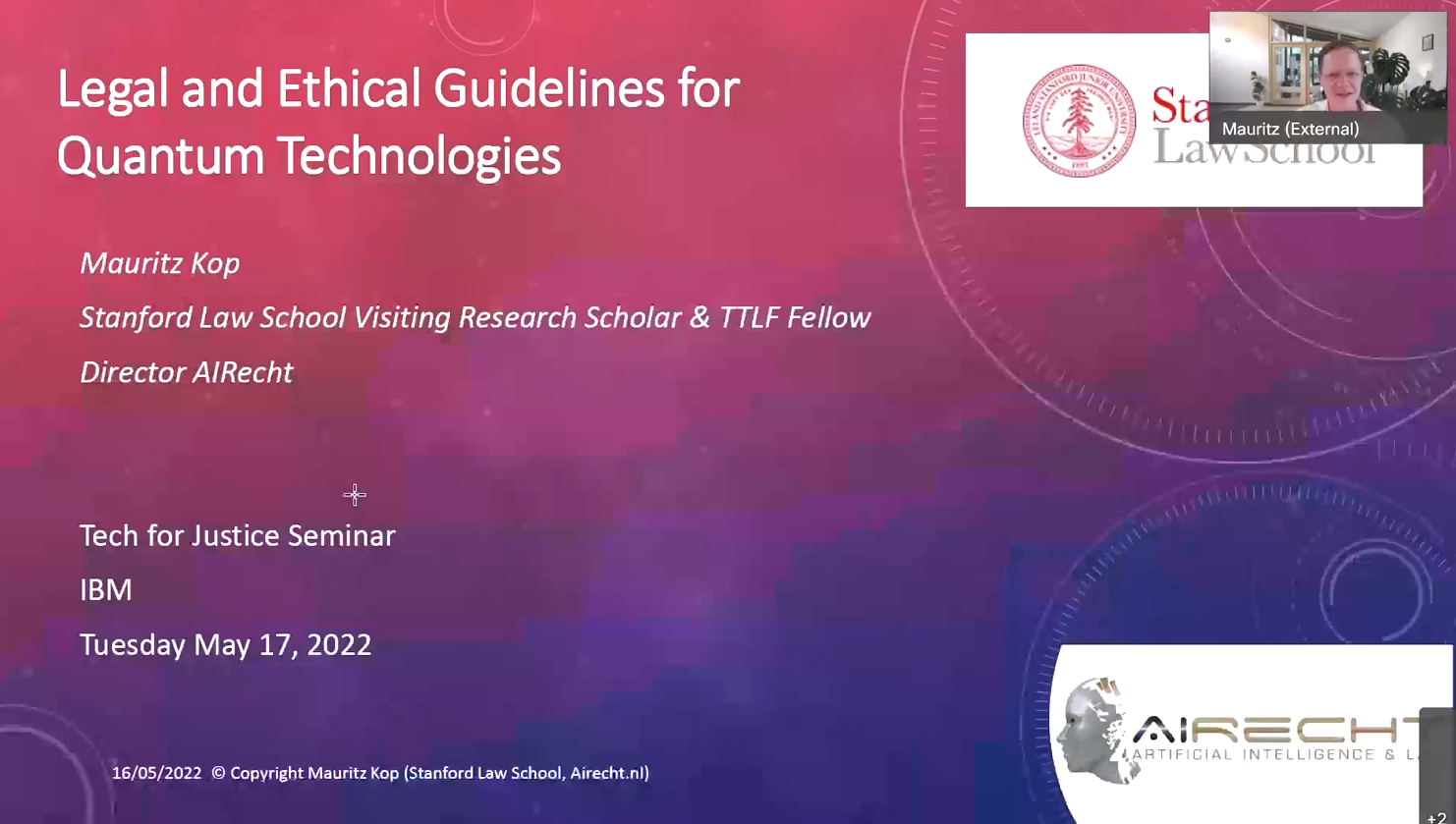
IBM Invites Mauritz Kop for Lecture on Quantum Ethics

New York, May 17, 2022—The development of quantum technology represents a significant advance in computational capability, with the potential to reshape industries, accelerate scientific discovery, and address complex problems. As with other transformative technologies, its power introduces a range of responsibilities. The relevant questions are not only about the technical capabilities of quantum mechanics, but also about the appropriate uses of the technology.

Reflecting this, IBM, a leading company in the quantum field, convened a seminar on May 17, 2022, for its New York and San Francisco teams to focus on the legal and ethical dimensions of this emerging field. The invited speaker for the event was Mauritz Kop, a visiting scholar at Stanford Law School, who presented his work on establishing a governance framework for quantum technologies to an audience of researchers, engineers, and policymakers.

The event was part of IBM's Tech for Justice initiative, a cross-divisional program dedicated to using technology to address systemic biases and advance social equity. Situating the conversation about quantum ethics within this framework indicates an understanding that principles of fairness, accountability, and transparency should be integrated into new technologies from an early stage.

The session was hosted by Dr. Aminat Adebiyi, a Research Staff Member, Experimentalist, and Maker at IBM, and moderated by Dr. Mira Wolf-Bauwens. Kop's collaboration with Wolf-Bauwens includes their shared work on the World Economic Forum's foundational principles for quantum computing, a project that highlights the role of multi-stakeholder cooperation in this area.

The Quantum Vanguard: IBM's Technological Position

To understand the context of the ethical discussion, it is useful to consider the technological landscape. IBM Quantum is one of the leading organizations in quantum computing and has achieved notable milestones in the field. Central to its strategy is the development of universal fault-tolerant quantum computers based on superconducting transmon qubits. This approach, which involves creating and manipulating quantum states in circuits cooled to cryogenic temperatures, has enabled IBM to build increasingly powerful and stable quantum processors.

Charting a Course for Responsible Quantum Development: A Summary of the Lecture

The material presented in the lecture builds upon a body of foundational research by Kop. His work in the Yale Journal of Law & Technology first proposed a comprehensive legal-ethical framework and a set of ten guiding principles for quantum technology. In the Stanford Law School Transatlantic Technology Law Forum, he explored the crucial roles of intellectual property and standardization in fostering sustainable innovation. Furthermore, in Physics World, published by the Institute of Physics, he articulated the necessity of a dedicated field of "quantum ethics," urging the physics community to engage directly with the social and moral implications of their work. Lastly, together with Luciano Floridi at Oxford, Kop conceptualized the Quantum-ELSPI framework as the ethical, legal, social, and policy implications of the suite of quantum technologies. The lecture for IBM synthesized and advanced these core themes.

Kop's lecture, "Legal and Ethical Guidelines for Quantum Technologies," was structured around the thesis that there is a timely opportunity to establish governance for quantum technology. In contrast to the development of the internet or artificial intelligence, where regulation often followed widespread adoption, it is possible to proactively embed democratic values and human rights principles into the architecture of quantum systems.

Interactive Discussion and Call to Action

The lecture was followed by an engaging Q&A session that highlighted the deep commitment of the IBM technical community to responsible innovation. The questions posed by participants explored the practical challenges and nuances of implementing ethical frameworks. Key themes of the discussion included the tangible impact of tech regulation to date, the specific processes needed to assess quantum's potential societal effects, and the distinct yet complementary roles of government and private enterprise in setting and adhering to standards.

Participants were keen to understand how a framework could effectively infuse 'humanism' into every aspect of technology development and how regulation could be used proactively to shape an emerging field for the better. The dialogue also addressed the most significant challenges facing quantum regulation specifically and the strategies required to overcome them.

Meer lezen

Montreal World Summit AI 2022 Features Mauritz Kop Keynote on EU AI Act

Montreal, Canada – May 4, 2022 – Today, at the prestigious World Summit AI Americas held at the Palais des congrès, Mauritz Kop, TTLF Fellow at Stanford Law School and Director of AIRecht, provided a concise overview of the proposed EU Artificial Intelligence Act. He was a featured panellist in a critical discussion titled, "Does the proposed EU Artificial Intelligence Act provide a regulatory framework for AI that should be adopted globally?". The summit, themed "AI with impact: for crisis response and business continuity and recovery," brings together leading AI brains and enterprise leaders.

Mr. Kop joined fellow distinguished panellists Professor Gillian Hadfield from the University of Toronto and José-Marie Griffiths, President of Dakota State University and former NSCAI Commissioner. The session was moderated by Meredith Broadbent, Former Chairman of the U.S. International Trade Commission and Senior Adviser at CSIS.

Novel Legal Framework for AI

During the panel, Mr. Kop outlined the main points of the novel legal framework for AI presented by the European Commission on April 21, 2021. He explained that the EU AI Act sets out horizontal rules applicable to all industries for the development, commodification, and use of AI-driven products, services, and systems within the EU's territory.

A core component of the Act is its sophisticated ‘product safety framework’, which is constructed around four distinct risk categories in a "pyramid of criticality". This risk-based approach dictates that AI applications with unacceptable risks are banned, while lighter legal regimes apply to low-risk applications. As the risk level increases, so do the stringency of the rules, ranging from non-binding self-regulation and impact assessments for lower-risk systems to potentially heavy, externally audited compliance requirements throughout the lifecycle of high-risk AI systems.

EU "Trustworthy AI" Paradigm

Mr. Kop emphasized that the Act aims to codify the high standards of the EU’s "trustworthy AI" paradigm, which mandates that AI systems must be legal, ethical, and technically robust, all while respecting democratic values, human rights, and the rule of law. A crucial aspect highlighted was the requirement for market entrance and certification of High-Risk AI Systems through a mandatory CE-marking procedure. This pre-market conformity regime also extends to the machine learning training, testing, and validation datasets used by these systems. Only after a declaration of conformity is signed and the CE marking is affixed can these high-risk systems enter and be traded on the European markets.

Enforcement will be managed by a new Union-level body, the European Artificial Intelligence Board (EAIB), supported by national supervisors in each Member State, similar to the GDPR's oversight structure. Mr. Kop noted the seriousness of non-compliance, with potential fines reaching up to 6% of a company's global turnover.

Balancing regulation with innovation, the EU AI Act also introduces legal sandboxes. These are designed to provide AI developers with "breathing room" to test new inventions and foster a flourishing AI ecosystem in Europe.

Meer lezen
Mauritz Kop and Mateo Aboy Present QT and Law Research at Lund Quantum Conference

When Lund University convened The Quantum Law Conference in late April 2022, the legal scholarship on quantum computing was still in its infancy. Organized by Valentin Jeutner under the WASP-HS-funded Quantum Law Project, the gathering—formally titled The Legal Dimensions of Quantum Computing—gave an early home to a question that has only grown more urgent: whether intellectual property law is fit for the quantum age. Mauritz Kop, then a TTLF Fellow at Stanford Law School, and Mateo Aboy, Principal Research Scholar at the University of Cambridge, brought a distinctive answer—one built on data rather than intuition.

Theory meets the patent record

Kop's theoretical contribution warned of IP overprotection: a "rainbow" of overlapping rights that could entrench first movers and concentrate market power in a young field. Rather than rest on the argument, the team tested it. Aboy led a patent-landscape study of the quantum computing subfield, asking whether feared "thicket" and "anticommons" effects were actually appearing. The pairing of a normative framework with empirical patent analysis is what made the Lund presentation unusual—and useful to policymakers who need evidence, not assertion.

A counter-intuitive result

The data pointed the other way. The patent system in quantum computing was not, at that stage, generating innovation-choking overprotection; instead, a growing share of quantum patent information was entering the publicly available disclosure record through lapsed and non-granted filings, forming an expanding information commons. The important caveat was secrecy: trade secrets and state secrets ordinarily do not appear in patent datasets, so quantitative mapping must always be read alongside qualitative analysis. The conclusion was measured—IP law works best in concert with competition law, steering between under- and overprotection.

From a conference room toward the journals

The work is not staying in Lund. The theoretical and market-power strand is forthcoming as a peer-reviewed article in the Journal of Intellectual Property Law & Practice (Oxford University Press), and the companion patent-landscape study is forthcoming in IIC – International Review of Intellectual Property and Competition Law (Springer), with a transatlantic author team spanning Stanford, Cambridge, and CeBIL at the University of Copenhagen. Together they promise one of the earliest evidence-based treatments of quantum-IP policy. It is a quieter companion to Kop's better-known warning that quantum computing carries risks that rival those of artificial intelligence: here the concern is not catastrophe but market structure—who gets to build on quantum technology, and on what terms. The answer the Lund research offers is calibration, not maximalism: predictability enough to attract investment, openness enough to keep the field competitive.

Meer lezen
Scarcity, Regulation, and the Abundance Society Roundtable at Stanford Law

In 2022, Mauritz Kop had the honor of contributing a chapter to the book project "Scarcity, Regulation, and the Abundance Society," a special volume of Frontiers in Research edited by two leading minds in technology law, Professor Mark Lemley of Stanford Law School and Professor Deven Desai of Georgia Institute of Technology. The project culminates years of research and dialogue, including a memorable and insightful roundtable held at Stanford Law School.

The central inquiry of the project is to explore how our legal and economic institutions, which are fundamentally built on scarcity, should respond as "technologies of abundance" make scarcity a thing of the past in many industries. As new technologies like AI, 3D printing, and synthetic biology democratize and disrupt production, the book examines whether we will try to legally replicate scarcity or reorder our society to focus on things other than scarcity.

The "Abundance and Equality" Chapter Edited by Mark Lemley

His chapter, titled "Abundance and Equality," was edited by Mark Lemley and connects the concepts of good governance and the end of scarcity by unifying equality with technology-driven abundance. The piece introduces the Equal Relative Abundance (ERA) principle—a post-Rawlsian framework for distributive justice designed for an age of abundance.

The ERA principle builds on John Rawls's "difference principle" but integrates desert-based critique, arguing that unequal rewards for contributions (due to hard work, talent, or entrepreneurial spirit) are justified only to the extent that they also improve the position of the least advantaged members of society. The chapter examines how ten key exponential technologies of the Fourth Industrial Revolution—including AI, quantum technology, and biotechnology—are the primary drivers of this shift from scarcity to abundance. It critically analyzes our existing scarcity-based institutions, particularly property and intellectual property law, and posits that we must begin experimenting with hybrid systems that mix the best of forward-thinking socialist and ethical post-capitalist paradigms, built on a foundation of participatory democracy.

Mauritz Kop Presents Book Chapter at 2022 Stanford Law’s Abundance Roundtable

On April 22, 2022, the project's contributors gathered for a roundtable workshop at Stanford Law School. The event provided a forum for a deeply interdisciplinary group of scholars to present their work and engage in a robust dialogue about the future of our society. The format consisted of short 8-10 minute presentations followed by 20 minutes of discussion, fostering a rich exchange of ideas.

A Convergence of Post-Scarcity Presentations and Discussions

During his session, Kop presented the core arguments from his "Abundance and Equality" chapter, outlining the tension between technology-driven abundance and the persistent reality of inequality for many across the globe. He introduced the ERA principle as a moral and political guide for distributing the benefits and burdens of our increasingly abundant future.

The roundtable featured a breadth of perspectives. Vivek Wadhwa discussed solving humanity's grand challenges, while Funmi Arewa explored the scarcity of opportunity within the digital economy. Zahr Said and Joshua Fairfield tackled the creation of artificial scarcity through intellectual property and the legal status of virtual property in the age of NFTs, respectively. Shane Greenstein of Harvard Business School offered insights on supply chains and the platformization of clothing personalization. This convergence of ideas underscored the complexity of the transition ahead and the need for holistic solutions.

Musical Interlude: A Spontaneous Translation of Ideas

The roundtable was a stimulating intellectual affair, filled with rigorous debate. During lunch break, celebrating the occasion, Mauritz Kop sat down at the piano in the Stanford Faculty Lounge and performed a brief impromptu musical interlude. It was a personal endeavour to translate the abstract and often-dense themes of our discussion—the post-scarcity economy, abundance, equality, and the human condition—into the universal language of music. It was an opportunity for him to share that moment with his colleagues, connecting the analytical with the artistic.

The "Scarcity, Regulation, and the Abundance Society" project is a vital and timely undertaking. The discussions at the Stanford roundtable and the resulting publications provide a critical foundation for reimagining our legal, economic, and social institutions for a new era. These forward-looking conversations are essential for ensuring that the future of technological abundance is one that fosters not new forms of inequality, but greater justice and human flourishing for all.

Meer lezen
Mauritz Kop Lecturer AI Regulation and Intellectual Property Law at CEIPI, University of Strasbourg

Strasbourg, France – We are pleased to feature insights from a lecture on "Intellectual Property and Ownership of AI Input and Output Data" delivered by Professor Mauritz Kop at the Centre for International Intellectual Property Studies (CEIPI), University of Strasbourg. This session was part of the University Diploma in Artificial Intelligence and Intellectual Property.

Rights and responsibilities pertaining to AI and data

Professor Kop, a Fellow at Stanford University and a strategic IP lawyer, shared his expertise on the rights and responsibilities pertaining to AI and data, offering both theoretical perspectives and practical tips at the current state of technological and legal development. The lecture aimed to equip attendees with a bird's-eye view of the intertwined key elements of this multidimensional topic.

AI, data governance, and intellectual property law

Professor Kop's session underscored the dynamic interplay between AI advancement, data governance, and intellectual property law. It highlighted the necessity for legal professionals to be "double or triple educated" to navigate this complex field and for ongoing efforts to create legal frameworks that foster responsible innovation while addressing societal and ethical considerations.

The lecture concluded by stressing that AI literacy and awareness, continuous learning, and proactive legal strategies are essential for all stakeholders in the AI ecosystem.

Meer lezen
Mauritz Kop Visiting Quantum & Law Scholar at Stanford Law School

Mauritz Kop is Visiting Quantum & Law Scholar at Stanford Law School in 2022-2023. Kop was invited by Prof. Mark Lemley, the William H. Neukom Professor of Law at Stanford Law School and the Director of the Stanford Program in Law, Science and Technology.

Advanced legal research on Regulating Quantum technology at Stanford Law School

This Stanford Law School ‘Regulating Quantum Technology’ research project will perform a detailed study of how to sensibly regulate the suite of quantum technologies including computing, sensing and networking, unifying the world of the large with that of the small. It intends to answer questions on how our innovation architecture should be constructed, so that benefits of quantum computing, sensing, simulation, and communication -including quantum-AI hybrids- will be distributed equitably, and risks proportionally addressed. Building upon foundational work done on quantum and AI innovation policy mechanisms, national security strategy, standardization & certification, ethics, responsible quantum R&D, governance principles, technology impact assessments, data ownership and intellectual property in quantum software and hardware structures - published in flagship Journals at Stanford, Harvard, Yale, Berkeley, Physics World, Max Planck, Springer Nature, and Oxford - the transdisciplinary research aims to develop an integrated, holistic vision on smart governance and regulation of quantum & AI infused digital transformation.

Happy to speak at a number of in person events in the nexus of AI, Quantum & Law in the coming weeks:

Scarcity, Regulation and the Abundance Society Roundtable at Stanford

1. April 22, Scarcity, Regulation and the Abundance Society Roundtable at Stanford, where I will present a chapter titled ‘Abundance & Equality’ for the book project co-edited by Mark Lemley and Deven Desai. The chapter connects good governance to the end of scarcity and unifies equality with technology driven abundance, by introducing a novel Post-Rawlsian Equal Relative Abundance (ERA) principle of distributive justice. As befits tradition, we will insert musical interludes for piano, with me performing ‘Stanford Theme & Variations’ à l'improviste in the Stanford Law School Faculty Lounge. https://law.stanford.edu/publications/scarcity-regulation-and-the-abundance-society/

Patenting Quantum Computing Technologies talk at Quantum & Law Conference in Lund

2. April 29, presenting our 'Patenting Quantum Computing Technologies and Market Power: A Quantitative Analysis' research together with my academic friends Profs Mateo Aboy (Cambridge) and Timo Minssen (Copenhagen) at the Quantum & Law Conference in Lund. We wrote 2 papers focusing on IP portfolio strategies, trade & state secrets, and their interface with antitrust regulations, utilizing industry and quantum domain specific mixed theoretical & empirical research methods. http://quantum-law.org/conference/

EU AI Act Presentation at AI World Summit Americas in Montreal

3. May 4, I’ll present an overview of the EU AI Act with its ‘product safety framework’ and market entrance requirements, constructed around a set of 4 risk categories at the AI World Summit Americas in Montreal. We will discuss whether it provides a regulatory framework for AI that should be adopted globally during a Headline panel with Prof. Gillian Hadfield (Toronto) and Dr José-Marie Griffiths (President Dakota State), moderated by Meredith Broadbent (Washington). https://americas.worldsummit.ai/speakers/

Keynote Quantum Computing Ethics at IBM Research

4. May 17, I’ll give a keynote on Quantum Computing Ethics at IBM Research during their Tech for Racial and Social Justice Seminar (internal event), organized by Dr Aminat Adebiyi, moderated by Dr Mira Wolf-Bauwens, with whom I worked together on the WEF Quantum Computing Principles. https://www.weforum.org/publications/quantum-computing-governance-principles/

Quantum Impact Assessment (QIA)

5. We are creating a world’s first application-driven Quantum Impact Assessment (QIA) in The Netherlands -raising ELSA awareness and removing barriers for adoption of QT- with a diverse, multidisciplinary team lead by Prof. Bart Schermer (Leiden) and Daniël Frijters for the Centre for Quantum & Society, made possible by ECP and Quantum Delta NL. https://quantumdelta.nl/centre-for-quantum-and-society

Quantum-ELSPI special for Springer Nature with Luciano Floridi

6. Meanwhile I am editing the Quantum-ELSPI special for Springer Nature on the Ethical, Legal, Social and Policy Implications of Quantum Technology, together with EiC Prof. Luciano Floridi (Oxford). https://web.archive.org/web/20260126194629/https://law.stanford.edu/publications/quantum-elspi-ethical-legal-social-and-policy-implications-of-quantum-technology/

More exciting projects soon ...

Meer lezen
World Economic Forum Quantum Computing Ethics & Governance Principles

During 2021, Mauritz Kop helped design the World Economic Forum Quantum Governance Principles. In January 2022, the World Economic Forum released its accompanying Quantum Computing Governance Principles Insight Report. The report and principles were developed as part of a co-design process over the course of 2021 with a diverse set of global quantum stakeholders from industry, academia and government.

Governance Principles for the Responsible Design and Adoption of Quantum Computing

In 2022, our multidisciplinary WEF expert group published the first set of governance principles for the responsible design and adoption of quantum computing technology. A global multi stakeholder initiative to create an ethical framework enabling the responsible design and adoption of quantum computing. Quantum computing, though at its early stages, will help provide very significant advances in our computing capabilities and will have a considerable impact on improving the state of the world in the coming years. It could have a revolutionary impact on human well-being, national security, and global society, along with potential commercial applications across industries.

The Quantum Computing Ethics project is part of the World Economic Forum’s Shaping the Future of Technology Governance: Artificial Intelligence and Machine Learning Platform.

10 Guiding Principles for Quantum Computing published at Yale

The Principles build in part on the prior 10 Guiding Principles for Quantum Computing published March 30, 2021 in the Yale Journal of Law & Technology in my article titled: Establishing a Legal-Ethical Framework for Quantum Technology.

There, I argue that the unique physical characteristics of quantum mechanics demand universal guiding principles of responsible, human-centered quantum technology. To this end, the article proposes ten guiding principles for the development and application of quantum technology. These ground rules aim to put controls in place and integrate our common democratic norms, standards and values into the design of our future hi-tech systems as much as possible

Law and ethics frequently interrelate. Ethical standards for quantum should however be a supplementation to legal measures, and not a replacement. Ethics alone can never be enough when regulating high-risk technologies like dual use quantum tech and quantum artificial intelligence. To make sure all groups of society benefit from quantum and AI we have to put controls and guardrails in place that address identified risks and incentivise sustainable innovation.

Meer lezen
Mauritz Kop Consults Senator Mark Warner on AI & Quantum Technology Policy

Washington D.C., January 4, 2022—As the United States Congress grapples with the complex challenges of regulating artificial intelligence and quantum technology, leading policymakers are seeking expert guidance to inform a robust and forward-thinking national strategy. On January 4, 2022, Mauritz Kop, a distinguished scholar in the field of technology law and governance, was consulted by the legal team of U.S. Senator Mark Warner (D-VA) to provide strategic insights on both AI and quantum technology policy.

This consultation highlights the growing recognition in Washington of the need for deep, interdisciplinary expertise to navigate the geopolitical, economic, and security dimensions of these transformative technologies. Senator Warner's team reached out to Kop based on his influential scholarship, including his extensive work at Stanford on the EU AI Act and the need for a strategic democratic tech alliance, his advisory role for the European Commission led by Ursula von der Leyen on the AI Act and Data Act, and his foundational article in the Yale Journal of Law & Technology proposing a comprehensive legal-ethical framework for quantum technology.

Senator Mark Warner: A Leader on Technology and National Security

Senator Mark Warner's engagement on these issues is both significant and timely. As the Chairman of the Senate Select Committee on Intelligence, he is at the forefront of addressing the national security implications of emerging technologies. His work involves overseeing the U.S. Intelligence Community and ensuring it is equipped to handle the threats and opportunities of the 21st century, where technological competition with nations like China is a central concern.

The Senate Select Committee on Intelligence has a broad mandate that includes analyzing intelligence on the technological capabilities of foreign powers and assessing the vulnerabilities of U.S. critical infrastructure. Senator Warner has been a vocal proponent of developing a national strategy for AI and quantum to maintain the United States' competitive edge and to ensure that these technologies are developed and deployed in a manner consistent with democratic values. This consultation with Mauritz Kop reflects the Senator's commitment to drawing on leading academic research to shape sound, bipartisan policy.

AI Policy: A Transatlantic, Risk-Based Approach that Lets Innovation Breathe

A key focus of the consultation was Kop's analysis of the European Union's AI Act. His Stanford publications argue for a balanced, pro-innovation regulatory model that can serve as a blueprint for international cooperation. Good governance and sensible legislation should incentivize desired behavior and simultaneously create breathing room for sustainable, beneficial innovation to flourish.

Quantum Governance: Establishing a Legal-Ethical Framework

The discussion also delved into the governance of quantum technology, drawing on Kop's seminal work in the Yale Journal of Law & Technology. Recognizing that quantum is rapidly moving from the theoretical to the practical, he stressed the urgency of establishing a legal-ethical framework before the technology is widely deployed and locked-in.

The consultation with Senator Warner's office represents a critical intersection of academic scholarship and high-level policymaking. As the United States charts its course in the era of AI and quantum, the insights provided by experts like Mauritz Kop are invaluable in ensuring that the nation's strategy is not only competitive but also responsible, ethical, and firmly rooted in democratic principles.

Meer lezen
Een IPCC voor AI en opkomende technologie: het IPREDICT-voorstel aan de VN

IPREDICT is de oproep aan de Secretaris-Generaal van de Verenigde Naties om een internationaal panel voor verantwoorde ontwikkeling van opkomende technologie op te richten — naar het model van het klimaatpanel IPCC. AIRecht-oprichter Mauritz Kop behoorde tot de internationale experts die het voorstel voorbereidden en leverde de inbreng over quantumtechnologie.

Een IPCC voor opkomende technologie

De kern is coördinatie: één onafhankelijke, interdisciplinaire bron die kunstmatige intelligentie, robotica, biotechnologie en quantumtechnologie beoordeelt vóórdat de gevolgen onomkeerbaar zijn. Het voorgestelde mandaat omvat betrouwbare informatie, expert-aanbevelingen, het aanmoedigen van verantwoorde innovatie in alle ontwikkelfasen en publieke betrokkenheid via een tweejaarlijks World Forum.

Internationale participanten

Het initiatief werd voorbereid door een breed gezelschap van wetenschappers uit recht, ethiek, robotica, AI en biotechnologie — van Princeton en Yale tot UNESCO-bioethici en SIPRI. Het is precies die multidisciplinaire mengeling die een panel als IPREDICT beoogt.

De bijdrage van AIRecht

Mauritz Kop leverde de quantum-expertise, in lijn met zijn werk aan een juridisch-ethisch kader voor verantwoorde quantumtechnologie. De achterliggende gedachte is dat anticiperende governance past bij technologie die met sprongen arriveert. Verder lezen over dat kader kan in Establishing a Legal-Ethical Framework for Quantum Technology.

Meer lezen
Ethics in the Quantum Age

Honored to write about Ethics in the Quantum Age in the Physics World Special on Quantum 2.0, and to be given the chance to outline an ethical framework for quantum technologies, which includes a definition of quantum-ethics.

Mauritz Kop, Why we need to consider the ethical implications of quantum technologies, Physics World, IOP Publishing, (December 1, 2021)

Physics World Special on Quantum 2.0

Physics World is the magazine of the UK-based Institute of Physics (IOP), one of the largest physical societies in the world.

Link to the article: https://physicsworld.com/a/why-we-need-to-consider-the-ethical-implications-of-quantum-technologies/

Download the Ethics in the Quantum Age article here.

We need to build bridges of mutual understanding between disciplines – a move that will involve learning to speak each other’s language, which is easier said than done. Therefore, it is a promising sign that the quantum community reaches out to lawyers, philosophers, and ethicists to explain them the importance of ethics and the societal impact of quantum technologies in their own technical journal.

Making Quantum Technologies Ethical

Please find a short introduction below:

Over the past decades, research into quantum technologies has come to the stage where the science is rapidly being translated into real-world applications be it quantum computers, materials and communications systems. These advancements are witnessed by the considerable number of quantum start-ups that have emerged in recent years. Yet before these innovations can be diffused, we must ensure that ethical, legal and social implications are sufficiently addressed. Against this backdrop, attention is now turning to interdisciplinary efforts to identify the dilemma’s ingrained in making quantum technologies ethical.

A Multi-layered Ethical Framework for Quantum Technologies

The article proposes a multi-layered ethical framework for quantum technologies, including a definition of quantum ethics. At one level, we employ the old, familiar “normative” ethics that apply to all transformative technologies and to information. In addition, the counterintuitive phenomena that underpin quantum physics – such as superposition, entanglement and tunnelling – require a tailored, applied ethics approach. In other words, due to the unique characteristics of quantum technologies – such as the unprecedented capabilities of quantum sensors, the features of quantum networks, and the probabilistic nature of quantum computing – we also develop a new subtype of context-specific practical ethics. In this way we constitute our theory in well-established ethical traditions while at the same time providing tailor-made solutions.

Definition of Quantum Ethics

One possible definition of quantum ethics could be: “Quantum ethics calls for humans to act virtuously, abiding by the standards of ethical practice and conduct set by the quantum community, and to make sure these actions have desirable consequences, with the latter being higher in rank in case it conflicts with the former.

More quantum research at Stanford Law School here.

Meer lezen
Music Law at the Royal Conservatoire The Hague

Returning to my old flame for 1 day: looking forward to teaching music law at the Royal Conservatoire The Hague tomorrow! https://www.koncon.nl/en/

It's nice not having to speak or write about AI, data or quantum technology for a change... ;)

Teaching music law at the Royal Conservatoire The Hague

I am giving an in person guest lecture to a small group of students at the Amare - Den Haag, and it is live streamed to the rest of the department. The Amare is home to Nederlands Dans Theater (NDT) as well, one of the world’s leading contemporary dance & ballet companies, dedicated to creation, research, innovation and talent development. https://www.ndt.nl/en/

Using self-produced audio fragments and practical examples, we cover 18 music law topics ranging from registering intellectual property rights to strategic contract negotiations. The tracks I prepared are played from my Powerpoint into a phenomenal pair of Bowers & Wilkins monitors, the ultimate sound system. https://www.muziekenrecht.nl/blog/2017/6/music-licensing-in-the-netherlands-movies-games-legal-aspects

Looking back in nostalgia to the cross-disciplinary masterclasses I had the pleasure of teaching in recent years inter alia at Leiden University, Utrecht University and Conservatorium Maastricht. https://www.musicajuridica.nl/blog/2017/5/gastcollege-intellectueel-eigendom-conservatorium-maastricht

CPO Radboud University seminar at Het Concertgebouw Amsterdam

Absolute highlight was the postgraduate CPO Radboud University seminar at Het Concertgebouw Amsterdam on music & law, which included a public domain quiz musically framed by an ad hoc ensemble of Koninklijk Concertgebouworkest musicians featuring the Chief Justice of the Supreme Court Maarten Feteris on piano and me (Mauritz Kop) on clarinet es/bes, performing bespoke Mozart, Beethoven and Bach arrangements. https://www.muziekenrecht.nl/blog/2018/cpo-seminar-muziek-recht-concertgebouw-amsterdam

Kudos to the KonCon management for making sure their talented students have firsthand access to vital information about the inner workings of the music & entertainment industry!

Meer lezen
Integrating Bespoke IP Regimes for Quantum Technology into National Security Policy

Should countries be able to treat quantum technology the way they treat fissionable materials—suspending patents and trade-secret enforcement when national security demands it? That is the provocative proposal at the center of Integrating Bespoke IP Regimes for Quantum Technology into National Security Policy, a 2021 Stanford working paper by Mauritz Kop and Mark Brongersma, posted as a preprint. The authors argue that quantum needs innovation-policy mechanisms cut to the physics of the very small, then folded into national security law.

A bespoke regime for a dual-use technology

Quantum, the authors observe, is an early-stage family of technologies—comparable to the transistor in the 1960s—whose dual-use character spans civil benefit and military harm. Because appropriable value lives simultaneously in hardware, software, and trade secrets, a legal regime borrowed wholesale from software or biotech will misfire. The paper surveys a toolkit drawn from adjacent fields—AI, biotechnology, nanotechnology, semiconductors, and nuclear—and argues that intellectual property and antitrust law must work in concert so that quantum does not deepen existing inequalities. Their guiding stance is twofold and deliberately paradoxical: treat quantum as genuinely unprecedented, but also learn from the history of adjacent technologies. This work runs alongside the market-power analysis Kop would later develop in intellectual property in quantum computing and market power, carrying the inquiry from competition theory into the harder terrain of national security law.

Pro-quantum antitrust and democratized access

Concretely, the authors weigh pro-quantum antitrust enforcement, the waiving and pledging of IP including compulsory licenses, and the democratization of essential technology. They confront the tension honestly: leading quantum startups have relied on IP protection—especially trade secrets—to raise capital, yet enclosing the foundational concepts of quantum computation and communication risks entrenching winner-takes-all dynamics against a community consensus on the right to equal access. Beyond IP, they catalog prizes, subsidies, state funding, and education as further levers for incentivizing progress.

A new TRIPS security exception

The paper's signature proposal is a new Article 73(b)(iv) security exception to the TRIPS Agreement, giving states the strategic option to exclude quantum technologies from IP protection—mirroring how the existing exception treats fissionable materials, and capable of serving either disclosure or secrecy. Situating quantum within a longer pendulum of open and closed innovation, the authors warn against a convergence of overstretched IP rights and progress made in secret, and close with a call for further multidisciplinary research. The result is a structured agenda for designing quantum innovation policy attuned to both its physics and its geopolitics, complementing the call for a strategic technology alliance among democratic countries.

Meer lezen