Innovation, Quantum-AI Technology & Law

Blog over Kunstmatige Intelligentie, Quantum, Deep Learning, Blockchain en Big Data Law

Blog over juridische, sociale, ethische en policy aspecten van Kunstmatige Intelligentie, Quantum Computing, Sensing & Communication, Augmented Reality en Robotica, Big Data Wetgeving en Machine Learning Regelgeving. Kennisartikelen inzake de EU AI Act, de Data Governance Act, cloud computing, algoritmes, privacy, virtual reality, blockchain, robotlaw, smart contracts, informatierecht, ICT contracten, online platforms, apps en tools. Europese regels, auteursrecht, chipsrecht, databankrechten en juridische diensten AI recht.

Suzan Slijpen Conference Speaker at the National University of Ireland

Legal Aspects of AI in Healthcare

On 16 August 2019, Suzan Slijpen LL.M. had the honour to speak about the legal aspects of the development and use of artificial intelligence (a disruptive technology) in healthcare, at the AI in Medicine Conference organized by the Irish Association of Physicists in Medicine (IAPM). The conference took place in Galway, at the National University of Ireland (School of Physics, NUI Galway/ OÉ Gaillimh). Suzan is a senior legal consultant at AIRecht.nl, and specializes in eHealth & medical devices, pharmaceutical law, European food law and contract law, from an AI helicopterview. She is also founder and lawyer at boutique law office Slijpen Legal.

Key topics of the Artificial Intelligence in Medicine lecture

Key legal topics that Suzan addressed in her Artificial Intelligence in Medicine lecture:

1. AI & Robotics: Disruptive Technologies: Synergetic effects of 4th Industrial Revolution technologies like robotics, big data, quantum computing, Blockchain, Virtual Reality (VR) and Internet of Things (IoT).

2. eHealth and medical devices: legal classification.

3. Fundamental Rights: Safeguarding of Fundamental Rights in AI applications, Rights of Patients.

4. Ethics and responsible AI: 1791 French Revolution Values, HLEG Concept of Trustworthy AI.

5. Intellectual Property on AI and Health Apps: Licensing your IP.

6. Liability for damages caused by smart robots: who is liable for misdiagnosis by an AI algorithm?

7. Legislation and Jurisprudence.

8. AI Impact Assessment: remove roadblocks for AI.

Legislation and regulations regarding AI in Healthcare

Do you want to know more about legislation and regulations regarding AI in Healthcare, or Legal aspects of disruptive tech in Medicine? Or do you want to organize a workshop or conference yourself and invite us as a speaker or teacher? Then please contact us about the possibilities!

Meer lezen

AI & Intellectual Property: Towards an Articulated Public Domain

New peer reviewed research article: ‘AI & Intellectual Property: Towards an Articulated Public Domain’ (download)

By Mauritz Kop

Link & citation at Texas Intellectual Property Law Journal (TIPLJ): 28 Tex. Intell. Prop. L. J. 297 (2020)

Link SSRN: https://ssrn.com/abstract=3409715

The article has been published in the Texas Intellectual Property Law Journal (2020, 28). TIPLJ is published in cooperation with the State Bar of Texas three times per year at the University of Texas School of Law. The Journal is the official journal of the State Bar of Texas Intellectual Property Law Section.

Res Publicae ex Machina (Public Property from the Machine)

Building upon the doctrinal body of knowledge, the article introduces a new public domain model for AI Creations and Inventions that crossed the autonomy threshold (i.e. no sufficient amount of human intervention that can be linked to the output): Res Publicae ex Machina (Public Property from the Machine). It includes examples.

Intellectual property framework AI systems

Besides that, the article describes the current legal framework regarding authorship and ownership of AI Creations, legal personhood, patents on AI Inventions, types of IP rights on the various components of the AI system itself (including Digital Twin technology), clearance of training data and data ownership.

Compact Artificial Intelligence & IP overview analysis

Main goal of this research is to offer an accessible, relatively compact Artificial Intelligence (AI) & IP overview analysis and in doing so, to provide some food for thought to interdisciplinary thinkers and policy makers in the IP, tech, privacy and freedom of information field.

Meer lezen
AI Trade Mission to Boston with Prime Minister Mark Rutte

AIRecht.nl lawyers Mauritz Kop and Suzan Slijpen joined the Dutch AI trade mission to Boston, Massachusetts led by Prime Minister Mark Rutte and Minister Bruno Bruins. It was a big success. We visited leading companies in health care, climate, and robotics and AI and participated in high quality meetings and events at -inter alia- Harvard Wyss Institute, MIT, IBM Watson, Amazon Robotics, Humatics and Philips Healthworks R&D HQ USA.

AI-Chefsache interview

During debriefing at the Museum of Fine Arts & Koch Gallery, Prime Minister Mark Rutte and Mauritz Kop reflected on AI becoming Chefsache, the concept of Trustworthy AI, exporting European ethical values to the USA via the Dutch AI Impact Assessment (ECP), and building a strong and vibrant AI ecosystem in The Netherlands.

AIRecht.nl website included in IBM Watson presentation

We were honoured and thrilled to see that Nicola Palmarini, Global Manager AI for Healthy Aging IBM Research - MIT/IBM Watson AI Lab Cambridge and Tedx Speaker, included our AIRecht.nl website in his presentation about the moral, legal and ethical implications of AI, at IBM Watson Health Experience Centre.

Building on shared expierences

Learning and building on shared experiences is a two way street. During the mission, we gathered knowledge of the technological state of the art in Robotics & AI. We shared our own latest research insights on AI & IP, open access, public domain and ethics that facilitate innovation with influential academic institutions and ambitious, frontrunning entrepreneurs. This blog contains a photo report of our economic mission to the beautiful city of Boston.

Meer lezen
Transparantie en uitlegbaarheid van AI algoritmes

Tijdens het Platform ECP event ‘Transparantie en uitlegbaarheid van AI algoritmes’ gaf AIRecht Managing Partner en lid van de Werkgroep Kunstmatige Intelligentie Mauritz Kop op 27 juni 2019 in Den Haag een korte presentatie over de eerste Europese AI Alliance Conferentie te Brussel, en de aldaar door HLEG Chair Pekka Ala-Pietilä aan EU Commissaris Mariya Gabriel gepresenteerde Policy and Investment Recommendations for Trustworthy AI.

Policy and Investment Recommendations for Trustworthy AI

De Policy and Investment Recommendations for Trustworthy AI van de onafhankelijke High-Level Expert Group on Artificial Intelligence (AI HLEG) bevatten 33 punten, waaronder 11 key takeways die Europese Artificiële Intelligentie naar duurzaamheid, groei en competitiveness moeten leiden. Best practices en Codes of Conduct zoals het ECP AI Impact Assessment spelen in daarin een prominente rol.

Succesvolle eerste Europese AI Alliance Assembly in Brussel

De HLEG kan terugkijken op een succesvolle eerste editie van de Europese AI Alliantie Conferentie in Brussel, die gehouden werd op 26 juni 2019. Tijdens de Assembly - die ook online werd gestreamd - werden de nieuwste prestaties in het AI-beleid en de toekomstperspectieven van de Europese strategie voor kunstmatige intelligentie besproken (i.e. sociale, mensgerichte AI die fundamentele rechten en vrijheden respecteert), inclusief de impact ervan op onze economie en samenleving.

Meer lezen
AI for Independent Law Firms: Mauritz Kop Speaks at The Law Firm Network Annual Conference in Amsterdam

Law firms and AI: Mauritz Kop addressed The Law Firm Network — the international association of independent law firms, founded in 1989 — at its 2021 Annual Conference in Amsterdam, hosted by Wieringa. The subject was the question every managing partner now owns: what does artificial intelligence change about legal work itself, and what must a firm regulate before it adopts the technology?

AI as production technology for legal work

Document review, drafting support and knowledge retrieval put artificial intelligence inside the law firm itself — and with it questions of confidentiality, supervision and liability for machine-assisted work product. Which client data may leave the building when a tool runs in someone else's cloud? Who stands behind a machine-drafted first version, and how is that review evidenced? And when the analysis misses the decisive clause, who carries the claim — vendor, firm or insurer?

The regulatory wave reaching clients

Risk classes, conformity obligations and governance: in the same period the European Commission tabled its April 2021 proposal for what has since become the adopted EU AI Act. Firms advising across borders need a shared vocabulary for the European approach to AI before their clients ask for it — and a risk-based, phased regulation rewards exactly the early gap analysis that independent firms can offer regional clients without global compliance departments.

Why managing partners are the right room

The audience is the leverage: managing partners set technology policy, sign vendor contracts and answer to clients in their own jurisdictions. Their questions are operational — what to pilot first, what to tell the professional-indemnity insurer, how to brief partners who did not grow up with the technology — and a legal frameworks session has to answer them concretely or it is scenery. The article sets out the four-step readiness sequence a mid-sized firm can actually run: inventory, contracts, supervision, client posture.

Networks spread readiness

One session, many jurisdictions: teaching an international assembly of independent firms multiplies through every member — each firm carries the frameworks home to its own bar context, client base and supervisory rules, turning one Amsterdam afternoon into dozens of localized conversations about confidentiality, supervision and AI governance. It is part of a broader teaching practice, from universities to professional associations, including the SandboxAQ lecture and workshop. The law of AI is converging across Europe; its adoption happens one firm, one engagement letter and one procurement decision at a time.

Meer lezen
European Parliament votes in favour of the new EU Copyright Directive

Today, the European Parliament voted in favour of the new EU Copyright Directive. This controversial IP legislation passed with 348 in favour, 274 against and 36 abstentions. Within 2 years (medio 2021), the Directive has to be implemented in the copyright legislations of the member States. However, articles 11 (now 15) and 13 (now 17) will do the EU internal market more harm than good.

Copyright expertise

Artificiële Intelligentie & Recht managing partner and IP lawyer Mauritz Kop delivered copyright expertise to the European Parliament during the legislative process.

Intellectual property law has become the new battleground for ideas on how the Digital Single Market strategy should deal with transformative innovation such as online platforms, big data, quantum computing and artificial intelligence. This potentially hinders rapid innovation and undermines the competitive position of Europe vis-à-vis China and the United States.

Consumer rights and competition/ antitrust law

Consumer welfare can be protected more effectively by consumer rights and competition/ antitrust law than by IP law. The introduction of additional rights (art. 15) results in an even more overcrowded and overgrown legal landscape, which could result in stagnation and legal uncertainty.

Meer lezen
AI, blockchain en quantum: 9 belangrijke technologische ontwikkelingen voor juristen

Negen ontwikkelingen bepalen de juridische agenda van het komende decennium — van de fusie van AI en blockchain tot quantum computing en datamacht. Deze tweede VerderDenken-column van Mauritz Kop, oorspronkelijk verschenen op het CPO-platform van de Radboud Universiteit, bouwt voort op zijn eerste overzicht en zoomt in op de juridische vragen erachter.

Van blockchain tot quantum computing

Het stuk opent bij de wederzijdse versterking van kunstmatige intelligentie en blockchain, gaat via deep learning en smart contracts naar quantum computing — superpositie, verstrengeling en superconducting qubits — en laat zien waarom die niet-lineaire sprong in rekenkracht directe gevolgen heeft voor encryptie, cyberveiligheid en regelgeving.

Aansprakelijkheid, eigendom en datamacht

Centraal staan drie hardnekkige vragen: wie draagt verantwoordelijkheid voor het handelen van autonome AI, of een machinecreatie door een intellectueel eigendomsrecht wordt beschermd, en of de concentratie van trainingsdata bij enkele techgiganten zich verhoudt tot het mededingingsrecht. De column schetst telkens de denklijnen, van onrechtmatige daad tot een Europees recht op data sharing.

Grondrechten by design

De afsluiting is principieel: omdat artificiële intelligentie een transformatieve kracht heeft, horen grondrechten als privacy en het discriminatieverbod in het ontwerp van slimme systemen te worden ingebouwd — een gedachte die later concreet werd in de risicogebaseerde EU AI Act. Verder lezen over de datadimensie kan in The Right to Process Data for Machine Learning Purposes in the EU.

Meer lezen
Legal Status of Robots and AI in Healthcare - Symposium Academy Het Dorp

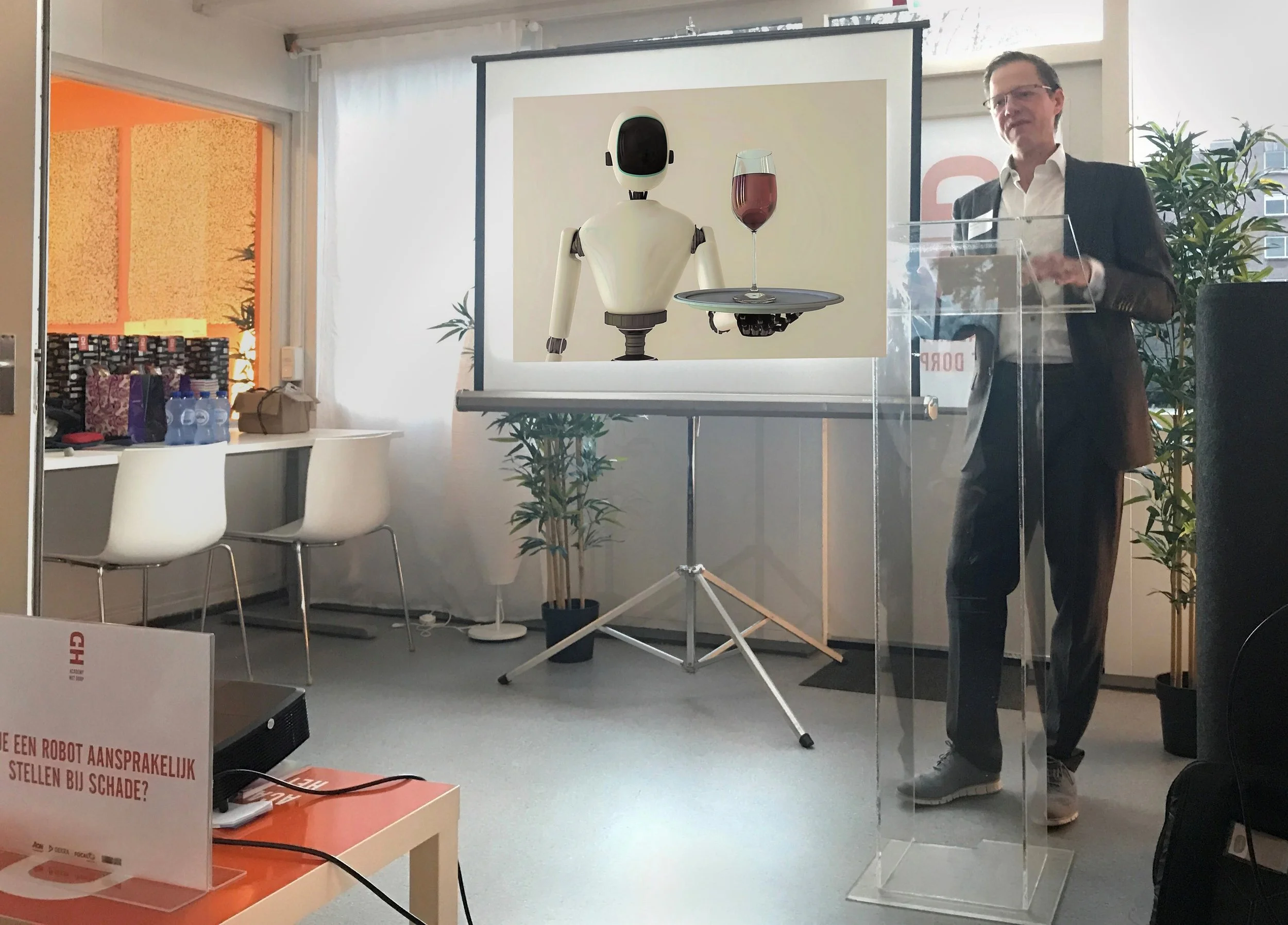
On December 3, 2018 our office Artificial Intelligence & Law delivered the lecture 'The legal status of smart robots: legal personality, intellectual property and fundamental rights'. On the occasion of the Symposium on robotisation and eHealth in the pharmaceutical industry, organized by Academy Het Dorp and Proeftuin Robotica. The central theme of this seminar on healthcare regulation was: Can you hold a robot liable in case of damages?

How should we deal with liability in robotics?

The following questions were addressed: Should robots equipped with AI have a separate legal status? How do you - as a developer/supplier and consumer/user/patient get a grip on liability for autonomous machines and artificial intelligence algorithms? How do we safeguard ethical principles and fundamental human rights? Who owns intellectual property rights in smart robots and copyrights on computer and AI generated works? How should we deal with liability in robotics?

Meer lezen
What are the main requirements for AI systems in Healthcare?

Main barriers to adoptation of Artificial Intelligence in healthcare.

Absence of a specific AI law, or clear legal framework from the perspective of both professional users (A) and patients (B).

When constructing such a framework, it is important to make a distinction between the various sub-areas of healthcare, such as research and development, professional care providers and recipients of care. Because each sub-area has different needs.

Barriers for professional users.

It is simply unclear for companies and private and academic research institutes in the medical sector what is and is not allowed in the field of AI, blockchain, computer & machine vision and robotics. Both at European level and at national level. This knowledge is important for the commodification of their inventions/creations. Two practical examples are permission from Farmatec and obtaining a CE-marking.

Requirements for sustained use of AI in healthcare.

Since traceability and transparency are key within any healthcare (and food-feed) system, blockchain could play an important role in sustained use of AI in healthcare.

A EU AI Directive or Regulation should be able to implement and/or adhere to principles of Eudralex (The body of European Union legislation in the pharmaceutical sector), Good Manufacturing Practices (GMP) and Good Distribution Practices (GDP) in particular.

Meer lezen
AI Impact Assessment | Netherlands

The AI ​​Impact Assessment offers entrepreneurs, data scientists and software programmers a concrete code of conduct with which AI can be safely implemented. The Artificial Intelligence Impact Assessment was developed by the Dutch ECP | Platform for the Information Society. The AI ​​Impact Assessment is a guide for the application of artificial intelligence. Through a practical checklist from a legal, technical and ethical point of view.

Download or view the English version of the Artificial Intelligence Impact Assessment

Code of Conduct Artificial Intelligence

The starting point of the AI Impact Assessment is the Code of Conduct for Artificial Intelligence. This code of conduct forms the basis of the AI Impact Assessment framework. The Artificial Intelligence Code of Conduct consists of two parts: common European ethical and constitutional values (i.e. liberty, equality, fraternity), legal principles and democratic preconditions, as well as practical rules and codes of conduct for AI applications, deep learning algorithms and autonomous systems.

Risk and safety assessment tools

The AI Impact Assessment is related to other risk and safety assessment tools such as the Privacy Impact Assessment, Algorithmic Accountability and Responsibility & Transparancy by Design. We see the same logic in the Asimov Three Laws of Robotics, the IBM Watson AI Guidelines (Everyday Ethics for Artificial Intelligence, A practical guide for designers & developers) and the 23 Asilomar AI principles. The AI Impact Assessment also has a guide function, and provides a similar moral compass.

Meer lezen
Artificial Intelligence Impact Assessment

AI Impact Assessment: checklist voor toepassing artificiële intelligentie

Het AI Impact Assessment biedt ondernemers, datawetenschappers en softwareprogrammeurs een gedragscode waarmee AI veilig geïmplementeerd kan worden. Het Artificial Intelligence Impact Assessment is ontwikkeld door het ECP|Platform voor de InformatieSamenleving. De AI Impact Assessment is een wegwijzer voor toepassing van artificiële intelligentie. Via een praktische checklist op zowel juridisch, technisch als ethisch vlak.

De uitvoering van de AI Impact Assessment wordt bij voorkeur begeleid door een daartoe gespecialiseerd jurist.

Risico-inschattingsinstrument

De AIIA vertoont verwantschap met andere risico-inschattingsinstrumenten zoals de Privacy Impact Assessment (PIA, ook wel Data Protection Impact Assessment (DPIA) of gegevensbeschermingseffectbeoordeling (GEB) genaamd). We zien eenzelfde logica terug bij de 3 Robotwetten van Asimov, de IBM Watson AI Guidelines en de 23 Asilomar AI principes. De AIIA heeft eveneens een gidsfunctie, en een vergelijkbaar moreel kompas.

Leidraad voor verantwoorde implementatie van kunstmatige intelligentie

De Artificiële Intelligentie Impact Assessment (AIIA) bevat een overzichtelijk stappenplan met 8 stappen, aan de hand waarvan bedrijven inzichtelijk kunnen maken welke juridische en ethische normen van belang zijn bij de creatie en toepassing van AI-systemen en smart robotics. Ook maken de AIIA en de Gedragscode Artificiële Intelligentie helder welke motieven en beweegredenen de basis vormen van de te maken keuzes en beslissingen tijdens het AI implementatietraject. Dit maakt het gebruik van kunstmatige intelligentie en slimme algoritmes transparanter.

Meer lezen
Algoritmes, Artificiële Intelligentie, Big data, Cloud Computing, Cognitive Computing, Computer Vision, Deep Learning, Extended Reality, Grondrechten, Informatierecht, Intellectueel Eigendom, Internet of Things, Internetrecht, Juridisch Advies, Kunstmatige Intelligentie, Nano Engineering, Neuraal Netwerk, Quantum Computing, Recht, Robotica, Robotlaw, Tech Startups, WetgevingMauritz KopArtificiële Intelligentie & RechtArtificial Intelligence Impact Assessment, robotisering, 4e industriële revolutie, slimme robots, kunstmatige intelligentie, AI Impact Assessment, checklist, stappenplan, ECP, Platform voor de InformatieSamenleving, jurist, legal, ethische normen, risico-inschattingsinstrumenten, Privacy Impact Assessment, PIA, Asimov, GEB, Gedragscode Artificiële Intelligentie, rechtsstatelijkheid, intellectueel eigendom, wet en regelgeving, belanghebbenden, Infinite computing, neuromorphic chips, AI-mind clouds, spintronics, wijsheid, compassie, Harari Home Deus, Singularity, Artificial General Intelligence, bias, Privacyvraagstukken, accessibility, blockchain, dystopische toekomstscenario’s, Orwelliaanse Versificator, 1984, The Matrix, Blade Runner, Ghost In The Machine, Westworld, Mad Max, Robocop, The Terminator, Brazil, Metropolis, Asilomar AI Principes, Privacy en Security by Design, Triple Helix Model, Nederlandse AI Strategie, Conferentie Nederland Digitaal, arbeidsmarkt, disruptie, leidraad, gidsfunctie, open internet, digitalisering, neuraal netwerk, machine learning, Internet of Things, data scientist, software programmeur, Europese AI Alliantie, Cybersecuritywetgeving, NIB-Richtlijn (EU) 2016/1148), NIS-Directive, IEC 62443, eIDAS, veiligheidseisen, Wbni, ISO, NEN, ANSI, end users, IBM Watson, AI Guidelines, ICAI, AINED
AI en recht: 8 technologische ontwikkelingen die elke jurist moet kennen

Acht technologieën veranderen de samenleving over de volle breedte — en daarmee ook het werk van de jurist. Deze VerderDenken-column van Mauritz Kop, oorspronkelijk verschenen op het CPO-platform van de Radboud Universiteit, zet de essentiële begrippen op een rij die elke moderne jurist zou moeten kennen.

Van AI tot Internet of Things

Het stuk begint bij de kunstmatige intelligentie zelf: het verschil tussen sterke en zwakke AI, de singulariteit als gedachte-experiment, en waarom vrijwel alle systemen in de praktijk smalle, taakgerichte AI zijn. Vandaar loopt de lijn naar het Internet of Things, waar de juridische vraag verschuift van losse apparaten naar de verantwoordelijkheid in een keten van sensoren en software.

Machine learning en de evolutie van het recht

Centraal staat de gedachte dat revolutionaire techniek vraagt om evolutie van het recht — om techniekneutrale regels die niet meteen verouderen. De column legt uit wat machine learning, deep learning en reinforcement learning zijn, waarom trainingsdata het juridische zwaartepunt vormen, en hoe een systeem als AlphaGo Zero onze intuïties over toerekening en verantwoordelijkheid op de proef stelt.

Grondrechten en de voorbereiding van de praktijk

De afsluiting is principieel: artificiële intelligentie kan een positieve maatschappelijke bijdrage leveren, mits fundamentele vrijheids- en gelijkheidsrechten vroeg in het ontwerp worden meegenomen — een gedachte die later concreet werd in de risicogebaseerde EU AI Act. Voor de praktijkjurist is de boodschap dat hij de grondbegrippen moet beheersen om de juiste vragen op het juiste moment te kunnen stellen. Verder lezen over de eigendomsvraag bij machinecreaties kan in Computer generated works: wie of wat is eigenaar?

Meer lezen