Innovation, Quantum-AI Technology & Law

Blog over Kunstmatige Intelligentie, Quantum, Deep Learning, Blockchain en Big Data Law

Blog over juridische, sociale, ethische en policy aspecten van Kunstmatige Intelligentie, Quantum Computing, Sensing & Communication, Augmented Reality en Robotica, Big Data Wetgeving en Machine Learning Regelgeving. Kennisartikelen inzake de EU AI Act, de Data Governance Act, cloud computing, algoritmes, privacy, virtual reality, blockchain, robotlaw, smart contracts, informatierecht, ICT contracten, online platforms, apps en tools. Europese regels, auteursrecht, chipsrecht, databankrechten en juridische diensten AI recht.

Berichten in Academics
Quantum Technology Impact Assessment (EU AI Alliance, European Commission)

Brussels, 20 April 2023—The emergence of powerful new capabilities in large AI models, such as Generative Adversarial Networks (GANs), underscores the critical need to continuously improve and update technology impact assessment tools, ensuring they keep pace with rapid technological development. As defined in recent scholarship, technology impact assessment is the systematic process of monitoring and determining the unintended, indirect, or delayed societal impacts of a future technological innovation. Crucially, it is also about capitalizing on opportunities and enabling responsible innovation from the outset.

An article by Stanford Law’s Mauritz Kop on this topic is also featured on the European Commission's Futurium website.

Shaping the Quantum Innovation Process

Quantum Impact Assessments (QIAs) are emerging as vital practical tools to facilitate the responsible adoption of quantum technologies. There are several related approaches to this assessment: (1) interactive QIA, which seeks to influence and shape the innovation process; (2) constructive QIA, where social issues guide the design of the technology from its earliest stages; and (3) real-time QIA, which connects scientific R&D with social sciences and policy from the start, before a technology becomes locked-in.

Often taking the form of codes of conduct, best practices, roadmaps, and physics de-risking tools, QIA instruments can be used by governments, industry, and academia. These soft law toolsallow stakeholders to explore how current technological developments affect the world we live in and to proactively shape the innovation process toward beneficial, societally robust outcomes.

Exploratory Quantum Technology Assessment

Implementing interdisciplinary, expert-based QIAs can help raise awareness about the ethical, legal, socio-economic, and policy (ELSPI) dimensions of quantum technology, including quantum-classical hybrid systems. For instance, QIAs cultivate a deeper understanding of the potential dual-use character of quantum technology, where beneficial applications (such as quantum sensing for medical diagnostics) can exist alongside potentially harmful ones (such as the same sensors being used for autocratic surveillance).

Building on the foundational work of the 2018 AI Impact Assessment developed by ECP | Platform voor de InformatieSamenleving chaired by Prof. Kees Stuurman, this work presents a prototype of a QIA instrument: the Exploratory Quantum Technology Assessment (EQTA). This pioneering initiative was made possible through a collaboration between the Dutch Ministry of Economic Affairs & Climate Policy, Quantum Delta NL (QDNL), and ECP. The EQTA will be presented by Eline de Jong and Mauritz Kop at the inaugural Stanford Responsible Quantum Technology Conference in May 2023.

Guidance for Responsible Quantum Technology Implementation

The EQTA provides a comprehensive, practical step-by-step plan that encourages stakeholders to initiate a dialogue to clarify which ethical, legal, and social aspects are important in the creation and application of quantum systems and their interaction with classical technologies. This structured approach helps make the use of quantum technology—as well as the data and algorithms that power it—more transparent and accountable from an early stage.

Looking forward, establishing a risk-based legal-ethical framework in combination with standardization, certification, technology impact assessment, and life-cycle auditing of quantum-driven systems is crucial to stewarding society towards responsible quantum innovation. Mauritz Kop’s research group has written more on this framework in their seminal article Towards Responsible Quantum Technology (Harvard).

Meer lezen
Stanford Light Opera Company: Johann Strauss’ Die Fledermaus

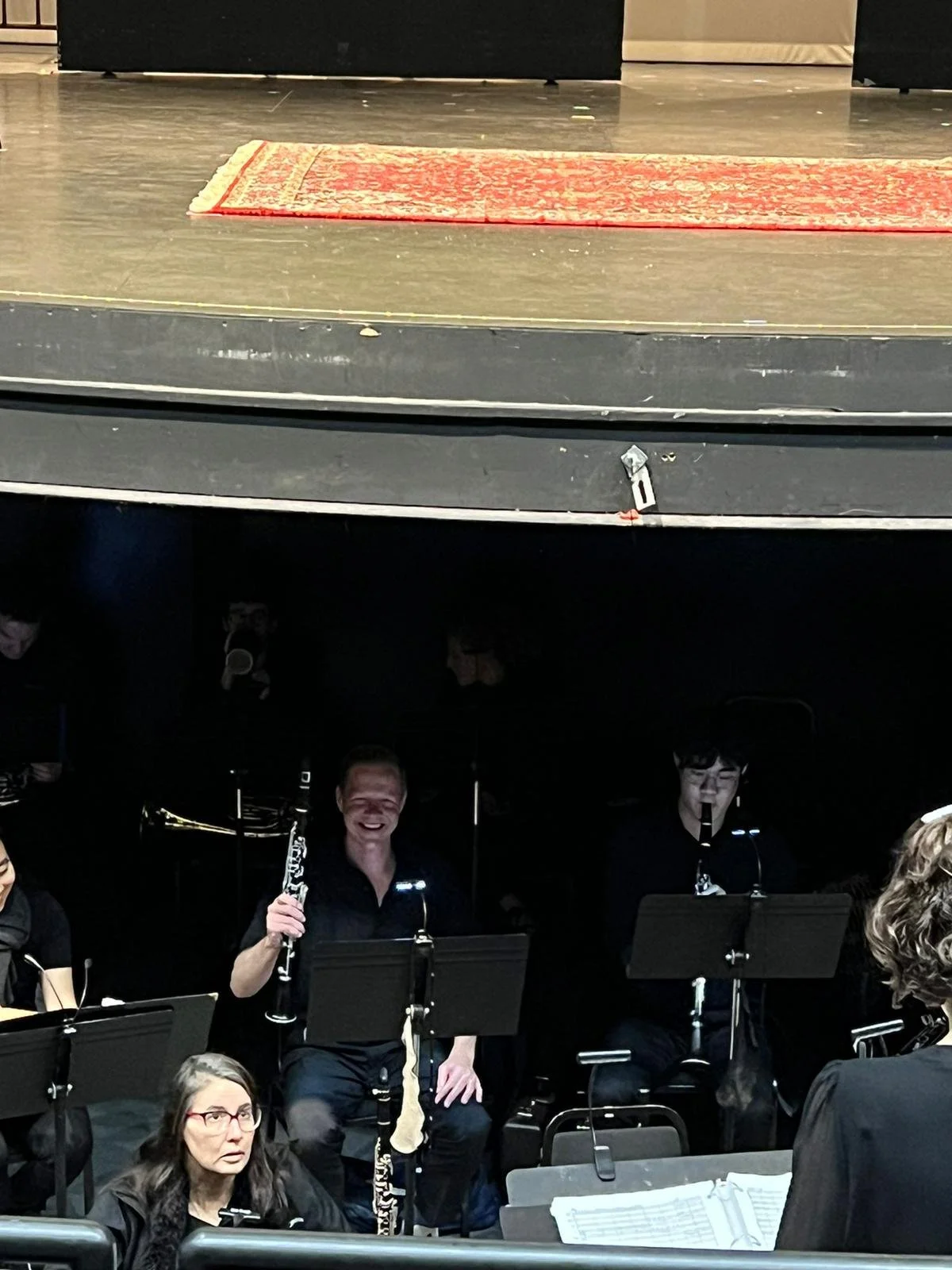
In February 2023, Stanford law scholar Mauritz Kop stepped off the page and into the orchestra pit, joining the Stanford Light Opera Company (SLOCo) for its winter production of Johann Strauss II's Die Fledermaus. He played clarinet—A and B-flat—substage with the company's orchestra across four performances at Dinkelspiel Auditorium. For a researcher whose work increasingly concerns the rights of performers and composers in the age of artificial intelligence, the view from below the stage was more than a hobby; it was a vantage point.

A student company's feminist Strauss

SLOCo's staging, directed by Nicolle Hendzel '23 in an English translation by Marcie Stapp, reimagined a ballroom farce as a deliberately feminist work, placing the characters who orchestrate the plot's great prank—and who hold power within it—in the hands of its women. The company is a student-run organization with roots in the Stanford Savoyards, a Gilbert and Sullivan society founded in 1973 and rebranded as SLOCo in 2016. The operetta itself dates to 1874, when it premiered at the Theater an der Wien in Vienna; nearly a century and a half later, a student orchestra gave it a contemporary edge.

Where music meets the law of AI

Kop is a Stanford Law School fellow and a practicing classical musician on piano and clarinet, and the two roles inform one another. His scholarship on copyright, authorship, and the public domain carries the weight of someone who has sat among the performers the law is meant to protect. That sensibility runs through his analysis of cloned voices and machine-generated compositions, where familiar copyright questions—who is the author, who is paid, and what enters the public domain—have been made newly pressing by generative systems. A scholar who has taught music law at the Royal Conservatoire in The Hague has good reason to keep one foot in live performance.

Why the arts belong in technology-law writing

Technology law has a tendency to treat the arts as something to be regulated rather than understood. An evening in a student orchestra reverses that order. The discipline of a rehearsed part delivered in real time, the collective labor of an ensemble, and the precarious economics of a production staged for love rather than profit are precisely what the law of music exists to serve. As AI begins to imitate the performer's craft at scale, the argument for a creator-aware approach to authorship and remuneration only sharpens—an argument that runs throughout Kop's scholarship on responsible technology across law, music, and policy. The clarinet, on this telling, is not a distraction from the research—it is a reminder of whom the research is for.

Meer lezen
Mauritz Kop Speaks on Quantum Ethics, Intellectual Property and Innovation at NASA SWEEEP Event

On October 3, 2022, a interdisciplinary dialogue on the future of quantum technology and its societal implications took place within a consortium focused on some of the most pressing environmental challenges of our time. Mauritz Kop, a visiting quantum and law scholar at Stanford University, was invited to address a workshop for the SouthWest Engine for Environment and Economic Prosperity (SWEEEP), a major initiative led by a consortium including NASA’s Jet Propulsion Laboratory (JPL), CalTech, and California State University, Northridge. The event, part of the National Science Foundation (NSF) Regional Innovation Engines program, provided a platform to discuss the intricate web of ethical, legal, socio-economic, and policy implications—termed "Quantum-ELSPI"—that must be navigated as quantum technologies are harnessed to address grand challenges like water scarcity and agricultural sustainability.

The Institutional Context: NASA and the SWEEEP Mission

The National Aeronautics and Space Administration (NASA), established in 1958, has a storied history of pushing the boundaries of science and technology for the benefit of humanity. While renowned for space exploration, its mission extends deeply into Earth science, utilizing its unique vantage point from space to understand and protect our home planet. From monitoring climate change and weather patterns to managing natural resources, NASA’s work is foundational to global environmental stewardship.

This commitment to terrestrial challenges is exemplified by its involvement in the SWEEEP initiative. SWEEEP is a direct response to the NSF Regional Innovation Engines program, a nationwide effort to catalyze and accelerate regional-scale, R&D-based innovation ecosystems. The program is designed to fund "Engines" that advance critical technologies, address societal challenges, promote economic growth, and cultivate regional talent, with potential funding of up to $160 million over ten years per Engine.

It was within this context of ambitious technological solution-building that Mauritz Kop was invited to provide a crucial perspective on governance and responsible innovation. The leaders of the initiative, including Edward Chow of NASA JPL and Bingbing Li of California State University Northridge, recognized that developing powerful new technologies carries a responsibility to proactively address their societal impact.

Quantum-ELSPI: A Framework for Responsible Innovation

In his address, Mauritz Kop introduced the comprehensive concept of Quantum-ELSPI, arguing for a multidisciplinary approach that integrates ethical, legal, socio-economic, and policy considerations directly into the R&D lifecycle. He stressed the importance of "building bridges between disciplines," enabling quantum physicists and engineers to communicate effectively with experts in the humanities and social sciences. The goal is not to give premature, all-encompassing answers, but to begin by asking the right questions.

For a project like SWEEEP, this means looking beyond the technical specifications of a quantum sensor to consider the legal frameworks for the data it collects, the ethical implications of its use in agriculture, and the socio-economic impact on farming communities. Kop noted that NSF reviewers would likely value such a forward-thinking awareness of the complex societal dimensions of the proposed technological interventions.

Intellectual Property in the Quantum Age: Fostering or Hindering Innovation?

A significant portion of the discussion was dedicated to the role of intellectual property (IP) in the quantum domain. Quantum computers and related systems are extraordinarily complex, comprising myriad components, each potentially protected by its own IP right. Kop described this as a "rainbow of IP rights," where patents, copyrights, trade secrets, and trademarks can create a dense and overlapping landscape.

While IP is designed to incentivize invention, he cautioned that an over-reliance on exclusive rights could lead to "IP overprotection," potentially stifling the cumulative, follow-on innovation that is essential for a burgeoning field like quantum technology. The challenge is to balance the need to protect inventions with the goal of building an open, thriving global quantum ecosystem.

Meer lezen
Mauritz Kop Presents Oxford JIPLP Article on Quantum Computing, IP and Market Power at IPSC 2022, Stanford Law School

IPSC 2022 at Stanford: at the first in-person Intellectual Property Scholars Conference after two virtual years (August 11–12, 2022), Mauritz Kop presented his Oxford JIPLP article Intellectual property in quantum computing and market power: a theoretical discussion and empirical analysis, co-authored with Mateo Aboy and Timo Minssen.

When IP stops doing its job

The theory: intellectual property exists to incentivize innovation, but excessive proliferation of exclusive rights over a foundational technology produces anticommons effects — overlapping thickets that raise transaction costs, deter follow-on research and concentrate first-mover market power. Quantum computing, built on decades of publicly funded science, is exactly where that risk bites hardest.

The patent data behind the argument

The empirics: the article analyzes the quantum-computing patent landscape — who files, where portfolios cluster, and what that implies for market structure in a field whose hardware, algorithms and error-correction methods may all carry exclusive rights. Theory says when proliferation harms innovation; the data say where quantum technology stands today.

A transatlantic collaboration, a Stanford homecoming

Kop, Aboy and Minssen connect European and American IP scholarship on quantum computing; for Kop the venue completed a circle, having spent early 2022 as visiting scholar at Stanford Law School. The presentation put the market-power findings before the scholars best placed to attack the methodology — which is what the IPSC works-in-progress format exists to do. And after two virtual editions, the 22nd IPSC's return to a physical Stanford conference room restored the corridor conversations that turn a panel question into a coauthorship.

Standards: the other half of ownership

Beyond patents, quantum interoperability standards will run on disclosure and licensing commitments from the very portfolio holders the article tracks. Whether those commitments are negotiated early, FRAND-style, or after positions harden will shape access to the technology as surely as any patent dispute — and the article's empirical map is groundwork for getting that negotiation right.

Third station of a research arc

From AI's data inputs (IPSC 2020) via waive-or-pledge quantum IP (IPSC 2021) to ownership structure and market power (2022): the sequence tracks a research line moving from machine learning's raw material to quantum computing's ownership structure, each stage workshopped in public before publication. That line later grew into an institutional one — see Stanford University launches the Stanford Center for Responsible Quantum Technology. If early patent concentration hardens into durable market power, access to the field's foundational capabilities narrows before the technology matures; making that risk empirically discussable, rather than rhetorical, is the article's lasting contribution.

Meer lezen
Mauritz Kop and Mateo Aboy Present QT and Law Research at Lund Quantum Conference

When Lund University convened The Quantum Law Conference in late April 2022, the legal scholarship on quantum computing was still in its infancy. Organized by Valentin Jeutner under the WASP-HS-funded Quantum Law Project, the gathering—formally titled The Legal Dimensions of Quantum Computing—gave an early home to a question that has only grown more urgent: whether intellectual property law is fit for the quantum age. Mauritz Kop, then a TTLF Fellow at Stanford Law School, and Mateo Aboy, Principal Research Scholar at the University of Cambridge, brought a distinctive answer—one built on data rather than intuition.

Theory meets the patent record

Kop's theoretical contribution warned of IP overprotection: a "rainbow" of overlapping rights that could entrench first movers and concentrate market power in a young field. Rather than rest on the argument, the team tested it. Aboy led a patent-landscape study of the quantum computing subfield, asking whether feared "thicket" and "anticommons" effects were actually appearing. The pairing of a normative framework with empirical patent analysis is what made the Lund presentation unusual—and useful to policymakers who need evidence, not assertion.

A counter-intuitive result

The data pointed the other way. The patent system in quantum computing was not, at that stage, generating innovation-choking overprotection; instead, a growing share of quantum patent information was entering the publicly available disclosure record through lapsed and non-granted filings, forming an expanding information commons. The important caveat was secrecy: trade secrets and state secrets ordinarily do not appear in patent datasets, so quantitative mapping must always be read alongside qualitative analysis. The conclusion was measured—IP law works best in concert with competition law, steering between under- and overprotection.

From a conference room toward the journals

The work is not staying in Lund. The theoretical and market-power strand is forthcoming as a peer-reviewed article in the Journal of Intellectual Property Law & Practice (Oxford University Press), and the companion patent-landscape study is forthcoming in IIC – International Review of Intellectual Property and Competition Law (Springer), with a transatlantic author team spanning Stanford, Cambridge, and CeBIL at the University of Copenhagen. Together they promise one of the earliest evidence-based treatments of quantum-IP policy. It is a quieter companion to Kop's better-known warning that quantum computing carries risks that rival those of artificial intelligence: here the concern is not catastrophe but market structure—who gets to build on quantum technology, and on what terms. The answer the Lund research offers is calibration, not maximalism: predictability enough to attract investment, openness enough to keep the field competitive.

Meer lezen
Scarcity, Regulation, and the Abundance Society Roundtable at Stanford Law

In 2022, Mauritz Kop had the honor of contributing a chapter to the book project "Scarcity, Regulation, and the Abundance Society," a special volume of Frontiers in Research edited by two leading minds in technology law, Professor Mark Lemley of Stanford Law School and Professor Deven Desai of Georgia Institute of Technology. The project culminates years of research and dialogue, including a memorable and insightful roundtable held at Stanford Law School.

The central inquiry of the project is to explore how our legal and economic institutions, which are fundamentally built on scarcity, should respond as "technologies of abundance" make scarcity a thing of the past in many industries. As new technologies like AI, 3D printing, and synthetic biology democratize and disrupt production, the book examines whether we will try to legally replicate scarcity or reorder our society to focus on things other than scarcity.

The "Abundance and Equality" Chapter Edited by Mark Lemley

His chapter, titled "Abundance and Equality," was edited by Mark Lemley and connects the concepts of good governance and the end of scarcity by unifying equality with technology-driven abundance. The piece introduces the Equal Relative Abundance (ERA) principle—a post-Rawlsian framework for distributive justice designed for an age of abundance.

The ERA principle builds on John Rawls's "difference principle" but integrates desert-based critique, arguing that unequal rewards for contributions (due to hard work, talent, or entrepreneurial spirit) are justified only to the extent that they also improve the position of the least advantaged members of society. The chapter examines how ten key exponential technologies of the Fourth Industrial Revolution—including AI, quantum technology, and biotechnology—are the primary drivers of this shift from scarcity to abundance. It critically analyzes our existing scarcity-based institutions, particularly property and intellectual property law, and posits that we must begin experimenting with hybrid systems that mix the best of forward-thinking socialist and ethical post-capitalist paradigms, built on a foundation of participatory democracy.

Mauritz Kop Presents Book Chapter at 2022 Stanford Law’s Abundance Roundtable

On April 22, 2022, the project's contributors gathered for a roundtable workshop at Stanford Law School. The event provided a forum for a deeply interdisciplinary group of scholars to present their work and engage in a robust dialogue about the future of our society. The format consisted of short 8-10 minute presentations followed by 20 minutes of discussion, fostering a rich exchange of ideas.

A Convergence of Post-Scarcity Presentations and Discussions

During his session, Kop presented the core arguments from his "Abundance and Equality" chapter, outlining the tension between technology-driven abundance and the persistent reality of inequality for many across the globe. He introduced the ERA principle as a moral and political guide for distributing the benefits and burdens of our increasingly abundant future.

The roundtable featured a breadth of perspectives. Vivek Wadhwa discussed solving humanity's grand challenges, while Funmi Arewa explored the scarcity of opportunity within the digital economy. Zahr Said and Joshua Fairfield tackled the creation of artificial scarcity through intellectual property and the legal status of virtual property in the age of NFTs, respectively. Shane Greenstein of Harvard Business School offered insights on supply chains and the platformization of clothing personalization. This convergence of ideas underscored the complexity of the transition ahead and the need for holistic solutions.

Musical Interlude: A Spontaneous Translation of Ideas

The roundtable was a stimulating intellectual affair, filled with rigorous debate. During lunch break, celebrating the occasion, Mauritz Kop sat down at the piano in the Stanford Faculty Lounge and performed a brief impromptu musical interlude. It was a personal endeavour to translate the abstract and often-dense themes of our discussion—the post-scarcity economy, abundance, equality, and the human condition—into the universal language of music. It was an opportunity for him to share that moment with his colleagues, connecting the analytical with the artistic.

The "Scarcity, Regulation, and the Abundance Society" project is a vital and timely undertaking. The discussions at the Stanford roundtable and the resulting publications provide a critical foundation for reimagining our legal, economic, and social institutions for a new era. These forward-looking conversations are essential for ensuring that the future of technological abundance is one that fosters not new forms of inequality, but greater justice and human flourishing for all.

Meer lezen
Mauritz Kop Visiting Quantum & Law Scholar at Stanford Law School

Mauritz Kop is Visiting Quantum & Law Scholar at Stanford Law School in 2022-2023. Kop was invited by Prof. Mark Lemley, the William H. Neukom Professor of Law at Stanford Law School and the Director of the Stanford Program in Law, Science and Technology.

Advanced legal research on Regulating Quantum technology at Stanford Law School

This Stanford Law School ‘Regulating Quantum Technology’ research project will perform a detailed study of how to sensibly regulate the suite of quantum technologies including computing, sensing and networking, unifying the world of the large with that of the small. It intends to answer questions on how our innovation architecture should be constructed, so that benefits of quantum computing, sensing, simulation, and communication -including quantum-AI hybrids- will be distributed equitably, and risks proportionally addressed. Building upon foundational work done on quantum and AI innovation policy mechanisms, national security strategy, standardization & certification, ethics, responsible quantum R&D, governance principles, technology impact assessments, data ownership and intellectual property in quantum software and hardware structures - published in flagship Journals at Stanford, Harvard, Yale, Berkeley, Physics World, Max Planck, Springer Nature, and Oxford - the transdisciplinary research aims to develop an integrated, holistic vision on smart governance and regulation of quantum & AI infused digital transformation.

Happy to speak at a number of in person events in the nexus of AI, Quantum & Law in the coming weeks:

Scarcity, Regulation and the Abundance Society Roundtable at Stanford

1. April 22, Scarcity, Regulation and the Abundance Society Roundtable at Stanford, where I will present a chapter titled ‘Abundance & Equality’ for the book project co-edited by Mark Lemley and Deven Desai. The chapter connects good governance to the end of scarcity and unifies equality with technology driven abundance, by introducing a novel Post-Rawlsian Equal Relative Abundance (ERA) principle of distributive justice. As befits tradition, we will insert musical interludes for piano, with me performing ‘Stanford Theme & Variations’ à l'improviste in the Stanford Law School Faculty Lounge. https://law.stanford.edu/publications/scarcity-regulation-and-the-abundance-society/

Patenting Quantum Computing Technologies talk at Quantum & Law Conference in Lund

2. April 29, presenting our 'Patenting Quantum Computing Technologies and Market Power: A Quantitative Analysis' research together with my academic friends Profs Mateo Aboy (Cambridge) and Timo Minssen (Copenhagen) at the Quantum & Law Conference in Lund. We wrote 2 papers focusing on IP portfolio strategies, trade & state secrets, and their interface with antitrust regulations, utilizing industry and quantum domain specific mixed theoretical & empirical research methods. http://quantum-law.org/conference/

EU AI Act Presentation at AI World Summit Americas in Montreal

3. May 4, I’ll present an overview of the EU AI Act with its ‘product safety framework’ and market entrance requirements, constructed around a set of 4 risk categories at the AI World Summit Americas in Montreal. We will discuss whether it provides a regulatory framework for AI that should be adopted globally during a Headline panel with Prof. Gillian Hadfield (Toronto) and Dr José-Marie Griffiths (President Dakota State), moderated by Meredith Broadbent (Washington). https://americas.worldsummit.ai/speakers/

Keynote Quantum Computing Ethics at IBM Research

4. May 17, I’ll give a keynote on Quantum Computing Ethics at IBM Research during their Tech for Racial and Social Justice Seminar (internal event), organized by Dr Aminat Adebiyi, moderated by Dr Mira Wolf-Bauwens, with whom I worked together on the WEF Quantum Computing Principles. https://www.weforum.org/publications/quantum-computing-governance-principles/

Quantum Impact Assessment (QIA)

5. We are creating a world’s first application-driven Quantum Impact Assessment (QIA) in The Netherlands -raising ELSA awareness and removing barriers for adoption of QT- with a diverse, multidisciplinary team lead by Prof. Bart Schermer (Leiden) and Daniël Frijters for the Centre for Quantum & Society, made possible by ECP and Quantum Delta NL. https://quantumdelta.nl/centre-for-quantum-and-society

Quantum-ELSPI special for Springer Nature with Luciano Floridi

6. Meanwhile I am editing the Quantum-ELSPI special for Springer Nature on the Ethical, Legal, Social and Policy Implications of Quantum Technology, together with EiC Prof. Luciano Floridi (Oxford). https://web.archive.org/web/20260126194629/https://law.stanford.edu/publications/quantum-elspi-ethical-legal-social-and-policy-implications-of-quantum-technology/

More exciting projects soon ...

Meer lezen
Mauritz Kop Consults Senator Mark Warner on AI & Quantum Technology Policy

Washington D.C., January 4, 2022—As the United States Congress grapples with the complex challenges of regulating artificial intelligence and quantum technology, leading policymakers are seeking expert guidance to inform a robust and forward-thinking national strategy. On January 4, 2022, Mauritz Kop, a distinguished scholar in the field of technology law and governance, was consulted by the legal team of U.S. Senator Mark Warner (D-VA) to provide strategic insights on both AI and quantum technology policy.

This consultation highlights the growing recognition in Washington of the need for deep, interdisciplinary expertise to navigate the geopolitical, economic, and security dimensions of these transformative technologies. Senator Warner's team reached out to Kop based on his influential scholarship, including his extensive work at Stanford on the EU AI Act and the need for a strategic democratic tech alliance, his advisory role for the European Commission led by Ursula von der Leyen on the AI Act and Data Act, and his foundational article in the Yale Journal of Law & Technology proposing a comprehensive legal-ethical framework for quantum technology.

Senator Mark Warner: A Leader on Technology and National Security

Senator Mark Warner's engagement on these issues is both significant and timely. As the Chairman of the Senate Select Committee on Intelligence, he is at the forefront of addressing the national security implications of emerging technologies. His work involves overseeing the U.S. Intelligence Community and ensuring it is equipped to handle the threats and opportunities of the 21st century, where technological competition with nations like China is a central concern.

The Senate Select Committee on Intelligence has a broad mandate that includes analyzing intelligence on the technological capabilities of foreign powers and assessing the vulnerabilities of U.S. critical infrastructure. Senator Warner has been a vocal proponent of developing a national strategy for AI and quantum to maintain the United States' competitive edge and to ensure that these technologies are developed and deployed in a manner consistent with democratic values. This consultation with Mauritz Kop reflects the Senator's commitment to drawing on leading academic research to shape sound, bipartisan policy.

AI Policy: A Transatlantic, Risk-Based Approach that Lets Innovation Breathe

A key focus of the consultation was Kop's analysis of the European Union's AI Act. His Stanford publications argue for a balanced, pro-innovation regulatory model that can serve as a blueprint for international cooperation. Good governance and sensible legislation should incentivize desired behavior and simultaneously create breathing room for sustainable, beneficial innovation to flourish.

Quantum Governance: Establishing a Legal-Ethical Framework

The discussion also delved into the governance of quantum technology, drawing on Kop's seminal work in the Yale Journal of Law & Technology. Recognizing that quantum is rapidly moving from the theoretical to the practical, he stressed the urgency of establishing a legal-ethical framework before the technology is widely deployed and locked-in.

The consultation with Senator Warner's office represents a critical intersection of academic scholarship and high-level policymaking. As the United States charts its course in the era of AI and quantum, the insights provided by experts like Mauritz Kop are invaluable in ensuring that the nation's strategy is not only competitive but also responsible, ethical, and firmly rooted in democratic principles.

Meer lezen
Mauritz Kop Presents Quantum: Waive or Pledge IP at IPSC 2021, Cardozo Law School

IPSC 2021 at Cardozo: on August 4, 2021, Mauritz Kop presented Quantum: Waive or Pledge IP at the Intellectual Property Scholars Conference, hosted online by Cardozo Law School — putting the intellectual-property architecture of quantum technology before the IP academy while the field's patent landscape was still forming.

A real policy dilemma in three words

Waive or pledge: if quantum computing's basic building blocks rest on decades of publicly funded research, should foundational exclusive rights be waived for defined categories — or kept but pledged, FRAND-style, against assertion? The presentation developed both instruments and their hybrids, from quantum-specific patent pledges to compulsory licensing and shorter, innovation-cycle-calibrated protection terms — an IP architecture for a technology whose patent landscape was consolidating faster than its governance.

Physics that unsettles doctrine

The no-cloning theorem forbids perfectly copying an arbitrary unknown quantum state — friction at the foundations for IP regimes predicated on the act of duplication. A law built around copying meets quantum states that cannot, even in principle, be copied; the legal-ethical groundwork for that collision is laid in Establishing a Legal-Ethical Framework for Quantum Technology.

From workshop draft to Berkeley Technology Law Journal

The critiqued draft matured into the Berkeley Technology Law Journal article mapping patents, trade secrets and copyright onto quantum hardware, algorithms and software — and arguing where bespoke instruments serve innovation better than one-size-fits-all exclusivity. The IPSC room's questions — incentives, successor liability, category definition — made the published version sturdier. That is what the works-in-progress format is for: short presentations, dense Q&A, no proceedings, everything in service of the draft.

Patent scholars meet information-law scholars

Cardozo's host program tilts the IPSC room toward information-law questions — data, platforms, access — so a waive-or-pledge proposal had to satisfy both the incentive logic of the patent scholars and the access logic of the information-law side. A proposal that survives both audiences is closer to policy-ready than one bred in either camp alone.

Arriving early, on purpose

In August 2021 quantum technology was still mostly a physics story in the legal academy. Presenting a worked-out IP architecture then put waive-or-pledge on the scholarly agenda while policy could still shape the landscape rather than litigate it afterward. The instrument-matching logic — pledge where the ecosystem polices itself, waive where concentration would gate basic science, keep compulsory licensing in reserve as the credible threat that keeps the voluntary instruments honest — has only gained relevance as the quantum patent landscape has consolidated since.

Meer lezen
Mauritz Kop Presents Machine Learning & EU Data Sharing Practices at IPSC 2020, Stanford Law School

IPSC 2020 at Stanford: Mauritz Kop presented Machine Learning & EU Data Sharing Practices at the Intellectual Property Scholars Conference — the works-in-progress forum where IP scholarship is stress-tested before journals see it. The 2020 edition, hosted by Stanford Law School, ran as virtual panels from July 15 through August 5 in the first pandemic summer.

Training data under four regimes at once

Machine learning is hungry, and in Europe its raw material sits under copyright, database rights, trade secrets and the GDPR simultaneously. The paper mapped that intersection — including the text-and-data-mining exceptions of the DSM directive — and asked which data-sharing arrangements actually let lawful European AI development proceed at scale.

An argument for coordination

Where exclusive rights and data-protection rules overlap without coordination, they tax exactly the data flows the EU's own artificial intelligence strategy depends on. That modernization argument, workshopped before a predominantly American IP audience with a different copyright baseline and fair-use culture, had to hold up under comparative fire — which is precisely what the IPSC format is for.

Part of the Stanford research agenda

The presentation belonged to Kop's research line at the Stanford-Vienna Transatlantic Technology Law Forum, which he had joined earlier that year — see Mauritz Kop becomes TTLF Fellow at Stanford University. The paper is preserved in the permanent Stanford RQT collection at the Stanford Law Library, and its data-protection companion piece appeared in the Harvard Journal of Law & Technology's digest — two halves of one question about Europe's machine-learning data rules.

A format built for critique

Short presentations, dense Q&A, no published proceedings: IPSC exists purely to make drafts better before journals see them. For interdisciplinary work spanning artificial intelligence, data governance and IP doctrine, an audience of doctrinalists, economists and technologists probes each weak point in turn — and a European paper before an American room must hold up under a different copyright baseline and fair-use culture besides.

Why it still matters

The training-data questions posed in that 2020 draft — who may train on what, and on which terms — have since moved to the center of AI regulation on both sides of the Atlantic. Opt-out patchworks under the text-and-data-mining exceptions, the GDPR's reach into model pipelines, the competitive pull of jurisdictions with cleaner data rules: each was on the table at that virtual Stanford panel before it reached the regulators' agenda. The workshop critique of that summer became part of the foundation the later debates built on — which is exactly what a works-in-progress conference is supposed to produce.

Meer lezen