Innovation, Quantum-AI Technology & Law

Blog over Kunstmatige Intelligentie, Quantum, Deep Learning, Blockchain en Big Data Law

Blog over juridische, sociale, ethische en policy aspecten van Kunstmatige Intelligentie, Quantum Computing, Sensing & Communication, Augmented Reality en Robotica, Big Data Wetgeving en Machine Learning Regelgeving. Kennisartikelen inzake de EU AI Act, de Data Governance Act, cloud computing, algoritmes, privacy, virtual reality, blockchain, robotlaw, smart contracts, informatierecht, ICT contracten, online platforms, apps en tools. Europese regels, auteursrecht, chipsrecht, databankrechten en juridische diensten AI recht.

Berichten in Governance
Stanford Law’s Jin-Hee Lee, Katie Liu and Mauritz Kop visit Caltech Quantum Research Center

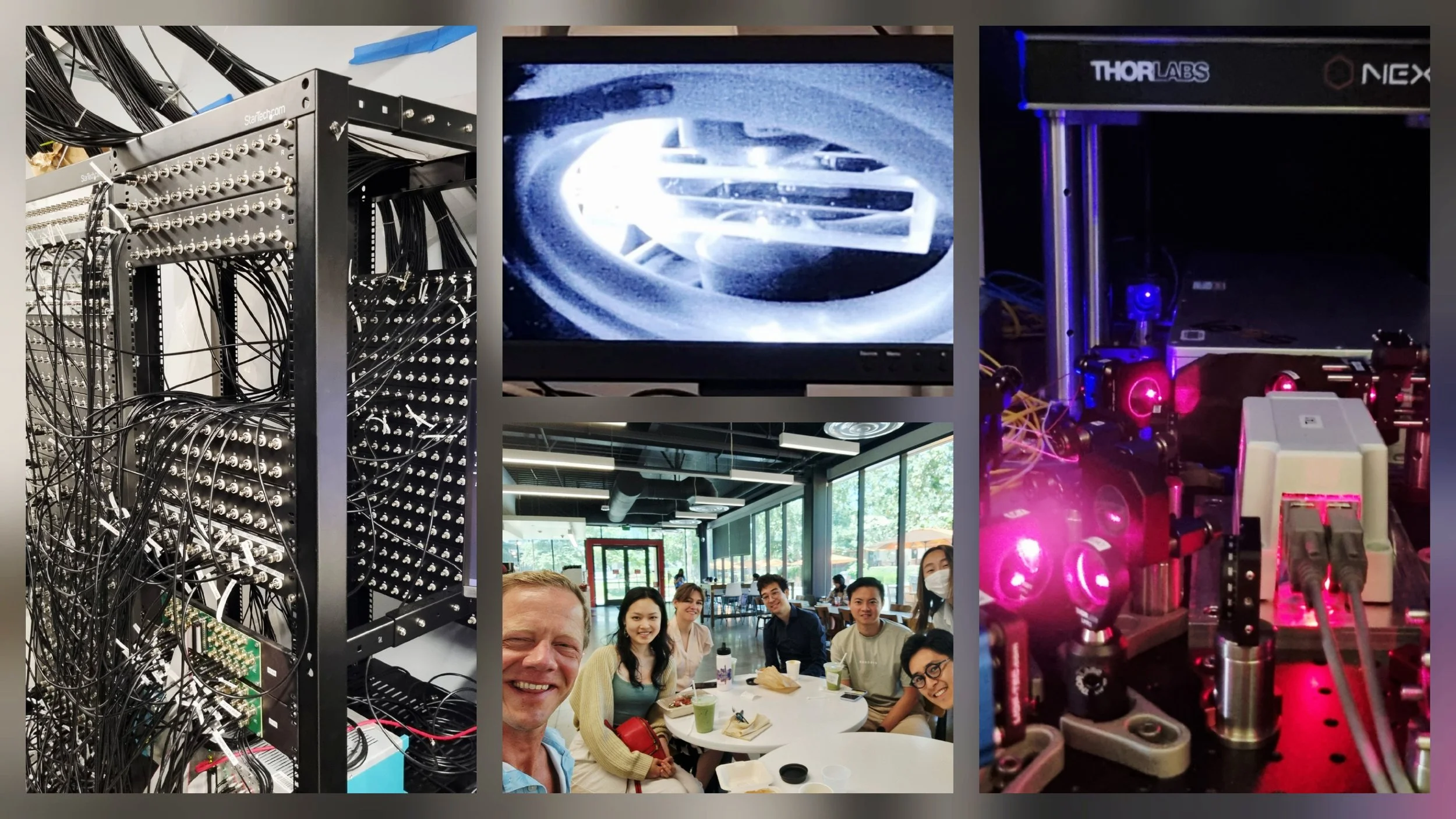
Pasadena, CA – On July 6, 2024, a team from the Stanford Center for Responsible Quantum Technology (RQT) embarked on a research field trip to the California Institute of Technology (Caltech), one of the world's preeminent hubs for quantum science research. This visit, part of an ongoing collaboration between the two world-leading institutions, was a crucial exercise in bridging the gap between the deeply technical world of quantum research and the complex legal, ethical, and societal frameworks required to govern it. The delegation, consisting of RQT Founding Director Mauritz Kop, RQT Fellow Jin-Hee Lee, and Research Assistant to the Director Katie Liu, traveled from Stanford to the heart of Southern California to engage directly with the scientists and engineers who are building the future of quantum. The visit was hosted by RQT Fellow Franz Pfanner, a PhD candidate at Caltech, and focused on the groundbreaking work being done at Caltech's Institute for Quantum Information and Matter (IQIM).

The day was dedicated to exploring the groundbreaking work being done at Caltech's Institute for Quantum Information and Matter (IQIM), a flagship research center led by Professor Manuel Endres, within the university's prestigious Division of Physics, Mathematics and Astronomy. This visit underscores the RQT Center's commitment to fostering a deeply interdisciplinary dialogue, ensuring that the development of responsible quantum governance is informed by a hands-on understanding of the technology itself.

The Epicenter of Quantum Innovation: Caltech's IQIM

Caltech stands as a global powerhouse in quantum research, and at its core is the Institute for Quantum Information and Matter (IQIM). Under the leadership of Professor Manuel Endres, IQIM is dedicated to exploring the frontiers of quantum science, from the fundamental physics of quantum information to the development of novel quantum materials and devices. The institute's work is organized around several Major Activities (MAs), each tackling a different facet of the quantum puzzle.

Bridging Quantum Theory and Society: The Stanford RQT Projects

The visit to Caltech provided a rich technical context for the work being done by the Stanford RQT team, whose projects are focused on the human and societal dimensions of this emerging technological revolution.

Jin-Hee Lee, an RQT Fellow, is pioneering research in the nascent field of Quantum Human-Computer Interaction (Q-HCI). Her project addresses a critical, yet often overlooked, aspect of the quantum future: how will humans interact with these powerful and counterintuitive machines? As quantum computers move beyond the binary logic of classical computing and into the probabilistic realm of qubits and superposition, the interfaces through which we engage with them must be completely re-imagined. Jin-Hee's work, guided by the ELSPI (Ethical, Legal, Social, and Policy Implications) framework, aims to ensure that these interfaces are not only functional but also accessible, intuitive, and ethically designed, preventing the creation of a new digital divide and keeping humanity at the center of the quantum age.

Katie Liu, a Research Assistant at the RQT Center, is focusing on the intersection of quantum technology and neuroscience. Her project, "Responsible Quantum AI in Healthcare – Neurotechnology and Beyond," explores the transformative potential of quantum AI (QAI) to enhance diagnostics and treatments for complex neurological conditions like Alzheimer's and Parkinson's disease. Using the SEA (Safeguarding, Engaging, Advancing) principles as her guide, Katie is investigating how quantum algorithms can analyze the vast datasets generated by neuroimaging and real-time brain monitoring to create personalized treatment plans. Her research also addresses the profound ethical challenges of this work, from ensuring patient data privacy through quantum-resistant encryption to mitigating the dual-use risks of advanced neurotechnology.

A Cross-pollination of Disciplines and a Moment of Reflection

Following the intellectually stimulating day at Caltech, the Stanford delegation visited The Huntington Library, Art Museum, and Botanical Gardens, taking time to reflect in the serene beauty of the Chinese Garden. The garden, with its intricate design and harmonious balance of natural and man-made elements, served as a powerful metaphor for the work ahead: building a responsible quantum future requires a similar blend of technical ingenuity, ethical foresight, and a deep appreciation for the human values we seek to preserve and enhance.

The journey to a quantum-enabled world is just beginning. But as the collaboration between institutions like Stanford and Caltech demonstrates, by working together across disciplines, we can ensure that this powerful new chapter in human history is written not with reckless abandon, but with wisdom, responsibility, and a shared commitment to the common good.

Meer lezen
Mauritz Kop Keynote Speaker at Quantum Governance Workshop at Arizona State University's Sandra Day O'Connor College of Law

Phoenix, Arizona—On May 15, 2024, the Center for Law, Science & Innovation at Arizona State University's Sandra Day O'Connor College of Law hosted a timely Workshop on Quantum Governance, bringing together a diverse group of experts to chart a course for the responsible development of quantum technologies. Mauritz Kop, Founding Director of the Stanford Center for Responsible Quantum Technology, delivered the keynote address, setting the tone for a day of critical and forward-looking discussions.

Hosted at ASU's Beus Center for Law and Society in beautiful Phoenix, the workshop provided an ideal academic setting for this crucial conversation. ASU's Sandra Day O'Connor College of Law is renowned for its focus on the intersection of law, science, and innovation, making it a natural hub for exploring thecomplex governance challenges presented by quantum's second revolution.

Kop's Keynote: Towards Responsible Quantum Technology Governance

In his keynote address, Mauritz Kop presented a comprehensive vision for establishing robust governance frameworks before quantum technology becomes widely integrated into society. He argued that the world must proactively prevent the missteps seen in the governance of previous transformative technologies like artificial intelligence, genetics, and nuclear power.

Kop's talk, "Towards Responsible Quantum Technology Governance," articulated the profound dual-use nature of the field. He detailed the immense potential benefits, from enhancing medical imaging and accelerating drug discovery to mitigating climate change and improving macroeconomic policy-making. Simultaneously, he outlined the significant risks, including the "Q-Day" threat to global cybersecurity, the potential for a new quantum arms race, and the dangers of misuse by authoritarian regimes for mass surveillance.

Learning from AI, Biosciences, and Nanotech

A core theme of the workshop, championed by host Professor Gary Marchant, was the importance of drawing lessons from the governance of prior technological waves. Professor Marchant, a leading scholar in the governance of emerging technologies, and other speakers presented valuable analyses of the successes and failures in regulating fields like biotechnology, nanotechnology, and AI.

A Synergy of Interdisciplinary Expertise

The workshop's strength lay in its rich diversity of speakers. The agenda featured experts from law, computer science, government, and industry, ensuring a holistic and multifaceted discussion. Presentations from Kaniah Konkoly-Thege of Quantinuum on regulatory developments, Jeffery Atik of Loyola Law School on antitrust implications, Royal "Aubrey" Davis of the United States Air Force Academy on historical approaches to transformative technologies, and Megan Wagner & Sarah Wastek from Sandra Day O’Connor College of Law on Governance Lessons from Nanotechnology, among others, created a vibrant intellectual exchange. This collaborative environment is essential for developing governance solutions that are not only technically sound but also legally robust and ethically grounded.

A Lasting Contribution: The Workshop Paper

A significant outcome of this collaborative event is the group-authored paper, "Learning From Emerging Technology Governance for Guiding Quantum Technology," which is available on SSRN here: https://papers.ssrn.com/sol3/papers.cfm?abstract_id=4923230. The paper synthesizes the insights and discussions from the workshop, providing a comprehensive roadmap for policymakers, industry leaders, and researchers. It serves as a durable and influential contribution to the global dialogue on quantum governance, outlining actionable strategies for fostering innovation while ensuring safety, equity, and accountability.

Meer lezen
Hoover Institution Invites Mauritz Kop to Speak on Quantum, Democracy and Authoriarianism

Professor Mauritz Kop Addresses Quantum Technology's Role in the Era of Digital Repression at Hoover Institution Workshop

Palo Alto, CA – April 22, 2024 – Professor Mauritz Kop, Founding Director of the Stanford Center for Responsible Quantum Technology (RQT), delivered insightful opening remarks at a breakout session on Quantum Technology as part of the two-day closed door workshop, "Getting Ahead of Digital Repression: Authoritarian Innovation and Democratic Response." The workshop, held on April 22-23, 2024, at Hoover Institution, Stanford University, was a collaborative effort by the National Endowment for Democracy’s International Forum for Democratic Studies, Stanford University’s Global Digital Policy Incubator, and the Hoover Institution’s China’s Global Sharp Power Project.

The event convened leading researchers and advocates to map how digital authoritarians are innovating globally and to identify new strategies for ongoing knowledge-sharing and cooperation to confront this deepening challenge. The agenda focused on understanding how autocrats leverage emerging technologies—from AI and digital currencies to quantum technology—for social control, censorship, and to export their governance models.

Guardrails Against Digital Authoritarianism

Professor Kop's address served as a crucial discussion starter for the breakout session, which aimed to brainstorm how advances in quantum technology might alter the dynamics of the struggle against digital authoritarianism and to explore potential guardrails. His remarks underscored the profound societal impact of quantum technologies and the imperative for proactive, principles-based governance to ensure they are developed and deployed responsibly, safeguarding human rights and democratic values on a global scale.

Meer lezen
IOP Quantum Science and Technology publishes Ten Principles for Responsible Quantum Innovation

Stanford, April 22, 2024—The leading peer-reviewed journal Quantum Science and Technology has published the open-access article, "Ten Principles for Responsible Quantum Innovation," a significant paper that offers actionable guidance for the ethical development of quantum technologies. The publication is the result of a two-year, deeply interdisciplinary study by a transatlantic group of leading scholars and represents a major step forward in operationalizing a framework for responsible quantum innovation.

This work builds upon the foundational research of the group, including the "Towards Responsible Quantum Technology" paper published by the Harvard Berkman Klein Center, and will be central to the mission of the Stanford Center for Responsible Quantum Technology.

A Global, Interdisciplinary Collaboration

The paper is a testament to the power of global, interdisciplinary collaboration. Authored by a spectacular team of leading lights in law, philosophy & ethics, socioeconomics, data science, quantum physics, materials science & engineering, and innovation policy, the study brings together a wealth of expertise from the world's most prestigious academic institutions.

The author group, led by Mauritz Kop of Stanford University, includes Mateo Aboy (University of Cambridge), Eline De Jong (University of Amsterdam), Urs Gasser (Technical University of Munich), Timo Minssen (University of Copenhagen), I. Glenn Cohen (Harvard University), Mark Brongersma (Stanford University), Teresa Quintel (Maastricht University), Luciano Floridi (University of Oxford and Yale University), and Raymond Laflamme (University of Waterloo). This formidable team provides a holistic and robust foundation for the quantum governance principles outlined in the paper.

A Framework for Responsible Quantum Innovation

The paper's central contribution is a set of ten guiding principles designed to operationalize a framework for Responsible Quantum Technology (RQT). This framework seeks to integrate considerations of the Ethical, Legal, Social, and Policy Implications (ELSPI) of quantum technologies directly into the research and development lifecycle, while also responding to the core dimensions of Responsible Research and Innovation (RRI): anticipation, inclusion, reflection, and responsiveness.

The principles are organized into three functional categories, termed the SEA framework, which provides a methodological guide for the quantum community:

  • Safeguarding: This pillar focuses on the proactive identification and mitigation of risks associated with quantum technologies.

  • Engaging: This principle emphasizes the critical need for inclusive and continuous dialogue among all stakeholders, from researchers and industry to policymakers and the public.

  • Advancing: This pillar is dedicated to ensuring that quantum technology is actively steered towards desirable societal outcomes and contributes to addressing the world's most pressing challenges.

The Ten Principles for Responsible Quantum Innovation

The Ten Principles paper proposes the following ten actionable principles to help address the risks, challenges, and opportunities associated with the entire suite of second-generation quantum technologies:

  1. Information Security: Make information security an integral part of QT, proactively addressing security threats, including the risk quantum computers pose to current encryption standards.

  2. Dual Use: Proactively anticipate the malicious use of quantum applications by addressing the risks of dual-use technologies that can be employed for both beneficial and harmful purposes.

  3. Quantum Race: Seek international collaboration based on shared values to address the winner-takes-all dynamics of a potential quantum arms race.

  4. Quantum Gap: Consider our planet as the sociotechnical environment in which QT should function, engaging states to ensure equitable access and prevent a "quantum divide."

  5. Intellectual Property: Incentivize innovation while being as open as possible and as closed as necessary, engaging institutions to find the right balance between protecting intellectual property and fostering an open research environment.

  6. Inclusion: Pursue diverse R&D communities in terms of disciplines and people, engaging a wide range of voices to ensure a holistic approach to innovation.

  7. Societal Relevance: Link quantum R&D explicitly to desirable societal goals, advancing society by focusing on applications that address pressing needs.

  8. Complementary Innovation: Actively stimulate sustainable, cross-disciplinary innovation, advancing technology by exploring synergies with other fields like AI and biotechnology.

  9. Responsibility: Create an ecosystem to learn about the possible uses and consequences of QT applications, advancing our understanding of Responsible QT through continuous feedback and assessment.

  10. Education and Dialogue: Facilitate dialogues with stakeholders to better envision possible quantum futures, advancing our collective thinking and education about QT and its impact.

A Catalyst for a Values-Based Quantum Future

The overarching objective of this interdisciplinary effort is to steer the development and use of quantum technology in a direction that is not only consistent with a values-based society but also actively contributes to solving its most significant challenges. The "Ten Principles for Responsible Quantum Innovation" provides a crucial foundation for this work.

The paper is a call to action for the entire quantum community—researchers, industry leaders, policymakers, and the public—to engage in the vital work of building a responsible quantum ecosystem. As the authors conclude, the goal is to develop and operationalize these guiding principles into the best practices and real-world applications that will define the quantum future. The annual Stanford RQT Conference, among other initiatives, will continue to provide a forum for these critical, interdisciplinary discussions.

Meer lezen
Nature Physics publishes A Call for Responsible Quantum Technology by Urs Gasser, Eline De Jong and Mauritz Kop

The leading journal Nature Physics has published "A Call for Responsible Quantum Technology," a significant Comment piece authored by a transatlantic team of scholars: Urs Gasser, Eline De Jong, and Mauritz Kop. Published on April 9, 2024, the article serves as a manifesto of the Stanford Center for Responsible Quantum Technology (RQT). It presents a compelling argument for proactively establishing ethical and societal guardrails for quantum technology (QT) while the field is still in its formative stages.

Citation: Gasser, U., De Jong, E. & Kop, M. A call for responsible quantum technology. Nat. Phys. 20, 525–527 (2024). https://doi.org/10.1038/s41567-024-02462-8

This foundational work builds upon the Stanford Center for RQT's prior scholarship, including the foundational paper "Towards Responsible Quantum Technology" published at Harvard and the University of California, and the "10 Principles for Responsible Quantum Innovation" published at IOP Science & Technology. All three authors are members of the Stanford RQT Center, which is founded and directed by Kop, who also served as the senior and corresponding author on the Nature publication. The article crystallizes the Center's crucial mission: to guide the development of quantum technologies in a direction that is safe, ethical, and beneficial for humanity and the planet.

Watch Urs Gasser and Eline De Jong present their Nature publication at the Stanford Responsible Quantum Technology Conference here: https://youtu.be/2vA9fID-7SA?si=MV67C9jN34UlsmuW&t=1279

The Core Argument: A Proactive Stance on Quantum Governance

The central thesis of "A Call for Responsible Quantum Technology" is both clear and urgent: the time to consider and implement governance frameworks for QT is now. The authors draw a crucial lesson from the history of other powerful innovations, such as nuclear fission and artificial intelligence (AI), where ethical, legal, and social considerations were often addressed reactively, "once the genie is already out of the bottle." Given the potentially transformative and disruptive power of quantum, the article argues that repeating this mistake is not an option.

A Framework for Responsible Quantum Innovation

To navigate this complex landscape, the authors propose a comprehensive framework for Responsible Quantum Technology. This is not a call for premature, heavy-handed legislation but for a systematic approach to anticipate and manage the ethical, legal, social, and policy implications (ELSPI) throughout the entire QT lifecycle.

The framework is designed to be operationalized through a set of quantum-specific guiding principles, which the authors organize into three functional categories, known as the SEA principles:

  • Safeguarding: Principles focused on mitigating downside risks, requiring that issues like information security and malicious dual-use scenarios are considered from the outset of research and development.

  • Engaging: Principles designed to foster robust interaction between innovators and diverse stakeholders to address complex issues like intellectual property, market competition, and equitable access.

  • Advancing: Principles that prioritize and incentivize the development of QT applications that serve desirable societal goals and the common good.

This layered approach, spanning technical, ethical, and socio-legal considerations, provides a navigational aid for researchers, funders, policymakers, and industry leaders, offering both an "issue spotter" to identify potential challenges and a "compass" to guide the technology's trajectory.

The Authors of the Nature Publication on Responsible Quantum Technology

The Nature article is a product of deep interdisciplinary expertise, authored by three leading figures at the Stanford Center for Responsible Quantum Technology:

Urs Gasser is a distinguished Professor at the Technical University of Munich (TUM), where he is Dean of the TUM School of Social Sciences and Technology. A Fellow at the Stanford RQT Center, he was previously the Executive Director of the Berkman Klein Center for Internet & Society at Harvard University. His research focuses on the societal and regulatory implications of emerging technologies, bringing a wealth of experience in technology law and policy.

Eline De Jong is a Dutch philosopher and ethicist serving as a Fellow at the Stanford RQT Center. She is currently a PhD candidate at the University of Amsterdam, specializing in the philosophy and ethics of quantum technology. Her background includes advising the Netherlands Scientific Council for Government Policy on the societal impact of AI, providing a deep understanding of the co-evolution of technology and society.

Mauritz Kop, the Founding Director of the Stanford RQT Center and the article's senior and corresponding author, is a tech lawyer, policy advisor, and academic whose work focuses on creating sui generis governance frameworks for exponential technologies like AI and quantum. His scholarship, published by leading institutions globally, aims to integrate risk management, regulatory compliance, and safety standards directly into the innovation process.

This collaboration between legal, policy, and ethics scholars underscores the article's central message: ensuring a responsible quantum future requires a concerted, interdisciplinary, and international effort. As the manifesto for the Stanford Center for RQT, Nature’s "A Call for Responsible Quantum Technology" is a foundational text, setting a clear and principled agenda for the global quantum community.

Meer lezen
Mauritz Kop Reviews Der Derian’s Project Q: War, Peace and Quantum Mechanics

Stanford University, April 1, 2024—In an era defined by rapid technological acceleration, the quantum revolution looms as perhaps the most profound and least understood transformation on the horizon. It is a domain where the esoteric principles of physics—superposition, entanglement, and uncertainty—are migrating from theoretical blackboards to the geopolitical chessboard. It is this critical, and often unsettling, intersection of science, society, and security that James Der Derian’s consequential new documentary, Project Q: War, Peace and Quantum Mechanics, masterfully explores. Having been graciously invited by the film’s producers at Bullfrog Films to review this important work as the Founding Director of the Stanford Center for Responsible Quantum Technology, Mauritz Kop found it to be an essential primer for what may well be the defining technological challenge of the 21st century.

The film serves as a crucial vehicle for fostering what Mauritz Kop calls ‘quantum literacy’—a foundational understanding of not just the science, but the societal, ethical, and political ramifications of quantum technologies, and their inherent dual-use nature. Der Derian, a distinguished scholar of international relations and director of the Centre for International Security Studies at the University of Sydney, is uniquely positioned to guide this inquiry. He eschews a purely technical exposition, instead weaving a narrative that brings together a diverse chorus of voices: leading physicists, philosophers, national security experts, artists, and historians. This multidisciplinary approach is the film’s greatest strength, transforming a subject that could easily be arcane and inaccessible into a deeply human and urgent conversation.

A Summary of the Film: The Quantum Conundrum

Project Q dives headfirst into the rapidly advancing world of quantum science, highlighting the massive investments by governments, corporations, and universities while probing the unanswered questions about humankind's quantum future. The documentary skillfully unpacks the foundational elements of quantum mechanics for a lay audience. It introduces concepts like complementarity, Niels Bohr’s principle that objects can exhibit contradictory properties, such as being both a wave and a particle, but not simultaneously. It visualizes superposition through the famous Schrödinger's cat analogy, where a particle—or a cat in a box—can exist in multiple states at once until the moment it is observed.

Project Q in Sydney: A Conclave for the Quantum Age

The documentary is inextricably linked to the real-world initiative from which it takes its name. Project Q, based at the University of Sydney, is an ambitious undertaking to bridge the gap between the scientists building the quantum future and the humanists, policymakers, and public who will inhabit it. A ‘quantum risk lab’'. The project’s home is the Q Station in Sydney, a former quarantine station with a history of isolating and managing existential threats. This setting serves as a poignant backdrop, a physical manifestation of the need to grapple with the potentially world-altering implications of quantum technology before they arrive unchecked.

A Must-Watch Call for Quantum Literacy

Project Q is a documentary of profound importance and timeliness. It is a wake-up call, an invitation to a global conversation that has been largely confined to laboratories and classified government briefings. Der Derian has crafted a film that is both intellectually rigorous and deeply accessible, challenging its audience to think critically about the path we are on. By exploring both the risks and benefits of quantum innovation, the film offers a vital multidisciplinary perspective on how this emerging suite of technologies might reshape global peace, security, and politics.

Meer lezen
Stanford Law’s Mauritz Kop advises UK Regulatory Horizons Council on Regulating Quantum Technology Applications

London, UK, February 28, 2024— The global race to harness the transformative potential of quantum technology is well underway. As nations position themselves at the forefront of this scientific and industrial revolution, the United Kingdom has taken a decisive step to not only lead in innovation but also in the thoughtful development of its regulatory landscape. A key milestone in this journey is the recent report on "Regulating Quantum Technology Applications" by the UK's Regulatory Horizons Council (RHC). It was an honour for Mauritz Kop to contribute to this important and timely work, and this post will delve into the background, his advisory role, and how scholarship from the Stanford Program in Law, Science and Technology (LST) directed by Professor Mark Lemley has helped shape the UK's pro-innovation approach to quantum governance.

Centre for Science and Policy’s Expert Network at the University of Cambridge

On August 8, 2023, Mauritz Kop, Visiting 'Quantum & Law' Scholar at Stanford University, had the honour of advising the UK's Regulatory Horizons Council, an expert committee that counsels the government on regulatory reform for emerging technologies. In his discussion with Tom Newby (Policy Fellow, Centre for Science and Policy at the University of Cambridge) of the RHC, Kop advocated for a pro-innovation regulatory framework—one that fosters growth and attracts investment while proactively addressing societal risks. He is delighted to see that his recommendations and overall vision of regulating quantum have been significantly reflected in the final report, which will now directly inform the UK's national quantum policy.

This engagement builds upon a foundation of extensive scholarship, including his work within the Cambridge University network and, most notably, research at the imminent Stanford Center for Responsible Quantum Technology. Its publications, such as the "10 Principles for Responsible Quantum Innovation" and "Regulating Transformative Technology in The Quantum Age: Intellectual Property, Standardization & Sustainable Innovation," have provided a robust intellectual framework for the very challenges the RHC was tasked to address.

A Pro-Innovation and Responsible Approach to Regulating Quantum & AI

His advice to the RHC was guided by the core vision of the imminent Stanford Center for Responsible Quantum Technology: to foster a regulatory environment that is enabling, not stifling. A pro-innovation framework, as he argued, is crucial for attracting domestic and international talent and investment. Innovators and investors are drawn to jurisdictions that offer regulatory clarity and a commitment to responsible development. By establishing such an environment, the UK can position itself as a premier destination for the burgeoning quantum industry.

The RHC report embraces this philosophy. It explicitly rejects a one-size-fits-all regulatory model and instead advocates for a nuanced, application-specific approach. Recognizing that quantum technologies are at varying stages of development, the report wisely suggests that the timing and nature of regulatory interventions should be carefully calibrated. This aligns with the view that governance should be agile and adaptive, evolving in step with the technology itself.

The Influence of the "10 Principles for Responsible Quantum Innovation" on UK Quantum Governance

Kop was particularly pleased to see the RHC report explicitly reference and incorporate the "10 Principles for Responsible Quantum Innovation." This framework, developed by Kop’s interdisciplinary team at Stanford Law School, is the culmination of interdisciplinary collaboration aimed at providing actionable guidance for policymakers, innovators, and other stakeholders in the quantum ecosystem.

The Path Forward: A New Model for Tech Governance

The collaboration between the Stanford Center for Responsible Quantum Technology and the UK's Regulatory Horizons Council exemplifies a new and promising model for technology governance. As we stand on the cusp of a quantum revolution, it is imperative that we move beyond the reactive regulatory postures of the past. The development of transformative technologies requires proactive and thoughtful engagement from all stakeholders, and academia has a crucial role to play in providing the intellectual frameworks and evidence-based analysis needed to inform sound policymaking.

Meer lezen
Council of Canadian Academies Publishes Quantum Potential Report

The Council of Canadian Academies has released Quantum Potential, the report of an independent expert panel on the responsible adoption of quantum technologies in Canada. Chaired by physicist Raymond Laflamme, the thirteen-member panel included Mauritz Kop—one panel member among the thirteen, whose listed expertise covered the ethical, legal, and policy dimensions—on a question Canada's federal departments had put to the academies: how to turn quantum research strength into broad, responsible adoption.

A national academy weighs in on quantum

Commissioned by Innovation, Science and Economic Development Canada and the National Research Council of Canada, the assessment treats quantum technology as an economic opportunity inseparable from its governance. The panel's reach across physics, economics, and law reflects a recurring premise of quantum policy: the hard questions—data security, market power, regulatory uncertainty, public trust—sit at the seams between disciplines, and the report frames quantum capabilities as advancing ahead of the institutions meant to steer them.

Promise and the adoption gap

The economics are striking. Quantum technologies, the report finds, may account for up to 3% of Canada's GDP by 2045, with quantum computing making the most significant contribution; the sectors most likely to be transformed range from defense and finance to chemistry and materials science. Yet the panel is candid about structural weakness: Canada's quantum expertise is clustered rather than diffused, rival countries are pulling ahead on research output, and there are few programs to encourage end-user adoption. The challenge, in short, is not only invention but diffusion—and anticipating the outcomes of technological change before they arrive.

Responsible adoption, two-handed

The report's normative center is its prescription for responsible adoption: a deliberately two-handed mix of state-sanctioned and self-regulating measures, reaching for anticipatory instruments—quantum impact assessments, soft-law mechanisms, and stakeholder consultation—rather than waiting for harms to crystallize. That posture echoes a recurring theme in the responsible-quantum literature, where governance is framed as a graduated toolbox calibrated to a technology whose risks are still taking shape. The convergence is not an endorsement of any one framework, but it helps explain why the panel drew on members working at the intersection of quantum science and law and policy.

Why it carries weight

National academies do not legislate; their authority is the authority of independent expert synthesis offered to governments deciding how to act. Quantum Potential functions as exactly that—structured evidence and options for Canadian policymakers as the country set its quantum course. Kop's engagement with Canadian and allied quantum governance is of a piece with his wider advisory work, which later included his 2024 consultations with the U.S. Department of State on quantum technology and foreign-policy strategy. For readers tracing how responsible-quantum thinking moves from scholarship into national policy, the report—and the broader body of work catalogued on the Mauritz Kop profile—is a useful waypoint: a moment when an independent panel told a government, in plain terms, that getting both the state-sanctioned and the self-regulating instruments in place early is the practical work of responsible quantum adoption.

Meer lezen
Mauritz Kop Speaks at CNAS Quantum Roundtable on Research Security, Technology Theft, and Intellectual Property Rights

Washington, D.C. – On October 11, 2023, the Center for a New American Security (CNAS) convened a timely, off-the-record roundtable discussion to address one of the most pressing national security challenges of our time: safeguarding American leadership in quantum technology. The event, titled "Quantum Roundtable: Research Security, Technology Theft, and Intellectual Property Rights," brought together a select group of leading experts from government, industry, and academia. Among the distinguished speakers was Mauritz Kop, Fellow and Visiting Scholar in Quantum and Law at Stanford University and later the Founding Director of the Stanford Center for Responsible Quantum Technology (RQT), and Chair of the annual Stanford RQT Conference.

The roundtable served as a critical forum for in-depth dialogue on formulating a robust U.S. strategy to protect its quantum ecosystem from intellectual property theft and illicit technology transfer, particularly in the context of strategic competition with nations like China. Quantum technology governance global expert Mauritz Kop was invited to provide his unique perspective, rooted in a holistic framework for responsible innovation, to help navigate the complex interface of intellectual property and national security.

The Center for a New American Security: Shaping the National Security Debate

The Center for a New American Security is a prominent, bipartisan non-profit organization that develops strong, pragmatic, and principled national security and defense policies. CNAS engages policymakers, experts, and the public with innovative, fact-based research, ideas, and analysis to shape and elevate the national security debate. Its Technology and National Security Program, led by Senior Fellow and Director Vivek Chilukuri, focuses on the complex challenges and opportunities presented by emerging technologies, aiming to ensure the United States maintains its technological leadership while upholding democratic values. This roundtable was a key component of the program's project on U.S. quantum strategy and its intersection with U.S.-China economic relations, reflecting CNAS’s commitment to proactive and forward-thinking policy development.

A High-Stakes Convening of Quantum Leaders

The roundtable's agenda was designed to facilitate a candid and substantive discussion among key stakeholders. The session was opened by CNAS Executive Vice President and Director of Studies, Dr. Paul Scharre, and Program Director Vivek Chilukuri, who set the stage by outlining the critical importance of the topic.

The main discussion featured two expert speakers:

Mauritz Kop, who brought a comprehensive legal, ethical, and policy perspective from his work at Stanford. His research focuses on developing governance frameworks for emerging technologies, integrating intellectual property, antitrust law, distributive justice, and national security strategy.

Dr. Elliott Mason, a Registered Patent Agent at Young Basile and a leader within the Quantum Economic Development Consortium (QED-C). Dr. Mason provided deep technical and practical insights from the front lines of quantum patenting and the development of industry standards.

Conclusion: A Principled Approach to Quantum Technology Governance

Mauritz Kop concluded his remarks by emphasizing the profound dilemmas and trade-offs inherent in governing quantum technology. The pendulum swings between open and closed innovation, and between mitigating risks and maximizing benefits, require a sophisticated, evidence-based, and adaptive approach.

His participation in the CNAS roundtable provided a crucial, principled voice, advocating for a strategy that is not merely defensive but forward-looking. By grounding the discussion in the RQT framework, he made a compelling case that true security lies in advancing a thriving, competitive, and responsible quantum ecosystem—one that leads the world in innovation while being firmly anchored in democratic values and a commitment to the planetary good. The event highlighted the essential role of deep, interdisciplinary dialogue in shaping a quantum future that is both secure and beneficial for all humankind.

Meer lezen
Mauritz Kop Interviewed by Al Jazeera on Responsible Quantum AI Computing at Stanford University

Al Jazeera English featured an interview with Mauritz Kop on responsible quantum computing and quantum artificial intelligence (QAI) at Stanford University, woven into a report from a Silicon Valley summit looking for computing's next breakthrough. Speaking in the spring of 2023, as a Transatlantic Technology Law Forum Fellow at Stanford Law School working on responsible quantum technology, Kop set out three themes that have anchored his work ever since: the societal benefits and risks of quantum computing, the need for guardrails for QAI, and his legal-futurist scenario of a Quantum Event Horizon.

Quantum technology arrives in public view

The interview's setting—an industry expo rather than a lecture hall—signaled how far quantum technology had already traveled from theory toward commerce. Kop's role in the segment was to translate that momentum into a governance question: what legal and policy architecture should accompany machines that exploit superposition and entanglement to do what classical computers cannot? The benefits, from quantum simulation in drug and materials discovery to advances in sensing, are real; so is the risk that fault-tolerant quantum computing could eventually undermine the public-key cryptography securing global infrastructure absent migration to post-quantum schemes. In quantum technology, the same capability that delivers the promise also carries the threat—which is why Kop argues the two cannot be governed as separate concerns.

Building the guardrails early

Kop's case for guardrails turns on timing. Quantum computing and artificial intelligence are each transformative; their convergence could compress the timelines on which human oversight depends. The remedy he advocates is to install safeguards at the design stage—through technical standards, impact assessment as a design instrument, and international coordination—rather than retrofitting them after deployment, when the cost of correction climbs. The Quantum Event Horizon names what those guardrails are meant to prevent: a threshold past which a quantum-AI system can no longer be brought back under meaningful human control. The concept is a design imperative, not a forecast—if such a point is even conceivable, the controls must precede it.

From research program to public conversation

What makes the Al Jazeera interview notable in hindsight is its moment. In the spring of 2023 the case for responsible quantum technology still had to be made to a general audience; the Stanford Center for Responsible Quantum Technology that Kop would found and direct was only then taking shape, with its inaugural conference held that year. Coverage on an international network helped carry the argument beyond the academy toward the citizens, regulators, and technologists whose decisions will determine whether quantum's next revolution is also a responsible one. The same conviction animates Kop's later policy writing, including his consultations with U.S. lawmakers on AI and quantum technology policy, and his profile of scholarship at the intersection of law, quantum technology, and AI.

Meer lezen
Quantum Technology Impact Assessment (EU AI Alliance, European Commission)

Brussels, 20 April 2023—The emergence of powerful new capabilities in large AI models, such as Generative Adversarial Networks (GANs), underscores the critical need to continuously improve and update technology impact assessment tools, ensuring they keep pace with rapid technological development. As defined in recent scholarship, technology impact assessment is the systematic process of monitoring and determining the unintended, indirect, or delayed societal impacts of a future technological innovation. Crucially, it is also about capitalizing on opportunities and enabling responsible innovation from the outset.

An article by Stanford Law’s Mauritz Kop on this topic is also featured on the European Commission's Futurium website.

Shaping the Quantum Innovation Process

Quantum Impact Assessments (QIAs) are emerging as vital practical tools to facilitate the responsible adoption of quantum technologies. There are several related approaches to this assessment: (1) interactive QIA, which seeks to influence and shape the innovation process; (2) constructive QIA, where social issues guide the design of the technology from its earliest stages; and (3) real-time QIA, which connects scientific R&D with social sciences and policy from the start, before a technology becomes locked-in.

Often taking the form of codes of conduct, best practices, roadmaps, and physics de-risking tools, QIA instruments can be used by governments, industry, and academia. These soft law toolsallow stakeholders to explore how current technological developments affect the world we live in and to proactively shape the innovation process toward beneficial, societally robust outcomes.

Exploratory Quantum Technology Assessment

Implementing interdisciplinary, expert-based QIAs can help raise awareness about the ethical, legal, socio-economic, and policy (ELSPI) dimensions of quantum technology, including quantum-classical hybrid systems. For instance, QIAs cultivate a deeper understanding of the potential dual-use character of quantum technology, where beneficial applications (such as quantum sensing for medical diagnostics) can exist alongside potentially harmful ones (such as the same sensors being used for autocratic surveillance).

Building on the foundational work of the 2018 AI Impact Assessment developed by ECP | Platform voor de InformatieSamenleving chaired by Prof. Kees Stuurman, this work presents a prototype of a QIA instrument: the Exploratory Quantum Technology Assessment (EQTA). This pioneering initiative was made possible through a collaboration between the Dutch Ministry of Economic Affairs & Climate Policy, Quantum Delta NL (QDNL), and ECP. The EQTA will be presented by Eline de Jong and Mauritz Kop at the inaugural Stanford Responsible Quantum Technology Conference in May 2023.

Guidance for Responsible Quantum Technology Implementation

The EQTA provides a comprehensive, practical step-by-step plan that encourages stakeholders to initiate a dialogue to clarify which ethical, legal, and social aspects are important in the creation and application of quantum systems and their interaction with classical technologies. This structured approach helps make the use of quantum technology—as well as the data and algorithms that power it—more transparent and accountable from an early stage.

Looking forward, establishing a risk-based legal-ethical framework in combination with standardization, certification, technology impact assessment, and life-cycle auditing of quantum-driven systems is crucial to stewarding society towards responsible quantum innovation. Mauritz Kop’s research group has written more on this framework in their seminal article Towards Responsible Quantum Technology (Harvard).

Meer lezen
Towards Responsible Quantum Technology published by Harvard Berkman Klein Center for Internet & Society

Boston, MA, March 21, 2023—In a landmark contribution to the global dialogue on technology governance, the Harvard Berkman Klein Center for Internet & Society has published the foundational article, "Towards Responsible Quantum Technology." This significant work, the result of a deeply interdisciplinary and transatlantic collaboration, lays out a comprehensive conceptual framework for steering the development of quantum technologies (QT) in a direction that is safe, ethical, and aligned with democratic values.

The manuscript, which was also published in the Hastings Science & Technology Law Journal by the University of California, College of the Law, San Francisco, and in the University of Cambridge repository -with preprints at Stanford Law, ArxiV and the European Commission’s Futurium website- represents a concerted effort to get ahead of the regulatory curve. It argues for a proactive, principled approach to governance while the technology is still malleable, learning from the often-reactive postures taken with previous technological waves like AI and the internet.

A Transatlantic Constellation of Scholars

The paper is authored by a distinguished group of international scholars led by Mauritz Kop, Visiting ‘Quantum & Law’ Scholar at Stanford and the imminent Founding Director of the Stanford Center for Responsible Quantum Technology. The team represents a formidable convergence of expertise from the world's leading academic institutions, including Stanford, Harvard, Oxford, Yale, Cambridge, the University of Waterloo, and the Universities of Munich, Amsterdam, Maastricht, and Copenhagen.

This collaboration brought together leading lights in law, data science, theoretical quantum physics, philosophy and ethics, socioeconomics, materials science and engineering, and innovation policy. The author group includes Mateo Aboy, Eline De Jong, Urs Gasser, I. Glenn Cohen, Timo Minssen, Teresa Quintel, Mark Brongersma, Luciano Floridi, and Raymond Laflamme, whose collective insights provide a holistic and robust foundation for the proposed framework.

The RQT Framework: Integrating Quantum-ELSPI and RRI

At the heart of the paper is the conceptual framework for Responsible Quantum Technology (RQT). This framework is designed to systematically integrate considerations of the Ethical, Legal, Social, and Policy Implications (ELSPI) of quantum technologies directly into the research and development lifecycle.

The RQT framework is built upon the established dimensions of Responsible Research and Innovation (RRI)—anticipation, inclusion, reflection, and responsiveness. By merging these two approaches, Quantum-ELSPI and RRI, the authors have created a powerful tool for ensuring that the development of quantum is not driven solely by technical or commercial imperatives, but by a deep and abiding commitment to societal well-being.

Operationalizing Responsible Quantum Technology: The 10 Principles and Future Regulation

The "Towards Responsible Quantum Technology" paper is the first in a series of studies designed to build a comprehensive governance architecture. It lays the conceptual groundwork that is further operationalized in a subsequent study led by Kop, the "10 Principles for Responsible Quantum Innovation." This second paper translates the high-level SEA framework into concrete, actionable principles for real-world application.

Ultimately, the RQT framework is intended to inform the emergent regulatory landscape for quantum technology. The authors provide an outlook on how regulatory interventions can be designed and contextualized to be effective without stifling innovation. By tailoring governance to the exceptional nature of quantum, the goal is to reduce the risk of unintended, counterproductive policy effects and to foster a thriving, responsible, and values-based quantum ecosystem. The paper concludes with a call to action for the research community and other stakeholders to build upon this foundational work, to further develop the guiding principles, and to translate them into the best practices that will define the quantum future.

Meer lezen