
Innovation, Quantum-AI Technology & Law

Blog over Kunstmatige Intelligentie, Quantum, Deep Learning, Blockchain en Big Data Law

Blog over juridische, sociale, ethische en policy aspecten van Kunstmatige Intelligentie, Quantum Computing, Sensing & Communication, Augmented Reality en Robotica, Big Data Wetgeving en Machine Learning Regelgeving. Kennisartikelen inzake de EU AI Act, de Data Governance Act, cloud computing, algoritmes, privacy, virtual reality, blockchain, robotlaw, smart contracts, informatierecht, ICT contracten, online platforms, apps en tools. Europese regels, auteursrecht, chipsrecht, databankrechten en juridische diensten AI recht.

Berichten in Quantum Technology
Mauritz Kop Advises Yale Law School's Lowenstein Human Rights Project on Quantum Technology and Human Rights

In November 2022, the Lowenstein Project at Yale Law School—the student-led human rights group founded in 1981 under the Schell Center for International Human Rights—reached out to Mauritz Kop for his expertise on quantum technology and human rights. The team was working on a background policy memorandum, in association with the Seoul National University Artificial Intelligence Policy Initiative and the Korean Mission to the United Nations in Geneva, to support a proposed new U.N. Special Rapporteurship on human rights in the development of new technologies. Their question was practical and revealing: how does a layperson "get smart" on quantum?

Lawyers seeking to make a hard field legible

The outreach was, in the project's own words, "primarily focused on the research process, especially from a lay perspective." The questions concerned method, not conclusions—where to begin, how to sequence the material, which kinds of technical understanding human rights applications actually require, and whom else to consult. Kop shared his insights into that process. He did not draft the memorandum and the engagement should not be overstated: it was a scholar helping advocates reach the threshold of understanding from which rights questions can be posed precisely rather than rhetorically.

Why the physics has to come first

Quantum is harder to make legible than artificial intelligence or social media, and easy to discuss in metaphors that mislead. Getting smart on it means grasping superposition, entanglement, and measurement—features with no classical analogue—well enough that rights claims become testable rather than atmospheric. A concrete worry about a future quantum computer breaking today's public-key encryption is a disciplined claim; generalized anxiety about "quantum" doing something powerful and unspecified is not. The difference is exactly what a layperson must cross to draft credible norms.

Quantum literacy as a precondition for rights protection

The episode is small but structural. The U.N. human rights system can only fashion meaningful safeguards for a technology its drafters understand; an instrument written from metaphor risks protecting the wrong things, or nothing. That is why responsible quantum governance has to be interdisciplinary from the start, with lawyers, ethicists, and physicists working together—a case Kop and colleagues have made across the responsible-quantum-technology literature, including the Ten Principles for Responsible Quantum Innovation. The Lowenstein outreach is that argument running in reverse: advocates recognizing that they had to learn the technology before they could protect against it.

A small request, a durable lesson

To be precise about the record: Kop answered the project's research-process questions; he was not an author of the memorandum, and whether a new Special Rapporteurship is ultimately established is a matter for the Human Rights Council. The durable point is narrower and more interesting—that human rights advocates building a case at the United Nations turned to a quantum scholar to make the field legible first. Quantum literacy is becoming a precondition for rights-protective governance, not an optional supplement to it.

Meer lezen

Morning Brew and Dark Reading Interview Mauritz Kop on Quantum Ethics and the EU AI Act

Within the same fortnight in June 2022, two technology outlets sought out Mauritz Kop on the two governance questions that run through his scholarship: the ethics of quantum computing, and Europe's proposed AI Act. Emerging Tech Brew, Morning Brew's technology vertical, featured him in "As quantum computing advances, who's thinking about ethics?"; Dark Reading featured him in "EU Debates AI Act to Protect Human Rights, Define High-Risk Uses." In both, Kop is identified as a Transatlantic Technology Law Forum fellow at Stanford University and a strategic intellectual property lawyer at AIRecht.

Quantum ethics: act before the technology locks in

To Emerging Tech Brew, Kop's central message was about timing. "We were obviously too late for AI, and now, [for quantum computing], we still have the chance to be in time before the technology gets locked in," he said—invoking the Collingridge dilemma, in which a technology is easiest to steer precisely when its risks are hardest to see. The urgency is rooted in physics: superposition and entanglement give quantum machines a categorically different kind of power, including the eventual ability to break the public-key cryptography that protects today's communications—one reason the World Economic Forum's quantum governance principles name "non-maleficence" as a core value. Kop paired a call for transparency about present capability with a warning about a "Pandora's Box of unknown risks," and likened the field's duty of care to the Hippocratic Oath—"in this case, our society is the patient."

The EU AI Act: a product-safety regime for AI

To Dark Reading, Kop framed the EU AI Act as a product-safety regime that closes the gaps left by an otherwise unregulated field. "The risks are too high for nonbinding self-regulation by companies alone," he said, describing the act as "a human centric legal-ethical framework that intends to safeguard and protect human rights and fundamental freedoms from violations of these rights and freedoms by algorithms and smart machines." High-risk classification, he explained, scales obligations to danger—stricter rules for AI in healthcare and defense than for AI in tourism—through a dynamic, evolving list.

One conviction, two technologies

Both interviews express a single idea: that governance works best when embedded early, by design, and grounded in human rights rather than retrofitted after harm. Kop did not minimize the compliance burden on startups, nor the legal uncertainty that surrounds early regulation; his answer is "Trustworthy AI by Design," built in from the first line of code, and regulatory sandboxes that give responsible innovation room to breathe. More on the author's work is available via his scholar profile.

Meer lezen
Mauritz Kop calls for a Quantum Governance Act at the University of Copenhagen, Faculty of Law

Much enjoyed giving a lecture titled ‘Quantum-ELSPI: A Call for a Quantum Governance Act’ on Thursday June 9, 2022 at the University of Copenhagen, Faculty of Law. This was an internal CeBiL event that took place before The Quantum Future symposium, organized by the Royal Danish Academy of Sciences and its newly established Committee for Quantum Information and Quantum Computing, together with the Niels Bohr Institute’s Quantum Life Centre.

EU Quantum Governance Act

With its own Copenhagen interpretation of quantum mechanics in which physical phenomena must be observed and measured to exist, the University of Copenhagen, Faculty of Law was the perfect place to propose an outline for a novel Quantum Governance Act on a European level, fostering open innovation while putting targeted, technology and industry specific risk based controls in place. The EU Quantum Act should jointly optimize advancing quantum technology (investment and innovation) with safeguaring quantum technology, society and humankind (guardrails, standards, values, IP protection and national security). For example, it could contain a product safety regime as found in the EU AI Act, combined with pro-innovation mechanisms as found in the US CHIPS Act. In addition, I connected regulating quantum to regulating general purpose technologies (GPT) like artificial intelligence (AI), but also to nanotechnology, biotechnology, semiconductors, and last not least to managing dual use fissionable materials such as nuclear isotopes and nuclear weapons, utilizing export and intellectual property controls.

The Law of Quantum: Quantum Regulatory Frameworks

The Quantum & Law lecture gave an overview of work done over the past 3 years on quantum regulatory frameworks, incentive and rewards systems, competition law, beyond intellectual property innovation law, ethics, national security policy, standardization, technology impact assessment, benchmarking and certification published or forthcoming in high impact journals at both sides of the Atlantic. My talk ended with discussing the latest research findings pertaining to the Law of Quantum, and Quantum-ELSPI academic disciplines. Thanks to the participants for their inspiring questions and comments!

Panel Debate about the Quantum Future at the Royal Danish Academy of Sciences

The brilliant lectures on atoms, photons, qubits, the nature of quantum information, the history of quantum physics, and current research into quantum computer paradigms -including combatting decoherence on both software and hardware levels- at The Quantum Future symposium where highly enjoyable. This fascinating program ended with a panel debate on how quantum technology will change our society, at the beautiful building of the Royal Danish Academy of Sciences, in attendance of fellow jurists Nicholson Price II, Louise C. Druedahl, Marcelo Corrales Compagnucci, and Agnieszka Radziwon.

Surfing the Waves of the Second Quantum Revolution

The panel debate at the Academy -superbly moderated by Nanna Bonde Thylstrup- gave a true, almost symptomatic picture of the various stakeholders' viewpoints and positions. But we are learning to speak each other's language better and better, a crucial and exciting step when it comes to balancing the societal impact of our mystical family of quantum technologies. Surfing the waves of the second quantum revolution requires building bridges between disciplines, beyond traditional research silos. Bringing together the humanities, social and natural sciences to spur sustainable innovation driven by a golden triangle of academia, government and industry is essential.

Thank you to Professor Timo Minssen and his team at CeBiL for the kind invite. https://jura.ku.dk/cebil/

Meer lezen
Mauritz Kop joins Expert Panel on Quantum Technologies of the Council of Canadian Academies (CCA)

Mauritz Kop joins the multidisciplinary Expert Panel on Quantum Technologies of the Council of Canadian Academies (CCA) over 2022-2023, chaired by Professor Raymond Laflamme. In November 2023, The Expert Panel on the Responsible Adoption of Quantum Technologies published their final report titled Quantum Potential. https://cca-reports.ca/reports/quantum-technologies/

The Council of Canadian Academies (CCA) Investigates Future Impact of Quantum Technologies

As Chair, Dr. Raymond Laflamme will lead a multidisciplinary group with expertise in quantum technologies, economics, innovation, ethics, and legal and regulatory frameworks. The Panel will answer the following question:

In light of current trends affecting the evolution of quantum technologies, what opportunities and challenges do these present in Canada?

The Quantum Potential Report

Quantum technologies are poised to play a major role in Canada’s future, from its national security to its economic standing. While Canada is among the global leaders in quantum research, it nevertheless faces challenges in the adoption of these technologies as they approach market readiness. Quantum Potential, a new expert panel report from the Council of Canadian Academies (CCA), outlines a responsible approach to quantum-technology adoption — a critical step toward ensuring Canada’s global competitiveness in the decades ahead.

Quantum Computing, Sensing, and Communications

Quantum Potential considers quantum computing, sensing, and communications, three categories of quantum technology at varying levels of maturity. While these technologies may strengthen digital infrastructure, improve data security, and optimize processes across a range of economic sectors, they also pose significant risks, such as misuse by malicious actors. Risks associated with quantum technologies span ethical, legal, social, and policy realms; without sufficient consideration, they may compromise public trust in quantum technologies, limit research funding, and stifle innovation.

The Commercialization Potential of Quantum Technologies in Canada

Quantum Potential explores the commercialization potential of quantum technologies, articulates Canada’s position within the global quantum value chain, and examines those conditions and policy levers that might promote their responsible adoption. https://cca-reports.ca/reports/quantum-technologies/

Quantum technologies offer opportunities to harness the properties of quantum mechanics for a breadth of applications, many of them novel. Though many quantum technologies are several years away from reaching market, it is believed that they have the potential to revolutionize many industries as they reach widespread commercial availability. Domestic industries will need to adopt these technologies if they wish to remain globally competitive, as will governments hoping to ensure national and economic security, public safety, and the integrity of critical infrastructure. To date, Canada has made noteworthy investments in the research and development of quantum technologies but has focused less on mechanisms to stimulate their diffusion and adoption.

Ethical, Legal, Social, and Policy Implications (Quantum-ELSPI)

The adoption of quantum technologies also carries significant ethical, legal, social, and policy implications. These include potential threats to data security and digital infrastructure, anticompetitive pressures by market-dominant firms, mass surveillance and privacy loss, regulatory uncertainty, inequitable access to technology, and social challenges related to employment and public trust in science. However, there are many strategies that could help address these challenges and stimulate the responsible adoption of quantum technologies. These include public-private co-operation, pro-competition oversight and policies, industry-led initiatives, and the creation of a diverse quantum workforce. In order to maximize the benefits of quantum technologies while mitigating potential risks, responsible approaches to adoption should use state-sanctioned and self-regulating measures – including quantum impact assessments, soft-law mechanisms, and consultations with stakeholders – to anticipate the effects of technological change.

Thanks to the sponsors National Research Council Canada and Innovation; Science and Economic Development Canada for facilitating this Report.

Meer lezen
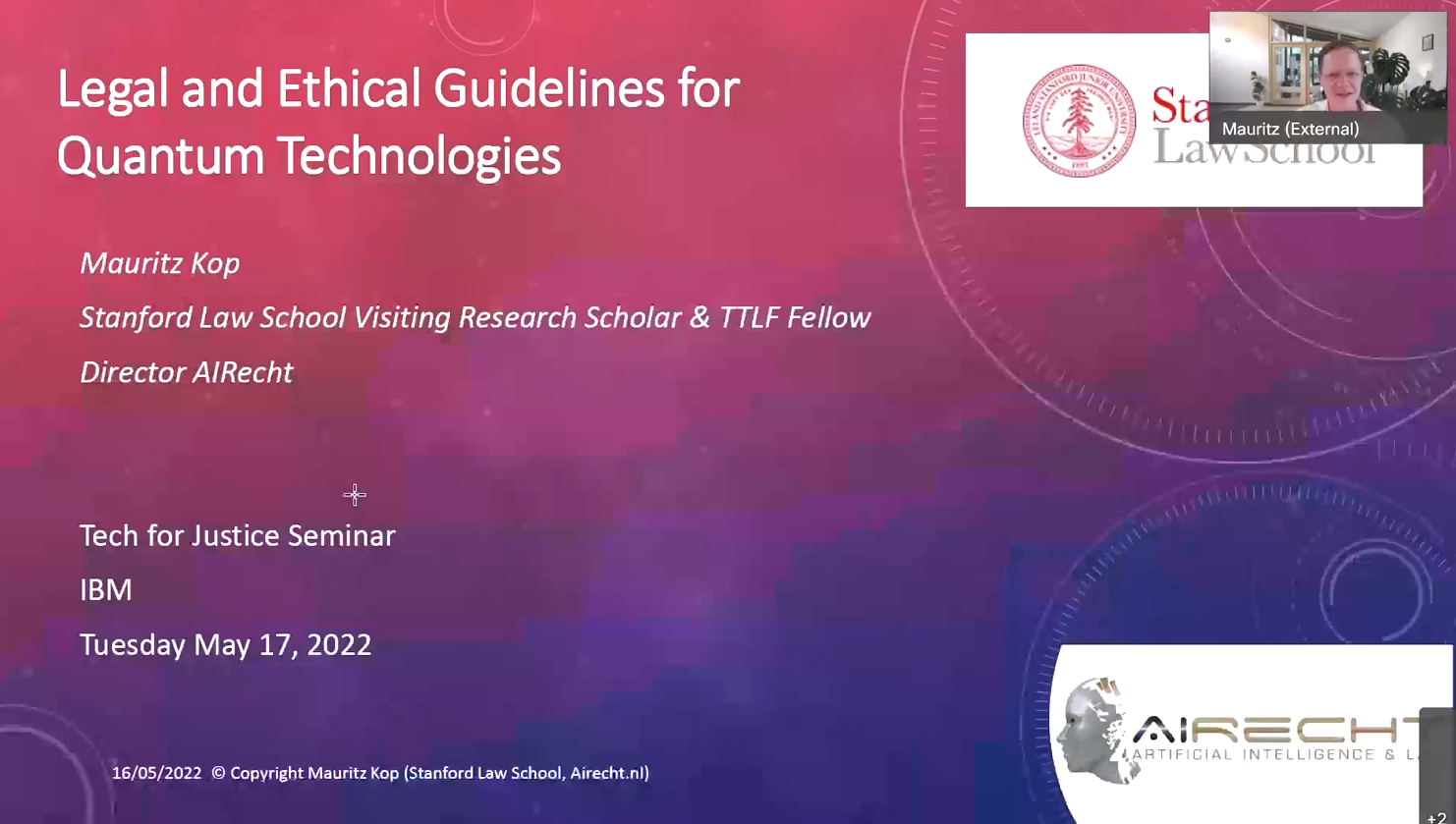
IBM Invites Mauritz Kop for Lecture on Quantum Ethics

New York, May 17, 2022—The development of quantum technology represents a significant advance in computational capability, with the potential to reshape industries, accelerate scientific discovery, and address complex problems. As with other transformative technologies, its power introduces a range of responsibilities. The relevant questions are not only about the technical capabilities of quantum mechanics, but also about the appropriate uses of the technology.

Reflecting this, IBM, a leading company in the quantum field, convened a seminar on May 17, 2022, for its New York and San Francisco teams to focus on the legal and ethical dimensions of this emerging field. The invited speaker for the event was Mauritz Kop, a visiting scholar at Stanford Law School, who presented his work on establishing a governance framework for quantum technologies to an audience of researchers, engineers, and policymakers.

The event was part of IBM's Tech for Justice initiative, a cross-divisional program dedicated to using technology to address systemic biases and advance social equity. Situating the conversation about quantum ethics within this framework indicates an understanding that principles of fairness, accountability, and transparency should be integrated into new technologies from an early stage.

The session was hosted by Dr. Aminat Adebiyi, a Research Staff Member, Experimentalist, and Maker at IBM, and moderated by Dr. Mira Wolf-Bauwens. Kop's collaboration with Wolf-Bauwens includes their shared work on the World Economic Forum's foundational principles for quantum computing, a project that highlights the role of multi-stakeholder cooperation in this area.

The Quantum Vanguard: IBM's Technological Position

To understand the context of the ethical discussion, it is useful to consider the technological landscape. IBM Quantum is one of the leading organizations in quantum computing and has achieved notable milestones in the field. Central to its strategy is the development of universal fault-tolerant quantum computers based on superconducting transmon qubits. This approach, which involves creating and manipulating quantum states in circuits cooled to cryogenic temperatures, has enabled IBM to build increasingly powerful and stable quantum processors.

Charting a Course for Responsible Quantum Development: A Summary of the Lecture

The material presented in the lecture builds upon a body of foundational research by Kop. His work in the Yale Journal of Law & Technology first proposed a comprehensive legal-ethical framework and a set of ten guiding principles for quantum technology. In the Stanford Law School Transatlantic Technology Law Forum, he explored the crucial roles of intellectual property and standardization in fostering sustainable innovation. Furthermore, in Physics World, published by the Institute of Physics, he articulated the necessity of a dedicated field of "quantum ethics," urging the physics community to engage directly with the social and moral implications of their work. Lastly, together with Luciano Floridi at Oxford, Kop conceptualized the Quantum-ELSPI framework as the ethical, legal, social, and policy implications of the suite of quantum technologies. The lecture for IBM synthesized and advanced these core themes.

Kop's lecture, "Legal and Ethical Guidelines for Quantum Technologies," was structured around the thesis that there is a timely opportunity to establish governance for quantum technology. In contrast to the development of the internet or artificial intelligence, where regulation often followed widespread adoption, it is possible to proactively embed democratic values and human rights principles into the architecture of quantum systems.

Interactive Discussion and Call to Action

The lecture was followed by an engaging Q&A session that highlighted the deep commitment of the IBM technical community to responsible innovation. The questions posed by participants explored the practical challenges and nuances of implementing ethical frameworks. Key themes of the discussion included the tangible impact of tech regulation to date, the specific processes needed to assess quantum's potential societal effects, and the distinct yet complementary roles of government and private enterprise in setting and adhering to standards.

Participants were keen to understand how a framework could effectively infuse 'humanism' into every aspect of technology development and how regulation could be used proactively to shape an emerging field for the better. The dialogue also addressed the most significant challenges facing quantum regulation specifically and the strategies required to overcome them.

Meer lezen
Mauritz Kop and Mateo Aboy Present QT and Law Research at Lund Quantum Conference

When Lund University convened The Quantum Law Conference in late April 2022, the legal scholarship on quantum computing was still in its infancy. Organized by Valentin Jeutner under the WASP-HS-funded Quantum Law Project, the gathering—formally titled The Legal Dimensions of Quantum Computing—gave an early home to a question that has only grown more urgent: whether intellectual property law is fit for the quantum age. Mauritz Kop, then a TTLF Fellow at Stanford Law School, and Mateo Aboy, Principal Research Scholar at the University of Cambridge, brought a distinctive answer—one built on data rather than intuition.

Theory meets the patent record

Kop's theoretical contribution warned of IP overprotection: a "rainbow" of overlapping rights that could entrench first movers and concentrate market power in a young field. Rather than rest on the argument, the team tested it. Aboy led a patent-landscape study of the quantum computing subfield, asking whether feared "thicket" and "anticommons" effects were actually appearing. The pairing of a normative framework with empirical patent analysis is what made the Lund presentation unusual—and useful to policymakers who need evidence, not assertion.

A counter-intuitive result

The data pointed the other way. The patent system in quantum computing was not, at that stage, generating innovation-choking overprotection; instead, a growing share of quantum patent information was entering the publicly available disclosure record through lapsed and non-granted filings, forming an expanding information commons. The important caveat was secrecy: trade secrets and state secrets ordinarily do not appear in patent datasets, so quantitative mapping must always be read alongside qualitative analysis. The conclusion was measured—IP law works best in concert with competition law, steering between under- and overprotection.

From a conference room toward the journals

The work is not staying in Lund. The theoretical and market-power strand is forthcoming as a peer-reviewed article in the Journal of Intellectual Property Law & Practice (Oxford University Press), and the companion patent-landscape study is forthcoming in IIC – International Review of Intellectual Property and Competition Law (Springer), with a transatlantic author team spanning Stanford, Cambridge, and CeBIL at the University of Copenhagen. Together they promise one of the earliest evidence-based treatments of quantum-IP policy. It is a quieter companion to Kop's better-known warning that quantum computing carries risks that rival those of artificial intelligence: here the concern is not catastrophe but market structure—who gets to build on quantum technology, and on what terms. The answer the Lund research offers is calibration, not maximalism: predictability enough to attract investment, openness enough to keep the field competitive.

Meer lezen
Mauritz Kop Visiting Quantum & Law Scholar at Stanford Law School

Mauritz Kop is Visiting Quantum & Law Scholar at Stanford Law School in 2022-2023. Kop was invited by Prof. Mark Lemley, the William H. Neukom Professor of Law at Stanford Law School and the Director of the Stanford Program in Law, Science and Technology.

Advanced legal research on Regulating Quantum technology at Stanford Law School

This Stanford Law School ‘Regulating Quantum Technology’ research project will perform a detailed study of how to sensibly regulate the suite of quantum technologies including computing, sensing and networking, unifying the world of the large with that of the small. It intends to answer questions on how our innovation architecture should be constructed, so that benefits of quantum computing, sensing, simulation, and communication -including quantum-AI hybrids- will be distributed equitably, and risks proportionally addressed. Building upon foundational work done on quantum and AI innovation policy mechanisms, national security strategy, standardization & certification, ethics, responsible quantum R&D, governance principles, technology impact assessments, data ownership and intellectual property in quantum software and hardware structures - published in flagship Journals at Stanford, Harvard, Yale, Berkeley, Physics World, Max Planck, Springer Nature, and Oxford - the transdisciplinary research aims to develop an integrated, holistic vision on smart governance and regulation of quantum & AI infused digital transformation.

Happy to speak at a number of in person events in the nexus of AI, Quantum & Law in the coming weeks:

Scarcity, Regulation and the Abundance Society Roundtable at Stanford

1. April 22, Scarcity, Regulation and the Abundance Society Roundtable at Stanford, where I will present a chapter titled ‘Abundance & Equality’ for the book project co-edited by Mark Lemley and Deven Desai. The chapter connects good governance to the end of scarcity and unifies equality with technology driven abundance, by introducing a novel Post-Rawlsian Equal Relative Abundance (ERA) principle of distributive justice. As befits tradition, we will insert musical interludes for piano, with me performing ‘Stanford Theme & Variations’ à l'improviste in the Stanford Law School Faculty Lounge. https://law.stanford.edu/publications/scarcity-regulation-and-the-abundance-society/

Patenting Quantum Computing Technologies talk at Quantum & Law Conference in Lund

2. April 29, presenting our 'Patenting Quantum Computing Technologies and Market Power: A Quantitative Analysis' research together with my academic friends Profs Mateo Aboy (Cambridge) and Timo Minssen (Copenhagen) at the Quantum & Law Conference in Lund. We wrote 2 papers focusing on IP portfolio strategies, trade & state secrets, and their interface with antitrust regulations, utilizing industry and quantum domain specific mixed theoretical & empirical research methods. http://quantum-law.org/conference/

EU AI Act Presentation at AI World Summit Americas in Montreal

3. May 4, I’ll present an overview of the EU AI Act with its ‘product safety framework’ and market entrance requirements, constructed around a set of 4 risk categories at the AI World Summit Americas in Montreal. We will discuss whether it provides a regulatory framework for AI that should be adopted globally during a Headline panel with Prof. Gillian Hadfield (Toronto) and Dr José-Marie Griffiths (President Dakota State), moderated by Meredith Broadbent (Washington). https://americas.worldsummit.ai/speakers/

Keynote Quantum Computing Ethics at IBM Research

4. May 17, I’ll give a keynote on Quantum Computing Ethics at IBM Research during their Tech for Racial and Social Justice Seminar (internal event), organized by Dr Aminat Adebiyi, moderated by Dr Mira Wolf-Bauwens, with whom I worked together on the WEF Quantum Computing Principles. https://www.weforum.org/publications/quantum-computing-governance-principles/

Quantum Impact Assessment (QIA)

5. We are creating a world’s first application-driven Quantum Impact Assessment (QIA) in The Netherlands -raising ELSA awareness and removing barriers for adoption of QT- with a diverse, multidisciplinary team lead by Prof. Bart Schermer (Leiden) and Daniël Frijters for the Centre for Quantum & Society, made possible by ECP and Quantum Delta NL. https://quantumdelta.nl/centre-for-quantum-and-society

Quantum-ELSPI special for Springer Nature with Luciano Floridi

6. Meanwhile I am editing the Quantum-ELSPI special for Springer Nature on the Ethical, Legal, Social and Policy Implications of Quantum Technology, together with EiC Prof. Luciano Floridi (Oxford). https://web.archive.org/web/20260126194629/https://law.stanford.edu/publications/quantum-elspi-ethical-legal-social-and-policy-implications-of-quantum-technology/

More exciting projects soon ...

Meer lezen
Een IPCC voor AI en opkomende technologie: het IPREDICT-voorstel aan de VN

IPREDICT is de oproep aan de Secretaris-Generaal van de Verenigde Naties om een internationaal panel voor verantwoorde ontwikkeling van opkomende technologie op te richten — naar het model van het klimaatpanel IPCC. AIRecht-oprichter Mauritz Kop behoorde tot de internationale experts die het voorstel voorbereidden en leverde de inbreng over quantumtechnologie.

Een IPCC voor opkomende technologie

De kern is coördinatie: één onafhankelijke, interdisciplinaire bron die kunstmatige intelligentie, robotica, biotechnologie en quantumtechnologie beoordeelt vóórdat de gevolgen onomkeerbaar zijn. Het voorgestelde mandaat omvat betrouwbare informatie, expert-aanbevelingen, het aanmoedigen van verantwoorde innovatie in alle ontwikkelfasen en publieke betrokkenheid via een tweejaarlijks World Forum.

Internationale participanten

Het initiatief werd voorbereid door een breed gezelschap van wetenschappers uit recht, ethiek, robotica, AI en biotechnologie — van Princeton en Yale tot UNESCO-bioethici en SIPRI. Het is precies die multidisciplinaire mengeling die een panel als IPREDICT beoogt.

De bijdrage van AIRecht

Mauritz Kop leverde de quantum-expertise, in lijn met zijn werk aan een juridisch-ethisch kader voor verantwoorde quantumtechnologie. De achterliggende gedachte is dat anticiperende governance past bij technologie die met sprongen arriveert. Verder lezen over dat kader kan in Establishing a Legal-Ethical Framework for Quantum Technology.

Meer lezen
Ethics in the Quantum Age

Honored to write about Ethics in the Quantum Age in the Physics World Special on Quantum 2.0, and to be given the chance to outline an ethical framework for quantum technologies, which includes a definition of quantum-ethics.

Mauritz Kop, Why we need to consider the ethical implications of quantum technologies, Physics World, IOP Publishing, (December 1, 2021)

Physics World Special on Quantum 2.0

Physics World is the magazine of the UK-based Institute of Physics (IOP), one of the largest physical societies in the world.

Link to the article: https://physicsworld.com/a/why-we-need-to-consider-the-ethical-implications-of-quantum-technologies/

Download the Ethics in the Quantum Age article here.

We need to build bridges of mutual understanding between disciplines – a move that will involve learning to speak each other’s language, which is easier said than done. Therefore, it is a promising sign that the quantum community reaches out to lawyers, philosophers, and ethicists to explain them the importance of ethics and the societal impact of quantum technologies in their own technical journal.

Making Quantum Technologies Ethical

Please find a short introduction below:

Over the past decades, research into quantum technologies has come to the stage where the science is rapidly being translated into real-world applications be it quantum computers, materials and communications systems. These advancements are witnessed by the considerable number of quantum start-ups that have emerged in recent years. Yet before these innovations can be diffused, we must ensure that ethical, legal and social implications are sufficiently addressed. Against this backdrop, attention is now turning to interdisciplinary efforts to identify the dilemma’s ingrained in making quantum technologies ethical.

A Multi-layered Ethical Framework for Quantum Technologies

The article proposes a multi-layered ethical framework for quantum technologies, including a definition of quantum ethics. At one level, we employ the old, familiar “normative” ethics that apply to all transformative technologies and to information. In addition, the counterintuitive phenomena that underpin quantum physics – such as superposition, entanglement and tunnelling – require a tailored, applied ethics approach. In other words, due to the unique characteristics of quantum technologies – such as the unprecedented capabilities of quantum sensors, the features of quantum networks, and the probabilistic nature of quantum computing – we also develop a new subtype of context-specific practical ethics. In this way we constitute our theory in well-established ethical traditions while at the same time providing tailor-made solutions.

Definition of Quantum Ethics

One possible definition of quantum ethics could be: “Quantum ethics calls for humans to act virtuously, abiding by the standards of ethical practice and conduct set by the quantum community, and to make sure these actions have desirable consequences, with the latter being higher in rank in case it conflicts with the former.

More quantum research at Stanford Law School here.

Meer lezen
Integrating Bespoke IP Regimes for Quantum Technology into National Security Policy

Should countries be able to treat quantum technology the way they treat fissionable materials—suspending patents and trade-secret enforcement when national security demands it? That is the provocative proposal at the center of Integrating Bespoke IP Regimes for Quantum Technology into National Security Policy, a 2021 Stanford working paper by Mauritz Kop and Mark Brongersma, posted as a preprint. The authors argue that quantum needs innovation-policy mechanisms cut to the physics of the very small, then folded into national security law.

A bespoke regime for a dual-use technology

Quantum, the authors observe, is an early-stage family of technologies—comparable to the transistor in the 1960s—whose dual-use character spans civil benefit and military harm. Because appropriable value lives simultaneously in hardware, software, and trade secrets, a legal regime borrowed wholesale from software or biotech will misfire. The paper surveys a toolkit drawn from adjacent fields—AI, biotechnology, nanotechnology, semiconductors, and nuclear—and argues that intellectual property and antitrust law must work in concert so that quantum does not deepen existing inequalities. Their guiding stance is twofold and deliberately paradoxical: treat quantum as genuinely unprecedented, but also learn from the history of adjacent technologies. This work runs alongside the market-power analysis Kop would later develop in intellectual property in quantum computing and market power, carrying the inquiry from competition theory into the harder terrain of national security law.

Pro-quantum antitrust and democratized access

Concretely, the authors weigh pro-quantum antitrust enforcement, the waiving and pledging of IP including compulsory licenses, and the democratization of essential technology. They confront the tension honestly: leading quantum startups have relied on IP protection—especially trade secrets—to raise capital, yet enclosing the foundational concepts of quantum computation and communication risks entrenching winner-takes-all dynamics against a community consensus on the right to equal access. Beyond IP, they catalog prizes, subsidies, state funding, and education as further levers for incentivizing progress.

A new TRIPS security exception

The paper's signature proposal is a new Article 73(b)(iv) security exception to the TRIPS Agreement, giving states the strategic option to exclude quantum technologies from IP protection—mirroring how the existing exception treats fissionable materials, and capable of serving either disclosure or secrecy. Situating quantum within a longer pendulum of open and closed innovation, the authors warn against a convergence of overstretched IP rights and progress made in secret, and close with a call for further multidisciplinary research. The result is a structured agenda for designing quantum innovation policy attuned to both its physics and its geopolitics, complementing the call for a strategic technology alliance among democratic countries.

Meer lezen
Mauritz Kop speaks at Center for Quantum Networks Conference

Mauritz Kop will be speaking about Legal & Ethical Guidelines for Quantum Technology on Saturday Nov. 20 at 9:15-10:15 a.m. Phoenix, Arizona time (GMT-7) as part of the Quantum Technologies, Law, and Public Policy: A Global Perspective Conference. This two-day online event is hosted by the National Science Foundation (NSF) sponsored Center for Quantum Networks at the University of Arizona, and the University of Denver Sturm College of Law. Speakers include a cross-disciplinary line-up of quantum & law scholars from UC Berkeley School of Law, University of Toronto Faculty of Law, the University of Arizona, Sabanci University, Loyola Law School, Lund University, and Stanford Law School.

Quantum Technologies, Law, and Public Policy: A Global Perspective

You can find the conference’s agenda and registration here: https://www.linkedin.com/posts/mauritzkop_quantum-technologies-law-and-public-policy-activity-6863066359228583936-peu9/

Besides explaining quantum physics and discussing regulation, the focus of our Quantum Technologies, Law, and Public Policy: A Global Perspective Conference lies also on developing countries and their challenge with the future of quantum technologies. This is arguably the first comprehensive conference on quantum technology and the law in the U.S..

The Quantum Internet

The Center for Quantum Networks (CQN) is taking on one of the great engineering challenges of the 21st century: to lay the technical and social foundations of the quantum internet. The Quantum Internet will surpass the capabilities of today’s internet because of the unique advantages of entanglement—a coordination of the quantum states of particles serving as computational bits that is not present in the realms of classical physics. https://cqn-erc.arizona.edu/

Legal & Ethical Guidelines for Quantum Technology

The main takeaways of my Legal & Ethical Guidelines for Quantum Technology presentation are:

1. The quantum community should establish a practical code of quantum ethics to make the application of quantum technologies equitable and safe.

2. The world needs a risk-based legal-ethical framework for quantum technologies that mitigates risks and maximizes opportunities, the burdens and gains of which should be equally distributed across members of society.

3. Since technology is never neutral, we should embed democratic values and human rights principles into the architecture and infrastructure of our quantum systems, of course without rendering them useless.

4. We should develop quantum technology impact assessments in the form of codes of conduct, best practices and moral guides that are implemented by inclusive, diverse multidisciplinary teams, and utilize these tools to raise quantum awareness and trust, promote ethical quantum by design, and even proactively ensure regulatory compliance and legal conformity, which includes standardization and certification.

After registering for the conference you will receive the Zoom link that gives access to the event.

Meer lezen
Quantum Computing and Intellectual Property Law

Berkeley Technology Law Journal, Vol. 35, No. 3, 2021

New Stanford University Beyond IP Innovation Law research article: “Quantum Computing and Intellectual Property Law”.

By Mauritz Kop

Citation: Kop, Mauritz, Quantum Computing and Intellectual Property Law (April 8, 2021). Berkeley Technology Law Journal 2021, Vol. 35, No. 3, pp 101-115, February 8, 2022, https://btlj.org/2022/02/quantum-computing-and-intellectual-property-law/

Download the article here: Kop_QC and IP Law BTLJ

Please find a short abstract below:

Intellectual property (IP) rights & the Quantum Computer

What types of intellectual property (IP) rights can be vested in the components of a scalable quantum computer? Are there sufficient market-set innovation incentives for the development and dissemination of quantum software and hardware structures? Or is there a need for open source ecosystems, enrichment of the public domain and even democratization of quantum technology? The article explores possible answers to these tantalizing questions.

IP overprotection leads to exclusive exploitation rights for first movers

The article demonstrates that strategically using a mixture of IP rights to maximize the value of the IP portfolio of the quantum computer’s owner, potentially leads to IP protection in perpetuity. Overlapping IP protection regimes can result in unlimited duration of global exclusive exploitation rights for first movers, being a handful of universities and large corporations. The ensuing IP overprotection in the field of quantum computing leads to an unwanted concentration of market power. Overprotection of information causes market barriers and hinders both healthy competition and industry-specific innovation. In this particular case it slows down progress in an important application area of quantum technology, namely quantum computing.

Fair competition and antitrust laws for quantum technology

In general, our current IP framework is not written with quantum technology in mind. IP should be an exception -limited in time and scope- to the rule that information goods can be used for the common good without restraint. IP law cannot incentivize creation, prevent market failure, fix winner-takes-all effects, eliminate free riding and prohibit predatory market behavior at the same time. To encourage fair competition and correct market skewness, antitrust law is the instrument of choice.

Towards an innovation architecture that mixes freedom and control

The article proposes a solution tailored to the exponential pace of innovation in The Quantum Age, by introducing shorter IP protection durations of 3 to 10 years for Quantum and AI infused creations and inventions. These shorter terms could be made applicable to both the software and the hardware side of things. Clarity about the recommended limited durations of exclusive rights -in combination with compulsory licenses or fixed prized statutory licenses- encourages legal certainty, knowledge dissemination and follow on innovation within the quantum domain. In this light, policy makers should build an innovation architecture that mixes freedom (e.g. access, public domain) and control (e.g. incentive & reward mechanisms).

Creating a thriving global quantum ecosystem

The article concludes that anticipating spectacular advancements in quantum technology, the time is now ripe for governments, research institutions and the markets to prepare regulatory and IP strategies that strike the right balance between safeguarding our fundamental rights & freedoms, our democratic norms & standards, and pursued policy goals that include rapid technology transfer, the free flow of information and the creation of a thriving global quantum ecosystem, whilst encouraging healthy competition and incentivizing sustainable innovation.

Meer lezen