Innovation, Quantum-AI Technology & Law

Blog over Kunstmatige Intelligentie, Quantum, Deep Learning, Blockchain en Big Data Law

Blog over juridische, sociale, ethische en policy aspecten van Kunstmatige Intelligentie, Quantum Computing, Sensing & Communication, Augmented Reality en Robotica, Big Data Wetgeving en Machine Learning Regelgeving. Kennisartikelen inzake de EU AI Act, de Data Governance Act, cloud computing, algoritmes, privacy, virtual reality, blockchain, robotlaw, smart contracts, informatierecht, ICT contracten, online platforms, apps en tools. Europese regels, auteursrecht, chipsrecht, databankrechten en juridische diensten AI recht.

Berichten in Quantum Technology
Mauritz Kop Fellow at Inter-CeBIL Harvard Cambridge Copenhagen

Harvard-Cambridge-Copenhagen, Sept 15, 2023 — Mauritz Kop has accepted a position as an Inter-CeBIL Fellow at the prestigious Novo Nordisk Foundation Copenhagen-Cambridge-Harvard Inter-CeBIL Programme for International Collaborative Bioscience Innovation & Law. In this role, Kop will focus his research on Advanced Medical Computing, Artificial Intelligence (AI) and Quantum Technologies within the life sciences ecosystem.

About the Inter-CeBIL Programme

The Inter-CeBIL Programme is a world-leading research hub dedicated to identifying and tackling the most significant legal and regulatory barriers to health and life science innovation. The initiative fosters robust knowledge networks to provide tailored legal and regulatory support to patients, researchers, businesses, and incubators, with the ultimate goal of ensuring that health and life science innovations can safely and effectively reach patients and markets.

This international collaboration brings together top-tier academic institutions to drive progress in healthcare and biotechnology. The program is a joint effort between the Centre for Advanced Studies in Bioscience Innovation Law (CeBIL) at the University of Copenhagen, the Petrie-Flom Center for Health Law Policy, Biotechnology, and Bioethics at Harvard Law School, and the University of Cambridge, among other key partners. The program is led by a distinguished team, including Professor Timo Minssen as the Founding Director of CeBIL at the University of Copenhagen, Professor I. Glenn Cohen who leads Harvard Law School’s contribution, and Professor Mateo Aboy who leads the Cambridge part.

Key Research Areas

The Inter-CeBIL Programme centers its research on three key "grand challenges":

1. Advanced Medical Computing: Focusing on Artificial Intelligence (AI) and Quantum Technologies (QT).

2. Pandemic Preparedness & Anti-Microbial Resistance (AMR).

3. Sustainable Innovation & Biosolutions: Encompassing eco-systems, drug R&D, drug regulation, and data infrastructures.

Focus on Key Area 1: Advanced Medical Computing, AI & Quantum Technology

This key research area addresses the increasingly critical role of advanced computing in the life sciences and medical sectors. Algorithms are becoming fundamental building blocks in a wide range of medical devices, digital health technologies (DHTs), and drug discovery tools (DDTs). The use of advanced computing, including AI/ML and quantum computing (QC), holds immense potential benefits for the life sciences, drug discovery, and medical sectors. These advancements also raise significant legal, ethical, governance, and regulatory issues that the program aims to address.

In his capacity as an Inter-CeBIL Fellow, Mauritz Kop will contribute his deep expertise in quantum-AI, its governance, and its legal-ethical implications to this key research area, helping to navigate the complex challenges and opportunities presented by these cutting-edge technologies.

Meer lezen
Stanford Responsible Quantum Technology Conference 2023

Stanford, CA – May 22, 2023 – The 21st century is undeniably the Quantum Age, and on May 22, 2023, Stanford University hosted the inaugural Stanford Responsible Quantum Technology Conference at the iconic Paul Brest Hall, Stanford Law School. This landmark annual event, themed "Quantum-ELSPI" for its first iteration, brought together the global quantum community to explore the multifaceted ethical, legal, socio-economic, and policy implications (ELSPI) of this transformative field.

The conference was designed as a unique confluence of quantum physics, law, and art, aiming to discuss informed suggestions on how to balance maximizing the benefits and mitigating the risks of applied quantum technology. It covered state-of-the-art quantum computing, sensing, simulation, communication, materials, and quantum-classical hybrids, all within diverse multidisciplinary settings and taking a pro-innovation stance.

A Day of Interdisciplinary Exploration and Artistic Inspiration

The day was marked by deeply interdisciplinary presentations and an elegant intellectual atmosphere, uniquely punctuated by live musical interludes featuring works by Mozart, Schönberg, and Chopin, and opera arias by Handel, Liszt, and Gounod. Attendees also witnessed interactive quantum physics experiments, including demonstrations of quantum sensing and interferometry, designed to make the counter-intuitive quantum world more accessible.

The program began with Opening Remarks by Mauritz Kop of Stanford University, AIRecht.nl, and Daiki. This set the stage for a day of profound discussions.

What Responsible Quantum Technology & Innovation Entails

As attendees experienced, the conference provided an illuminating platform for discussing the state-of-the-art in quantum science, governance tipping points, risk-benefit analyses, intellectual property, societal impact assessments, and the myriad exciting novel use cases being developed. The discussions on what Responsible Quantum Technology & Innovation truly entails in diverse, multidisciplinary, and intergenerational settings were a highlight for all participants.

Mauritz Kop offered closing remarks, and the day concluded with a reception, further fostering the sense of community and shared purpose.

Deep gratitude was extended to all the speakers, moderators, musicians (Ireh Kim, Jin-Hee Catherine Lee, Zoe Logan Schramm, Katie Liu, Daniel Changxiao Sun, and Mauritz Kop), and physicists (Franz Inthisone Pfanner, Daniel Changxiao Sun) who contributed to the success of this inaugural event. Special thanks were also conveyed to Professor Mark Lemley and the team at Stanford Law School for making this memorable conference a reality.

The Stanford Responsible Quantum Technology Conference has set a high bar for future discussions, and the quantum community eagerly anticipates Stanford RQT 2.0.

Meer lezen
Mauritz Kop Interviewed by Al Jazeera on Responsible Quantum AI Computing at Stanford University

Al Jazeera English featured an interview with Mauritz Kop on responsible quantum computing and quantum artificial intelligence (QAI) at Stanford University, woven into a report from a Silicon Valley summit looking for computing's next breakthrough. Speaking in the spring of 2023, as a Transatlantic Technology Law Forum Fellow at Stanford Law School working on responsible quantum technology, Kop set out three themes that have anchored his work ever since: the societal benefits and risks of quantum computing, the need for guardrails for QAI, and his legal-futurist scenario of a Quantum Event Horizon.

Quantum technology arrives in public view

The interview's setting—an industry expo rather than a lecture hall—signaled how far quantum technology had already traveled from theory toward commerce. Kop's role in the segment was to translate that momentum into a governance question: what legal and policy architecture should accompany machines that exploit superposition and entanglement to do what classical computers cannot? The benefits, from quantum simulation in drug and materials discovery to advances in sensing, are real; so is the risk that fault-tolerant quantum computing could eventually undermine the public-key cryptography securing global infrastructure absent migration to post-quantum schemes. In quantum technology, the same capability that delivers the promise also carries the threat—which is why Kop argues the two cannot be governed as separate concerns.

Building the guardrails early

Kop's case for guardrails turns on timing. Quantum computing and artificial intelligence are each transformative; their convergence could compress the timelines on which human oversight depends. The remedy he advocates is to install safeguards at the design stage—through technical standards, impact assessment as a design instrument, and international coordination—rather than retrofitting them after deployment, when the cost of correction climbs. The Quantum Event Horizon names what those guardrails are meant to prevent: a threshold past which a quantum-AI system can no longer be brought back under meaningful human control. The concept is a design imperative, not a forecast—if such a point is even conceivable, the controls must precede it.

From research program to public conversation

What makes the Al Jazeera interview notable in hindsight is its moment. In the spring of 2023 the case for responsible quantum technology still had to be made to a general audience; the Stanford Center for Responsible Quantum Technology that Kop would found and direct was only then taking shape, with its inaugural conference held that year. Coverage on an international network helped carry the argument beyond the academy toward the citizens, regulators, and technologists whose decisions will determine whether quantum's next revolution is also a responsible one. The same conviction animates Kop's later policy writing, including his consultations with U.S. lawmakers on AI and quantum technology policy, and his profile of scholarship at the intersection of law, quantum technology, and AI.

Meer lezen
Fortune Publication: How to Prevent Quantum-A.I. Hybrids from Taking Over the World

Palo Alto, May 16, 2023—We are delighted to share our new Fortune piece titled "How to prevent quantum-A.I. hybrids from taking over the world," that showcases our Stanford-led research on Responsible Quantum Technology! The 21st century is rapidly becoming the Quantum Age. While the full realization of general-purpose quantum computers is still on the horizon, the emergence of hybrid systems that combine quantum phenomena with classical hardware is already a reality, making its way into both domestic and international markets. This convergence of quantum technology and artificial intelligence (AI) promises to unlock unprecedented advancements across various fields, but it also presents a host of complex geopolitical and grand strategy challenges that demand our immediate attention. As we stand on the precipice of this technological revolution, it is imperative that we proceed with a strong sense of responsibility, ensuring that these powerful tools are developed and deployed in a manner that aligns with our most cherished societal values.

Critical Quantum Insights for a Business Audience

The article, "How to prevent quantum-A.I. hybrids from taking over the world," published in Fortune on May 16, 2023, delves into the profound implications of this technological convergence, offering critical quantum insights for a business audience. It highlights the stark contrast between the development of quantum technology (QT) in liberal democracies, where adherence to fundamental human rights and democratic values is paramount, and its potential applications in autocratic regimes that may wield it for more nefarious purposes. The piece underscores the existential importance of international collaboration, not only on pressing global issues like climate change and inequality but also in the race for technological dominance, where the preservation of freedom and democratic principles hangs in the balance. As quantum-AI hybrids become increasingly prevalent, the authors argue that business and government leaders must engage with experts and the public to establish robust ethical standards, accountability mechanisms, and responsible technology frameworks to actively foster a competitive, values-based quantum-AI ecosystem.

In 2022, Kop & Wadhwa wrote a Foreign Policy paper titled ‘Why Quantum Computing Is Even More Dangerous Than Artificial Intelligence’, see: https://airecht.nl/blog/2022/why-quantum-computing-is-even-more-dangerous-than-artificial-intelligence-foreign-policy

The Dawn of the Quantum-AI Era: Navigating Opportunities and Risks

At the heart of this discourse is the recognition that any major technological advance inevitably raises critical questions of justice, benefit, and risk. The sheer scale and rapid pace of QT-enabled advancements, coupled with their counterintuitive nature, make these considerations all the more urgent. The potential applications are vast and transformative, ranging from quantum chemistry and drug design to logistical optimization and clean energy. However, the threats are equally significant, with the most widely understood being the imminent danger that quantum computing poses to our current cybersecurity infrastructure and data privacy.

In response to these challenges, a global conversation is underway among stakeholders to find a delicate balance between harnessing the benefits of QT and mitigating its risks. Many are turning to the established principles of Responsible Research and Innovation (RRI), which emphasize the importance of responsiveness, inclusivity, reflexivity, and anticipation. RRI posits that scientific and technological breakthroughs should be guided not only by scientific brilliance and economic incentives but also by social norms, ethical values, environmental sustainability, and public engagement. This approach encourages the integration of societal concerns throughout the entire innovation lifecycle, from the initial stages of research and development to the eventual distribution and use of new technologies.

A Framework for Responsible Quantum Innovation: The RQT Approach

Building upon this foundation, a Stanford-led interdisciplinary research group, comprising scholars from law, data science, theoretical physics, philosophy, ethics, social sciences, materials science, and innovation policy, has conceptualized a novel framework known as Responsible Quantum Technology (RQT). This framework is designed to proactively steward the development of QT toward equitable outcomes, mitigate potential risks, and foster an interdisciplinary approach to research and development. RQT embeds the key principles of RRI alongside a comprehensive consideration of the ethical, legal, socio-economic, and policy implications, collectively referred to as Quantum-ELSPI. The ultimate goal of RQT is to ensure that research and innovation efforts are aligned with societal expectations and contribute to the enhancement of planetary welfare.

Meer lezen
Quantum Technology Impact Assessment (EU AI Alliance, European Commission)

Brussels, 20 April 2023—The emergence of powerful new capabilities in large AI models, such as Generative Adversarial Networks (GANs), underscores the critical need to continuously improve and update technology impact assessment tools, ensuring they keep pace with rapid technological development. As defined in recent scholarship, technology impact assessment is the systematic process of monitoring and determining the unintended, indirect, or delayed societal impacts of a future technological innovation. Crucially, it is also about capitalizing on opportunities and enabling responsible innovation from the outset.

An article by Stanford Law’s Mauritz Kop on this topic is also featured on the European Commission's Futurium website.

Shaping the Quantum Innovation Process

Quantum Impact Assessments (QIAs) are emerging as vital practical tools to facilitate the responsible adoption of quantum technologies. There are several related approaches to this assessment: (1) interactive QIA, which seeks to influence and shape the innovation process; (2) constructive QIA, where social issues guide the design of the technology from its earliest stages; and (3) real-time QIA, which connects scientific R&D with social sciences and policy from the start, before a technology becomes locked-in.

Often taking the form of codes of conduct, best practices, roadmaps, and physics de-risking tools, QIA instruments can be used by governments, industry, and academia. These soft law toolsallow stakeholders to explore how current technological developments affect the world we live in and to proactively shape the innovation process toward beneficial, societally robust outcomes.

Exploratory Quantum Technology Assessment

Implementing interdisciplinary, expert-based QIAs can help raise awareness about the ethical, legal, socio-economic, and policy (ELSPI) dimensions of quantum technology, including quantum-classical hybrid systems. For instance, QIAs cultivate a deeper understanding of the potential dual-use character of quantum technology, where beneficial applications (such as quantum sensing for medical diagnostics) can exist alongside potentially harmful ones (such as the same sensors being used for autocratic surveillance).

Building on the foundational work of the 2018 AI Impact Assessment developed by ECP | Platform voor de InformatieSamenleving chaired by Prof. Kees Stuurman, this work presents a prototype of a QIA instrument: the Exploratory Quantum Technology Assessment (EQTA). This pioneering initiative was made possible through a collaboration between the Dutch Ministry of Economic Affairs & Climate Policy, Quantum Delta NL (QDNL), and ECP. The EQTA will be presented by Eline de Jong and Mauritz Kop at the inaugural Stanford Responsible Quantum Technology Conference in May 2023.

Guidance for Responsible Quantum Technology Implementation

The EQTA provides a comprehensive, practical step-by-step plan that encourages stakeholders to initiate a dialogue to clarify which ethical, legal, and social aspects are important in the creation and application of quantum systems and their interaction with classical technologies. This structured approach helps make the use of quantum technology—as well as the data and algorithms that power it—more transparent and accountable from an early stage.

Looking forward, establishing a risk-based legal-ethical framework in combination with standardization, certification, technology impact assessment, and life-cycle auditing of quantum-driven systems is crucial to stewarding society towards responsible quantum innovation. Mauritz Kop’s research group has written more on this framework in their seminal article Towards Responsible Quantum Technology (Harvard).

Meer lezen
Towards Responsible Quantum Technology published by Harvard Berkman Klein Center for Internet & Society

Boston, MA, March 21, 2023—In a landmark contribution to the global dialogue on technology governance, the Harvard Berkman Klein Center for Internet & Society has published the foundational article, "Towards Responsible Quantum Technology." This significant work, the result of a deeply interdisciplinary and transatlantic collaboration, lays out a comprehensive conceptual framework for steering the development of quantum technologies (QT) in a direction that is safe, ethical, and aligned with democratic values.

The manuscript, which was also published in the Hastings Science & Technology Law Journal by the University of California, College of the Law, San Francisco, and in the University of Cambridge repository -with preprints at Stanford Law, ArxiV and the European Commission’s Futurium website- represents a concerted effort to get ahead of the regulatory curve. It argues for a proactive, principled approach to governance while the technology is still malleable, learning from the often-reactive postures taken with previous technological waves like AI and the internet.

A Transatlantic Constellation of Scholars

The paper is authored by a distinguished group of international scholars led by Mauritz Kop, Visiting ‘Quantum & Law’ Scholar at Stanford and the imminent Founding Director of the Stanford Center for Responsible Quantum Technology. The team represents a formidable convergence of expertise from the world's leading academic institutions, including Stanford, Harvard, Oxford, Yale, Cambridge, the University of Waterloo, and the Universities of Munich, Amsterdam, Maastricht, and Copenhagen.

This collaboration brought together leading lights in law, data science, theoretical quantum physics, philosophy and ethics, socioeconomics, materials science and engineering, and innovation policy. The author group includes Mateo Aboy, Eline De Jong, Urs Gasser, I. Glenn Cohen, Timo Minssen, Teresa Quintel, Mark Brongersma, Luciano Floridi, and Raymond Laflamme, whose collective insights provide a holistic and robust foundation for the proposed framework.

The RQT Framework: Integrating Quantum-ELSPI and RRI

At the heart of the paper is the conceptual framework for Responsible Quantum Technology (RQT). This framework is designed to systematically integrate considerations of the Ethical, Legal, Social, and Policy Implications (ELSPI) of quantum technologies directly into the research and development lifecycle.

The RQT framework is built upon the established dimensions of Responsible Research and Innovation (RRI)—anticipation, inclusion, reflection, and responsiveness. By merging these two approaches, Quantum-ELSPI and RRI, the authors have created a powerful tool for ensuring that the development of quantum is not driven solely by technical or commercial imperatives, but by a deep and abiding commitment to societal well-being.

Operationalizing Responsible Quantum Technology: The 10 Principles and Future Regulation

The "Towards Responsible Quantum Technology" paper is the first in a series of studies designed to build a comprehensive governance architecture. It lays the conceptual groundwork that is further operationalized in a subsequent study led by Kop, the "10 Principles for Responsible Quantum Innovation." This second paper translates the high-level SEA framework into concrete, actionable principles for real-world application.

Ultimately, the RQT framework is intended to inform the emergent regulatory landscape for quantum technology. The authors provide an outlook on how regulatory interventions can be designed and contextualized to be effective without stifling innovation. By tailoring governance to the exceptional nature of quantum, the goal is to reduce the risk of unintended, counterproductive policy effects and to foster a thriving, responsible, and values-based quantum ecosystem. The paper concludes with a call to action for the research community and other stakeholders to build upon this foundational work, to further develop the guiding principles, and to translate them into the best practices that will define the quantum future.

Meer lezen
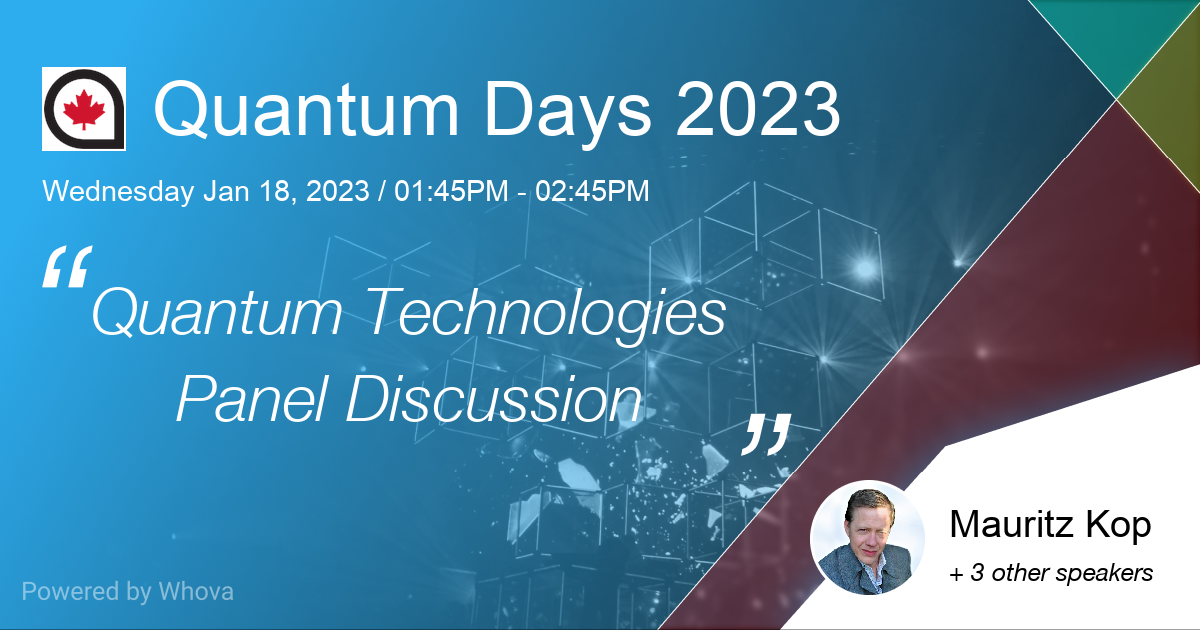
Quantum Days Canada: CCA Panel on Quantum Technologies

When the Council of Canadian Academies brought its quantum expert panel to Quantum Days in January 2023, it did something unusual for a national academy: it opened an unfinished study to public input. Mauritz Kop joined the session to frame the ethical, legal, social, and policy stakes of quantum adoption—and to invite the audience to help shape the questions, not just receive the answers.

A government-commissioned panel, in public

The panel had been formed at the request of federal sponsors, including the National Research Council of Canada and Innovation, Science and Economic Development Canada, and was chaired by the physicist Raymond Laflamme. The Quantum Days appearance gathered members of that panel—Laflamme, Jeff Kinder, Mauritz Kop, and Jacqueline Bartlett among the named participants—to discuss the panel's mandate, key questions, and priorities while its assessment of Canadian quantum adoption was still being written. It was a national study opened up mid-draft, with its conclusions deliberately still open.

Live polls and equitable access

The session's signature move was procedural: the audience was invited to feed the eventual report through live polls, under the banner of helping Canada build a quantum ecosystem. That design choice carries an argument. Responsible quantum governance, on Kop's reading, treats equitable access to quantum-enabled prosperity as a question to be settled by deliberation rather than left to the market, and asks how codes of conduct and design guidelines can be agreed across cultures whose ethical intuitions differ. Live audience input is well suited to surfacing exactly the trade-offs that have no single technically correct answer—and it reflects the distributive themes that run through Kop's broader scholarship on responsible technology.

Why the policy lens belongs at a physics conference

Quantum systems invite governance because their behavior is genuinely unfamiliar. Superposition and entanglement change what computation can do, with consequences for cryptography and security that existing law did not anticipate. The case for an ethical, legal, social, and policy lens at a technical conference is that the rules must be drafted while the science is still moving—a position consistent with the standards-and-principles direction Kop and colleagues set out in the Ten Principles for Responsible Quantum Innovation.

A panel on its way to a report

The Quantum Days session is one step in a longer process. The same panel, under the same chair, is carrying its study through 2023 toward a national assessment of quantum adoption in Canada, with Kop among its members. The sequence—open the questions in public, gather input through live polls, then translate that deliberation into evidence for decision-makers—offers a working model of quantum governance that is both expert-led and publicly grounded, an early example of treating quantum policy as a question worked out in the open rather than a finished product to be announced. (That study became the CCA's Quantum Potential report, published November 30, 2023.)

Meer lezen
Mauritz Kop Advises Yale Law School's Lowenstein Human Rights Project on Quantum Technology and Human Rights

In November 2022, the Lowenstein Project at Yale Law School—the student-led human rights group founded in 1981 under the Schell Center for International Human Rights—reached out to Mauritz Kop for his expertise on quantum technology and human rights. The team was working on a background policy memorandum, in association with the Seoul National University Artificial Intelligence Policy Initiative and the Korean Mission to the United Nations in Geneva, to support a proposed new U.N. Special Rapporteurship on human rights in the development of new technologies. Their question was practical and revealing: how does a layperson "get smart" on quantum?

Lawyers seeking to make a hard field legible

The outreach was, in the project's own words, "primarily focused on the research process, especially from a lay perspective." The questions concerned method, not conclusions—where to begin, how to sequence the material, which kinds of technical understanding human rights applications actually require, and whom else to consult. Kop shared his insights into that process. He did not draft the memorandum and the engagement should not be overstated: it was a scholar helping advocates reach the threshold of understanding from which rights questions can be posed precisely rather than rhetorically.

Why the physics has to come first

Quantum is harder to make legible than artificial intelligence or social media, and easy to discuss in metaphors that mislead. Getting smart on it means grasping superposition, entanglement, and measurement—features with no classical analogue—well enough that rights claims become testable rather than atmospheric. A concrete worry about a future quantum computer breaking today's public-key encryption is a disciplined claim; generalized anxiety about "quantum" doing something powerful and unspecified is not. The difference is exactly what a layperson must cross to draft credible norms.

Quantum literacy as a precondition for rights protection

The episode is small but structural. The U.N. human rights system can only fashion meaningful safeguards for a technology its drafters understand; an instrument written from metaphor risks protecting the wrong things, or nothing. That is why responsible quantum governance has to be interdisciplinary from the start, with lawyers, ethicists, and physicists working together—a case Kop and colleagues have made across the responsible-quantum-technology literature, including the Ten Principles for Responsible Quantum Innovation. The Lowenstein outreach is that argument running in reverse: advocates recognizing that they had to learn the technology before they could protect against it.

A small request, a durable lesson

To be precise about the record: Kop answered the project's research-process questions; he was not an author of the memorandum, and whether a new Special Rapporteurship is ultimately established is a matter for the Human Rights Council. The durable point is narrower and more interesting—that human rights advocates building a case at the United Nations turned to a quantum scholar to make the field legible first. Quantum literacy is becoming a precondition for rights-protective governance, not an optional supplement to it.

Meer lezen
Morning Brew and Dark Reading Interview Mauritz Kop on Quantum Ethics and the EU AI Act

Within the same fortnight in June 2022, two technology outlets sought out Mauritz Kop on the two governance questions that run through his scholarship: the ethics of quantum computing, and Europe's proposed AI Act. Emerging Tech Brew, Morning Brew's technology vertical, featured him in "As quantum computing advances, who's thinking about ethics?"; Dark Reading featured him in "EU Debates AI Act to Protect Human Rights, Define High-Risk Uses." In both, Kop is identified as a Transatlantic Technology Law Forum fellow at Stanford University and a strategic intellectual property lawyer at AIRecht.

Quantum ethics: act before the technology locks in

To Emerging Tech Brew, Kop's central message was about timing. "We were obviously too late for AI, and now, [for quantum computing], we still have the chance to be in time before the technology gets locked in," he said—invoking the Collingridge dilemma, in which a technology is easiest to steer precisely when its risks are hardest to see. The urgency is rooted in physics: superposition and entanglement give quantum machines a categorically different kind of power, including the eventual ability to break the public-key cryptography that protects today's communications—one reason the World Economic Forum's quantum governance principles name "non-maleficence" as a core value. Kop paired a call for transparency about present capability with a warning about a "Pandora's Box of unknown risks," and likened the field's duty of care to the Hippocratic Oath—"in this case, our society is the patient."

The EU AI Act: a product-safety regime for AI

To Dark Reading, Kop framed the EU AI Act as a product-safety regime that closes the gaps left by an otherwise unregulated field. "The risks are too high for nonbinding self-regulation by companies alone," he said, describing the act as "a human centric legal-ethical framework that intends to safeguard and protect human rights and fundamental freedoms from violations of these rights and freedoms by algorithms and smart machines." High-risk classification, he explained, scales obligations to danger—stricter rules for AI in healthcare and defense than for AI in tourism—through a dynamic, evolving list.

One conviction, two technologies

Both interviews express a single idea: that governance works best when embedded early, by design, and grounded in human rights rather than retrofitted after harm. Kop did not minimize the compliance burden on startups, nor the legal uncertainty that surrounds early regulation; his answer is "Trustworthy AI by Design," built in from the first line of code, and regulatory sandboxes that give responsible innovation room to breathe. More on the author's work is available via his scholar profile.

Meer lezen
Mauritz Kop calls for a Quantum Governance Act at the University of Copenhagen, Faculty of Law

Much enjoyed giving a lecture titled ‘Quantum-ELSPI: A Call for a Quantum Governance Act’ on Thursday June 9, 2022 at the University of Copenhagen, Faculty of Law. This was an internal CeBiL event that took place before The Quantum Future symposium, organized by the Royal Danish Academy of Sciences and its newly established Committee for Quantum Information and Quantum Computing, together with the Niels Bohr Institute’s Quantum Life Centre.

EU Quantum Governance Act

With its own Copenhagen interpretation of quantum mechanics in which physical phenomena must be observed and measured to exist, the University of Copenhagen, Faculty of Law was the perfect place to propose an outline for a novel Quantum Governance Act on a European level, fostering open innovation while putting targeted, technology and industry specific risk based controls in place. The EU Quantum Act should jointly optimize advancing quantum technology (investment and innovation) with safeguaring quantum technology, society and humankind (guardrails, standards, values, IP protection and national security). For example, it could contain a product safety regime as found in the EU AI Act, combined with pro-innovation mechanisms as found in the US CHIPS Act. In addition, I connected regulating quantum to regulating general purpose technologies (GPT) like artificial intelligence (AI), but also to nanotechnology, biotechnology, semiconductors, and last not least to managing dual use fissionable materials such as nuclear isotopes and nuclear weapons, utilizing export and intellectual property controls.

The Law of Quantum: Quantum Regulatory Frameworks

The Quantum & Law lecture gave an overview of work done over the past 3 years on quantum regulatory frameworks, incentive and rewards systems, competition law, beyond intellectual property innovation law, ethics, national security policy, standardization, technology impact assessment, benchmarking and certification published or forthcoming in high impact journals at both sides of the Atlantic. My talk ended with discussing the latest research findings pertaining to the Law of Quantum, and Quantum-ELSPI academic disciplines. Thanks to the participants for their inspiring questions and comments!

Panel Debate about the Quantum Future at the Royal Danish Academy of Sciences

The brilliant lectures on atoms, photons, qubits, the nature of quantum information, the history of quantum physics, and current research into quantum computer paradigms -including combatting decoherence on both software and hardware levels- at The Quantum Future symposium where highly enjoyable. This fascinating program ended with a panel debate on how quantum technology will change our society, at the beautiful building of the Royal Danish Academy of Sciences, in attendance of fellow jurists Nicholson Price II, Louise C. Druedahl, Marcelo Corrales Compagnucci, and Agnieszka Radziwon.

Surfing the Waves of the Second Quantum Revolution

The panel debate at the Academy -superbly moderated by Nanna Bonde Thylstrup- gave a true, almost symptomatic picture of the various stakeholders' viewpoints and positions. But we are learning to speak each other's language better and better, a crucial and exciting step when it comes to balancing the societal impact of our mystical family of quantum technologies. Surfing the waves of the second quantum revolution requires building bridges between disciplines, beyond traditional research silos. Bringing together the humanities, social and natural sciences to spur sustainable innovation driven by a golden triangle of academia, government and industry is essential.

Thank you to Professor Timo Minssen and his team at CeBiL for the kind invite. https://jura.ku.dk/cebil/

Meer lezen
Mauritz Kop joins Expert Panel on Quantum Technologies of the Council of Canadian Academies (CCA)

Mauritz Kop joins the multidisciplinary Expert Panel on Quantum Technologies of the Council of Canadian Academies (CCA) over 2022-2023, chaired by Professor Raymond Laflamme. In November 2023, The Expert Panel on the Responsible Adoption of Quantum Technologies published their final report titled Quantum Potential. https://cca-reports.ca/reports/quantum-technologies/

The Council of Canadian Academies (CCA) Investigates Future Impact of Quantum Technologies

As Chair, Dr. Raymond Laflamme will lead a multidisciplinary group with expertise in quantum technologies, economics, innovation, ethics, and legal and regulatory frameworks. The Panel will answer the following question:

In light of current trends affecting the evolution of quantum technologies, what opportunities and challenges do these present in Canada?

The Quantum Potential Report

Quantum technologies are poised to play a major role in Canada’s future, from its national security to its economic standing. While Canada is among the global leaders in quantum research, it nevertheless faces challenges in the adoption of these technologies as they approach market readiness. Quantum Potential, a new expert panel report from the Council of Canadian Academies (CCA), outlines a responsible approach to quantum-technology adoption — a critical step toward ensuring Canada’s global competitiveness in the decades ahead.

Quantum Computing, Sensing, and Communications

Quantum Potential considers quantum computing, sensing, and communications, three categories of quantum technology at varying levels of maturity. While these technologies may strengthen digital infrastructure, improve data security, and optimize processes across a range of economic sectors, they also pose significant risks, such as misuse by malicious actors. Risks associated with quantum technologies span ethical, legal, social, and policy realms; without sufficient consideration, they may compromise public trust in quantum technologies, limit research funding, and stifle innovation.

The Commercialization Potential of Quantum Technologies in Canada

Quantum Potential explores the commercialization potential of quantum technologies, articulates Canada’s position within the global quantum value chain, and examines those conditions and policy levers that might promote their responsible adoption. https://cca-reports.ca/reports/quantum-technologies/

Quantum technologies offer opportunities to harness the properties of quantum mechanics for a breadth of applications, many of them novel. Though many quantum technologies are several years away from reaching market, it is believed that they have the potential to revolutionize many industries as they reach widespread commercial availability. Domestic industries will need to adopt these technologies if they wish to remain globally competitive, as will governments hoping to ensure national and economic security, public safety, and the integrity of critical infrastructure. To date, Canada has made noteworthy investments in the research and development of quantum technologies but has focused less on mechanisms to stimulate their diffusion and adoption.

Ethical, Legal, Social, and Policy Implications (Quantum-ELSPI)

The adoption of quantum technologies also carries significant ethical, legal, social, and policy implications. These include potential threats to data security and digital infrastructure, anticompetitive pressures by market-dominant firms, mass surveillance and privacy loss, regulatory uncertainty, inequitable access to technology, and social challenges related to employment and public trust in science. However, there are many strategies that could help address these challenges and stimulate the responsible adoption of quantum technologies. These include public-private co-operation, pro-competition oversight and policies, industry-led initiatives, and the creation of a diverse quantum workforce. In order to maximize the benefits of quantum technologies while mitigating potential risks, responsible approaches to adoption should use state-sanctioned and self-regulating measures – including quantum impact assessments, soft-law mechanisms, and consultations with stakeholders – to anticipate the effects of technological change.

Thanks to the sponsors National Research Council Canada and Innovation; Science and Economic Development Canada for facilitating this Report.

Meer lezen
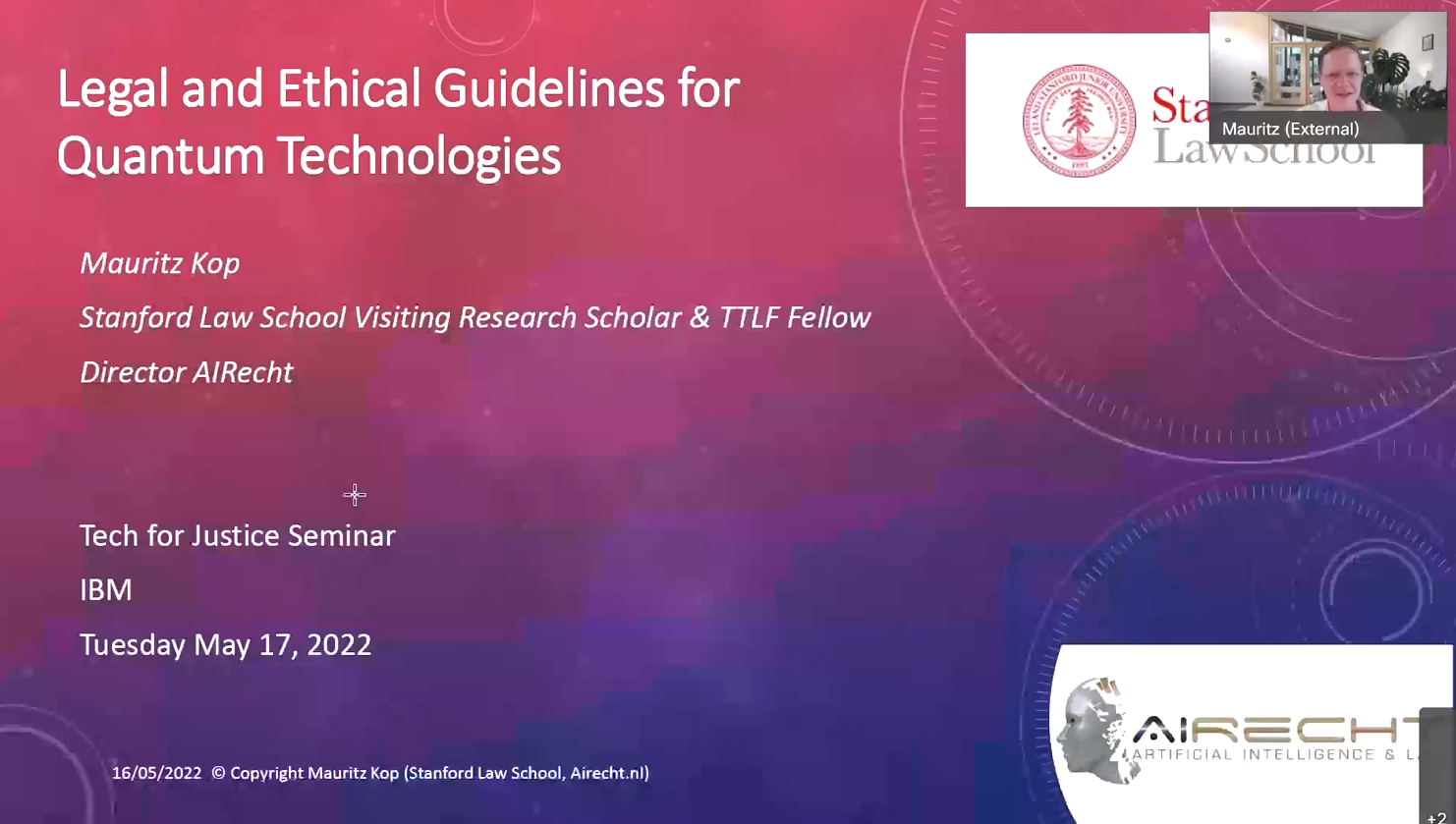
IBM Invites Mauritz Kop for Lecture on Quantum Ethics

New York, May 17, 2022—The development of quantum technology represents a significant advance in computational capability, with the potential to reshape industries, accelerate scientific discovery, and address complex problems. As with other transformative technologies, its power introduces a range of responsibilities. The relevant questions are not only about the technical capabilities of quantum mechanics, but also about the appropriate uses of the technology.

Reflecting this, IBM, a leading company in the quantum field, convened a seminar on May 17, 2022, for its New York and San Francisco teams to focus on the legal and ethical dimensions of this emerging field. The invited speaker for the event was Mauritz Kop, a visiting scholar at Stanford Law School, who presented his work on establishing a governance framework for quantum technologies to an audience of researchers, engineers, and policymakers.

The event was part of IBM's Tech for Justice initiative, a cross-divisional program dedicated to using technology to address systemic biases and advance social equity. Situating the conversation about quantum ethics within this framework indicates an understanding that principles of fairness, accountability, and transparency should be integrated into new technologies from an early stage.

The session was hosted by Dr. Aminat Adebiyi, a Research Staff Member, Experimentalist, and Maker at IBM, and moderated by Dr. Mira Wolf-Bauwens. Kop's collaboration with Wolf-Bauwens includes their shared work on the World Economic Forum's foundational principles for quantum computing, a project that highlights the role of multi-stakeholder cooperation in this area.

The Quantum Vanguard: IBM's Technological Position

To understand the context of the ethical discussion, it is useful to consider the technological landscape. IBM Quantum is one of the leading organizations in quantum computing and has achieved notable milestones in the field. Central to its strategy is the development of universal fault-tolerant quantum computers based on superconducting transmon qubits. This approach, which involves creating and manipulating quantum states in circuits cooled to cryogenic temperatures, has enabled IBM to build increasingly powerful and stable quantum processors.

Charting a Course for Responsible Quantum Development: A Summary of the Lecture

The material presented in the lecture builds upon a body of foundational research by Kop. His work in the Yale Journal of Law & Technology first proposed a comprehensive legal-ethical framework and a set of ten guiding principles for quantum technology. In the Stanford Law School Transatlantic Technology Law Forum, he explored the crucial roles of intellectual property and standardization in fostering sustainable innovation. Furthermore, in Physics World, published by the Institute of Physics, he articulated the necessity of a dedicated field of "quantum ethics," urging the physics community to engage directly with the social and moral implications of their work. Lastly, together with Luciano Floridi at Oxford, Kop conceptualized the Quantum-ELSPI framework as the ethical, legal, social, and policy implications of the suite of quantum technologies. The lecture for IBM synthesized and advanced these core themes.

Kop's lecture, "Legal and Ethical Guidelines for Quantum Technologies," was structured around the thesis that there is a timely opportunity to establish governance for quantum technology. In contrast to the development of the internet or artificial intelligence, where regulation often followed widespread adoption, it is possible to proactively embed democratic values and human rights principles into the architecture of quantum systems.

Interactive Discussion and Call to Action

The lecture was followed by an engaging Q&A session that highlighted the deep commitment of the IBM technical community to responsible innovation. The questions posed by participants explored the practical challenges and nuances of implementing ethical frameworks. Key themes of the discussion included the tangible impact of tech regulation to date, the specific processes needed to assess quantum's potential societal effects, and the distinct yet complementary roles of government and private enterprise in setting and adhering to standards.

Participants were keen to understand how a framework could effectively infuse 'humanism' into every aspect of technology development and how regulation could be used proactively to shape an emerging field for the better. The dialogue also addressed the most significant challenges facing quantum regulation specifically and the strategies required to overcome them.

Meer lezen