Innovation, Quantum-AI Technology & Law

Blog over Kunstmatige Intelligentie, Quantum, Deep Learning, Blockchain en Big Data Law

Blog over juridische, sociale, ethische en policy aspecten van Kunstmatige Intelligentie, Quantum Computing, Sensing & Communication, Augmented Reality en Robotica, Big Data Wetgeving en Machine Learning Regelgeving. Kennisartikelen inzake de EU AI Act, de Data Governance Act, cloud computing, algoritmes, privacy, virtual reality, blockchain, robotlaw, smart contracts, informatierecht, ICT contracten, online platforms, apps en tools. Europese regels, auteursrecht, chipsrecht, databankrechten en juridische diensten AI recht.

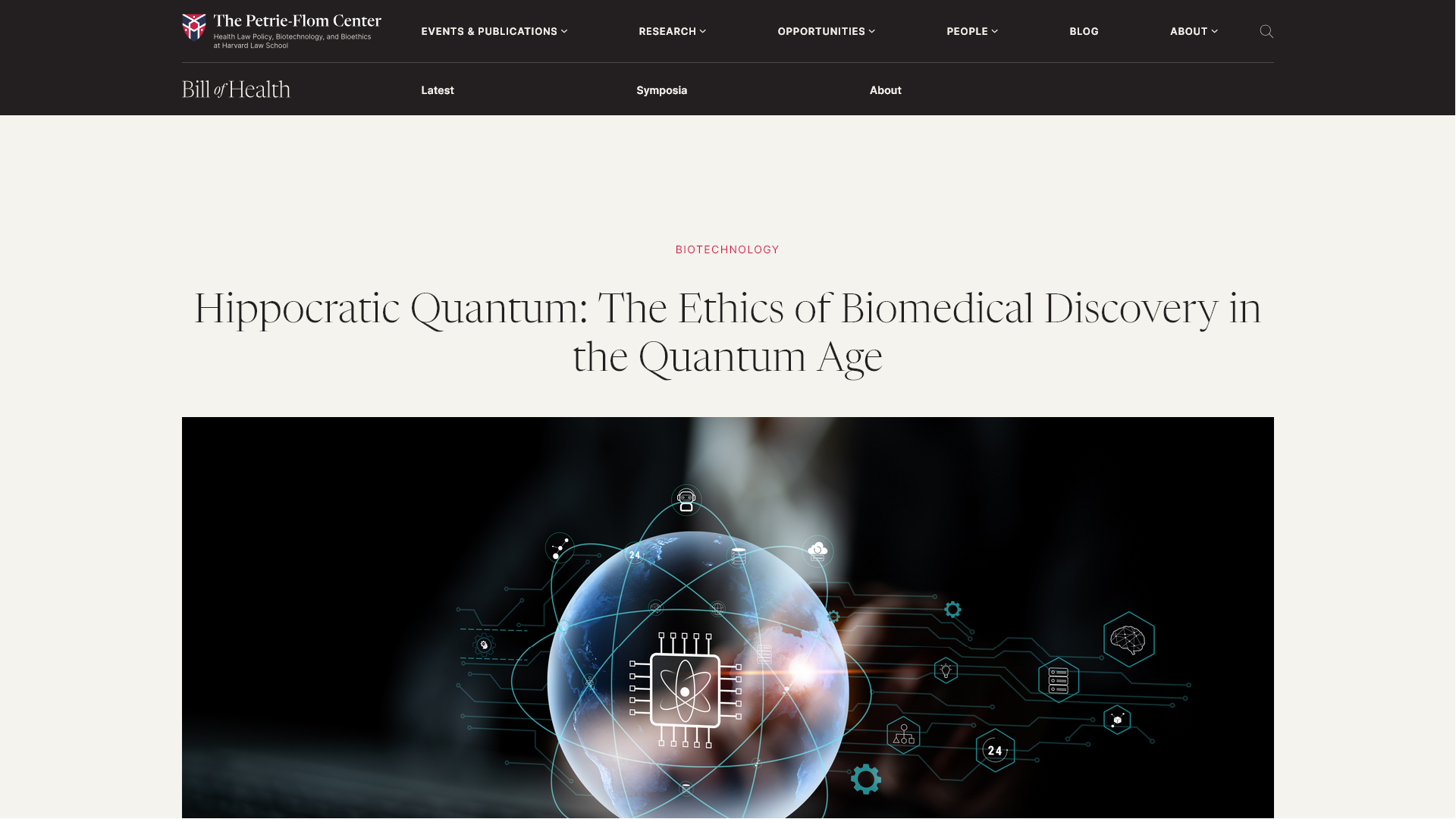
Harvard Law Publishes Hippocratic Quantum: The Ethics of Biomedical Discovery in the Quantum Age

Cambridge, MA, February 25, 2026—Harvard Law’s Petrie-Flom Center has published Mauritz Kop’s new article, Hippocratic Quantum: The Ethics of Biomedical Discovery in the Quantum Age:https://petrieflom.law.harvard.edu/2026/02/25/hippocratic-quantum-the-ethics-of-biomedical-discovery-in-the-quantum-age/

The article advances a proposition that is becoming increasingly difficult for health lawyers, policymakers, and biomedical innovators to ignore: as quantum technologies begin to enter biomedical discovery, the decisive challenge is no longer only scientific capability, but rather governance. In Kop’s account, quantum-enabled medicine should not be understood as a distant or speculative frontier that can be regulated later, once the engineering settles. It should instead be approached as a present-tense quantum governance problem, one that already implicates patient confidentiality, data integrity, cyber resilience, export controls, supply chains, and the geostrategic value of biomedical knowledge.

The article’s answer is not a new morality, but a more demanding implementation of an existing one: quantum medicine requires a Hippocratic framework that is technical enough for engineers, legal enough for regulators, and concrete enough for hospitals and pharmaceutical firms, yet flexible enough to let innovation breathe and encourage the crucial public-private investment necessary to advance allied quantum capabilities.

Five examples of quantum-enabled biomedical innovations

To ground this institutional view, one must consider the specific technological capabilities currently transitioning from theoretical physics to applied biomedicine. Five feasible vectors of innovation illustrate the breadth of this shift. In the domain of quantum computing, hybrid classical-quantum algorithms are emerging to optimize complex drug discovery pipelines and process large-scale genomic datasets. In quantum sensing, technologies such as diamond nitrogen-vacancy magnetometry enable ultra-sensitive, room-temperature mapping of neurological and cardiac activity. For quantum simulation, researchers are utilizing qubit-based systems to model molecular interactions and drug-target binding affinities with high accuracy, aiming to reduce reliance on extensive physical wet-lab screening. Within quantum imaging, techniques leveraging entangled photons permit the high-resolution visualization of cellular structures at lower light intensities, thereby mitigating phototoxicity in living tissues, benefitting medical diagnosis. Finally, in quantum networking, the deployment of quantum key distribution protocols offers a mechanism to cryptographically secure the transmission of sensitive multi-omics data across distributed hospital and research architectures.

From legal-ethical framework to Quantum-ELSPI

The Harvard article is best read as part of a longer intellectual trajectory. An early expression of that project appeared in March 2021 in the Yale Journal of Law & Technology, in Establishing a Legal-Ethical Framework for Quantum Technology: https://yjolt.org/blog/establishing-legal-ethical-framework-quantum-technology

That Yale piece argued that quantum technologies were moving from hypothetical ideas to commercial realities, and that law and policy should not wait for full technical maturity before building governance tools. It proposed a culturally sensitive legal-ethical framework for applied quantum technologies, drawing on AI governance and nanotechnology’s ELSI tradition while recognizing the distinct physical characteristics of quantum systems. Crucially, it also insisted that ethical aspiration must be accompanied by practical mechanisms for monitoring, validation, and life-cycle risk management. In retrospect, many of the themes that now reappear in Hippocratic Quantum were already visible there: the concern for human-centered design, the call for risk-based governance, and the insistence that ethics without institutionalization would be inadequate.

Why quantum medicine changes the governance question

The new Harvard article narrows the focus to biomedicine, but in doing so it sharpens the stakes. Biomedical discovery is not simply another application area. It is a setting in which long-lived and highly sensitive data, bodily integrity, public-health interests, commercial incentives, and geopolitical competition intersect. Quantum technologies matter here not because they promise speculative disruption, but because they may incrementally and then materially improve specific tasks: hybrid quantum-classical computational chemistry, de novo molecular design, lead optimization, selected toxicity and metabolism modeling, and perhaps aspects of high-fidelity sensing, simulation, and networked quantum computation. The issue, then, is not whether every promise will be realized immediately. It is whether institutions are preparing now for the forms of capability that are already foreseeable.

A Harvard-facing research arc

This Harvard publication also extends a longer Harvard-facing research arc across AI, health law, and responsible quantum governance. That arc includes:

  1. The Right To Process Data For Machine Learning Purposes In The EU (Harvard JOLT) https://jolt.law.harvard.edu/digest/the-right-to-process-data-for-machine-learning-purposes-in-the-eu

  2. Towards Responsible Quantum Technology (Harvard Berkman Klein) https://cyber.harvard.edu/publication/2023/towards-responsible-quantum-technology

  3. EU And US Regulatory Challenges Facing AI Health Care Innovator Firms (Harvard Petrie-Flom) https://petrieflom.law.harvard.edu/2024/04/04/eu-and-us-regulatory-challenges-facing-ai-health-care-innovator-firms/

  4. A Brief Quantum Medicine Policy Guide (Harvard Petrie-Flom) https://petrieflom.law.harvard.edu/2024/12/06/a-brief-quantum-medicine-policy-guide/

  5. How Quantum Technologies May Be Integrated Into Healthcare: What Regulators Should Consider (Stanford Law) https://hls.harvard.edu/bibliography/how-quantum-technologies-may-be-integrated-into-healthcare-what-regulators-should-consider/

Seen in this broader context, Hippocratic Quantum brings together early legal-ethical framing, responsible quantum governance, healthcare regulation, and geopolitical analysis into a single biomedical governance argument.

The article has also been featured by The Quantum Insider, which highlighted its central argument that quantum medicine’s promise must be matched by stronger privacy and governance safeguards: https://thequantuminsider.com/2026/02/27/analysis-quantum-medicines-promise-raises-new-privacy-and-governance-risks/

Meer lezen


Mauritz Kop Principal Investigator of MINDS Quantum Strategy Grant at CIGI

Waterloo, February 18, 2026—The Centre for International Governance Innovation (CIGI) has awarded Mauritz Kop a new leadership role as Principal Investigator (incoming) of a MINDS Targeted Engagement Grant on Quantum Strategy. The grant advances a central proposition of his recent work: quantum technologies are no longer best understood as a narrow scientific frontier or a conventional innovation file. They have become a strategic domain in which law, industrial policy, intellectual property, defense planning, and geopolitical competition now converge.

That convergence matters because quantum capability is being built in an era of systemic rivalry, supply-chain vulnerability, and technological coercion. In that environment, democratic states cannot afford to treat quantum merely as a research ecosystem problem. They must govern it as part of a broader strategy for safeguarding the democratic industrial commons: the shared base of talent, infrastructure, know-how, trusted supply chains, standards, and institutions on which long-run security, prosperity, and coalition advantage depend.

What MINDS in Defence and Security Is and Why This Grant Fits

The MINDS program—Mobilizing Insights in Defence and Security—is a Canadian Department of National Defence initiative designed to strengthen evidence-based defense policy thinking and foster the next generation of defense and security experts. Its Targeted Engagement Grants provide non-recurring support for projects such as workshops, roundtables, research, and publications, and they are assessed primarily against the annual Defence Policy Challenges.

The current 2025-2026 MINDS challenge set is especially well aligned with the subject matter of this grant. The official challenge framework emphasizes several critical priorities: securing Canada’s sovereignty and continental defense posture; attracting advanced-technology talent across the defense sector; and strengthening the defense industrial base through resilient supply chains and dual-use technologies such as quantum and artificial intelligence. Furthermore, the framework addresses the pressures of strategic competition—including adversarial exploitation of vulnerabilities—and the accelerating adoption of pan-domain, emerging technologies where interoperability, trust, and responsible governance must be preserved.

Strategic Leadership and Human Capital

Kop’s fellowship at CIGI has centered on the governance of transformative technologies, especially quantum technology, AI, dual-use export controls, national security, and intellectual property. The new grant builds directly on that portfolio, but with a more operational mandate. As incoming Principal Investigator, his role will be to provide the project’s strategic and intellectual leadership: conceptualizing the workshop, defining the central themes and policy questions, structuring the panels for direct relevance to Canadian defense audiences, chairing the main event, moderating key expert sessions, identifying high-level contributors, and guiding the project’s analytical outputs.

The Quantum Nexus Paper Behind the Grant

The grant builds on Kop’s recent paper, The Nexus of Quantum Technology, Intellectual Property, and National Security: An LSI Test for Securing the Quantum Industrial Commons, now available on arXiv.

In that paper, he argues that quantum technologies have moved from laboratory structures to the geopolitical stage, and that democratic states therefore need a governance model that is neither naively open nor reflexively protectionist. The paper's contribution is an implementable coalition playbook, offering empirically anchored criteria, templates, and differentiated guardrails - including red zone domains where denial is the default - to avoid both over-securitization and under-securitization. Properly applied, LSI reduces the risk of a self-defeating hard decoupling from China while establishing standards-first interoperability as a stabilizing eigenstate of the international order and enabling RQT by design to shape trusted adoption pathways beyond the coalition, including in the majority world.

Meer lezen
An LSI Test for Securing the Quantum Industrial Commons

Mauritz Kop—Founder of the Stanford Center for Responsible Quantum Technology and a CIGI Senior Fellow—has posted as a preprint a book-length Article that reframes quantum strategy as a problem of disciplined openness. The Nexus of Quantum Technology, Intellectual Property, and National Security argues that democracies should pursue neither closure nor laissez-faire, but "security-sufficient openness," screened through a single administrable test. It is a strategic companion to the cryptographic argument set out in "A Bletchley Park for the Quantum Age."

Deterrence by denial for democratic resilience

The Article's organizing idea is responsible quantum technology reframed as values-based deterrence by denial: a legal, ethical, and institutional control plane that protects the shared "quantum industrial commons"—talent, tooling, standards, supply chains, and the research base—against authoritarian appropriation. Deterrence by denial aims to make hostile gains too slow or costly to be worthwhile, rather than relying on the threat of retaliation, and the Article presents it as the least escalatory way to preserve crisis stability. It situates the analysis against an approaching strategic "event horizon," citing the U.S.-China Economic and Security Review Commission's call for a "Quantum First by 2030" posture and parallel White House initiatives to secure critical inputs.

The LSI test

The central contribution is the LSI test, which asks whether any given control is least-trade-restrictive, security-sufficient, and innovation-preserving. The test is built to avoid two failure modes: over-securitization, which chills publication, standards leadership, and venture formation, and under-securitization, which leaks crown-jewel capabilities that are slow to reacquire. LSI is applied across a "pillarized" quantum stack—computing, sensing, simulation, networking, communication, quantum-AI hybrids, and enabling materials—and to its upstream dependencies in patent and trade-secret doctrine, government-funded IP and data rights, export controls, investment screening, and cryptographic baselines including post-quantum cryptography and crypto-agility. The framing borrows from physics with care: because the relevant systems are genuinely probabilistic, the Article uses the "Eight Worlds" scenario method to keep governance robust across divergent futures.

A coalition playbook against a "Silicon Curtain"

Rather than stop at theory, the Article assembles an implementable coalition playbook—administrable criteria, templates, and differentiated guardrails, including red-zone domains where denial is the default—and integrates instruments of economic statecraft such as a strategic critical-minerals reserve and a Quantum Criticality Index. Its closing warning is that mishandled securitization could raise a self-defeating "Silicon Curtain" between allied innovators; the constructive alternative is standards-first interoperability treated as a stabilizing feature of the international order. The work has been posted as a preprint on arXiv and is announced on AIRecht in the Nexus paper announcement.

Meer lezen
The Nexus of Quantum Technology, Intellectual Property, and National Security

Some moments in technology policy demand a text that turns scattered anxieties into administrable law. For the collision of quantum technology, intellectual property, and national security, Mauritz Kop's book-length Article on arXiv makes that move: The Nexus of Quantum Technology, Intellectual Property, and National Security: An LSI Test for Securing the Quantum Industrial Commons—a work that reads today's probabilistic security environment like a wavefunction of plausible futures, and asks which policy choices will collapse it into an outcome democracies can live with.

The claim: security-sufficient openness

The Article's central claim is that the United States and its allies should pursue security-sufficient openness, operationalized through an LSI test: every intervention—an export control, an outbound-investment screen, a patent-secrecy order—must be the least trade-restrictive, security-sufficient, innovation-preserving measure available, whether the actor is a state or a private firm. Between total openness, which hands strategic capabilities to rivals mobilized under military-civil fusion, and total restriction, which strangles the science, the test stakes out the only ground that is defensible in both senses of the word.

Red zones, enclaves, and economic statecraft

What makes the work more than a framework essay is its machinery. The Article delivers an implementable coalition playbook: empirically anchored criteria, templates, and differentiated guardrails—including red-zone domains where denial is the default—plus secure closed-loop enclaves where allied researchers can pursue high-sensitivity R&D without choosing between secrecy and collaboration. The instruments of economic statecraft that democracies have increasingly been deploying are integrated here into a single disciplined doctrine, with the U.S. assessments calling for a Quantum First posture by 2030 supplying the deadline.

What is at stake

The Article names the twin failure modes precisely. Over-securitize, and democracies erect a self-defeating Silicon Curtain—suppressing publication, standards participation, and startup formation until the alliance walls itself off from its own innovation. Under-securitize, and strategically meaningful capabilities in computing, sensing, and cryptanalysis diffuse to adversaries faster than open societies can respond. Threading that needle is the geostrategic design problem of the decade—the same problem Kop works on as an expert at the Eric Schmidt-backed von Neumann Commission on quantum-AI geostrategy. Properly applied, the LSI test secures the quantum industrial commons without suffocating the scientific commons beneath it—and extends trusted adoption pathways to the majority world. This post walks through the Article's argument, its playbook, and what both mean for the lawyers and legislators who will write the quantum statutes of the late 2020s.

Meer lezen
CIGI Publishes Global Quantum Policy Brief by Mauritz Kop and Tracey Forrest

Waterloo, 5 February 2026—The Centre for International Governance Innovation (CIGI) has published a new policy brief, Global Quantum Governance: From Principles to Practice, authored by Mauritz Kop and Tracey Forrest. The brief is written for policy makers, regulators, standards bodies, and industry actors facing a practical transition: quantum technologies are moving from laboratory milestones toward deployment pathways where governance choices—especially around cybersecurity and cross-border infrastructure—become difficult to reverse.

Download the Policy Brief here: https://www.cigionline.org/documents/3746/PB_No.222_Kop_and_Forrest.pdf

Why this brief on quantum governance, and why now

The brief’s central timing claim is that near-term milestones—particularly post-quantum cryptography (PQC) migration and quantum networking—create a governance tipping point. After that point, certain security and societal harms may be costly (or impossible) to remediate. In the brief’s framing, PQC migration is not merely an engineering update; it is a “temporal rights and resilience” imperative because present-day decisions about crypto-agility, key life-cycle management, and data minimization determine whether sensitive data remains protected against future adversaries.

This urgency is paired with a structural diagnosis: national initiatives—including the EU’s proposed Quantum Act—are important, but insufficient on their own given quantum’s dual-use characteristics, global supply chains, and asymmetric capabilities across states and firms. The authors argue for a governance architecture that is “standards-first” and internationally coordinated, capable of sustaining what they call “security-sufficient openness,” and overseen by an International Quantum Agency.

The brief’s recommendations in practical terms

The brief concludes with a multi-pronged path “from principles to practice,” emphasizing four implementable priorities:

  1. Strengthen foundations through standards and PQC execution: align cryptographic profiles across sectors; update procurement so crypto-agility, key life-cycle management, and “harvest now, decrypt later” mitigation become baseline requirements; and adopt “cryptographic resilience” via agile standards, testing, and incident playbooks.

  2. Harmonize among allies: coordinate export controls, investment screening, and supply-chain security via mechanisms such as a proposed G7 Quantum Technology Point of Contact Group and narrowly scoped license-exception approaches in Five Eyes/AUKUS-style arrangements, while avoiding poorly designed measures that impose high compliance costs and chill benign collaboration.

  3. Incentivize global collaboration and capacity building: federate national quantum clouds, SDG-oriented demonstrators, and regional test networks under common governance rules; and consider, longer-term, a “CERN for Quantum” that provides shared access anchored in transparency and equitable access, including for Global South partners.

  4. Institutionalize foresight and bounded algorithmic regulation: resource international foresight capacities—within an IQA-type body or linked observatories—to update risk scenarios and stress-test legal frameworks, while experimenting with limited, well-governed AI-assisted monitoring and red-teaming to inform accountable human decision makers.

Takeaway for AIRecht’s readership

For legal and policy practitioners, the brief’s message is that quantum governance is entering a phase where operational artifacts—standards, benchmarks, procurement baselines, and interoperability profiles—will increasingly determine real-world rights, liabilities, and security outcomes. PQC migration and quantum networking are treated as the near-term proving ground for whether democracies can coordinate “security-sufficient openness” at scale.

For innovators and investors, the brief underscores that governance is not a brake on quantum progress but a design constraint that—if addressed early—can preserve global interoperability, reduce fragmentation, and support responsible diffusion of quantum capability without deepening geopolitical divides.

Meer lezen
Responsible Peer Review at Scholarly Journals: Guiding Manuscripts to Their Best Form

Behind every published paper stands an unnamed reader who helped make it publishable. That reader is a peer reviewer—unpaid, anonymous, and usually invisible. Mauritz Kop, Founder of the Stanford Center for Responsible Quantum Technology, has done that work across a strikingly broad set of fields, and this essay treats peer review as a craft worth describing: how to do it well, and where he does it.

Steward, not gatekeeper

Everything follows from how a reviewer understands the role. Read as a turnstile, review collapses into fault-finding; read as care for the scholarly record, it turns into the question of what a paper needs to reach its strongest form. Saying no remains part of the job when nothing can rescue a manuscript—but repair, not rejection, is the starting assumption. The method that supports this is unglamorous: read once generously to grasp intent, again critically to test claim against method and evidence, and a third time as the non-specialist who has to follow it. What the author then receives should be a guide, not a grade—precise, proportionate, and respectful of the labor behind the work.

What interdisciplinary review demands

The journals map the range of the practice—npj Digital Medicine, Ethics and Information Technology, Minds and Machines (Springer Nature), NanoEthics (Springer Nature), Intellectual Property Quarterly (Thomson Reuters), the Journal of Intellectual Property Law & Practice (Oxford University Press), and Quantum Science and Technology (IOP Publishing). Evidence means something different in each: a trial result, a philosophical argument, a reading of statute, and a physics experiment are not validated the same way, so the reviewer adapts to the discipline at hand. Physics makes the point sharp. A quantum protocol that assumes an unknown state can be copied violates the no-cloning theorem; a scheme that ignores decoherence, or forgets that measurement perturbs the very state it reads, has not survived contact with the physics—a rigor that also animates Kop's Quantum-ELSPI work on the legal and ethical implications of quantum technology.

Confidentiality and recognition

You will find no war stories here about particular submissions, and the silence is deliberate. Confidentiality is not an accessory to peer review but its precondition: only because reviewers say nothing can authors hand unfinished work to a stranger. Such discretion makes the labor hard to see, and harder to honor. The exception came in 2022, when IOP Publishing granted Kop its Trusted Reviewer Certification, a competency-based recognition of reviewers who demonstrate a high standard of review—a mark of rigor and usefulness rather than sheer output. Practiced this way, peer review is less a barrier than the quiet mechanism that keeps the scholarly record trustworthy.

Meer lezen
GARP Interviews Mauritz Kop on Quantum Governance Strategies for Risk Professionals

The Global Association of Risk Professionals (GARP) interviewed Mauritz Kop for David Weldon's article Full-Scale Quantum Computing May Be Years Away. Risk Mitigation Can't Wait.—bringing quantum governance to the desks of risk professionals worldwide.

Q-Day is the wrong question

Kop's message to the risk profession inverts the usual timeline anxiety. The immediate danger is not a cinematic moment when encryption falls; it is the quiet accumulation of harvested data—financial records, identity data, health and government archives—collected today for decryption tomorrow, compounded by weak vendor oversight and a lack of crypto-agility. Records that outlive their cryptography may already face that exposure, whatever the hardware roadmaps say.

Five must-haves for a quantum governance strategy

The strategy Kop laid out is deliberately operational: a PQC migration roadmap anchored in asset classification and harvest-now-decrypt-later exposure; board-level ownership; integration with existing cyber, model, and operational risk frameworks; vendor due diligence on quantum-safety claims; and independent testing and benchmarking instead of marketing trust. Layered across architecture, algorithms, and operations, it treats quantum as an extension of disciplines risk professionals already command—the same principles-to-practice arc as the global quantum policy brief he co-authored at CIGI.

From the trading floor to the boardroom

Quantum, Kop argues, is both threat and tool for finance: it endangers the confidentiality of everything archived, and it is being explored for better simulation, optimization, and risk discovery. His benchmark for the U.S.: core post-quantum migration substantially done before 2030 for long-lived data and critical systems. The institutions that will meet that deadline are the ones whose boards treat quantum readiness as governance, not as someone else's research project.

Meer lezen
AI Regulation in California: The Daiki SB-53 Recipe for the Transparency in Frontier Artificial Intelligence Act

California's Senate Bill 53—the Transparency in Frontier Artificial Intelligence Act—is the first U.S. law aimed squarely at frontier AI models through a compute threshold. Daiki, the AI and quantum governance company co-founded by Mauritz Kop, has published a practical recipe for complying with it, and for turning compliance into governance capital.

From voluntary principles to enforceable rules

SB-53 marks the moment U.S. artificial intelligence regulation acquired teeth: a compute threshold of 1026 floating-point operations, a "large frontier developer" category above USD 500 million in revenue, published Frontier AI Frameworks, transparency reports on deployment, critical-incident reporting on a fifteen-day (sometimes twenty-four-hour) clock, whistleblower protections, and Attorney General penalties of up to USD 1 million per violation. Most obligations apply from January 1, 2026—which makes readiness a present-tense question, not a planning horizon. Kop has engaged U.S. lawmakers on these trajectories, including consulting Senator Mark Warner on AI and quantum technology policy.

Six steps to SB-53 readiness

The Daiki recipe walks an organization from applicability analysis (model inventory, compute estimation, revenue exposure) through a standards-based governance baseline on ISO/IEC 42001 and the NIST AI RMF, the design of an operational Frontier AI Framework, repeatable transparency-report workflows, incident and whistleblower pipelines, and finally harmonization with the EU AI Act and other regimes—one governance system, not a stack of statute-shaped silos.

Why boards should care

The deeper argument is strategic: a frontier-AI law built on evidence-generating transparency rewards organizations that can prove their safety practices. Boards that treat SB-53 as an opportunity to institutionalize frontier-grade discipline—rather than as an isolated burden—convert a regulatory deadline into trust, resilience, and license to operate.

Meer lezen
Mauritz Kop Speaks at Oxford University on Quantum Threats

Oxford University, 10 November 2025—This afternoon, Professor Mauritz Kop joined distinguished colleagues at the University of Oxford for a high-level panel discussion titled “Quantum Supremacy: Technology, Strategy, and International Order.” Hosted by the Department of Politics and International Relations (DPIR) and the Oxford Emerging Threats & Technology Working Group (ETG), the event convened a diverse audience of scholars, policymakers, and industry leaders to dissect the rapidly evolving landscape of quantum technologies.

Moderated by Sarah Chen, the session moved beyond the hyperbolic headlines often associated with quantum computing to address the granular realities of strategy, governance, and international security. Alongside Kop, the panel featured Dr. Simson Garfinkel of BasisTech, Angus Lockhart of SECQAI, and Professor Michael Holynski of the UK Quantum Technology Research Hub. The resulting dialogue offered a dense, forward-looking examination of quantum threats and opportunities—ranging from the precision of quantum sensing and the urgency of post-quantum cryptography (PQC) to the geopolitical friction points of supply-chain resilience and the risk of sub-optimal governance lock-in.

The Mission of Oxford’s Emerging Threats & Technology Working Group

The context for this discussion was set by the unique mandate of the host organization. The Emerging Threats & Technology Working Group at Oxford University stands as one of the few academic platforms systematically examining how critical and emerging technologies (CETs) reshape the security environment. Meeting regularly to assess the national-security implications of technologies such as artificial intelligence, quantum computing, directed energy, and space systems, the Group brings together participants from academia, industry, and government in a hybrid format.

This institutional design is consequential. By convening interdisciplinary seminars and publishing detailed session reports, Oxford Emerging Threats builds a community capable of treating quantum technology not merely as a laboratory curiosity or a narrow industrial race, but as a systems problem. Within this forum, quantum is framed as a variable that touches deterrence, alliance cohesion, human rights, and the resilience of critical infrastructures. For Stanford RQT (Responsible Quantum Technology), represented by Kop, this mandate aligns closely with the necessity to develop governance, standards, and strategic frameworks that keep quantum innovation compatible with an open, rules-based international order.


Reframing the Narrative: From Quantum Supremacy to Allied Quantum Assurance

In his opening remarks, Kop challenged the utility of the term “quantum supremacy” when applied to state actors. While the term has technical validity in describing a computational threshold, legally and strategically it acts as a misleading metaphor. Kop argued that for democratic states, the more relevant concept is assurance: the ability of allies to deploy quantum-era capabilities in a way that is verifiable, interoperable, and resilient, while simultaneously preserving an open international order.

To operationalize this, Kop proposed the framework of Allied Quantum Assurance, a strategy built upon recognizing that the world is currently crossing a “quantum event horizon.” Much like an astrophysical event horizon represents a point of no return, the current governance tipping point implies that early decisions on standards, export controls, supply chains, and research security will lock allies into long-lasting path dependencies.

The immediate driver of this urgency is the “harvest-now, decrypt-later” (HNDL) risk—a metaphorical “Q-Day” scenario where data exfiltrated today is decrypted by a future, Shor-capable quantum computer. This reality reframes strategic stability: whereas classical nuclear deterrence rests on mutually assured destruction, quantum security centers on deterrence-by-denial, achieved through informational assurance and operational resilience.

Meer lezen
War on the Rocks Publishes "A Bletchley Park for the Quantum Age"

Washington DC, Nov. 6, 2025—War on the Rocks has published a major new commentary by Stanford RQT’s Mauritz Kop, titled “A Bletchley Park for the Quantum Age.” The article translates his broader research on quantum governance into a concrete, operational blueprint for post-quantum cryptography (PQC) migration across the United States and its allies.

Appearing in a venue read closely by practitioners in defence, intelligence, and foreign policy, the piece draws a deliberate conceptual line from the World War II codebreaking effort at Bletchley Park to today’s challenge of securing democratic communications. It argues that Bletchley Park was more than a geographic location; it was a method—an integrated system of science, engineering, operations, and alliance management. Kop contends that a similar methodology is required now to protect national security systems against cryptanalytically relevant quantum computers.

The Enigma Machine utilized a complex series of electromechanical rotors to produce a polyalphabetic substitution cipher, creating an encryption standard that was widely deemed unbreakable by contemporary adversaries. Defeating this system required the Allies to operationalize abstract mathematics into industrial capability, a feat that fundamentally altered the trajectory of the war.

The article situates PQC migration not as a narrow information technology upgrade, but as a core tenet of United States and allied quantum-AI grand strategy. It highlights how flagship programmes such as the United States Department of Defense’s Replicator initiative must be made “quantum-ready” to avoid becoming silently obsolete once large-scale quantum computers arrive.

Professor Kop extends his gratitude to War on the Rocks editor Lieutenant Colonel Walter ‘Rick’ Landgraf, PhD, whose precise editorial work helped sharpen the argument and tailor it to the publication’s strategic readership.

The Core Argument: A Bletchley Method for Post-Quantum Cryptography Migration

The essay begins from a straightforward technical premise. Once fault-tolerant quantum computers exist, Shor’s algorithm will efficiently factor large integers and compute discrete logarithms, thereby breaking the public-key cryptosystems—such as RSA and elliptic-curve cryptography—on which secure communication currently relies. In parallel, Grover’s algorithm will provide a quadratic speed-up in brute-force search, effectively halving the security margin of many symmetric-key schemes.

In this setting, the world’s cryptographic infrastructure cannot simply be patched at the margins. It requires a comprehensive, carefully managed transition to new, quantum-resistant algorithms.

Kop proposes that the United States and its allies apply a “Bletchley method” to this problem by tightly linking:

  1. Domestic execution of PQC migration, and

  2. An allied, standards-based certification compact that prevents fragmentation.

Defensively, this means post-quantum cryptography by default and certified interoperability across critical systems. Politically, it means that Washington earns the right to lead abroad by delivering verifiable results at home.

The framework is organised around two distinct but mutually reinforcing tracks:

  • Track One – “Ultra at Home”: rigorous domestic execution, and

  • Track Two – “Allied Codebook Abroad”: international architecture designed to avoid a “quantum splinternet.”

Meer lezen
Mauritz Kop Speaker at United Nations International Year of Quantum Science and Technology 2025

On 31 October 2025, Mauritz Kop, Founder of Stanford RQT (Responsible Quantum Technology), served as one of the main speakers at the North America regional workshop on the Ethical, Legal, and Social Aspects (ELSA) of Broadening Global Ownership of Quantum Technologies. The online workshop was part of the United Nations International Year of Quantum Science and Technology 2025 (IYQ 2025), a year-long initiative mandated by the United Nations General Assembly (UNGA) and led by the United Nations Educational, Scientific and Cultural Organization (UNESCO) to mark 100 years of quantum mechanics and to address the emerging “quantum divide” in access, skills, and infrastructure.

The North America edition was convened by Dr. Zeki C. Seskir and Professor Shohini Ghose as part of a six-region ELSA-of-quantum workshop series. Each regional workshop is feeding into a global IYQ event on the Ethical, Legal, and Social Aspects of Broadening Global Ownership of Quantum Technologies to be held in Istanbul in November 2025.

The program brought together four principal speakers—Mauritz Kop, Bruna Shinohara de Mendonça, Lindsay Rand, and Isabelle Lacroix—and designated commentators Rodrigo Araiza Bravo and Karl Thibault. The workshop closed with an open discussion in which participants reflected on regional needs, expected impact, and the kind of alignment that is necessary for a fair and secure quantum future.

The International Year of Quantum and the North America ELSA Workshop

The International Year of Quantum Science and Technology 2025 was proclaimed by the United Nations General Assembly in June 2024. The resolution calls on states and international organizations to use 2025 to raise public awareness of quantum science, promote education and capacity-building—especially in the Global South—and strengthen cooperation so that all countries can participate in and benefit from quantum technologies.

Within this broader mandate, the ELSA of Broadening Global Ownership of Quantum Technologies initiative focuses on quantum governance. The North America workshop was explicitly framed around three questions:

  1. Which ethical, legal, and social aspects of quantum technologies are most urgent for North America today?

  2. Which ELSA topics are most important globally?

  3. How should the future of ELSA and related policy implications be shaped in Europe, North America, and worldwide, and what forms of alignment are needed?

The three-hour program opened with an overview of the IYQ ELSA event series, followed by the four invited talks, a short break, and then a structured discussion and closing reflections.

From ELSA to ELSPI: A Metaparadigm for Quantum Governance

Kop’s keynote, “From ELSA to ELSPI: A Metaparadigm for Quantum Governance,” drew on his recent work on Quantum-ELSPI and Responsible Quantum Technology, including Quantum-ELSPI: A Novel Field of Research; Ten Principles for Responsible Quantum Innovation (co-authored with, among others, Raymond Laflamme); and his legislative blueprint Towards a European Quantum Act.

He began by defining Quantum-ELSPI (co-developed with Luciano Floridi then at Oxford, now at Yale) as the study of Ethical, Legal, Socio-economic, and Policy Implications of quantum technologies. Classical ELSA—Ethical, Legal, and Social Aspects—was designed for more conventional technologies and, in his view, is too narrow for quantum systems that combine:

  • Dual-use components that can be deployed for both civilian and military purposes;

  • Long security horizons, where sensitive data captured today may be decrypted decades later by cryptanalytically relevant quantum computers; and

  • Fragile supply chains, in which a handful of materials, cryogenic systems, or photonic components create systemic bottlenecks.

To address this, Kop articulated three foundational pillars of the Quantum-ELSPI metaparadigm, developed in a recent Science article with co-authors Mateo Aboy, Urs Gasser, Glenn Cohen, and others:

  1. Standards-First Governance
    Technical and assurance standards—such as post-quantum cryptography (PQC) profiles, quantum quality-management systems, and certification schemes—are treated as the primary vehicle for embedding values into systems. Law, policy, and institutional design are built around these standards rather than attempting to regulate hypothetical risks in the abstract.

  2. Execution-Oriented Ethics
    Ethics is framed as a delivery problem. Instead of high-level value statements, Kop emphasized auditable supply chains, post-quantum cryptography migration drills, and verifiable deployment metrics in sectors such as finance, health care, and government archives. Ethics, in this sense, is measured by what actually ships and how it behaves under stress.

  3. Planetary Welfare
    The third pillar reframes quantum technologies not only as instruments of national competitiveness or military advantage, but as ecological and health technologies. Quantum-ELSPI is thus aligned with the Sustainable Development Goals (SDGs), emphasizing applications in climate modeling, clean-energy materials discovery, quantum-enabled medical technologies, and resilient humanitarian communications.

Taken together, these pillars elevate Quantum-ELSPI from a narrow ethics add-on to a metaparadigm for governing the entire quantum stack—from materials and cryogenic infrastructure to cloud-based access, algorithms, and hybrid quantum–classical systems.

Meer lezen
Mauritz Kop Advises Stanford FSI Students on Quantum Policy and Cybersecurity Project

Mauritz Kop advised a Stanford student research team on their quantum policy and cybersecurity project—part of Technology, Innovation, and Great Power Competition, the policy-entrepreneurship course at the Gordian Knot Center for National Security Innovation, Freeman Spogli Institute (FSI).

Startup methods, statecraft problems

In Steve Blank's experiential course, student teams take real-world challenges from U.S. and partner-nation policymakers and work them like founders: rapid discovery, agile iteration, actionable insights for real decision-makers. One team—led by Hannah Nabavi, a graduate student in Aeronautics and Astronautics and Threshold Venture Fellow—chose the quantum frontier: quantum computing and post-quantum cybersecurity as a great-power-competition problem.

From Q-Day to the three pillars

Kop's advisory session gave the team its working map: the Q-Day threat and why harvest-now, decrypt-later collection makes it urgent today; post-quantum cryptography mitigation in finance; the three quantum pillars of computing, sensing, and networking; and the investment ecosystem—startups, ventures, and the discipline that separates substance from hype. It is the same teaching thread he brings to quantum computing and law students at Fordham.

The next quantum policy generation

When aerospace engineers choose post-quantum security as their policy challenge, the signal—in Kop's reading—is clear: quantum literacy is becoming core strategic literacy. The team set out to share its final paper at the end of the fall 2025 quarter—exactly the kind of student work the quantum governance field needs more of.

Meer lezen