Innovation, Quantum-AI Technology & Law

Blog over Kunstmatige Intelligentie, Quantum, Deep Learning, Blockchain en Big Data Law

Blog over juridische, sociale, ethische en policy aspecten van Kunstmatige Intelligentie, Quantum Computing, Sensing & Communication, Augmented Reality en Robotica, Big Data Wetgeving en Machine Learning Regelgeving. Kennisartikelen inzake de EU AI Act, de Data Governance Act, cloud computing, algoritmes, privacy, virtual reality, blockchain, robotlaw, smart contracts, informatierecht, ICT contracten, online platforms, apps en tools. Europese regels, auteursrecht, chipsrecht, databankrechten en juridische diensten AI recht.

Towards an Atomic Agency for Quantum-AI

Stanford, CA May 5, 2025 — Today, Mauritz Kop published interdisciplinary research proposing “A Principled Approach to Quantum Technologies”, and the establishment of an “Atomic Agency for Quantum-AI” on the website of the European Commission. The Atomic Agency essay analyzes emerging AI and quantum technology (including their increasing complementarity and interdependence embodied in quantum-AI hybrids) regulation, export controls, and technical standards in the U.S., EU, and China, comparing legislative efforts anno 2025 to strategically balance the benefits and risks of these transformative technologies through the lens of their distinct innovation systems. The Principled Approach paper posits that quantum technology's dual use character brings with it the need to balance maximizing benefits with mitigating risks. In this spirit, the paper argues that quantum technology development should best be guided by a framework for Responsible Quantum Technology, operationalized by a set of tailored principles to optimize risk-benefit curves. Download the paper here.

Towards an Atomic Agency for Quantum-AI

The article analyzes emerging regulation, export controls, and technical standards for both quantum and AI (including their increasing complementarity and interdependence embodied in quantum-AI hybrids) in the U.S., EU, and China and offers novel conceptual frameworks to steward these technologies towards shared global benefit.

Key Takeaways:

1. Converging Need for Responsible Governance: Despite distinct innovation philosophies (market-driven in the U.S., values-based in the EU, and state-driven in China), there's a growing international consensus on the necessity for principled and responsible technology governance for both AI and quantum technologies.

2. The 'Washington Effect' vs. 'Beijing Effect': The U.S.'s security-centric policies are creating a de facto "Washington effect," potentially setting global rules for quantum law but risking premature regulation. Conversely, China's push for state-aligned standardization (e.g., via the Digital Silk Road) signals a "Beijing effect," which could export autocratic norms and fragment global interoperability, a trend exacerbated by unilateral export controls.

3. Potential U.S., EU and China Visions on a Quantum Governance Act: Given the distinct innovation ecosystems and strategic priorities of the United States, the European Union, and China, it is instructive to envision how each might hypothetically structure a dedicated legislative framework for quantum technologies. The research outlines hypothetical "Quantum Governance Acts" for each, reflecting their respective governance philosophies and innovation models, while also considering pathways towards greater international alignment based on shared values:

a. United States: Removing Barriers for U.S. Quantum Technology Act (deregulation, industrial standards-centric approach, Safeguarding through Advancing quantum technology, prioritizing market dynamism, national & economic security, and defense).

b. European Union: EU Quantum Act (harmonized regulation rooted in fundamental rights and societal benefit based on New Legislative Framework while incorporating elements from European Chips Act, renewed focus on defense via “European DARPA”).

c. China: Comprehensive Quantum Law (Safeguarding state control while Advancing state goals, blending elements of authoritarian governance with surveillance capitalism, integration of civilian and military sectors, self-reliance, exporting state norms & values through technical standards).

4. Global Challenges & Opportunities for Alignment: Faced with planetary challenges like disease, inequality and climate change, aligning on Responsible Quantum Technology (RQT) norms and standards is a critical global opportunity. The article cautions against a simplistic zero-sum game or Cold-War redux narrative for quantum competition, arguing it hinders vital international cooperation.

5. Quantum-Relativistic Innovation Theory of Everything: Philosophical thought experiment to understand innovation dynamics by drawing analogies from quantum mechanics (uncertainty, superposition at micro-level) and general relativity (context, structure at macro-level), theories about the fundamental nature of reality.

6. Smart Regulation and RQT by Design: Effective governance must move beyond mere restrictions to actively incentivize responsible behaviors, promoting "Responsible Quantum Technology (RQT) by design" through flexible instruments like Quantum Impact Assessments (QIA), RQT by design metrics, adaptive, modular legislation, & regulatory sandboxes.

7. Harmonized "Quantum Acquis Planétaire": The article advocates for a global body of Quantum Law ("Quantum Acquis Planétaire"), complemented by sector-specific practices. Such a quantum acquis would be anchored in universal ethical values and translated into foundational standards and agile legal guardrails. This requires inter-continental policymaking and strategic "recoupling" between major players like the U.S. and China, based on incentives and shared values (“what connects us” – e.g. human dignity, security, well-being).

8. An "Atomic Agency for Quantum-AI": A central proposal is the establishment of an international agency modeled after the International Atomic Energy Agency (IAEA). This body would aim to enforce a global acquis, deter a quantum arms race, ensure non-proliferation of dual-use quantum-AI technologies via safeguards implementation (inspired by nuclear governance), and potentially oversee a global UN Quantum Treaty.

9. Need for International Collaboration & Research Platforms: Realizing ambitious goals like fault-tolerant quantum centric supercomputing, and scalable topological qudits unlocking higher-dimensional quantum systems leveraging multi-level logic, requires collective global expertise and collaborative research platforms akin to CERN or ITER, challenging protectionist measures that stifle necessary cooperation. Immediate global actions should focus on leveraging quantum for the UN Sustainable Development Goals (SDGs), mitigating a 'Quantum Divide,' promoting quantum literacy, and building a skilled quantum workforce.

The research underscores the urgent need for robust global quantum-AI governance structures and calls for a shift from purely competitive dynamics towards pragmatic cooperation and the codification of a harmonized global framework.

Meer lezen
Mauritz Kop Delivers Keynote on Global Quantum Governance Frameworks at the World Quantum Summit in Washington DC

At the World Quantum Summit in Washington, DC, held during DC Climate Week on May 2, 2025, Mauritz Kop, Founder of the Stanford Center for Responsible Quantum Technology, delivered a keynote on Global Quantum Governance Frameworks. The address landed in a symbolic year—the centennial of quantum mechanics and the International Year of Quantum Science and Technology—and made a single, sustained argument: that quantum's distinctive physics demands tailored governance, and that the world should cooperate to unlock quantum for societal progress rather than fracture into rival blocs.

A fragmented compliance web—and a standards-first answer

Kop's diagnosis is that developers of quantum and hybrid systems already face a fragmented web of regional and global requirements, from export controls to sector-specific rules supported by standards, certifications, and quality-management systems. His remedy is unified quantum interoperability standards to avert a "quantum splinternet," paired with the Responsible Quantum Technology (RQT) framework and its benchmarks. This standards-first posture—building technical consensus before locking in less adaptable legislation—runs through his scholarship on responsible quantum innovation, including the Ten Principles for Responsible Quantum Innovation published in IOP Quantum Science and Technology.

Benefits, risks, and Quantum-ELSPI

The keynote mapped quantum's promise and peril by domain. On the benefit side, Kop aligned responsible quantum innovation with the UN Sustainable Development Goals—drug discovery, weather forecasting, battery chemistry, carbon capture. On the risk side, he flagged "Q-day," when current RSA and AES encryption fails, alongside dual-use ambiguity in quantum simulation and sensing. These interrelated ethical, legal, socio-economic, and policy implications form what he calls Quantum-ELSPI, the lens through which he argues quantum should be governed in line with civil liberties, human rights, and the rule of law.

An Atomic Agency for the quantum age

The address built toward an institutional proposal: a globally harmonized "Quantum Acquis Planétaire," a UN Quantum Treaty modeled on the 2024 UN AI Resolution and the 1968 Nuclear Non-Proliferation Treaty, and an "Atomic Agency for Quantum/AI" inspired by the IAEA's safeguards model, complemented by CERN-style international resource pooling. The keynote is distinct from Kop's role as a speaker for the International Year of Quantum Science and Technology 2025: that recognition concerns the year's designation, whereas this address sets out the specific governance architecture he believes the quantum age now requires. His central claim is that the architecture must be designed today—before second-generation, agentic quantum and AI systems outpace the law—and that it should be standards-first, rights-respecting, and global by construction, so that quantum technology serves a collective future of widespread, equitably distributed prosperity.

Meer lezen
Mauritz Kop Expert at Eric Schmidt backed von Neumann Commission

Stanford, CA – Mauritz Kop, the Frm. Founding Executive Director of the Stanford Center for Responsible Quantum Technology (RQT), has accepted an invitation to serve as an expert on The von Neumann Commission. The announcement, made on February 1, 2025, positions Kop to contribute to a critical global dialogue at the intersection of quantum computing, artificial intelligence, and grand strategy. The Oxford-based, independent research commission is backed by the Eric and Wendy Schmidt Fund for Strategic Innovation and other key institutions. The von Neumann Commission’s inquiry will be multifaceted, addressing the core technical prospects for quantum acceleration, its strategic implications for the global balance of power, the risks to strategic stability, and the necessary governance frameworks to ensure responsible development. The Commission's investigation is set against the backdrop of a new technological paradigm—the convergence of quantum and AI—and is informed by the historical legacy of its namesake, the strategic vision of its sponsors, and the vital perspectives of its experts.

The Quantum-AI Convergence: A New Technological Paradigm

At the heart of The von Neumann Commission's inquiry is the powerful synergy between quantum computing and artificial intelligence. This convergence is not merely additive; it is a cross-pollination that promises to redefine the boundaries of both fields. To understand this, one must first grasp the fundamental difference between classical and quantum computation.

Classical computers, from supercomputers to smartphones, process information using bits, which can exist in one of two definite states: 0 or 1. Quantum computing, by contrast, operates on the principles of quantum mechanics. It uses qubits, which can exist in a state of superposition—representing both 0 and 1 simultaneously. This property, combined with entanglement, where the state of one qubit is instantly correlated with another regardless of distance, allows quantum computers to explore a vast computational space and perform parallel calculations on an exponential scale.

Professor Kop’s Expertise as a von Neumann Commissioner

As a Commission expert, Professor Kop will contribute a multidisciplinary perspective grounded in his extensive research on the law, ethics, societal impact, and policy of quantum and AI. Professor Kop has advised numerous governments and international organizations on their quantum technology strategies, including the United States (notably the Department of State on its quantum foreign policy, U.S. Senators on quantum governance, and as a Guest Professor at the US Air Force Academy), Canada, the United Kingdom, and The Netherlands, as well as multilateral institutions such as the World Economic Forum (WEF), UNESCO, CERN, and the OECD. He has also provided expert guidance to the European Union on landmark AI legislation, including the EU AI Act and the Data Act. His specific contributions to The von Neumann Commission will draw from his expertise in:

● Geostrategy, Democracy, and Authoritarianism: Analyzing the strategic struggle between democratic and authoritarian models of technology governance. This includes his work in Foreign Policy and the Stanford-Vienna Transatlantic Technology Forum on forming a strategic tech alliance among democratic nations and his lectures at institutions like the Hoover Institution on the impact of quantum technologies on the global balance of power.

● Comparative Regulatory and Innovation Models: Analyzing the legal and policy differences between the US, EU, and China. His scholarship, including his "Ten principles for responsible quantum technology" in IOP Quantum Science and Technology, his “Establishing a Legal-Ethical Framework for Quantum Technology” at Yale University, and foundational articles at Harvard Berkman Klein and Nature, dissects these competing models and provides a crucial framework for navigating global strategic competition.

● China’s Quantum and AI Strategy: Providing in-depth analysis of China's legal, ethical, and policy landscape for quantum technologies. This includes evaluating the country's national strategy, its approach to dual use civil-military fusion, its influence on U.S. and E.U. national and economic security through China’s Digital Silk Road Initiative, and its comparative strengths and weaknesses in the global technology race, as analyzed in his “Towards an Atomic Agency for Quantum-AI” scholarship at the European Commission’s Futurium.

● National and Economic Security: Examining the role of export controls, rare earth and critical mineral supply chain vulnerability as published at the Stanford Program on Geopolitics, Technology, and Governance at CISAC / FSI, intellectual property law as published at Berkeley and the Max Planck Institute, and cybersecurity in managing the geostrategic dimensions of quantum technology. His work in these areas, including his contributions to forums like Tel Aviv University's Cyber Week, provides critical insights into protecting strategic assets.

● Standards and Governance: Contributing to the development of robust standards, certification protocols, and performance benchmarks to ensure the safety, reliability, and ethical implementation of these powerful technologies, drawing from lessons from nuclear governance, and from his conferences and seminars at Stanford, Fordham Law, Arizona State, Copenhagen, the Center for Quantum Networks (CQN) and the Centre for International Governance Innovation (CIGI) in Waterloo.

By integrating these insights, Kop will aid the Commission in formulating a holistic understanding of the challenges pertaining to systemic rivalry and great power competition ahead.

Meer lezen
Stanford Scholar Mauritz Kop Teaches Quantum Computing & Law at Fordham Law School

New York, NY, January 21, 2025 – Stanford University scholar Mauritz Kop, a leading voice in the intricate nexus of quantum technology, AI, and law, today addressed the legal community at the Fordham Law School Library. His presentation, titled "Here Comes Quantum Computing — What the Legal Community Needs to Know," was a featured event in the Maloney Library's esteemed "Tech Lunch 'n' Learn" series, a program designed to keep legal professionals at the forefront of technological innovation.

Stanford Scholar Mauritz Kop the Quantum Future for the Legal Community at Fordham Law

Kop, the Founding Director of the Stanford Center for Responsible Quantum Technology, offered a comprehensive overview of the transformative potential and inherent risks of quantum technologies at Fordham Law. He emphasized that the leitmotif of our time is that "Quantum’s benefits outweigh its risks, if implemented responsibly".

Responsible Quantum Technology (RQT) is a framework designed to ensure that the innovation and implementation of quantum technologies align with societal demands and enhance global welfare. It provides a principled approach to guide quantum technology development.

Responsible Quantum Technology

The core components and objectives of RQT entail:

Compliance and Safety: Developers, vendors, and users of quantum systems must adhere to a range of emerging regional and global requirements. This includes technology-specific rules and industry-specific regulations in sectors like finance and healthcare, supported by standards and certifications to guarantee safe deployment.

Addressing Implications (Quantum-ELSPI): RQT involves engaging with quantum technologies in a way that is consistent with Quantum-ELSPI—the ethical, legal, socio-economic, and policy implications of the technology. This requires a tailored approach that considers the unique and counter-intuitive principles of quantum mechanics, such as superposition and entanglement.

Alignment with RRI: The RQT framework responds to the key dimensions of Responsible Research and Innovation (RRI): anticipation, reflexivity, inclusion, and responsiveness.

Ethical Foundation: RQT must align with quantum ethics, which involves identifying the dilemmas inherent in making these technologies ethical through interdisciplinary, context-specific methods.

Legal Frameworks: The framework requires adherence to legal norms like the rule of law and proportionality. It advocates for future legislation that mitigates risks and maximizes benefits, providing legal certainty to incentivize Responsible Quantum Innovation (RQI).

Socio-Economic Considerations: RQT dictates that quantum technology should prioritize society's most pressing goals, such as cybersecurity, economic stability, and managing climate change. It also mandates that the benefits and burdens of the technology should be equitably distributed.

Policy Guidance: RQT serves as a tool for policymakers, helping them learn from the governance of other disruptive technologies like AI, nuclear energy, and the internet. An important policy goal is to foster values-based quantum ecosystems globally.

Operational Principles: The RQT paradigm is put into practice through "10 Principles for Responsible Quantum Innovation". These principles are structured to safeguard, engage, and advance (SEA) quantum technologies, society, and humankind, with the ultimate goal of protecting society by responsibly advancing the technology.

Practical Tools: The framework can be used by policymakers to design regulations and can be complemented by self-regulatory tools like technology impact assessments to monitor, validate, and audit quantum applications throughout their lifecycle using appropriate RQT benchmarks and metrics.

Hardwiring Values: A core tenet of RQT is embedding shared values and standards into the design, deployment, and infrastructure of quantum systems. This includes current work on how to embed values and standards into the architecture and infrastructure of quantum AI systems, products, and services. The goal is to guide these technologies toward collective social and environmental benefit.

Quantum Computing — What the Legal Community Needs to Know

The ‘Quantum Computing — What the Legal Community Needs to Know’ lecture provided an in-depth exploration of second-generation (2G) quantum technologies, which harness the unique principles of quantum physics, such as superposition and entanglement, to solve problems beyond the grasp of classical computers. Kop highlighted recent breakthroughs, including Google's "Willow" quantum computing chip, which completed a complex calculation in under five minutes—a task that would take the fastest supercomputers an estimated 10 septillion years. This, he explained, demonstrates the potential for quantum computers to revolutionize sectors like healthcare, finance, energy, and defense.

Navigating the Ethical and Legal Maze

A significant portion of the talk was dedicated to the ethical, legal, socio-economic, and policy implications (Quantum ELSPI) of this emerging field. Kop stressed the dual-use nature of quantum technology, which, much like nuclear energy, can be applied to both civilian and military purposes. This duality necessitates a robust governance framework to prevent misuse by adversaries and to avoid a new arms race.

Kop advocated for a "Responsible Quantum Technology (RQT)" framework to ensure that innovation aligns with societal values and legal standards. This approach calls for a recalibration of legal frameworks to mitigate risks while fostering responsible innovation. He pointed to the "Collingridge dilemma," cautioning that regulating quantum too early could stifle innovation, while regulating too late could result in irreversible negative consequences.

A Call for Global Cooperation and Responsible Innovation

The lecture underscored the necessity of global cooperation in developing unified quantum interoperability standards to avoid a "quantum splinternet" fragmented along geopolitical lines. Kop argued for a research and development agenda that is "as open as possible, and as closed as necessary" to address national security concerns while fostering international partnerships.

To operationalize the RQT paradigm, Kop and his research group have proposed "10 Principles for Responsible Quantum Innovation," organized to safeguard, engage, and advance (SEA) quantum technologies for the benefit of humanity.

Fordham's Commitment to Legal Tech Education

The "Tech Lunch 'n' Learn" series at Fordham's Maloney Library provides a crucial platform for such discussions, inviting experts to shed light on the evolving landscape of law and technology. These sessions empower students and practitioners to grapple with complex subjects like AI, data privacy, and now, quantum computing.

Kop's lecture at Fordham served as a vital call to action for the legal community to proactively engage with the development of quantum technologies. As he concluded, "As society shapes technology, technology shapes society". The legal profession has a critical role to play in ensuring that the quantum era unfolds in a manner that is secure, equitable, and beneficial for all.

Meer lezen
Mauritz Kop Consults UNESCO and OECD on Ethics and Quantum Technology Policy

Paris, January 9, 2025— As quantum technologies advance at a rapid pace, global institutions are turning to leading experts to help shape the ethical and policy frameworks that will govern this transformative era. Mauritz Kop, a prominent scholar in the field of quantum law and governance Founding Director of the Stanford Center for Responsible Quantum Technology, has been actively consulting with two of the world's foremost international bodies: the United Nations Educational, Scientific and Cultural Organization (UNESCO) and the Organisation for Economic Co-operation and Development (OECD). His contributions are helping to build a global consensus on the responsible development and deployment of quantum technologies.

Expert Opinions for UNESCO and its World Commission on the Ethics of Scientific Knowledge and Technology (COMEST)

UNESCO, through its World Commission on the Ethics of Scientific Knowledge and Technology (COMEST), is at the forefront of establishing global ethical norms for emerging technologies. COMEST is an advisory body composed of leading international scholars tasked with formulating ethical principles to guide decision-makers beyond purely economic considerations.

Recognizing his expertise, COMEST invited Mauritz Kop to an exclusive Expert Hearing on May 13, 2024. This session was convened to gather insights for the Commission's forthcoming landmark report on the "Ethics of the Research, Development and Deployment of Quantum Computing Technologies." Together with three other experts who each presented different perspectives, Kop was asked to present his research on Responsible Quantum Technology, quantum-ELSPI (Ethical, Legal, Societal, and Policy Implications), and bespoke governance frameworks for Quantum Information Science (QIS). His scholarship - often co-authored with RQT Fellows such as Mateo Aboy, Eline de Jong, Mark Brongersma, and Raymond Laflamme, provides the Commission with state-of-the-art analysis of the ethical and governance challenges, helping to enrich the foundation of their upcoming report.

Stanford Law’s Mauritz Kop Provides Recommendations on UNESCO Preliminary Draft: 'Ethics of Quantum Computing'

Following the request to participate in the expert hearing, Stanford Law’s Mauritz Kop was formally invited to provide written recommendations on the "Preliminary Draft Report on the Ethics of Quantum Computing" on January 9, 2025. This invitation underscores the value of his contributions to the Commission's work. While the draft itself remains confidential, its direction can be understood through its public predecessor, the "Concept note of the World Commission on the Ethics of Scientific Knowledge and Technology (COMEST) on the ethics of quantum computing," published on July 24, 2024.

The concept note lays out a comprehensive vision for the ethical governance of quantum computing. It correctly asserts that while quantum technology is still in its early stages, the time to establish ethical guardrails is now, learning from the reactive approach taken with other technologies like social media. The note emphasizes that quantum technology is not neutral; its development and use have profound social and political impacts.

Mauritz Kop Invited by OECD to Speak on Global Policy and National Strategies for Responsible Quantum Technology Development

In addition to his work with UNESCO, Mauritz Kop was invited by the OECD to contribute his expertise to its Global Forum on Technology (GFTech) event, "Future in flux? Global policy issues and national strategies for responsible quantum technology development," held in November 2023. The event was originally scheduled to take place in Tel Aviv, Israel, but was moved to a virtual format due to regional unrest.

Looking Ahead: The International Year of Quantum Science and Technology 2025

The work of UNESCO and the OECD is particularly timely, as the United Nations has officially declared 2025 the International Year of Quantum Science and Technology (IYQ 2025). This global initiative, led by UNESCO, marks the 100th anniversary of the development of modern quantum mechanics and aims to raise global awareness of the importance of quantum science and its applications.

Meer lezen
Mauritz Kop Consults U.S. Department of State on Quantum Technology and Foreign Policy Strategy

Washington D.C. – On December 12, 2024, Mauritz Kop, Founding Director of the Stanford Center for Responsible Quantum Technology (RQT) and the Stanford Quantum Incubator, was invited to consult with the U.S. Department of State on the pressing challenges and strategic opportunities presented by the quantum era. The analytic outreach event, hosted by the Bureau of Intelligence and Research’s Office of Analytic Outreach (INR/AO), provided a critical forum to discuss the integration of quantum technology considerations into U.S. foreign policy and national security strategy.

This engagement highlights the growing recognition within the U.S. government that understanding quantum technology is no longer the exclusive domain of physicists and engineers, but a crucial imperative for diplomats, intelligence analysts, and foreign policy architects.

Informing Diplomacy with Strategic Insight

The U.S. Department of State is the nation’s lead foreign affairs agency, responsible for advancing the interests and security of the American people. Within the Department, the Bureau of Intelligence and Research (INR) holds a unique mandate to provide independent, all-source intelligence and analysis to the Secretary of State and other senior policymakers. INR’s primary mission is to deliver timely, objective, and insightful assessments that inform decision-making on the full spectrum of diplomatic and foreign policy challenges. It is within this context of providing deep, substantive expertise that the Office of Analytic Outreach convenes leading external experts like Mauritz Kop to engage directly with government analysts and officials.

A Bird's-Eye View of Quantum's Strategic Landscape

While the specific details of the consultation remain confidential, the discussion drew upon Mr. Kop’s extensive research on quantum governance, which offers a strategic framework for policymakers. His analysis emphasizes several key themes crucial for navigating the complexities of the quantum age.

A central theme is the inherently dual-use character of quantum technology. This paradigm holds both immense promise and profound risk. On one hand, quantum advancements are poised to revolutionize sectors vital to human progress; quantum sensors could dramatically improve medical imaging and seismic prediction, while quantum simulation could enhance drug discovery and macroeconomic modeling. On the other hand, this same power presents formidable threats. The advent of a fault-tolerant quantum computer, or "Q-Day," could catastrophically break the classical encryption that underpins global finance, data security, and critical infrastructure, with a potential timeframe of just two to three years.

This governance model is set against a backdrop of intense geopolitical competition. Kop’s research posits the risk of a "Quantum Event Horizon"—a governance tipping point at which one technological bloc could achieve quantum supremacy and with that the keys to the world’s operating system, creating an irreversible, "winner-takes-all" advantage that could destabilize the global order. This makes it a strategic imperative for the United States and its allies to lead in building a "globally leading, values-laden Made in America quantum ecosystem."

Embedding Democratic Values into the Quantum Future

A core pillar of the responsible governance framework presented is the imperative to embed democratic values and human rights principles into the very architecture of quantum systems. Technology is never neutral; it inherently carries the values of its creators. Therefore, the U.S. and its like-minded partners have a generational opportunity to set the "rules of the road" for quantum technology through international standard-setting that prioritizes privacy, fairness, and fundamental freedoms. This involves fostering diverse, interdisciplinary research and development teams to combat inherent biases and ensure outcomes align with the principles of a free society.

Stanford RQT and the Department of State’s Bureau of Intelligence and Research

The engagement with the Department of State’s Bureau of Intelligence and Research represents a vital step in bridging the gap between the academic frontier of quantum research and the pragmatic realities of foreign policy. The work of the Stanford Center for Responsible Quantum Technology remains committed to fostering these essential conversations, ensuring that as humanity prepares to take its next great technological leap, it does so with foresight, responsibility, and a steadfast commitment to democratic values.

Meer lezen
A Brief Quantum Medicine Policy Guide: What Regulators Should Consider for Quantum and AI in Precision Medicine

As quantum technology and artificial intelligence move toward precision medicine, regulators face a problem they have not yet built tools for. A Brief Quantum Medicine Policy Guide—published on the Harvard Petrie-Flom Center's Bill of Health blog by Mauritz Kop, Suzan Slijpen, Katie Liu, Jin-Hee Lee, Constanze Albrecht, and I. Glenn Cohen, and cross-posted with the Stanford Center for Responsible Quantum Technology and the European Commission's European AI Alliance—is a concise map of the use cases, the overlapping legal regimes, and what agencies such as the FDA and EMA should consider. It is a companion to the team's longer treatment of how quantum technologies may be integrated into healthcare, and continues the collaboration later reflected in Kop's work consulting Amgen on quantum biomedical discovery.

Quantum use cases in healthcare

The guide sorts second-generation quantum medicine by domain. Quantum computing and simulation could accelerate de novo drug discovery by modeling molecular interactions, speed genome sequencing, and assist protein-folding prediction; quantum sensing could deliver continuous high-precision vital-sign monitoring, precision laser therapy, and earlier retinal diagnostics; post-quantum cryptography and quantum key distribution could secure patient data in line with HIPAA and GDPR. A recurring thread is the semiconducting quantum dot, whose ability to cross the blood-brain barrier opens possibilities in oncology imaging, targeted drug delivery, and neurodegenerative-disease research. Throughout, the authors keep the claims proportionate, marking many applications as early-stage or theoretical.

A fragmented regulatory map

There is no quantum-specific medical-device law in either the EU or the US. European devices fall mainly under the Medical Devices Regulation, with the EU AI Act and data laws in supporting roles, while CE marking is slowed by a shortage of Notified Bodies versed in AI or quantum. US devices may sit within the existing FDA framework—potentially including the Software-as-a-Medical-Device pathway—alongside HIPAA, the FTC, and standards such as ISO 13485. The guide's first practical counsel is for manufacturers to engage agencies early.

What regulators should build next

The guide names four changes: evaluation protocols attuned to quantum behaviors; risk-management frameworks that protect human subjects from quantum unpredictability; clinical-trial guidelines tailored to quantum devices; and interoperability standards. It then proposes a three-part architecture—ex-ante regulatory sandboxes for quantum-AI devices, ex-durante expert subcommittees, and an ex-post registration database—framed by ten guiding principles, from promoting quantum literacy to fostering institutional plasticity in bodies like the FDA and EMA. The throughline is a standards-first, anticipatory posture: prepare the institutions before the technology arrives, and balance innovation against patient safety rather than choosing between them.

Meer lezen
Law, Ethics and Policy of Quantum & AI in Healthcare and Life Sciences published at Harvard, Stanford and European Commission

A collaborative research initiative by scholars from Stanford, Harvard, and MIT, published by the Petrie-Flom Center at Harvard Law School, the Stanford Center for Responsible Quantum Technology, and the European Commission, delves into the complex regulatory and ethical landscape of integrating quantum technologies and artificial intelligence (AI) into the healthcare and life sciences sectors. This series of policy guides and analyses, authored by an interdisciplinary team including Mauritz Kop, Suzan Slijpen, Katie Liu, Jin-Hee Lee, Constanze Albrecht, and I. Glenn Cohen, offers a comprehensive examination of the transformative potential and inherent challenges of this technological convergence.

Regulating Quantum & AI in Healthcare and Medicine: A Brief Policy Guide

This body of research, examining the entangled legal, ethical, and policy dimensions of integrating quantum technologies and AI into healthcare, is articulated across a series of publications in leading academic and policy forums. These works collaboratively build a comprehensive framework for understanding and navigating the future of medicine. A related policy guide was also published on the European Commission's Futurium platform, further disseminating these findings to a key international policymaking audience. The specific publications include:

1. A Brief Quantum Medicine Policy Guidehttps://blog.petrieflom.law.harvard.edu/2024/12/06/a-brief-quantum-medicine-policy-guide/

2. How Quantum Technologies May Be Integrated Into Healthcare, What Regulators Should Considerhttps://law.stanford.edu/publications/how-quantum-technologies-may-be-integrated-into-healthcare-what-regulators-should-consider/

3. EU and US Regulatory Challenges Facing AI Health Care Innovator Firmshttps://blog.petrieflom.law.harvard.edu/2024/04/04/eu-and-us-regulatory-challenges-facing-ai-health-care-innovator-firms/

4. Regulating Quantum & AI in Healthcare: A Brief Policy Guidehttps://futurium.ec.europa.eu/en/european-ai-alliance/document/regulating-quantum-ai-healthcare-brief-policy-guide

by Mauritz Kop, Suzan Slijpen, Katie Liu, Jin-Hee Lee, Constanze Albrecht & I. Glenn Cohen

Forging the Future of Medicine: A Scholarly Perspective on the Law, Ethics, and Policy of Quantum and AI in Healthcare

The research posits that the fusion of AI with second-generation quantum technologies (2G QT)—which harness quantum-mechanical phenomena like superposition and entanglement—is poised to revolutionize precision medicine. This synergy of quantum computing, sensing and simulation with artificial intelligence promises hyper-personalized healthcare solutions, capable of tackling intricate medical problems that lie beyond the grasp of classical computing. The potential applications are vast, spanning from accelerated drug discovery and development workflows and enhanced diagnostic imaging to rapid genome sequencing and real-time health monitoring. For instance, quantum simulations could model molecular interactions to create more effective pharmaceuticals, while quantum dots may offer novel platforms for targeted cancer therapies and treatments for neurodegenerative conditions by overcoming the blood-brain barrier.

However, the authors caution that these groundbreaking advancements are accompanied by significant ethical, legal, socio-economic, and policy (ELSPI) implications. The emergence of Quantum Artificial Intelligence (QAI), Quantum Machine Learning (QML), and Quantum Large Language Models (QLLM) is expected to amplify these ELSPI concerns. The dual-use nature of these technologies, such as their potential application in gain-of-function research, necessitates a principled and human-centric governance approach.

Meer lezen
The Innovator Features Mauritz Kop in Interview on Responsible Quantum Governance

In its weekly long-form feature, the Paris-based digital media outlet The Innovator sat down with Mauritz Kop—Founder and Executive Director of the Stanford Center for Responsible Quantum Technology and a Stanford Law School TTLF Fellow—to ask a deceptively simple question: how close is quantum technology, and who will it actually serve? The interview, conducted by founding editor Jennifer L. Schenker after Kop's appearance at the XPANSE conference in Abu Dhabi, is notable for refusing the two easy answers. It neither dismisses quantum as decades-distant nor inflates it into magic. Instead it offers a branch-by-branch reading—in Kop's own terms—of a technology arriving faster than the rules meant to govern it.

A family of technologies, not a single arrival

Kop's central move is to treat quantum as a family—computing, sensing, networking, cryptography—rather than a monolith. Useful, scalable quantum computing, on his estimate, is the nearest of the branches; secure quantum networking sits roughly a decade out; and quantum-AI hybrids are already under active development. Each branch keeps its own governance clock, and conflating them is precisely how policy goes wrong. The interview's discipline in separating the timelines is what makes it useful to the corporate readers The Innovator serves.

The divide, and the duty to close it

The conversation does not stop at capability. Kop is candid that quantum hardware is "difficult and expensive to develop," raising the prospect of a quantum divide that deepens existing inequalities rather than easing them. Set against that risk is a large, genuinely planetary upside: combined with AI and advances in energy, quantum tools could help address climate-scale problems in materials and chemistry. The gap between those two futures, in Kop's telling, is governance—which is why he calls for "planetary thinking" tied to values-laden standards, the same anticipatory posture that animates his broader scholarship on the ethical, legal, social, and policy implications of quantum technology.

Advice for the early movers

For business leaders, the interview delivers a clear thesis: invest early, but build governance capability in step with technical capability. Quantum literacy, Kop argues, is a first-mover advantage, and the discipline responsible adoption requires today is the same discipline compliance is likely to require as regulatory expectations develop. That conviction runs through the body of work documented on Kop's scholar profile, where standards developed early give organizations something concrete to build toward before binding law settles. Featured in the aftermath of a deep-tech summit, the interview captures a field at its inflection point—and a scholar insisting that the responsible path and the strategic path are, increasingly, the same road.

Meer lezen
Mauritz Kop Speaker at XPANSE 2024 Abu Dhabi: The Seminal Exponential Tech Event

Abu Dhabi, Nov. 22, 2024—Professor Mauritz Kop, the Founder and Executive Director of the Stanford Center for Responsible Quantum Technology, was invited to speak at the XPANSE 2024 forum in the captivating city of Abu Dhabi. His involvement represented a significant contribution to the global dialogue on the future of exponential technologies. Held from November 20th to 22nd, the festival-style event at the ADNEC Centre convened international experts to establish a forward-looking agenda for technology governance and development. The forum was structured as an "ecosystem-building engine" intended to guide the next phase of development for industries and societies.

XPANSE, hosted by ADQ and developed in partnership with the international think tank MATTER, brought together approximately 2,500 participants. The attendees included Nobel Prize Laureates such as Sir Roger Penrose, Steven Chu, and Anton Zeilinger, as well as industry leaders, government ministers, and scientists. The agenda covered a wide range of exponential technologies, including quantum computing, artificial general intelligence (AGI), genomics, fusion energy, and brain-machine interfaces. The initiative functions as a continuous, year-round program designed to connect scientific research with leadership, policy, and investment on a global scale. Special recognition is due to Dr. Zina Jarrahi Cinker, Chief Creator of XPANSE, for her exceptional work in organizing this seminal event.

Charting the Course for Responsible Quantum Governance

A central component of Professor Kop's participation was his role on the high-level panel, "Global Policy Frameworks for Quantum Technology." The session addressed the need for proactive governance frameworks for emerging quantum technologies, drawing lessons from the development of prior technological waves like the internet and artificial intelligence. The objective was to outline adaptive and principled regulatory structures that support innovation while ensuring societal safeguards.

Professor Kop was joined on the panel by a distinguished group of colleagues. The discussion was moderated by Fabienne Marco, Director of the Quantum Social Lab at the Technical University of Munich (TUM), and featured insights from Professor Urs Gasser, Dean of the TUM School of Social Sciences and Technology, and Dr. Hoda Al Khzaimi, Associate Vice Provost of Research Translation and Innovation at New York University Abu Dhabi. The collaboration with TUM's think tank highlighted the importance of international cooperation in this field.

Quantum Meets Fractal Geometric Art at the Intersection of Art, Infinity, and Intuition

In addition to the policy discussions, Professor Kop presented his "Quantum Meets Fractal Geometric Art" installation. This performance, held on the Main Stage in the Imaginarium’s Enchanted Forest, was designed as an immersive experience exploring the connections between mathematics, art, and physics. The installation had previously been performed at the TUM Festival of Ideas event in Munchen, Germany in November 2023 and at the Stanford RQT Conference in May 2024.

Mauritz Kop Featured Quantum Expert in The Innovator Interview

Professor Kop's perspectives were further disseminated through an interview with Jennifer Schenker of The Innovator. This conversation provided a platform to deliver clear, actionable recommendations for preparing for the quantum era to a global audience of leaders.

He outlined the broad scope of quantum technologies, including computing, sensing, networking, and quantum-AI hybrids. He linked these technologies to the United Nations' Sustainable Development Goals (SDGs), illustrating their potential to address major global challenges in areas such as medicine, carbon capture, and climate modeling.

His primary message to the corporate sector was direct: "I advise corporates to invest heavily both in quantum and quantumAI today to get ahead of the curve and to start learning about its responsible use to remain compliant." He emphasized the need for "quantum literacy" among leaders and cautioned governments against overly restrictive regulations, such as broad export controls, that could impede innovation. He advocated for "planetary thinking" and smart, pro-innovation regulation tied to established technical safety and interoperability standards.

Meer lezen
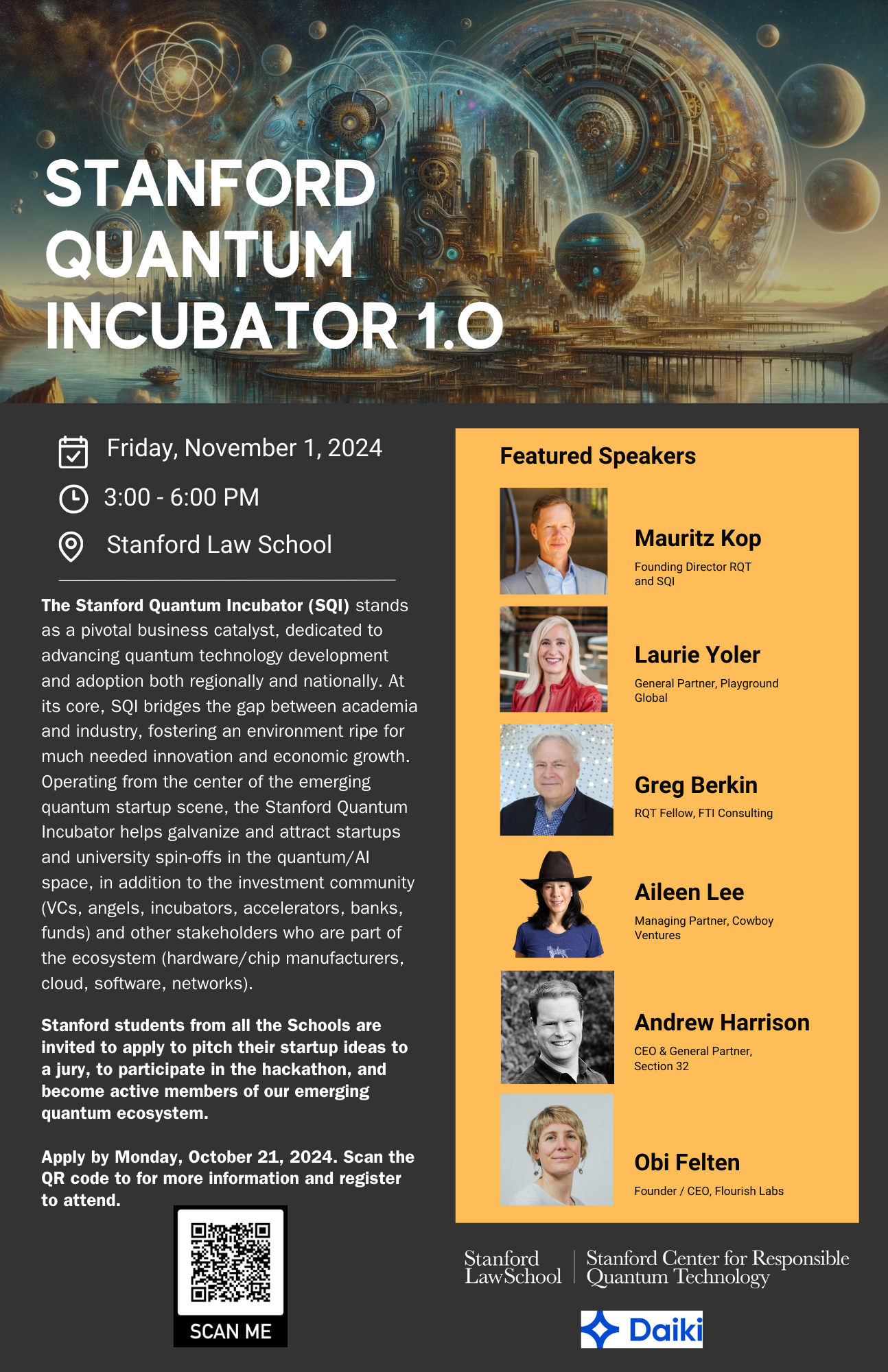
Stanford Quantum Incubator Workshop 1.0, November 1, 2024, at Stanford Law School

On November 1, 2024, the Stanford Quantum Incubator (SQI) convened its pilot workshop at Stanford Law School: a half-day of startup pitches, a hackathon, and venture-community networking, built to test whether a responsible quantum and AI startup ecosystem could be assembled deliberately from the ground up. Founded by Mauritz Kop and sponsored by the Stanford Center for Responsible Quantum Technology and the governance company Daiki, the incubator sits at an unusual address—inside a law school—where commercialization and responsible-innovation questions are treated as a single design problem.

An incubator inside a law school

Most technology incubators live in engineering quadrangles or business schools. SQI's decision to anchor itself in Stanford Law School signals a thesis about second-generation quantum technology: that its legal, ethical, social, and policy implications should be engaged before products ship, not litigated after. The center had already built that conviction into its research and convening program; the incubator carried it into entrepreneurship, framing responsible innovation as a competitive feature rather than a compliance cost.

Pitch, hackathon, and a values-laden ecosystem

Workshop 1.0 was participatory by design. Students from across Stanford—physics, computer science, medicine, business—were invited to apply by October 21, 2024, to pitch ventures to a jury of investment professionals, join a hackathon, and become members of the emerging ecosystem. Organized by SQI Fellows Greg Berkin and Bradley Horowitz, the workshop drew an investment-community jury that Kop thanked—Mark Lemley, David Hornik, Laurie Yoler, Obi Felten, Aileen Lee, Andrew Harrison, and Ching-Yu Hu among them—with speakers Alex Waldherr, Katie Liu, and Victor Wei addressing topics from novel quantum-computing chip architectures to responsible quantum technology in pharma and healthcare. The explicit goal was to build a local, values-laden ecosystem of quantum competency—competence and conscience grown together rather than sequenced.

Why early-stage governance matters for quantum

The incubator launched at a moment when second-generation quantum technologies—computing, cryptography, sensing, simulation, networking, and communication—were beginning to cross from the laboratory into markets spanning healthcare, finance, manufacturing, logistics, defense, and space. Because these technologies depend on engineered control over fragile quantum states that decohere easily, the questions of how to commercialize, secure, and govern them arrive at the same time as the first products. Convening founders, investors, and researchers at the earliest stage is one way to ensure those questions are asked while the answers can still shape the technology, a logic that also runs through the center's work on quantum and AI in healthcare and the life sciences.

A proof of concept

As an inaugural event, Workshop 1.0 functioned as a proof of concept for a deliberate, interdisciplinary model of quantum entrepreneurship—one that pairs commercial ambition in the emerging quantum market with values designed in rather than bolted on. The pilot offered an early template for SQI's stated aim of bridging Stanford's research strength and the venture ecosystem forming around it.

Meer lezen