Innovation, Quantum-AI Technology & Law

Blog over Kunstmatige Intelligentie, Quantum, Deep Learning, Blockchain en Big Data Law

Blog over juridische, sociale, ethische en policy aspecten van Kunstmatige Intelligentie, Quantum Computing, Sensing & Communication, Augmented Reality en Robotica, Big Data Wetgeving en Machine Learning Regelgeving. Kennisartikelen inzake de EU AI Act, de Data Governance Act, cloud computing, algoritmes, privacy, virtual reality, blockchain, robotlaw, smart contracts, informatierecht, ICT contracten, online platforms, apps en tools. Europese regels, auteursrecht, chipsrecht, databankrechten en juridische diensten AI recht.

AI, Machine Learning & Recht — de VerderDenken-columns (CPO Radboud Universiteit)

Tussen 2018 en 2021 verscheen op VerderDenken.nl, het kennisplatform van het CPO van de Radboud Universiteit, een reeks van acht columns over AI en recht van de hand van Mauritz Kop. Wie ze vandaag terugleest, ziet geen tijdscapsule maar een routekaart: vrijwel elk thema uit de reeks werd nadien Europese wetgeving of internationale onderzoeksagenda.

Acht columns, van machine learning tot quantum

De reeks opent bij de basis — wat is machine learning, en waarom moeten juristen de techniek begrijpen? — en eindigt bij de verantwoorde toepassing van quantumtechnologie. Daartussen: negen technologische ontwikkelingen voor de rechtspraktijk, het eigendom van computer generated works, het pleidooi voor een recht op dataprocessing, de contouren van een wettelijk AI-kader, de juridische waarborgen bij versnelde vaccinintroductie, en een juridisch-ethisch kader voor quantumtechnologie — destijds een vroege verkenning in de Nederlandse vakpers. Het overzichtsartikel geeft van elke column de Nederlandse titel mét Engelse vertaling en een korte duiding.

Een archief dat wetgeving voorspelde

De columns bepleitten een risicogebaseerde benadering van kunstmatige intelligentie vóórdat de EU AI Act bestond, en agendeerden datarecht vóór de Data Act. Die vooruitziendheid was geen toeval maar methode: eerst de techniek serieus nemen — hoe leert een model, waar komt de data vandaan, wat kan quantum wél en niet — en dan pas normeren. Dezelfde denkbeweging kreeg op dit blog zijn meest uitgesproken vorm in De posthumanistische revolutie van AI — en groeide bij de quantumcolumns uit tot het onderzoeksprogramma dat later aan Stanford Law School gestalte kreeg.

Dank aan een redactie die ruimte gaf

Het overzicht is óók een dankbetuiging. De redactie van VerderDenken.nl gaf onderwerpen die destijds exotisch klonken — machinaal auteurschap, quantumregulering — drie jaar lang een serieus podium, dacht mee over kop en opbouw, en hield de reeks scherp én leesbaar voor een breed juridisch publiek. Nu het platform zelf offline is en de columns gearchiveerd zijn, bundelt dit artikel de volledige reeks op één vindbare plek.

Lees het volledige overzicht voor alle acht titels, de doorwerking richting het Europese AI-kader en het Stanfordse quantumwerk, en de blijvende les voor de rechtspraktijk: bouw het recht terwijl de techniek nog vorm krijgt.

Meer lezen

Quantum-AI vraagt om een dubbel technisch dossier

Waarom dit nu telt

Quantum-AI-systemen zijn niet langer alleen een onderzoeksmotief. Zodra een AI-dienst een quantumprocessor, quantumsimulator, quantum sensor of quantum-geïnspireerde optimalisatielaag gebruikt, verandert de documentatievraag. De koper wil niet alleen weten welke data, modelkeuzes en toezichtmaatregelen bij het AI-systeem horen. Hij wil ook weten wat het quantumdeel precies doet, onder welke meetcondities het is getest, en of de prestatieclaim reproduceerbaar is buiten de demonstratieomgeving.

Het dubbele dossier

De EU AI Act maakt die vraag scherper. Voor hoog-risico AI-systemen draait technische documentatie om risicobeheer, logging, nauwkeurigheid, robuustheid, cybersecurity en menselijk toezicht. Een quantumcomponent ontsnapt daar niet aan. Zij voegt een tweede bewijsvlak toe: hardware of simulator, ruis, kalibratie, meetherhaling, foutmarge, backend-wijzigingen en de grens tussen quantum-geïnspireerde code en echt quantumgebruik. Zonder dat tweede vlak kan een systeem juridisch netjes lijken terwijl een beslissende technische laag onleesbaar blijft.

De actuele onderzoekslijnen laten zien waarom dit geen theoretische luxe is. Quantumalgoritmen voor thermal-state preparation, quantum-versterkte federated learning en industriële quantumroadmaps brengen AI, sensoren, privacy en hardwareprestaties dichter bij elkaar. Voor Europese procurement betekent dat: vraag niet alleen of een leverancier AI Act-ready is, maar welk bewijs hij geeft voor de quantumlaag. De kern is technische documentatie voor quantum-AI: welke rol speelt het quantumdeel, welke prestatie is geclaimd, wie valideert die claim en wat gebeurt er na een hardware- of modelwijziging? Juist die laatste vraag hoort al in de aanbesteding, omdat een backendwissel of herkalibratie de betrouwbaarheid van het hele systeem kan raken.

Contractuele vertaling

Een bruikbaar dossier heeft vijf velden: rolafbakening, meet- en testbewijs, data- en privacyrouting, wijzigingsbeheer en contractuele verantwoordelijkheid. Die velden halen de magie uit de verkooptaal zonder de technologie kleiner te maken dan zij is. AIRecht vertaalt zulke claims naar due diligence, compliance en contracttaal: niet als brede strategiepresentatie, maar als leesbaar dossier voor legal, procurement, security en productmanagement. Juist bij frontiertechnologie is sober bewijswerk vaak de beste bescherming tegen overdreven claims.

Meer lezen
Self-service contractscan met tegenvoorstel: lees je AI-, software- of SaaS-contract niet meer blind

Self-service contractscan met tegenvoorstel — Teken je AI-, software- of SaaS-contract niet blind

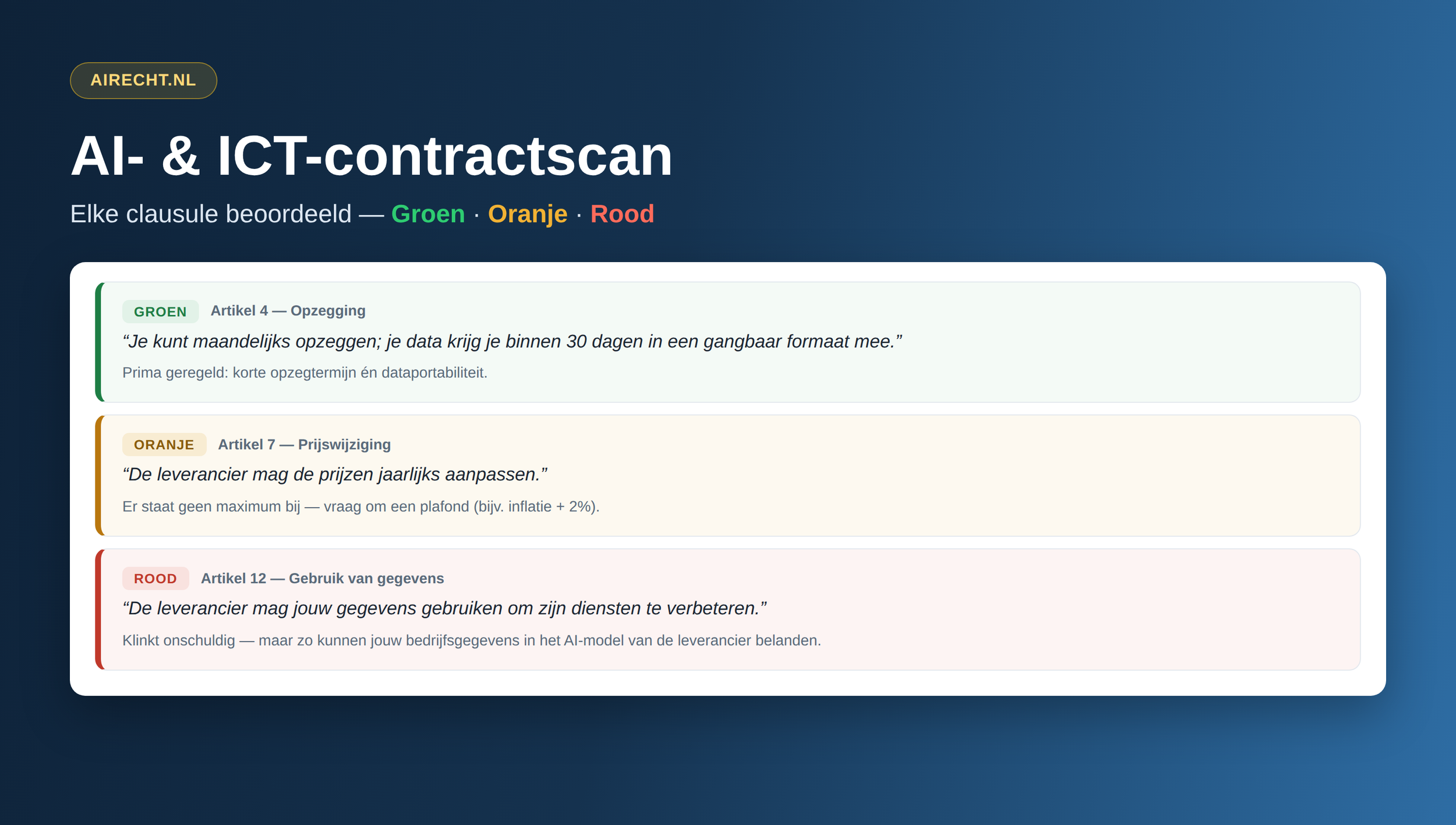
Een leverancierscontract van vijftien pagina's oogt professioneel: nette artikelen, bekende woorden, niets dat schreeuwt om aandacht. Dus je bladert, herkent de grote lijnen — en je tekent. Pas maanden later, bij een prijsverhoging of een datalek, blijkt wat er werkelijk in artikel 8 stond. De meeste contracten zijn niet gemeen, maar wel eenzijdig geschreven: de opsteller legt de risico's bij jou. De nieuwe AI- & ICT-contractscan (self-service) op airecht.nl leest je contract clausule voor clausule en beoordeelt elke bepaling met Groen, Oranje of Rood — met uitleg in gewone taal en concrete verbeterpunten.

De clausule die iedereen overheen leest

Neem deze zin: "De leverancier mag jouw gegevens gebruiken om zijn diensten te verbeteren." Klinkt als service. Maar bij een AI-leverancier betekent "diensten verbeteren" al snel: jouw bedrijfsdata gaat het model in — offertes, klantgegevens, interne documenten. Precies dit soort redelijk ogende zinnen kleurt de scan rood, met erbij wat je kunt vragen of laten schrappen vóór je tekent. En minstens zo belangrijk: de GAP-detectie signaleert kritische clausules die ontbreken — geen exitregeling, geen datateruggave, geen aansprakelijkheidsafspraak. Juist bij contracten die "verrassend soepel" lezen zit daar het echte risico.

Gebouwd op twintig jaar praktijk — geen algemene checklist

De analyse wordt getoetst aan de eigen contractpraktijk: twintig jaar onderhandelde AI-, software- en technologiecontracten. De scan herkent formuleringen niet omdat ze ergens op internet staan, maar omdat ze in échte onderhandelingen voorbijkwamen — het verschil tussen "deze zin bestaat" en "deze zin kostte een klant ooit zijn data". Eerst voelen wat de scan ziet? De gratis risico-indicatie toont na aanmelding voor de nieuwsbrief direct je risicoprofiel. De volledige analyse is de betaalde stap: elk oordeel, elke verbetering en de GAP-detectie, direct op je scherm én als rapport per e-mail — vast tarief per omvang vanaf €119, eenmalig per contract, geen abonnement. Je contract wordt niet bewaard. Lees hoe de scan werkt, welke clausules het vaakst rood kleuren en hoe je het rapport gebruikt om zelf sterker te onderhandelen — zodat je bij je volgende AI- of softwarecontract precies weet welke vragen je moet stellen vóór je tekent.

Wat je verder leest in dit artikel

Drie clausules uit de praktijk mét het oordeel van de scan, de vijf tariefklassen (± 450 woorden per pagina, je ziet je prijs direct), hoe je het rapport omzet in concrete tegenvoorstellen aan je leverancier, en de antwoorden op de drie meestgestelde vragen — van losse clausules scannen tot documenten langer dan vijftig pagina's.

Zo werkt het: je voert de self-service contractscan zelf uit — een zelf-scan zonder afspraak, een zelf-check wanneer het jou uitkomt — en weet binnen enkele minuten welke clausules groen, oranje of rood zijn, en waar je kunt onderhandelen. Nieuw: je ontvangt een concreet tegenvoorstel met vervangingstekst dat je de wederpartij kunt toesturen.

Meer lezen
Quantumveilig is nog geen lekvrij: ML-KEM als inkoop- en auditvraag

De vraag na de standaard

ML-KEM is inmiddels een vaste naam in post-quantum migratie. NIST FIPS 203 geeft organisaties een herkenbaar anker voor sleuteluitwisseling in een wereld waarin klassieke cryptografie onder druk komt te staan. Toch begint de juridische vraag pas na de keuze voor de standaard. Een nieuwe studie naar hardware-implementaties wijst op mogelijke power- en elektromagnetische leakage bij de Fujisaki-Okamoto-verificatiestap in ML-KEM. Voor bestuurders, inkopers en juristen betekent dit dat post-quantum cryptografie niet alleen een algoritmebesluit is, maar ook een bewijsprobleem rond ontwerp, testen en leveranciersinformatie. De kernvraag wordt eenvoudiger en scherper: welke productvariant voert de standaard uit, en hoe weet de klant dat die uitvoering niet via het apparaat zelf informatie prijsgeeft?

Waarom dit in contracten thuishoort

Een leverancier kan "quantum-ready" zeggen en toch weinig prijsgeven over de concrete implementatie. Dat is te mager voor organisaties die AI-systemen, modelgewichten, medische data, broncode, identiteitsmiddelen of lang bewaarde auditlogs beschermen. Zij moeten weten welke productvariant ML-KEM gebruikt, welke hardware- en firmwarepaden zijn getest, welke side-channel maatregelen zijn genomen en wat er gebeurt na een update. De nuttige vraag is dus niet alleen of NIST-standaarden op de roadmap staan. De vraag is welk bewijs de klant krijgt wanneer de veiligheid afhangt van chips, HSM's, edge-apparaten, compilerkeuzes en onderhoud. Daarmee hoort ML-KEM niet alleen bij security architecture, maar ook bij aanbesteding, garanties, meldplichten en vendor reviews.

Een bestuurbare auditroute

De praktische route is sober. Bouw per systeem een matrix met vijf velden: toepassing van ML-KEM, fysieke of logische blootstelling, side-channel testbewijs, contractuele garantie en resterende onzekerheid. Die matrix past naast bestaande AI Act-, NIS2-, privacy- en leveranciersdossiers. AIRecht koppelt dit aan een vaste AI- en quantumgovernance brief voor organisaties die hun cryptografische inventaris, ML-KEM leveranciersvragen en contractclausules brongebonden willen toetsen. Zo wordt ML-KEM leveranciersbewijs geen technisch bijschrift, maar een normaal onderdeel van inkoop, audit en bestuursverantwoording. De winst zit niet in grote woorden over quantumveiligheid, maar in betere vragen voordat een contract, firmwareversie of cloudcomponent te diep in de organisatie vastzit.

Meer lezen
De cryptografische inventaris wordt een bestuursdossier

Waarom dit nu bestuurlijk wordt

Post-quantum cryptografie is geen abstract laboratoriumonderwerp meer voor ondernemingen die AI-, cloud- en datadiensten inkopen. De Amerikaanse overheid heeft de migratie naar quantumveilige cryptografie omgezet in uitvoeringswerk, NIST werkt aan aanpassingen voor PIV-identiteitsstandaarden en leveranciers zullen steeds vaker moeten uitleggen welke algoritmen, certificaten en sleutelketens zij gebruiken. Voor Nederlandse organisaties is de praktische vraag welke afhankelijkheden zij delen met dezelfde cloud-, identity- en AI-infrastructuur, en welke gegevens nog gevoelig zijn wanneer quantumcapaciteit verder opschuift.

Wat de inventaris zichtbaar maakt

Dit artikel behandelt post-quantum cryptografie als bestuursdossier. De kern is een inventaris die bestuur, legal, security en inkoop samen kunnen lezen: welke gegevens blijven lang gevoelig, welke systemen beschermen AI-logs of modelgewichten, welke contracten noemen migratie of crypto-agility, en welke leverancier kan zijn routekaart bewijzen? Die inventaris is juridisch relevant omdat veel moderne complianceplichten draaien om aantoonbaarheid. Een AI-governanceprogramma dat technisch dossier, logging en risicobeheer serieus neemt, moet ook weten of het bewijs zelf cryptografisch houdbaar blijft.

De post legt een brug tussen NIST-standaarden, Amerikaanse PQC-uitvoering, IBM's quantumroadmap en bestaande AIRecht-thema's rond quantum governance en due diligence. De verrassend nuchtere conclusie is dat de eerste goede maatregel geen futuristische voorspelling is. Zij is een lijst: algoritmen, certificaten, systemen, leveranciers, bewaartermijnen, eigenaars en ontbrekende antwoorden. Zodra die lijst bestaat, kan het bestuur prioriteren zonder te vervallen in quantumhype of schijnzekerheid. Dat maakt het onderwerp bruikbaar voor contractonderhandelingen, auditcommissies en technische teams die anders langs elkaar heen praten.

Van leveranciersvraag naar dossier

Voor AIRecht-lezers ligt de commerciële waarde in een compacte review van AI- en quantumgovernance: een vaste briefing die cryptografische inventaris, leveranciersclausules, AI-bewijsstukken en bestuursvragen naast elkaar legt. Zo krijgt post-quantum migratie een controleerbare plek binnen AI Act-, cyber-, privacy- en contractgovernance. De bijdrage eindigt met concrete leveranciersvragen en een klein bestuurskader waarmee organisaties kunnen beginnen zonder hun hele securityprogramma opnieuw uit te vinden, juist bij lopende cloud- en AI-inkoop en nieuwe leveranciersreviews.

Meer lezen
From Kananaskis to Évian: Will the G7 Govern Quantum, or Keep Describing It?

When G7 leaders meet in Évian-les-Bains from June 15 to 17, 2026, quantum technology sits on the leaders' table for a second consecutive year. In a new CIGI op-ed, Stanford and CIGI legal scholar Mauritz Kop argues that the era of shared values and summit language has run its course: between the Kananaskis Common Vision and the OECD Recommendation on Quantum Technologies, the conceptual groundwork is done. What remains is implementation — and implementation is what voluntary coordination delivers slowly, unevenly, or never.

From a Common Vision to Working Machinery

Kananaskis named the right concerns in June 2025 but built light machinery — no timelines, no benchmarks, no procurement commitments. A year on, Kop puts the question to Évian directly: does the G7 intend to govern quantum, or to keep describing it? His answer is not another principles instrument but a delivery body with named products and deadlines, reporting back to leaders at the 2027 summit.

Five Decisions for Évian

The piece sets out five decisions leaders can take in France: post-quantum cryptography migration milestones for critical infrastructure; trusted and resilient quantum supply chains; standards-based governance backed by procurement; dual-use coordination through a least trade-restrictive, security-sufficient and innovation-preserving (LSI) test; and vigilance on the market structure of an industry already concentrating around a few compute-, patent- and talent-rich incumbents.

Each decision turns a value into something auditable. The "harvest-now, decrypt-later" threat makes cryptographic migration a present-tense problem with an unknown deadline; when Google gives itself until 2029, governments that have given themselves ten years should take notice. The same logic runs through supply-chain chokepoints, technical standards and export controls — defaults that will be written by someone, and better written deliberately than by accident.

The Window Is Still Open

Quantum is leaving the laboratory and becoming strategic infrastructure, a shift central banks already treat as systemic. The window for writing the rules of the road remains open, Kop warns, but it will not stay open forever. For the legal and policy background to the dual-use argument, see our coverage of the LSI test for securing the quantum industrial commons.

Meer lezen
Call for Applications: CIGI Quantum Nexus Emerging Scholars Program for Canadian Strategic Advantage

The Centre for International Governance Innovation (CIGI) is accepting applications for a competitive emerging scholars program attached to The Quantum Nexus: A Framework for Canadian Strategic Advantage in a Contested Domain, a research project supported by the Department of National Defence's MINDS program and led by CIGI Senior Fellow Mauritz Kop. The deadline is July 15, 2026.

A mentorship cohort with a mission

Four to six emerging scholars from across Canada—undergraduates through post-docs, from any discipline—join a virtual program from September to December 2026. The format is deliberately personal: a one-on-one mentorship session with the Principal Investigator, an online international expert workshop in October, and a group masterclass on emerging-technology governance and publication development in November. No prior quantum expertise is required, and applications from equity-deserving groups are strongly encouraged; the program is built on the conviction that good governance of emerging technologies needs many kinds of minds. It is the same conviction that brought a Canadian quantum governance delegation to Stanford to prepare Canada's G7 presidency.

From analytical note to CIGI report

This is a publication program, not a lecture series. Every participant develops a 1,200–1,500-word analytical note on an assigned subtopic within one of six themes—spanning intellectual property and export controls, post-quantum cryptography migration, critical materials and supply chains, quantum-AI convergence, standards and allied interoperability, and the application of the LSI test (least trade-restrictive, security-sufficient, innovation-preserving) to a real case. The notes are contributed to the project's final CIGI report as a dedicated Emerging Scholars annex—a substantive contribution at the start of a research career.

Dates and deadlines

Applying takes one PDF: a 300–500-word expression of interest naming the theme you want to work on, a CV, and one reference letter, sent to programs@cigionline.org (subject line: Emerging Scholars Application: DND MINDS Project). Applications close July 15, 2026; acceptances follow in mid-August; the program runs September through December. For emerging scholars who want to help shape how the quantum age is governed, this is the opening.

Meer lezen
NATO StratCom Features Mauritz Kop as Subject Matter Expert in Workshop Video on Quantum and Cognitive Sovereignty

The NATO Strategic Communications Centre of Excellence engaged Mauritz Kop as a subject-matter expert for its Riga workshop The Integrity of Reality and Cognitive Sovereignty—via a thirty-minute video interview recorded as study material for participants and as input to the Centre's threatcasting work.

A video briefing for Riga

Held in early June 2026, in the week of the Centre's flagship Riga StratCom Dialogue, the workshop examined what happens to shared truth when both conflict and communication are increasingly automated. Kop's recorded interview adds the layer the strategic-communications field is only beginning to map: the quantum layer. His opening line does the analytical work of a whole briefing—the past is not yet stable. The argument extends the case he made when the Hoover Institution invited him to speak on quantum, democracy, and authoritarianism.

Three quantum pressures on the mind's privacy

The interview names three converging pressures on cognitive sovereignty: civic-scale quantum sensing that, in principle, could resolve subsurface and interior spaces from public rights-of-way—what Kop calls the X-Ray City scenario; quantum-enhanced biosensing and brain-computer interfaces that open the inference of mental states; and the temporal instability of the cryptographic record under harvest-now, decrypt-later collection. For the first two, Kop argues for capability protection—prohibition-grade guardrails at the infrastructure layer, not consent forms after deployment.

Why communicators should care about cryptography

An adversary who can retroactively forge or contest the signed record does not need to fabricate convincingly—only to seed doubt at scale. The interview's prescription is precision over speed: the LSI test for every proposed control, standards-first governance, and verifiable allied migration to post-quantum cryptography as the strategic-communications measure rarely recognized as one.

Meer lezen
OECD Recommendation on Quantum Technologies Builds on Responsible Quantum Principles Developed at Stanford RQT

On May 28, 2026, the OECD Council adopted OECD/LEGAL/0508, the Recommendation of the Council on Quantum Technologies—the first intergovernmental standard to set shared principles for the responsible development and use of trusted quantum technologies. Its four high-level principles and five policy recommendations will read as familiar to anyone who has followed responsible-quantum scholarship, because the instrument's core ideas track work that the Stanford Center for Responsible Quantum Technology and its founder, Mauritz Kop, helped build over the previous half-decade.

The first intergovernmental quantum standard

Developed through a multistakeholder process—forty-seven experts from twenty-six nationalities across four scoping meetings in 2025, building on the OECD's January 2025 Quantum Technologies Policy Primer—the Recommendation asks all Actors to promote innovation that respects democratic values, to prevent and mitigate harms across the technology lifecycle, to promote secure and broad access, to facilitate collaboration, and to foster accountability and trustworthiness. It is non-binding but normatively weighty: thirty-eight adherents are now expected to implement it through their own legal frameworks. The OECD's broader responsible-quantum-technology agenda has long argued that the field needs exactly this kind of shared, anticipatory baseline.

A visible lineage, not a formal citation

The Recommendation names no academic source, and nothing in its text formally credits Stanford RQT. What it shows is conceptual lineage. Its lifecycle-embedded, values-first framing echoes the Ten Principles for Responsible Quantum Innovation; its post-quantum-cryptography and quantum-resilient-infrastructure language draws on the same concern with cryptanalysis that animated Kop's 2021 Yale legal-ethical framework; its accountability-and-trustworthiness principle parallels families in the World Economic Forum Quantum Computing Governance Principles he helped conceptualize; and its call for science-based standards mirrors the standards-first program he and colleagues set out in Science. Kop was among the experts consulted in the course of the OECD's quantum-policy work, an engagement that sits within a longer record of peer-reviewed calls for responsible quantum technology.

Why anticipation is the right posture

Both the Recommendation and the scholarship it echoes favor agile, forward-looking, evidence-based governance—and the physics explains why. Quantum technologies draw their power from superposition and entanglement, phenomena that do not scale gently: an entanglement-enabled sensor can cross a sensitivity threshold, and a cryptanalytically relevant machine can render trusted public-key cryptography suddenly breakable, in ways that arrive nonlinearly. Governance that waits for a capability to mature arrives too late by construction. This is the case the responsible-quantum field, including the Quantum-ELSPI research agenda, has pressed since 2021—and the case OECD/LEGAL/0508 now encodes for thirty-eight economies.

What comes next

The Recommendation tasks the OECD's Digital Policy Committee and Committee for Scientific and Technological Policy to develop practical guidance and to report back within five years, so the standard is built to evolve with the technology. Its arrival signals that these responsible-quantum arguments have reached the institutions that set international norms—a quiet but consequential validation of work begun years earlier at Stanford.

Meer lezen
CNAS Interviews Mauritz Kop for The Entanglement Edge Quantum Networking Report

The Center for a New American Security has published The Entanglement Edge: U.S. Strategic Priorities in Quantum Networking—and Mauritz Kop briefed the CNAS research team on quantum networking and cybersecurity in November 2025, as part of the expert interviews behind it.

The entanglement edge, soberly measured

The report by Constanza M. Vidal Bustamante and Morgan Peirce declines the hype on both sides. Quantum key distribution is a niche complement, not a replacement, for post-quantum cryptography; China's 10,000-kilometer QKD network is real infrastructure but not next-generation readiness; and America's task is to fund what compounds—interconnects, benchmarks, supply chains, PQC migration—while declining to subsidize theater.

Where Kop's briefing landed

Kop gave the researchers an administrable rule: "PQC by default"—QKD only where incremental assurance can be proven over cost and complexity, quantum random-number generators widely for stronger entropy. His briefing pressed the shift from guidance to verifiable outcomes: a federal transition lead with a public dashboard, procurement requiring validated FIPS 203/204/205 modules, crypto-agility drills, and allied "one test, many markets" certification so the coalition's cryptographic baseline cannot fracture into a quantum splinternet. It is the operational sequel to the positions he brought to the U.S. Department of State on quantum technology and foreign policy.

What planners should take away

The harvest-now, decrypt-later campaigns are already running; the contest that decides their outcome is over verification—whose security architecture can be tested, certified, and trusted across an alliance. Reports built on dozens of expert interviews, rather than vendor decks, are how that architecture gets designed before the deadline arrives.

Meer lezen
Mauritz Kop Interviewed for IDC PeerScape Report on Quantum Computing Governance Practices

International Data Corporation (IDC), the global IT market-intelligence firm, has published IDC PeerScape: Practices for Quantum Computing Governance (May 2026, Doc # US54518926), by David Weldon and Heather West, PhD. The report distills how forward-thinking organizations are building governance for quantum computing on top of their existing data and risk-management practices—and Mauritz Kop, Founder of the Stanford Center for Responsible Quantum Technology, was interviewed and contributed expert responses for attribution.

A buyer-side discipline, not a research curiosity

The PeerScape genre is peer-learning guidance: IDC collects what organizations already moving on a problem are doing and packages it for the technology buyer—the CIO, CISO, and risk owner. By treating quantum governance this way, an established IT-research house signals that quantum readiness has become a present-tense program for enterprises, not a topic reserved for policy seminars. The organizations profiled include the Stanford Center for Responsible Quantum Technology, an academic center, alongside industry organizations.

The two-pronged risk

IDC frames the urgency around the cryptographic clock. Sensitive data needs protection now against "harvest now, decrypt later" attacks, in which encrypted traffic captured today is unsealed once a sufficiently capable quantum computer exists; and migrating critical infrastructure to post-quantum cryptographic standards is complex enough that it must begin now. The arithmetic is unforgiving: any data whose confidentiality must outlast the arrival of cryptographically relevant quantum machines is at risk, which is why migration is a near-term governance obligation rather than a deferred IT task.

Governance engineered as an operating system

Kop's contribution carries the through-line of his work at Stanford RQT: turning quantum governance from principles into implementable operating models. He describes strategies that are operational (decision rights, controls, assurance, lifecycle gates), strategic (dual-use posture and geopolitics), and domain-aware (post-quantum cryptography, intellectual property, and sectoral use cases in medicine, finance, and space). Principles alone, he argues, do not scale—governance must be engineered with explicit RACI, stage-gates, documentation, and assurance, and a standards-based quantum-technology quality management system gives organizations an auditable, repeatable baseline.

Part of a widening practitioner record

The IDC interview joins a pattern of bringing responsible-quantum research to the people who must implement it, complementing Kop's policy work such as the global quantum policy brief published by CIGI. The same operating-system thesis recurs across audiences—from risk professionals to IT buyers to states—because it is designed to scale across functions. The deeper lesson is that quantum governance is best treated as an asset to build now: organizations that map their use cases, stage-gate their controls, adopt standards-first assurance, and plan for regulatory interoperability convert a long-horizon threat into resilience and license to operate. Readers can find more on the underlying scholarship through Kop's profile and selected works.

Meer lezen
BioLawLaPaLooZa: Mauritz Kop on Hippocratic Quantum and the End of Stable Records at Stanford Law School

At BioLawLaPaLooZa, the annual law-and-biosciences conference convened at Stanford Law School by Henry T. "Hank" Greely and co-hosted with the Journal of Law and the Biosciences, Mauritz Kop delivered a talk that fused two strands of his recent work: the biomedical-ethics argument of his Harvard-published Hippocratic Quantum project and the security lens of his NATO Strategic Communications advisory work. It was his third appearance at the gathering, which builds on his earlier BioLawLaPaLooZa remarks.

The past is not yet stable

Kop's organizing line was that "the past is not yet stable." Rather than treating the quantum threat as a future event, he argued that today's authenticated, confidential records are contingent on a cryptographic transition still under way: adversaries can harvest encrypted data now and decrypt it once a Shor-capable machine factors the large integers beneath RSA. Confidentiality, in this reading, must be defended retroactively as well as prospectively—making the migration to post-quantum cryptography, for hospitals and biobanks, a clinical duty rather than an IT preference. The point reframes a familiar threat model: the danger is not only what a future machine will decrypt, but what is being copied and stored today against that day.

Four classical principles, recomputed

The talk recast the four principles of biomedical ethics—autonomy, beneficence, non-maleficence, and justice—for a quantum register. Quantum does not replace them, Kop said; it changes what applying them requires. Autonomy comes to demand data sovereignty and a credible right not to know as quantum-AI systems build finer probabilistic patient models. Dual-use simulators that design therapeutics can also lower the barrier to designing pathogens, which is where his LSI test—least trade-restrictive, security-sufficient, innovation-preserving—supports tiered disclosure over blanket secrecy. And the justice problem is a widening one: the quantum divide, he warned, may prove steeper than the digital divide.

The X-Ray City and a constitution for medicine

Widening the lens, Kop described civic-scale quantum gravimetric and magnetic sensors moving from the laboratory toward infrastructure pilots—able, from public rights-of-way, to resolve subsurface and interior spaces, and so to reach into the privacy of the home. He calls this prospect the X-Ray City, and said he had told NATO it needs a Hippocratic Quantum posture of its own. He closed with a "quantum constitution for medicine" in four standards of care: quantum-safe encryption, sovereignty over patient digital twins, human oversight in the loop, and tiered disclosure under the LSI test. The premise the room had not heard before, he suggested, was simply that the past itself is not yet settled.

Meer lezen