Innovation, Quantum-AI Technology & Law

Blog over Kunstmatige Intelligentie, Quantum, Deep Learning, Blockchain en Big Data Law

Blog over juridische, sociale, ethische en policy aspecten van Kunstmatige Intelligentie, Quantum Computing, Sensing & Communication, Augmented Reality en Robotica, Big Data Wetgeving en Machine Learning Regelgeving. Kennisartikelen inzake de EU AI Act, de Data Governance Act, cloud computing, algoritmes, privacy, virtual reality, blockchain, robotlaw, smart contracts, informatierecht, ICT contracten, online platforms, apps en tools. Europese regels, auteursrecht, chipsrecht, databankrechten en juridische diensten AI recht.

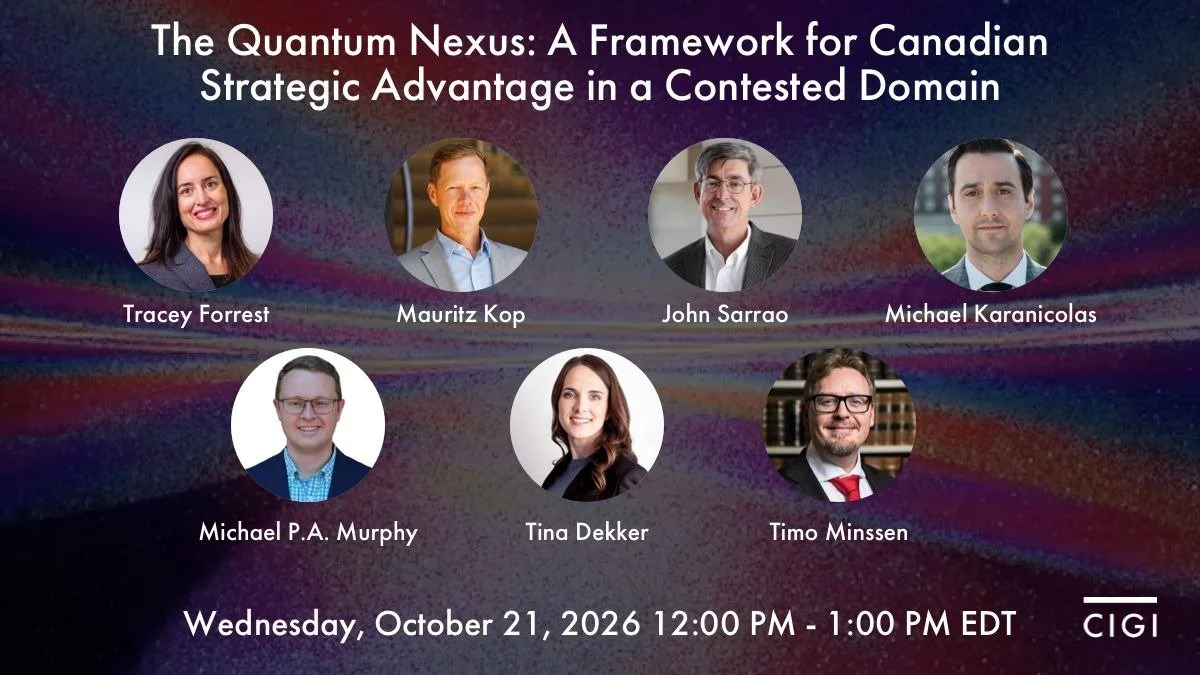
Prof. Mauritz Kop Chairs CIGI Quantum Nexus Workshop and Roundtable on Quantum, Intellectual Property, and National Security

On Wednesday, October 21, 2026, Prof. Mauritz Kop chairs the CIGI Quantum Nexus workshop in Waterloo: a public online expert panel from 12:00 to 1:00 PM Eastern Time, followed by a closed-door roundtable. As Senior Fellow and Principal Investigator at the Centre for International Governance Innovation, Kop leads the project The Quantum Nexus: A Framework for Canadian Strategic Advantage in a Contested Domain, funded through the Department of National Defence's MINDS program.

Five Panelists, a Senior Roundtable, and Six Emerging Scholars

The panel brings together John Sarrao (SLAC National Accelerator Laboratory), Michael Karanicolas (Dalhousie University), Tina Dekker, Michael P. A. Murphy (Queen's University), and Timo Minssen (University of Copenhagen), with CIGI's Tracey Forrest. The roundtable, held under the CIGI Rule, includes the Privy Council Office's Dominic Rochon, the Canadian Intellectual Property Office's Konstantinos Georgaras, former U.S. Assistant Secretary of Commerce Kevin J. Wolf, Michele Mosca, Larry Diamond, and Los Alamos physicist Alan J. Hurd. Six emerging scholars from universities across Canada, personally selected and mentored by Kop, join the day and will write analytical notes for the project's final CIGI report.

The LSI Test and Kop's Work With Canada Since 2022

The workshop builds on Kop's Nexus paper, indexed in the Harvard-Smithsonian NASA Astrophysics Data System, and its LSI test for security measures that are least trade-restrictive, security-sufficient, and innovation-preserving. It continues his work on the Council of Canadian Academies expert panel chaired by the late Raymond Laflamme, his CIGI policy brief with Tracey Forrest, and his War on the Rocks essays. Our article also traces CIGI's history, from its founding by BlackBerry's Jim Balsillie, with a founding gift from Mike Lazaridis, to its role among G7 think tanks. The public panel will be recorded, and registration for the online session is open to everyone on the CIGI event page.

Meer lezen
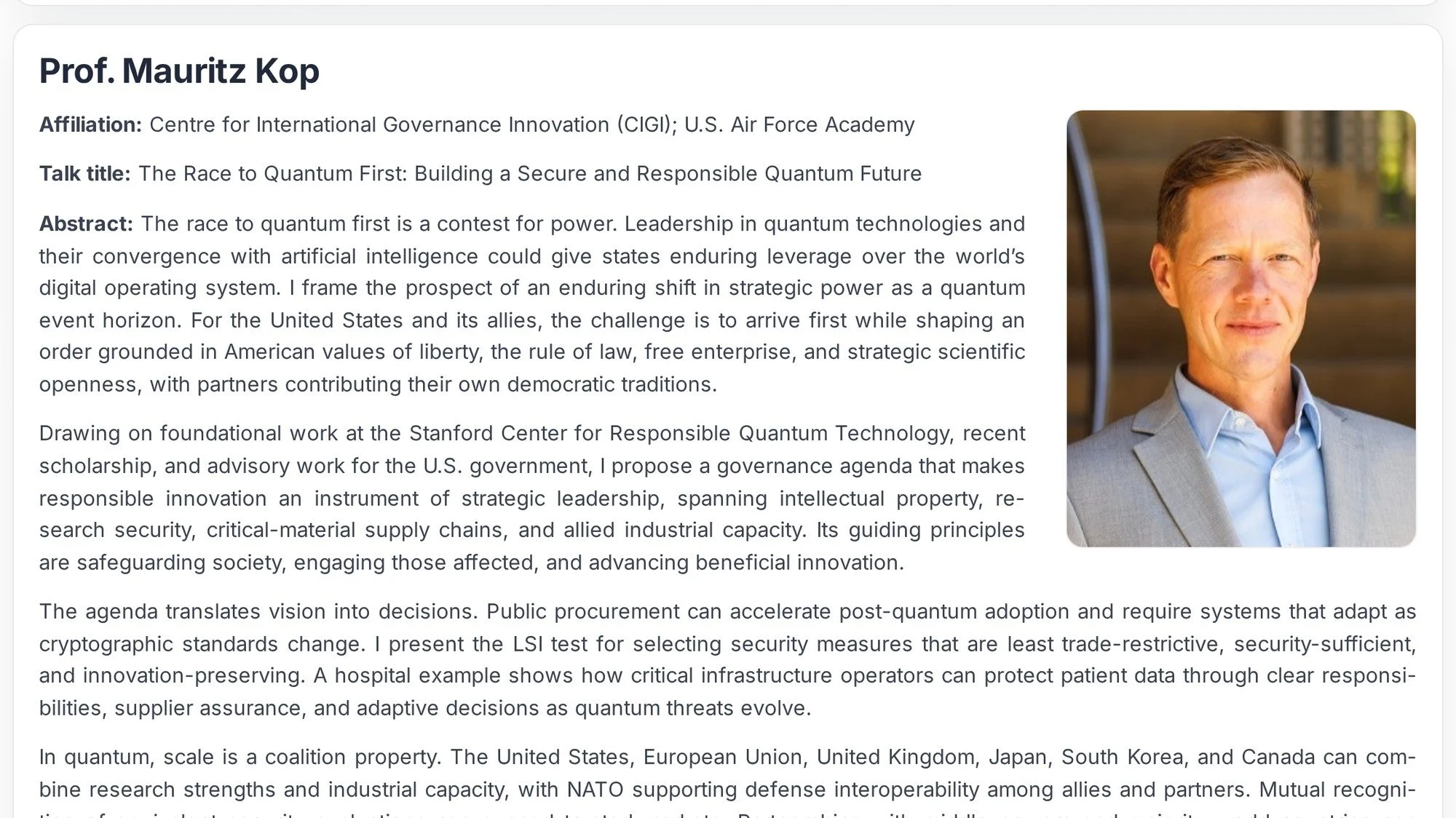
Prof. Mauritz Kop Invited to Speak on the Race to Quantum First at the Inaugural ACM PQQS 2026, With Turing Award Laureate Charles Bennett and Dan Boneh

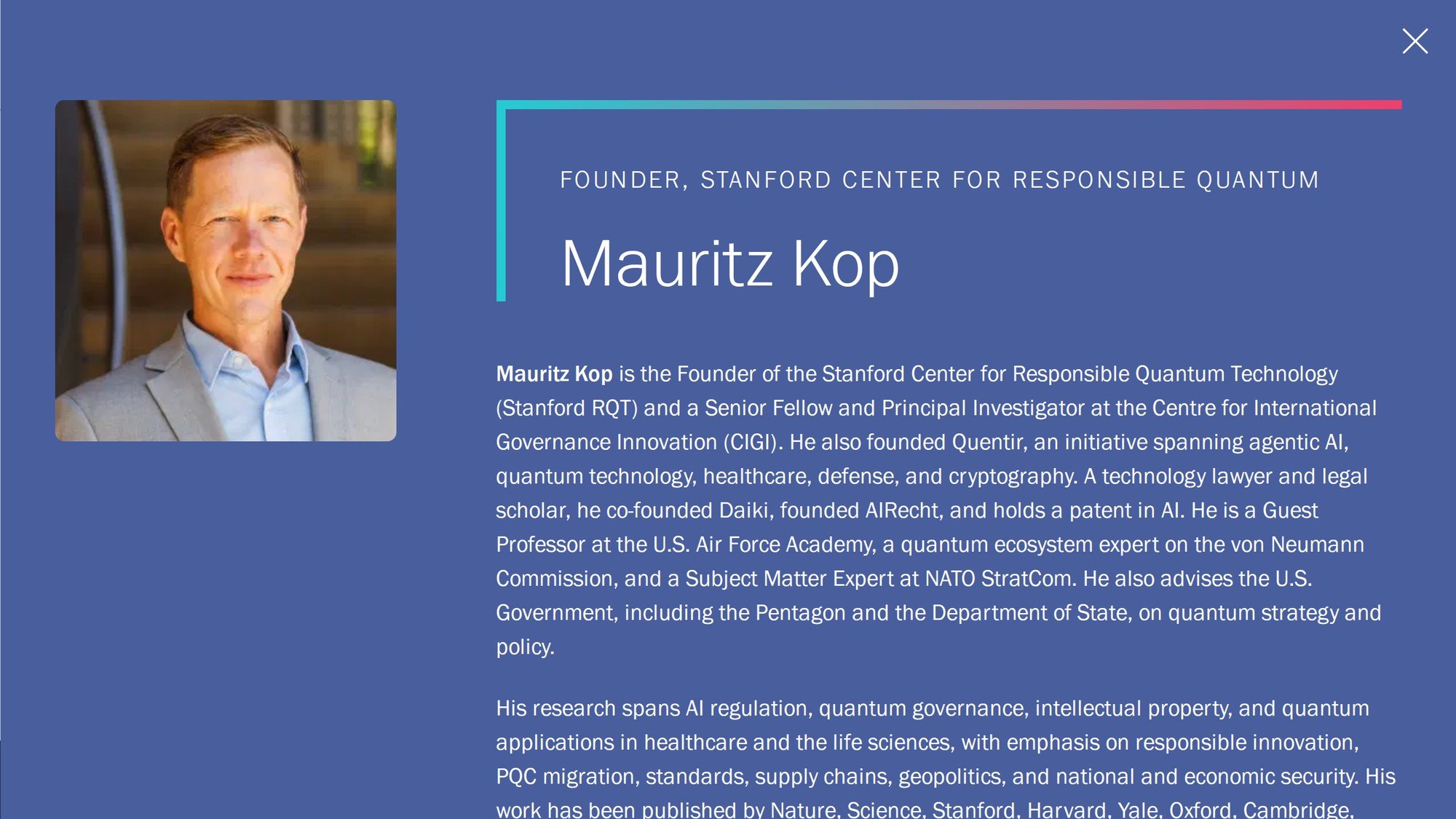
Prof. Mauritz Kop has been invited to speak at ACM PQQS 2026, where Turing Award laureate Charles Bennett of IBM Research also gives a keynote. The inaugural ACM Conference on Post-Quantum and Quantum-based Security runs from November 2 to 4, 2026 in Silicon Valley near San Jose. Kop, Founder of the Stanford Center for Responsible Quantum Technology, is listed with his affiliations at CIGI and the U.S. Air Force Academy, and his talk is titled The Race to Quantum First: Building a Secure and Responsible Quantum Future.

A New ACM SIGSAC Venue With Bennett, Boneh, Babbush, Preneel, and NIST

ACM's security community launched PQQS as a new annual venue for post-quantum cryptography, quantum cryptography, and the security of quantum computing systems. General Chair Elisa Bertino and program chairs Rei Safavi-Naini and Ashish Kundu assembled a program of twenty-six peer-reviewed papers, keynotes by Charles Bennett, Dan Boneh, Ryan Babbush of Google Quantum AI, Renato Renner, and Ramana Kompella, invited talks by Bart Preneel, Reza Nejabati, Vipul Goyal, Yevgeniy Dodis, and J.R. Rao, and a panel with NIST's Dustin Moody and Michele Mosca. One of the call's four topic areas covers post-quantum migration policy, regulation, and ecosystem readiness.

Procurement, the LSI Test, and a European Quantum Act

Kop's talk proposes a governance agenda in which responsible innovation becomes an instrument of strategic leadership for the United States and its allies. Public procurement can accelerate post-quantum adoption, and the LSI test from his Nexus paper, indexed in the Harvard-Smithsonian NASA Astrophysics Data System, selects security measures that are least trade-restrictive, security-sufficient, and innovation-preserving. A hospital example shows how operators can protect patient data, and a European Quantum Act architecture would strengthen the EU as a capable allied partner. The talk also weighs a lean, U.S.-led verification body inspired by IAEA safeguards. It builds on Stanford RQT's foundational papers, on his two War on the Rocks essays on the race to quantum first, and on his advisory work for the U.S. Government, including the Pentagon and the Department of State.

Meer lezen
Prof. Mauritz Kop Invited to Co-Opting AI: Quantum at the University of Virginia, With Paul Davies, Shohini Ghose, and Host Mona Sloane

Prof. Mauritz Kop, Founder of the Stanford Center for Responsible Quantum Technology, has been invited to speak at Co-Opting AI: Quantum, a public conversation hosted by the University of Virginia's Digital Technology for Democracy Lab, NYU's Institute for Public Knowledge, and Sloane Lab. The online event takes place on Wednesday, October 28, 2026, from 4:00 to 5:15 PM Eastern Time, with the physicists Paul Davies of Arizona State University and Shohini Ghose of Wilfrid Laurier University, and with Professor Mona Sloane as host.

Episode 55 of Mona Sloane's Co-Opting AI Series Turns to Quantum

Mona Sloane's Co-Opting AI series has gathered leading scholars on technology and society since April 2019, from Alondra Nelson and Virginia Eubanks on Justice to Sandra Wachter on the GDPR and Danielle Keats Citron on Privacy. The quantum episode is the series' fifty-fifth and its first on quantum technology. The organizers frame it around one idea: quantum computing is arriving into institutions, supply chains, and geopolitical formations shaped by AI, and that inheritance will shape how quantum develops as a technological and social phenomenon. For lawyers who work on AI governance, this is the moment the familiar questions of liability, access, and accountability move to the next technology.

Stanford RQT Scholarship and Kop's Talks From Oxford to Washington

Kop brings the body of work that defined responsible quantum technology: the Yale Journal of Law and Technology article on a legal-ethical framework for quantum technology, the Ten Principles for Responsible Quantum Innovation, the Nature Physics call for responsible quantum technology, the Science article on standards-first governance, and the Quantum-ELSPI research field. The invitation follows his talks at Oxford, TU Munich, CNAS, CIGI, and Stanford Law School, his two War on the Rocks essays, and his advisory work for the U.S. Government, including the Pentagon and the Department of State. The session is open to the public and will be recorded for those who register.

Meer lezen
Rijksbrede Quantumstrategie van 5 oktober 2026: het PQC-tijdpad tot 2035, quantumveilige eisen bij rijksinkoop uiterlijk eind 2028 en de NAVO Quantum Technology Roadmap

Op 5 oktober 2026 stuurde het kabinet de Rijksbrede Quantumstrategie naar de Tweede Kamer. Het meest concrete hoofdstuk gaat over post-quantumcryptografie: een tijdpad waarin rijksoverheidsorganisaties hun versleuteling stap voor stap quantumveilig maken. Uiterlijk eind 2026 staat het quantumrisico in hun risicomanagement en hebben zij een eigen cryptografiebeleid. Uiterlijk eind 2027 is er een (concept-)migratieplanning. Uiterlijk eind 2030 zijn toepassingen met een hoog risico gemigreerd, en uiterlijk eind 2035 volgt het gemiddelde risico.

Waarom eind 2028 telt voor leveranciers

Uiterlijk eind 2028 moeten rijksorganisaties bij inkoop en aanbesteding eisen kunnen stellen over quantumveilige cryptografie, met aandacht voor contractmanagement. Software die in 2028 wordt ingekocht, draait vaak tot ver na 2030. Een leverancier die nu een cryptografische inventaris, crypto-agility en een migratiepad met data kan laten zien, staat sterker bij de volgende aanbesteding. Het artikel bevat vijf vragen die een aanbestedende dienst vanaf 2028 redelijkerwijs kan stellen.

Wat het tijdpad wel en niet verplicht

Het tijdpad is intern rijksbeleid en schept zelf geen wettelijke plicht voor bedrijven. Daarnaast geldt sinds 15 augustus 2026 de Cyberbeveiligingswet voor essentiële en belangrijke entiteiten, en uiterlijk eind 2028 komen er rijksrichtlijnen om essentiële bedrijven richting te geven over de migratie. De strategie zet QKD voor informatiebeveiliging bij de Rijksoverheid op dit moment niet in, vanwege bezwaren van meerdere Europese veiligheidsdiensten.

Ontcijferen en de NAVO-roadmap

Dezelfde strategie ziet in een toekomstige quantumcomputer kansen voor politie en inlichtingendiensten om versleutelde criminele communicatie te ontcijferen. Dat is een beleidsvoornemen zonder nieuwe bevoegdheid: het Wetboek van Strafvordering en de Wiv 2017 blijven de grens trekken. De NAVO publiceerde op 29 september 2026 een samenvatting van haar Quantum Technology Roadmap, met een proefverbinding tussen Brussel en Mons in het vierde kwartaal van 2027 en zonder einddatum voor PQC. Nederland zit tot en met mei 2027 de Transatlantic Quantum Community van de NAVO voor.

Meer lezen
Quantum Computational Antitrust: How Quantum Computing Could Reshape Competition Enforcement

Antitrust enforcement is becoming a contest between models. Agencies screen procurement databases with algorithms, firms price with reinforcement learning, and scholars at Stanford's CodeX center have organized the discipline of computational antitrust around a simple premise: enforcement must compute as well as the markets it polices. This analysis asks what happens when the computation itself turns quantum.

Why enforcers and firms already compete with algorithms

Brazil's CADE mines bidding data for cartel fingerprints, Korea scores tenders for collusion risk, and the OECD catalogues the tooling. Experiments meanwhile show that independent AI pricing agents can learn supra-competitive strategies without ever communicating, a form of algorithmic collusion that slips past cartel law's agreement requirement. The enforcement arms race is already running on classical hardware, and the stakes were spelled out early in the Oxford JIPLP work on quantum computing, intellectual property and market power.

What quantum computing could add to merger review and cartel screening

Quantum computers will not "try everything at once." Future fault-tolerant machines may improve particular simulation, optimization, and sampling tasks that merger review poses, although no general enforcement advantage has been demonstrated. None of this is deployed at any agency today, and the essay says so plainly. The nearer-term disruption runs through evidence. Harvest-now-decrypt-later means lawfully seized encrypted cartel archives may become readable mid-investigation once quantum machines can run Shor's algorithm, a rare case of the quantum threat working for enforcers, within hard due-process limits.

Why access to quantum computing becomes a competition question

The deepest question is asymmetry. If quantum forecasting and optimization arrive first at firms that already dominate cloud platforms and patent portfolios, informational advantage compounds into entrenched market power through purely unilateral conduct, with no cartel required. Quantum technology therefore poses competition authorities an access question before it poses an evidence question, and the answers will be set by whoever engages first: standards bodies, cloud gatekeepers, or regulators.

The full analysis sets out a five-part readiness agenda for enforcement agencies this decade, from cryptographic inventories of their own case files and leniency archives to sandboxed pilots of quantum screening tools with pre-registered validation protocols. Read it to see how competition agencies can prepare validation protocols, access safeguards, and scoped pilots before quantum-assisted evidence reaches proceedings.

Meer lezen
Kwartaalbrief najaar 2026: twee AI Act-data, productaansprakelijkheid voor software en AI-agents

Op 6 oktober 2026 ging de kwartaalbrief van najaar 2026 naar de lezers van AIRecht, MuziekenRecht, MusicaJuridica en Juridisch Advies voor Bedrijven. Hier staat hij in zijn geheel, met eerst wat AIRecht dit kwartaal schreef en daarna de drie andere praktijken. Per stuk in drie regels: voor wie, wat en waarom.

Wat verandert er dit najaar voor jou en je bedrijf? Sinds 15 augustus geldt de Cyberbeveiligingswet, en veel mkb-bedrijven merken die via de contracten van hun klanten. Uiterlijk 9 december moeten de lidstaten de nieuwe productaansprakelijkheidsrichtlijn omzetten, en die rekent software uitdrukkelijk tot producten. En wie muziek maakt, leest over AI-stemmen in covers, credits, splitsheets en wat er met je masters gebeurt als een label omvalt.

AIRecht — AI & recht

Dezelfde software, een andere AI Act-datum

  • Voor wie: wie AI inzet voor sollicitanten en personeel, of in een gereguleerd product
  • Wat: de AI Act kent nu twee startdata voor hoog-risico-AI: 2 december 2027 en 2 augustus 2028
  • Waarom: welke datum voor jouw systeem geldt, bepaalt je hele planning

Nieuwe productaansprakelijkheid voor software: wat richtlijn (EU) 2024/2853 richting 9 december 2026 doet met exoneratie, bewijslast en AI-dekking

  • Voor wie: softwareleveranciers en bedrijven met AI in hun product
  • Wat: de nieuwe richtlijn, om te zetten uiterlijk 9 december 2026, rekent software, AI en updates tot producten; voor Nederland telt de implementatiewet
  • Waarom: laat vóór die datum nalopen of je aansprakelijkheidsbeding en je verzekering daarop aansluiten

Californië schrapt sinds 1 januari 2026 het verweer 'de AI deed het zelf' (AB 316). Hoe ver artikel 6:77 BW, de AI Act en de productaansprakelijkheidsrichtlijn in Nederland komen

  • Voor wie: bedrijven die AI-agents laten bestellen, mailen of betalen
  • Wat: in Californië telt 'de AI deed het zelf' sinds 1 januari 2026 niet meer als verweer
  • Waarom: leg nu vast wie instaat voor wat je AI-agents doen

De volgende kwartaalbrief verschijnt in januari. Tussendoor lees je alles op de sites zelf, en een contract laten screenen kan altijd: €119 voor 1-5 pagina's.

Meer lezen
Responsible Quantum-Enabled Financial Forecasting: What Banks and Supervisors Must Govern Before Quantum Advantage

Banks were talking about quantum computing while the hardware was still a physics demonstration. In 2025, financial institutions reported further hardware experiments, including a hybrid bond-trading study on production-scale data, and these remain research results rather than live production deployments. This analysis separates the verified results from the marketing and asks what responsible quantum finance demands before the technology touches live forecasting.

Which banks ran quantum experiments in 2025, and what they found

The evidence base is suddenly concrete. A JPMorganChase-led research collaboration demonstrated certified randomness on Quantinuum hardware in a Nature paper, a cryptographic and simulation primitive rather than a forecasting result. HSBC and IBM reported up to 34 percent better fill-probability predictions, on their chosen metric and against their own classical baselines, on production-scale bond-trading data. Goldman Sachs researchers priced out what genuine advantage in derivatives would cost in logical qubits. Each result comes with caveats, and the caveats are exactly where governance begins.

How supervisors will apply model risk management to quantum models

Financial regulators already police predictive models, from classical statistics to artificial intelligence, through model risk management regimes like the Federal Reserve's SR 11-7. Quantum forecasting strains that machinery: outputs are probabilistic, hardware noise drifts daily, and in at least one bank experiment the noise itself seemed to help. The essay sets out what quantum-grade validation, documentation, and independent challenge should look like.

Why compute asymmetry and post-quantum migration belong on the same agenda

Two system-level risks frame the institutional ones. If early capability concentrates in a few firms, markets inherit a new compute asymmetry, a market-integrity question with echoes of the concentration concerns we mapped in Intellectual Property in Quantum Computing and Market Power.

The same progress that speeds up forecasting breaks the encryption financial infrastructure depends on. The G7 Cyber Expert Group has warned that adversaries may be harvesting encrypted financial data today to decrypt later, and now urges a coordinated post-quantum migration across the sector. Decades-long confidentiality horizons and expiring cryptography are two sides of one balance sheet.

The conclusion is practical: the governance hooks for quantum technology in finance already exist in model risk management, operational resilience, AI oversight, and cryptographic standards. What is missing is an explicit statement, from supervisors and boards alike, of how quantum capability plugs into each hook. Read the full analysis for the verified experiments, the validation blueprint, and the governance framework.

Meer lezen
Californië schrapt sinds 1 januari 2026 het verweer 'de AI deed het zelf' (AB 316). Hoe ver artikel 6:77 BW, de AI Act en de productaansprakelijkheidsrichtlijn in Nederland komen

Sinds 1 januari 2026 mag in Californië niemand die AI ontwikkelt, aanpast of gebruikt zich in een civiele zaak nog verweren met de stelling dat de AI de schade zelfstandig veroorzaakte. Dat regelt Assembly Bill 316, op 13 oktober 2025 ondertekend en opgenomen als artikel 1714.46 van de Californische Civil Code. Andere verweren blijven bestaan: de gedaagde mag nog steeds betogen dat de schade onvoorzienbaar was, dat het causale verband ontbreekt of dat een ander mede schuld heeft.

Wat AB 316 verandert voor gebruikers van AI-agents

Het verweer werd aantrekkelijk nu AI-agents zelfstandig orders plaatsen, e-mails versturen en betalingen uitvoeren. In de Amerikaanse tort law kan een tussenkomende oorzaak de aansprakelijkheid van de oorspronkelijke dader afsnijden. Californië haalt de AI zelf uit die categorie. Het autonomieverweer verdwijnt, terwijl de eiser nog steeds een fout of gebrek moet bewijzen. De wet raakt contractuele uitsluitingen niet en geldt alleen waar Californisch recht van toepassing is. Waar dat zo is, verschuift de vraag naar het contract met de leverancier: wie draagt intern de rekening als de agent de fout maakte?

Hoe ver het Nederlandse recht al komt

Artikel 6:77 BW rekent een tekortkoming toe aan de schuldenaar die bij de uitvoering van een overeenkomst een ongeschikte zaak gebruikt, tenzij dat onredelijk zou zijn. Of dat ook naar analogie geldt voor zelfstandige software, is nog niet beslist; de ratio maakt het een beargumenteerde mogelijkheid. Bekende risico's van een systeem kunnen tegen een beroep op overmacht pleiten, maar de toerekening hangt af van de concrete tekortkoming, de overeenkomst en de omstandigheden. Buiten contract ligt het moeilijker. Daar moet een benadeelde onder artikel 6:162 BW een schending van een zorgvuldigheidsnorm aantonen, en het voorstel voor een Europese AI-aansprakelijkheidsrichtlijn, dat dat bewijs zou verlichten, is per 6 oktober 2025 ingetrokken.

Wat de productaansprakelijkheidsrichtlijn en de AI Act toevoegen

De nieuwe productaansprakelijkheidsrichtlijn (EU) 2024/2853, om te zetten uiterlijk op 9 december 2026, geldt voor producten die vanaf die datum in de handel komen. Zij behandelt software als product, betrekt het zelflerend vermogen bij de beoordeling van een gebrek en verbiedt contractuele uitsluiting jegens de benadeelde. Artikel 26 AI Act verplicht gebruikers van hoog-risicosystemen volgens de huidige tijdlijn vanaf 2 december 2027 (bijlage III) en 2 augustus 2028 (hoog-risicosystemen in producten) tot menselijk toezicht en het bewaren van logs. Die logs bepalen straks mede of een gebruiker kan aantonen dat schade onvoorzienbaar was. Het artikel opent bij de Engelse deodand, die tot 1846 het voorwerp zelf verbeurd verklaarde, en sluit af met vijf vragen over aansprakelijkheid voor AI-agents in contract, logs en verzekering.

Meer lezen
Mauritz Kop Hosts a Quantum Policy Delegation from Thailand at Stanford Law School (Spring 2024)

When a government starts writing a quantum strategy, its first draft is usually a list of laboratories and funding lines. The second draft, the one that matters, is about governance. That is the draft visiting delegations came to Stanford Law School to sharpen, and a delegation from Thailand was among them in the spring of 2024.

Why governments bring their quantum strategies to a law school

The hard questions in a national quantum program are rarely about hardware. They concern research security, export controls, standards participation, talent pipelines, and the timing of post-quantum migration, questions where physics, economics, and law meet. A center built to study responsible quantum technology sits on exactly that intersection, which is why quantum policy visits so often route through a law school. The pattern is well documented: Stanford hosted delegations and dignitaries from several continents, including a high-level EU cybersecurity delegation.

How middle powers can influence regional quantum standards and partnerships

Quantum research and industrial capability are developing in many countries beyond the United States and China. A middle power that concentrates on niche strengths, such as sensing for agriculture or health, secure communications, or specialty components in the supply chain, can become indispensable to allies and attractive to investors without ever fielding the largest computer. The prerequisite is governance readiness: rules investors can price, security practices partners can trust, and standards seats occupied early. That playbook is being written now, and Southeast Asian nations are among its most attentive readers.

What a working session between a ministry and a research center produces

A delegation visit works as a stress test. Draft priorities meet unfamiliar objections, assumptions about quantum technology timelines get calibrated against what researchers actually see, and ministries discover which parts of their strategy translate across borders. The output is rarely a document. It is a network of people who can call each other when the drafting gets difficult, and for a visiting government such relationships complement the formal reports and national strategies it commissions.

The full post looks at what the Thai delegation's visit says about quantum diplomacy at working level, and why national quantum strategies take shape in seminar rooms long before they reach a summit.

Meer lezen
Thomson Reuters tegen Ross (Derde Circuit, 29 september 2026): wat het hoger beroep over AI-training op Westlaw-headnotes betekent voor tekst- en datamining en artikel 53 AI Act

Wat het Derde Circuit op 29 september 2026 besliste

Het Amerikaanse hof van beroep voor het Derde Circuit heeft op 29 september 2026 de uitspraak bevestigd in de zaak die Thomson Reuters, eigenaar van Westlaw, sinds 2020 voert tegen Ross Intelligence. Ross trainde een AI-zoekmachine voor juristen met materiaal dat volgens Thomson Reuters was afgeleid van de headnotes van Westlaw, de korte redactionele samenvattingen bij uitspraken. Het hof verwierp volgens Reuters en PYMNTS het beroep van Ross op fair use. De motivering is verzegeld. Het gaat om de eerste uitspraak van een Amerikaans hof van beroep over AI-training en auteursrecht, en om een niet-generatief systeem dat concurreerde met de bron waarop het was getraind. Ross had zijn platform al in januari 2021 gesloten vanwege de proceskosten.

Hoe het Nederlandse en Europese recht dezelfde vraag benadert

Volgens artikel 11 Auteurswet bestaat er geen auteursrecht op rechterlijke uitspraken. Wat een uitgever toevoegt, zoals noten, samenvattingen en registers, kan wel beschermd zijn als het een eigen intellectuele schepping is. Daarnaast beschermt de Databankenwet substantiële investeringen in juridische databanken. Europa kent geen fair use. De ruimte voor training zit in de uitzondering voor tekst- en datamining van artikel 15o Auteurswet. Die vereist rechtmatige toegang en geldt niet als de rechthebbende een passend voorbehoud heeft gemaakt, bij online inhoud machineleesbaar. Een contractueel verbod op AI-training in abonnementsvoorwaarden is een afzonderlijk mechanisme dat de abonnee als contractpartij bindt. De ruimere uitzondering van artikel 15n geldt alleen voor wetenschappelijk onderzoek door onderzoeksorganisaties en erfgoedinstellingen.

Voor aanbieders van AI-modellen voor algemene doeleinden komt daar artikel 53 AI Act bij: sinds 2 augustus 2025 moeten zij een auteursrechtbeleid voeren en een openbare samenvatting van hun trainingsinhoud publiceren, ongeacht waar zij trainden. Voor modellen die al vóór die datum op de markt waren, loopt de overgangstermijn tot 2 augustus 2027. De Commissie kan sinds 2 augustus 2026 boetes opleggen.

Waarom dit Nederlandse legal-tech en afnemers raakt

De uitspraak kan de licentiekosten en toetredingsdrempels verhogen voor wie op de redactionele laag van juridische informatie wil trainen. Hoe ver dat reikt, blijft onzeker zolang de motivering verzegeld is. Open data van de Rechtspraak bieden een alternatief, met als beperking dat slechts een deel van de uitspraken wordt gepubliceerd. Het artikel bespreekt de geschiedenis van Wheaton v. Peters (1834), de Europese regels en vijf vragen voor ontwikkelaars en afnemers, waaronder wie in het contract het risico van een inbreukclaim over trainingsdata draagt.

Meer lezen
Quantum Computing Companies by Industry and Qubit Modality: A 2026 Field Guide

The quantum industry of 2026 no longer fits on a conference slide. Hardware firms ship processors on published roadmaps, software specialists have become acquisition targets, and banks, pharmaceutical companies, and automakers run standing quantum programs. This field guide maps the quantum computing companies active in each industry and explains why reading that map correctly is now a legal skill as well as a technical one. The guide names only milestones, revenue figures, and partnerships that are publicly documented, and it treats corporate roadmaps as targets rather than achievements.

Hardware in 2026: six qubit modalities and the companies building each

The platform layer divides by qubit modality. IBM, Google Quantum AI, Rigetti, IQM, and Alice & Bob build superconducting machines; IonQ and Quantinuum lead trapped ions; PsiQuantum bets on photonics made in semiconductor fabs; Pasqal and QuEra champion neutral atoms; D-Wave sells annealing. Modality shapes supply chains and patent positions, while export classification turns on an item's technical parameters, destination, and end user. After Microsoft's contested topological-qubit announcement of 2025, it also decides how much scientific skepticism a roadmap deserves.

Who is buying: pharma, finance, automotive, and government programs

The buy side has professionalized. Boehringer Ingelheim partnered with Google on quantum drug discovery in 2021; JPMorgan Chase, HSBC, and Goldman Sachs run sustained quantum finance programs spanning optimization experiments and post-quantum migration; BMW works with Quantinuum on materials chemistry for future mobility. Governments buy differently, through benchmarking programs and national missions that double as industrial policy. Artificial intelligence taught these organizations what an emerging-technology program looks like, and quantum computing is inheriting both the playbook and its blind spots.

Why lawyers should read vendor roadmaps before signing

Every quantum contract now sits inside three legal structures at once: cloud procurement terms that decide who owns results, export controls that classify quantum hardware as dual-use technology across allied jurisdictions, and national-security screening that reaches quantum M&A and cross-border investment. The strategic backdrop, why states treat this sector as critical infrastructure in waiting, is set out in our analysis of the nexus of quantum technology, intellectual property, and national security.

The full guide names the players per layer and per industry, separates verified 2025 and 2026 milestones from marketing, and closes with the due-diligence questions boards, buyers, and policymakers should ask before they sign.

Meer lezen
Quantum Neurosymbolic AI: Verifiable Machine Reasoning Meets Quantum Computing

The defining weakness of today's generative AI is that it cannot show a checkable reason for its answers. Neurosymbolic AI, neural networks fused with symbolic logic, is one structural research answer to hallucination, and it is now converging with quantum computing from the other direction. This analysis maps that intersection: what is proven, what is prospective, and why the law should engage before the architecture hardens.

How the neural leg proposes and the symbolic leg verifies

The neurosymbolic thesis already has a working demonstration. A neural model that invents creative constructions, paired with a symbolic engine that verifies every deductive step, solved Olympiad geometry problems at medalist level with machine-checkable proofs. The same division of labor, generalized, is what regulated industries have asked of artificial intelligence all along: keep the learning, add the audit trail. Add world models, predictive internal representations that support counterfactual reasoning, and the architecture starts to resemble something lawyers know intimately: rules applied to established facts, tested against but-for scenarios.

Where quantum technology could enter, and how mature it is

Quantum computing could eventually serve either leg. On the neural side, quantum kernel methods carry rigorous but narrow speedup proofs. On the symbolic side, some proof-search and constraint problems may admit quantum search or optimization methods, with no practical advantage demonstrated so far. The maturity picture is clear: no quantum advantage has been demonstrated for any neurosymbolic workload, and the direction remains prospective research. Prospective is precisely when governance is cheap.

Why the EU AI Act rewards reasoning that can be inspected

The regulatory alignment is unusually clean. The documentation, transparency, and human-oversight obligations for high-risk systems are easier to meet when reasoning can be surfaced, contested, and appealed, a bar that explainability by construction clears structurally where post-hoc explanation techniques strain. For legal applications the stakes are concrete: verifiable machine reasoning supports examination, contestation, and appeal, a theme running through our work since Shaping the Law of AI: Transatlantic Perspectives.

The analysis below walks through the neurosymbolic wave, the world-model turn, the quantum primitives that could serve each leg, and a three-part agenda for policymakers who want verifiable AI reasoning rewarded in procurement, conformity assessment, and standards while the architecture is still open to influence.

Meer lezen